



Table of Contents Show
Architecture school stress is one of the most documented academic pressures in higher education, with peer-reviewed research showing that one in three architecture students screen positive for moderate to extremely severe depression, and nearly half for anxiety. The pressure comes from studio deadlines, all-nighters, and a culture that quietly rewards self-sacrifice. Wellness essentials, from sleep to nutrition to movement, are what keep students working without breaking.
The numbers are not minor. A study published in the Building Healthy Academic Communities Journal found that 33% of architecture and landscape architecture students reported moderate to extremely severe stress, and the leading triggers were school deadlines, workload outside class, and inadequate sleep. A 2018 SONA survey cited in recent burnout reviews reported that 86% of architecture students sometimes or always go without sleep to finish a project. None of this is sustainable, and none of it produces better design work.
The good news is that small, consistent habits change the picture. The 15 essentials below are not luxury self-care. They are practical tools that protect the only person who can finish your portfolio: you.
🔢 Quick Numbers
- 33% of architecture students screen positive for moderate to extremely severe depression, and 46% for anxiety (Building Healthy Academic Communities Journal, 2024)
- 86% of architecture students sometimes or always skip sleep to complete projects (SONA student survey, 2018)
- Architecture students were 43% more likely to experience panic than the typical student in Melissa Kirkpatrick’s 2018 MArch dissertation survey (Architects Benevolent Society)

Why Is Architecture School So Stressful?
Architecture school stress is structural, not personal. The studio model places students in a project-based environment with constant juries, open-ended briefs, and reviews where work is critiqued in front of peers. A 2025 systematic review on burnout in architecture students published in TPM: Testing, Psychometrics, Methodology in Applied Psychology identified the main drivers as excessive workloads, perfectionist expectations, and blurred boundaries between academic and personal life.
The American Institute of Architecture Students (AIAS) has been documenting this culture since 2000, when its first Studio Culture Task Force was formed in response to what the organization described as severe deficiencies in the health and safety of architecture students. More than two decades later, the same patterns persist across schools of architecture, which means individual students need their own wellness systems regardless of what their program does or fails to do. The connection between built environments and psychological state is well-studied, and the article on architectural designs to improve mental health covers the same principles that apply to your studio environment.
The Hidden Cost of All-Nighters
Persistent sleep deprivation contributes to fatigue, slower reaction times, and impaired memory and concentration, exactly the cognitive functions that design work depends on. The studio culture that normalizes overnight work in best architecture schools across Europe and the USA is not a productivity strategy. It is a cognitive impairment strategy. Cleaner sleep produces stronger drawings, sharper presentations, and better critique responses.
⚠️ Common Mistake to Avoid
Many students treat wellness as something to fix during summer break, after the project is submitted, or when grades are in. By then, the damage is already compounding. Wellness essentials work as prevention, not as a recovery tool. Building one habit during the worst week of the semester is more useful than promising yourself a full reset in three months.

15 Wellness Essentials for Architecture Students
Each essential below addresses a specific pressure point in architecture school: sleep deprivation, sedentary studio hours, poor nutrition, social isolation, or mental overload. You do not need to adopt all 15 at once. Pick two or three that match your weakest area and build from there.
1. A Non-Negotiable Sleep Window
Set a fixed window of at least 7 hours that protects sleep regardless of project status. Studio work expands to fill the time you give it, so a hard stop at midnight or 1 a.m. forces better daytime decisions. The American Academy of Sleep Medicine recommends at least 7 hours per night for adults, and architecture students are not an exception to human biology.

2. A Real Breakfast (Not Just Coffee)
Coffee is not breakfast. A protein-and-fiber breakfast such as eggs, oats, yogurt with nuts, or whole-grain toast with peanut butter stabilizes blood sugar and reduces the mid-afternoon crash that pushes students toward vending machines and energy drinks. Skipping the meal entirely lowers focus during morning studio.
3. Water Bottle Always on the Desk
Mild dehydration impairs attention, short-term memory, and mood, all of which matter during a long charrette. Keep a one-liter bottle on your desk and refill it twice a day. Coffee and tea count partially, but plain water remains the cleanest baseline.
💡 Pro Tip
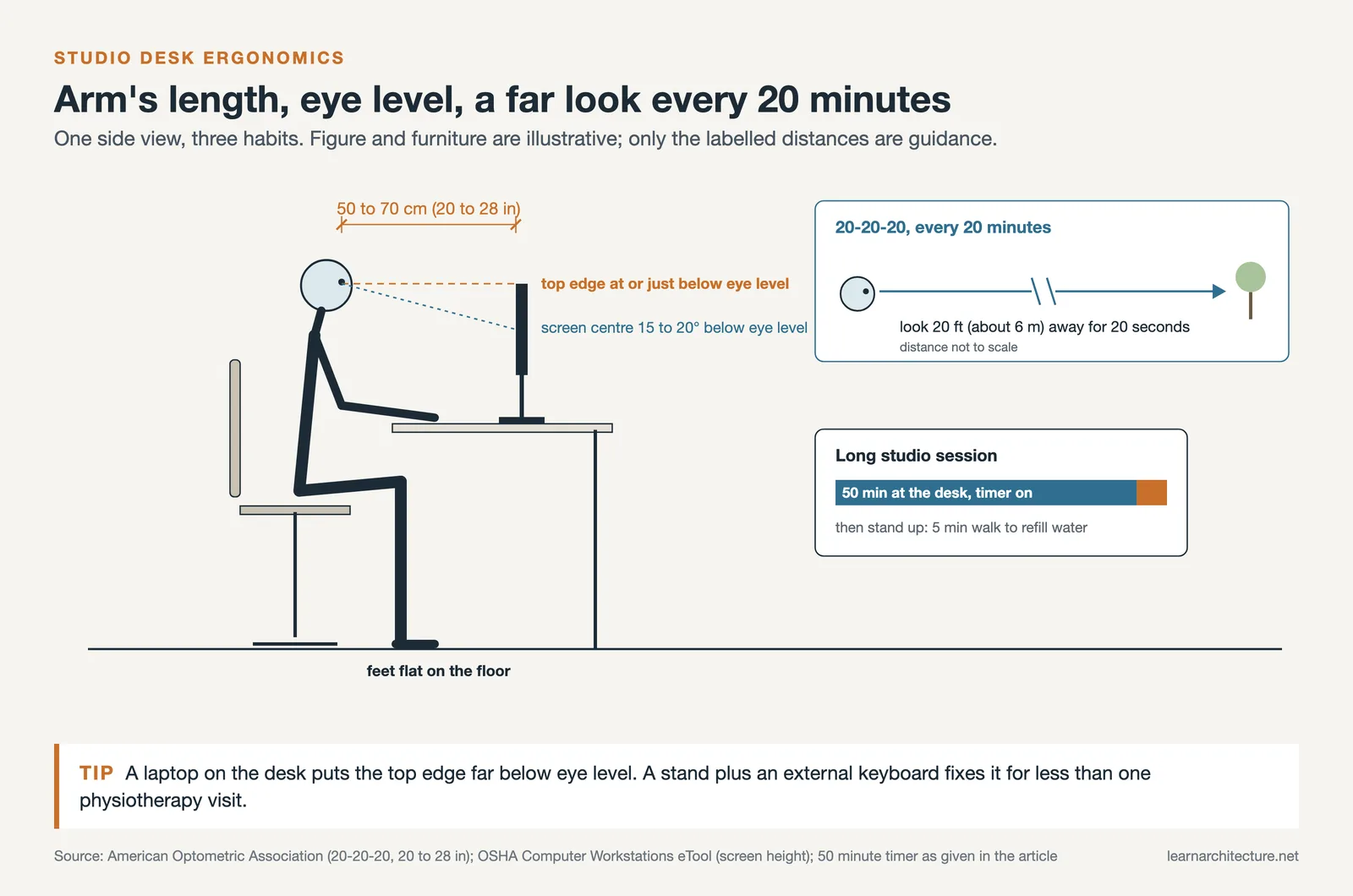
When you sit down for a long studio session, set a 50-minute timer and stand up the moment it goes off, even if you are mid-line on a Rhino model. Designers underestimate how much their thinking drifts after the first hour at a desk. A 5-minute walk to refill your water bottle resets attention more reliably than another shot of espresso.
4. Daily Movement (Even 20 Minutes Counts)
You do not need a gym membership to count as active. A 20-minute walk between classes, climbing stairs to studio, or a short bodyweight routine in your room offsets the long sitting hours that studio life requires. The Centers for Disease Control and Prevention recommends 150 minutes of moderate aerobic activity per week, which works out to about 22 minutes a day.
5. A Lunch Break Away From the Desk
Eating in front of your screen while continuing to draft signals to your nervous system that there is no break. A 25 to 30 minute break in a different room or outdoors lets cortisol drop and lets your eyes refocus past 50 cm. Schools of architecture often have courtyards or rooftops that work well for this.
6. The 20-20-20 Rule for Eye Strain
Every 20 minutes, look at something 20 feet (about 6 meters) away for 20 seconds. The American Academy of Ophthalmology recommends this rule to reduce digital eye strain, which is a real risk during long Revit, AutoCAD, or rendering sessions.
7. Whole-Foods Snacks at the Studio
Replace one chips-and-soda combo per day with nuts, fruit, yogurt, or boiled eggs. The change is unglamorous but compounds across a semester. Top architecture schools in Europe and the USA all have the same vending machine problem, and the workaround is a small container of food you bring from home.

8. A Weekly Day (or Half-Day) Off
Even one full half-day per week with zero studio work is restorative. AIAS materials on healthy studio culture explicitly note that adopting chronically unhealthy sleep patterns to complete studio work is not a tolerated facet of design education when programs are functioning properly. The same logic applies to skipping rest entirely.
🎓 Expert Insight
“Burnout is the absence of growth. It robs us of our ability to thrive.”
Dr. Akua Boateng, Mental Health Therapist (AIA Tackling Mental Health in Architectural Practice webinar)
For architecture students, this framing matters. Periods of intense studio work feel productive, but if they erase the personal time and rest that sustain creativity, the long-term cost is a student who can no longer access their own design thinking.
9. A Simple Breathing Practice
A 4-7-8 breath (inhale 4 seconds, hold 7, exhale 8) for two minutes before a review or jury settles the autonomic nervous system. It is free, takes no app, and works in a bathroom stall before a critique. This is one of the most undervalued tools across architecture school rankings, because it does not look like work but produces measurably calmer presentations.
10. A Trusted Friend Outside Architecture
Studio culture is dense and inward-looking. The 2002 AIAS report The Redesign of Studio Culture noted that more than 73% of students surveyed said they often felt isolated from others outside the architecture school. One friend from another department, a high school friend, or a family member you call weekly is enough to keep perspective.

11. A Mental Health Resource You Already Saved
Save the contact for your university counseling center before you need it, not during a crisis. Most best architecture schools in the USA and best architecture schools in Europe offer free counseling sessions through student services. Knowing the number is on your phone removes the friction of finding it during a hard week.
12. Posture and Ergonomics at the Studio Desk
Lower your screen so the top of the monitor sits at eye level. Adjust your chair so your feet rest flat. Most architecture studios are ergonomically poor, and the back and neck pain that develops in third year carries into a 40-year career. A small laptop stand and an external keyboard cost less than one trip to a chiropractor.
13. A 10-Minute Outdoor Walk Daily
Outdoor walking, even on a campus path, regulates circadian rhythm through morning sunlight exposure and reduces ruminative thinking. Architecture students spend a disproportionate amount of time indoors, and a 10-minute walk midday breaks the loop.
14. Permission to Submit Imperfect Work
Perfectionism is the strongest predictor of burnout among architecture students according to multiple studies cited in the 2025 TPM systematic review. Submitting a project that is 85% of what you imagined is almost always better than chasing 100% at the cost of two consecutive all-nighters. The work that gets evaluated is the work you can deliver, not the work you would have delivered with another week.
15. A Weekly Review of Workload and Mood
Spend 10 minutes every Sunday writing down what is due, what is realistic, and how you are actually feeling. This single practice shifts students from reactive to planned, and surfaces stress patterns early. It is the simplest intervention on this list and arguably the most useful.
🏗️ Real-World Example
Penn State Stuckeman School Studio Culture Policy (2019): This program formally codified that healthy and well-balanced lives are essential to studio success, and built peer-led wellness check-ins into its accredited curriculum. Schools that publish and enforce such policies report lower student attrition and stronger long-term student satisfaction, demonstrating that institutional design choices change individual outcomes.
How to Build These Habits Without Adding More Stress
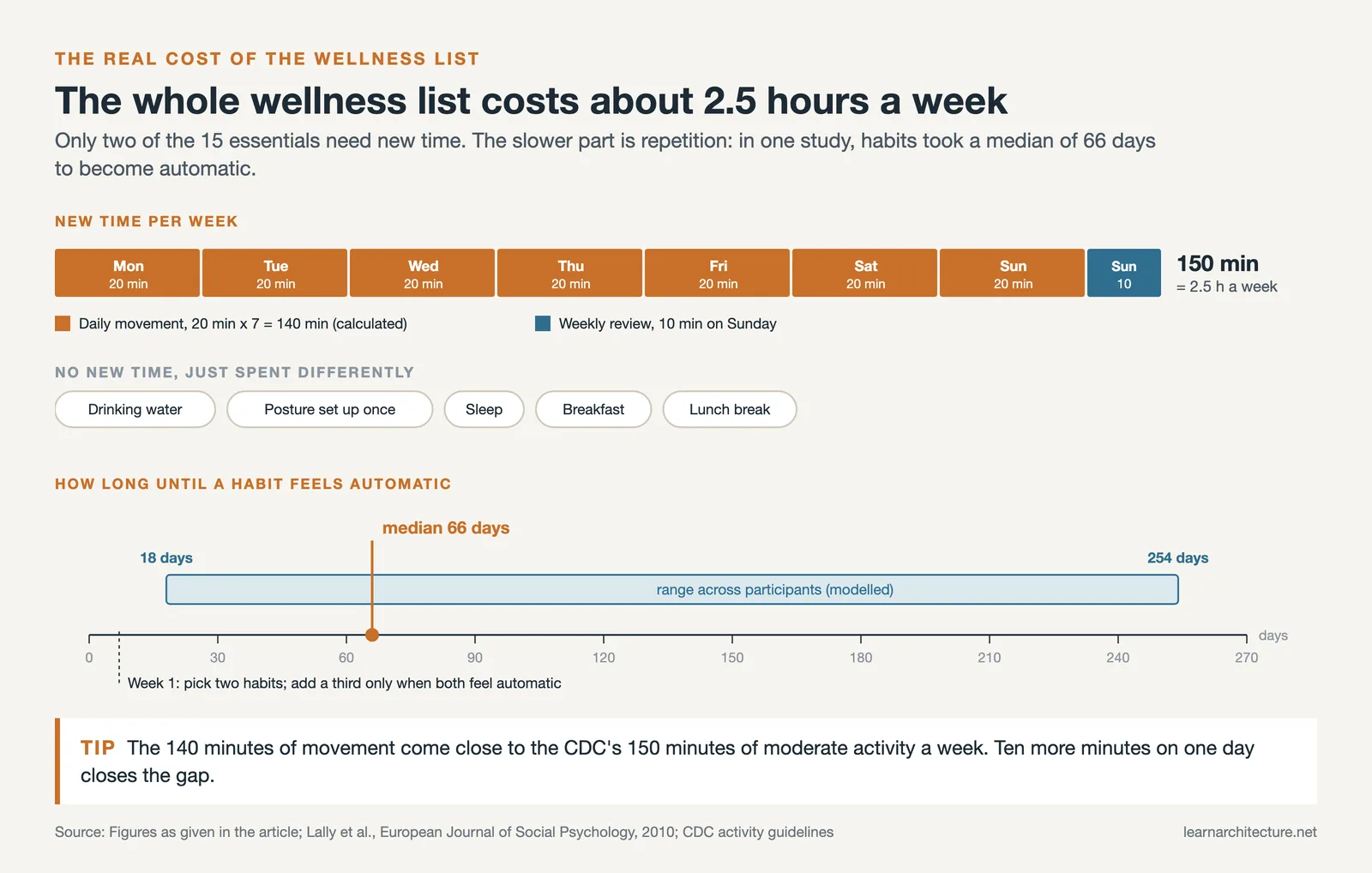
The mistake students make with wellness lists is treating them as another deadline. The 15 essentials work the opposite way: pick two, run them for a week, and add a third only when the first two feel automatic. Behavioral research on habit formation suggests it takes between 18 and 254 days for a behavior to become automatic, with a median around 66 days. Architecture school is long enough for that to happen, even if it does not feel like it during finals week. For students who want to address the upstream cause of stress, which is workload and time management, the architecture education tips guide covers prioritization frameworks and feedback practices that reduce last-minute panic and overlap directly with several of the essentials above.
How Much Time Do These Habits Actually Take?
Most of the 15 essentials add no time at all. Drinking water happens during work. Posture is a one-time setup. Sleep, breakfast, and a lunch break are time you already spend, just spent differently. The two practices that need genuine new time are daily movement (about 20 minutes) and the weekly review (10 minutes). The total cost is roughly 2.5 hours per week, which is less than a single review session.
⚖️ Pros & Cons at a Glance
✔️ Pros: Improved focus during studio, fewer sick days, better critique performance, lower long-term burnout risk, stronger sleep quality
✖️ Cons: Initial habit-building takes effort, social pressure from all-nighter culture, requires saying no to last-minute studio invites occasionally
Wellness Practices Across Architecture Programs
Different programs handle student wellness differently. The table below summarizes how studio culture varies across regions, based on AIAS reports, NAAB accreditation conditions, and published policies from individual schools.
| Region | Typical Studio Hours | Wellness Policy Status | Common Practice |
|---|---|---|---|
| USA (NAAB-accredited) | Heavy, project-based | Required Learning & Teaching Culture Policy | Student-led wellness committees |
| UK (RIBA-validated) | Heavy, with formal reviews | RIBA mental health initiatives | Counseling tied to student union |
| EU (Bologna system) | Moderate to heavy | Varies by country and school | National student health programs |
| Asia (varied) | Often very heavy | Less formalized | Peer support, family networks |
Knowing what your program offers, and what it does not, is the first step. Top architecture schools in the world increasingly publish their studio culture policies online. If yours does not, ask the student council or AIAS chapter to share it. The broader question of how architecture affects our well-being applies inside the studio just as it does in the buildings students design, since long hours in poorly lit, acoustically harsh spaces produce measurable stress responses regardless of the occupant’s role.
Linking Wellness to Better Design Work
The argument for wellness in architecture school is not only ethical. It is practical. Spaces designed by exhausted students are demonstrably worse than those designed by rested students. Sleep, nutrition, and movement directly affect spatial reasoning, attention to detail, and the kind of patient iteration that strong design demands. The students who consistently produce the best portfolios across schools of architecture tend to be the ones who treat their bodies as part of the design tool kit, not as obstacles to working longer.
This connection is also why studio culture reform matters at the institutional level. Healthier students do better work, and better work is what programs ultimately want. Best architecture schools in Europe and the USA that have invested in formal wellness policies are not slowing their students down. They are protecting the cognitive and creative capacity those students will need across a 40-year career.
📐 Technical Note
For students working long hours at a screen, ergonomic standards from ANSI/HFES 100-2007 recommend monitor distance of 50 to 70 cm, top of screen at or just below eye level, and screen brightness matched to ambient light. Most studio desks fail at least two of these conditions, which is why neck and shoulder pain is common by year three.

When Wellness Essentials Are Not Enough
Some forms of stress in architecture school require more than habit changes. Persistent sleep problems, panic attacks, suicidal thoughts, or sustained low mood are signs that professional support is needed, and architecture students seek that support too rarely. According to the AIA’s reporting on mental health in architectural practice, only about 20% of struggling students reach out for professional help.
If any of those signs apply, contact your university counseling center, your country’s mental health helpline, or a trusted faculty member. The Mental Health Foundation in the UK and the National Alliance on Mental Illness (NAMI) in the USA both offer free resources specifically for college students. Asking for help is not the opposite of finishing your degree. It is what makes finishing your degree possible.
✅ Key Takeaways
- Architecture school stress is a structural problem documented across decades, not a sign of personal weakness.
- The most effective wellness habits, like sleep, hydration, movement, and breaks, take little new time but produce major gains in studio focus.
- Pick two essentials at a time and build them into automatic habits before adding more.
- Studio culture norms that reward all-nighters and self-sacrifice are the source of the problem; healthy boundaries protect long-term creative output.
- If wellness habits alone are not stabilizing your mental health, professional support through your school’s counseling center is the right next step.
Final Thoughts
Architecture school stress will not disappear because the field decides it should. Programs change slowly, and studio culture changes even more slowly. Your wellness, on the other hand, can change starting tonight, with one decision about sleep, water, or a 10-minute walk. The students who finish architecture school with their health intact are not the ones who worked the hardest. They are the ones who built systems that protected them from a culture that often does not.
Mental health and stress patterns vary by individual. The information in this article is general guidance and is not a substitute for professional medical or psychological advice. If you are experiencing severe distress, please contact a licensed professional or your local crisis helpline.
















Leave a comment