



Table of Contents Show
Financial tips for aspiring architects start with one honest truth: the path to licensure is long, the upfront costs are real, and early-career salaries rarely match the years of study behind them. Smart money habits at the student and intern stage protect your design ambition later. The ten strategies below cover tuition, exam costs, side income, and long-term planning so you can graduate, get licensed, and grow your practice without financial pressure dictating every career choice.
Architecture rewards patience more than almost any other professional field. A five-year Bachelor of Architecture, two to three years of paid internship, and six exam divisions stand between most aspiring architects and a license. According to the U.S. Bureau of Labor Statistics, architects earned a median annual wage of $96,690 in May 2024, with employment projected to grow 4 percent from 2024 to 2034. Those numbers are encouraging, but they describe licensed professionals, not the students and interns living through the most expensive years of the journey.
This guide is written for that earlier stage. The ten tips below are practical, specific, and aimed at decisions you can make right now, whether you are choosing a school, finishing your AXP hours, or sitting for your first ARE division.
🔢 Quick Numbers
- Median annual wage for architects: $96,690 (U.S. Bureau of Labor Statistics, May 2024)
- Average undergraduate Architecture tuition: $11,721 in-state, $38,671 out-of-state (College Tuition Compare, 2025)
- Total ARE 5.0 cost across six divisions: approximately $1,410 at $235 per division (PPI/Kaplan reference, NCARB fee schedule)
- Projected job openings for architects per year, on average: 7,800 over the 2024 to 2034 decade (BLS)
1. Choose Your School Based on Total Cost, Not Sticker Price
The first major financial decision an aspiring architect makes is where to study. The headline tuition number on a school’s website is rarely what you actually pay, and it is rarely the only cost that matters. Public universities charge state residents far less than private institutions, and architecture programs at public schools often produce graduates who place into the same firms as their pricier private counterparts.
To compare programs honestly, you need to look at four things: tuition and fees, room and board, materials and software, and the location’s cost of living during the years you will be spending more time in studio than at home. A school that costs $20,000 less per year but sits in a city with double the rent can quietly close that gap.
Comparing Architecture Program Costs by Institution Type
The table below shows typical 2025 cost ranges. Use it as a starting point, then verify each number with the specific schools on your shortlist:
| Institution Type | Annual Tuition Range | Estimated 5-Year Total | Best For |
|---|---|---|---|
| Public, in-state | $10,000 to $15,000 | $50,000 to $75,000 | Cost-conscious students with state residency |
| Public, out-of-state | $30,000 to $45,000 | $150,000 to $225,000 | Students seeking specific specialty programs |
| Private, nonprofit | $40,000 to $70,000+ | $200,000 to $350,000+ | Students with strong scholarships or family support |
| Online B.Arch | $25,000 to $63,000 total | $25,000 to $63,000 | Working students balancing income and study |
Cost comparison alone does not pick the right school. NAAB accreditation, faculty quality, and studio culture matter just as much. But once you have a shortlist of schools that meet your academic criteria, choosing the cheaper one is almost always the smarter financial move. For a deeper look at what shapes career outcomes after graduation, the team at Learn Architecture published a useful overview on whether architecture is a good career that pairs well with this kind of cost analysis.
2. Apply for Every Scholarship You Reasonably Qualify For
Scholarships are the single most underused financial tool among architecture students. Many aspiring architects assume that the big national awards are out of reach and skip applying entirely. The result is that the scholarships actually go to the smaller pool of students who do apply, often with weaker portfolios than the students who self-selected out.
The American Institute of Architecture Students (AIAS) maintains a continually updated list of national, regional, and specialty scholarships through its scholarships and fellowships page. The Architects Foundation, the Royal Institute of British Architects (RIBA), and many landscape architecture-specific funds round out a much larger ecosystem than most students realize. A focused guide on architecture scholarships for students walks through the full landscape of merit-based, need-based, and diversity-focused awards.
💡 Pro Tip
Treat scholarships like a part-time job during your first year. Block out two hours every Sunday for one semester and target ten applications per month. Most aspiring architects who land meaningful funding apply to twenty or thirty scholarships, not two or three. The math is brutal but consistent: more applications, more money.
3. Budget for Software, Materials, and Studio Costs From Day One
Architecture students spend money on things other majors do not. A laptop powerful enough to run Revit, Rhino, and rendering engines runs $1,500 to $3,000. Model-making materials, plotting fees, site visits, and travel for studio crits add up quickly. Specialty software licenses are often discounted for students, but only if you actively claim them.
Build a separate line item in your budget for studio expenses. Treat it as fixed, not optional. A common pattern among first-year students is to underestimate this category and end up funding it with credit card debt that compounds over the next four years. Tracking these costs from the first semester gives you a realistic picture of what you actually need to earn during summers and breaks.
📐 Technical Note
Autodesk offers free educational licenses for AutoCAD, Revit, and 3ds Max for students enrolled at accredited institutions, valid for one year and renewable. Trimble offers SketchUp Pro at student pricing, and Rhinoceros provides a one-time student license at a substantially reduced rate compared to commercial pricing. Verify current student pricing directly with each vendor before purchasing, since terms change annually.
4. How Much Should You Plan for ARE and AXP Costs?
The Architect Registration Examination (ARE 5.0) consists of six divisions, each with its own fee. The total exam cost is $1,578 ($263 per division, as of September 2026) if you pass every division on the first attempt, and considerably more if you need to retake any. Add an annual NCARB Record fee of $105 for licensure candidates (as of September 2026), and the licensure pipeline carries its own multi-thousand-dollar price tag separate from your degree.
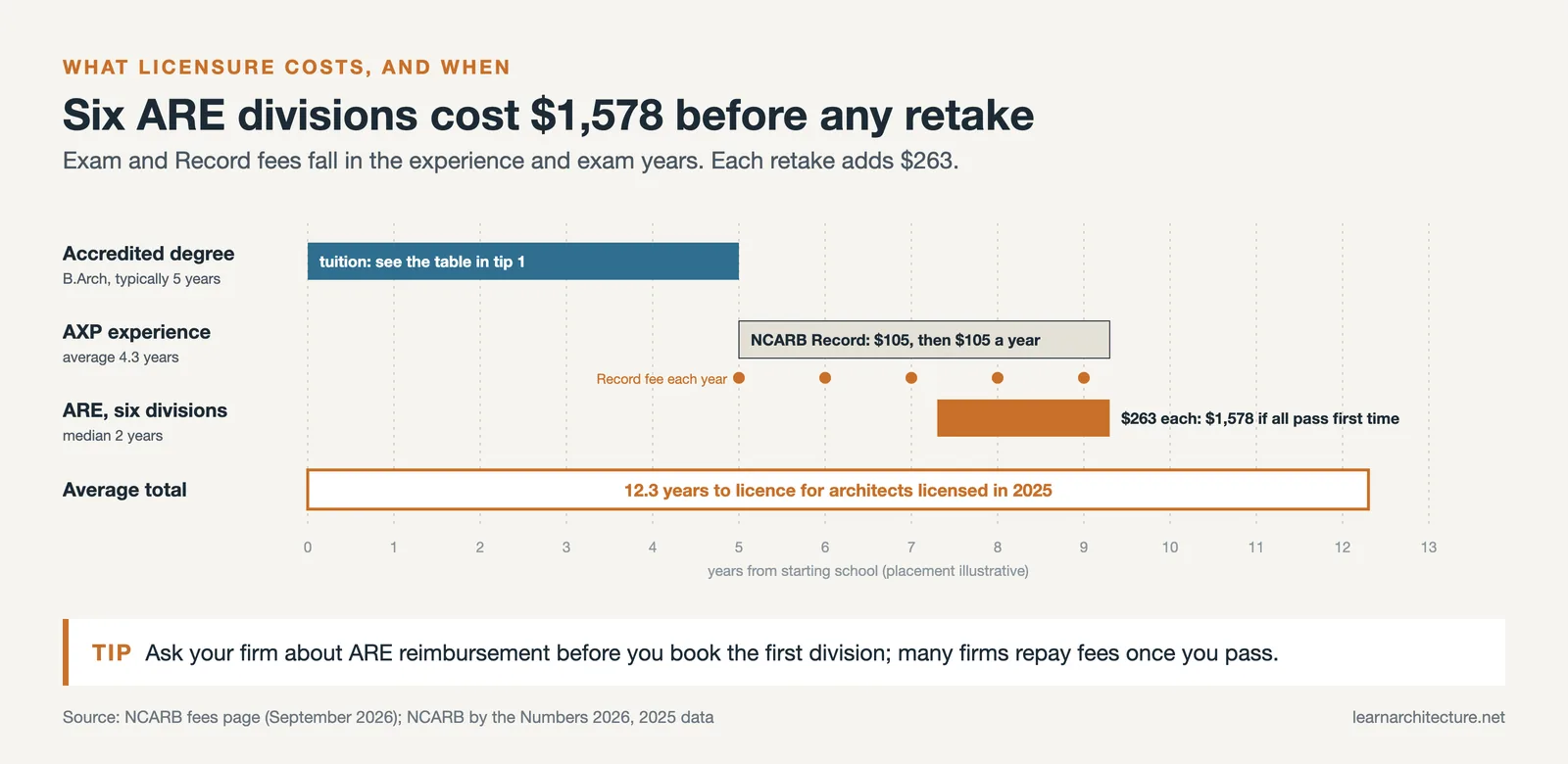
The full breakdown is published by the National Council of Architectural Registration Boards on their official NCARB fees page, where you can verify current pricing for the AXP, ARE divisions, and Record renewals. Many firms reimburse exam fees once you pass, so before you pay out of pocket, ask your employer about their ARE reimbursement policy. Even firms that do not advertise this benefit often have informal budgets for it.
5. Negotiate Your First Salary, Even When It Feels Awkward

Entry-level architects often accept the first offer they receive without counter-negotiating, partly because the field has a reputation for tight margins and partly because they do not want to seem ungrateful. Both reasons cost real money over a career. A $3,000 salary increase in your first year compounds across decades through future raises calculated as percentages of your base.
Before accepting any offer, research the local market. Glassdoor, the AIA Compensation & Benefits Report, and conversations with recently hired peers give you a defensible range. Frame your counter-offer around specific skills you bring (Revit fluency, computational design experience, prior internships), not around what you need to live. The Learn Architecture guide on architect earning potential covers how location, experience, and specialization shift the numbers.
⚠️ Common Mistake to Avoid
Many aspiring architects believe negotiating an entry-level offer will cost them the job. In practice, hiring managers expect a counter-offer and have a budget range with room above the initial number. Declining to negotiate signals inexperience more than it signals enthusiasm, and it locks in a lower base for years of compounding raises.
6. Build a Side Income Stream Aligned With Your Skills
Architecture students and interns sit on a stack of marketable skills that translate well to side work: rendering, drafting, graphic design, model-making, teaching SketchUp or Revit on platforms like Skillshare or Udemy. Even small side projects worth a few hundred dollars per month materially change your debt trajectory over five years.
Freelance rendering work is one of the most accessible income streams for students. Real estate firms, small interior designers, and competition entrants all pay for visualization help. Pricing your time honestly matters here: $25 per hour as a student is reasonable for production work, while specialized post-production or design input commands higher rates. The article on becoming a freelance architect has practical guidance on rate-setting and client acquisition.
7. Manage Student Debt Before It Manages You

Architecture education is expensive enough that some level of debt is realistic for most students. The goal is not to avoid debt entirely but to keep it within a range your future income can comfortably service. A common rule of thumb: total student debt at graduation should not exceed your expected first-year salary. For most architecture graduates, that means keeping debt under $60,000 to $70,000.
If your projected debt looks higher than that ratio, your options include transferring to a less expensive school, slowing the program down to add part-time work, taking a year off to save before resuming, or pursuing the M.Arch route after a cheaper undergraduate degree in a related field. None of these paths feels glamorous, but each one preserves financial flexibility after graduation.
📌 Did You Know?
According to NCARB data, the average length of time from beginning architecture school to becoming licensed is about 12.3 years (for architects licensed in 2025) when you account for education, AXP hours, and exam completion. Every year shaved off that timeline through smart financial and career choices translates directly into higher lifetime earnings, since licensed architects earn substantially more than their unlicensed peers in the same firms.
8. Start Retirement Saving in Your First Job, Even at a Modest Amount
Most aspiring architects defer retirement saving until they “make real money,” which usually means after licensure or after paying down student debt. That delay is mathematically expensive. A 25-year-old who invests $200 per month at a 7 percent average return ends up with more at age 65 (about $525,000 against $488,000 at 7 percent compounded monthly) than a 35-year-old who invests $400 per month, despite contributing a third less in total ($96,000 against $144,000).
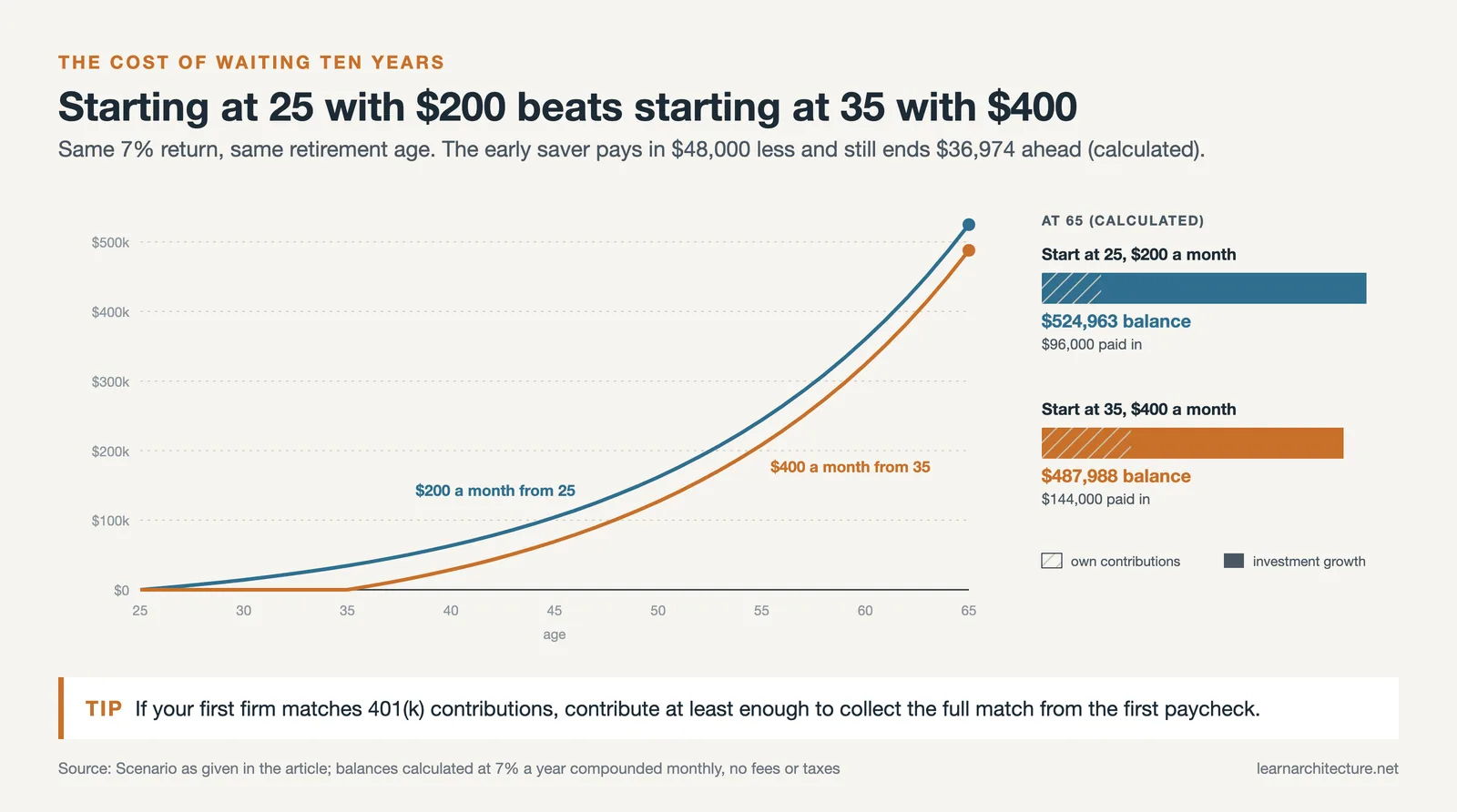
If your first firm offers a 401(k) with any employer match, contribute at least enough to capture the full match. The match is, in effect, a guaranteed 100 percent return on the matched portion. Skipping it because money feels tight is one of the most common and costly financial mistakes in early architectural careers.
9. Build an Emergency Fund Before Anything Else

Architecture careers track the broader economy. When development slows, hiring tightens, projects pause, and layoffs in design firms become more common. An emergency fund of three to six months of essential expenses gives you the ability to weather a job loss without taking the first replacement offer that comes along, which is usually a lower-paying or worse-fit position.
For an entry-level architect, three months of essential expenses might be $9,000 to $15,000 depending on city. That number feels enormous when you are also paying down student loans, but it is achievable in two to three years through automatic transfers of $300 to $500 per month into a high-yield savings account. Treat the emergency fund as non-negotiable, even before increasing retirement contributions beyond the employer match.
🏗️ Real-World Example
The 2008 to 2009 architecture downturn: According to AIA data referenced widely in industry post-mortems, U.S. architecture firms shed roughly 30 percent of their workforce during the Great Recession, with smaller firms hit hardest. Architects who had built emergency savings before the crash were able to relocate, retrain, or wait for the right firm to rehire. Those without savings often took unrelated jobs and re-entered the field years late, losing both income and licensure progress.
10. Plan Your Long-Term Career Around Earning Trajectory, Not Just Job Titles
The biggest income jumps in an architectural career rarely come from staying on the standard ladder of project architect to associate to senior associate. They come from licensure (which typically adds 10 to 20 percent to base salary), from specialization in high-demand areas like healthcare or sustainable design, from moving into project management or principal roles, or from starting your own practice. Mapping these decision points early gives you a sense of when to push for promotion, when to switch firms, and when to specialize.
Geographic location is another major lever. Architects in dense urban markets like New York and San Francisco often earn 30 to 50 percent more than peers in smaller cities, though cost of living absorbs much of that gap. The honest comparison is take-home pay after rent, taxes, and student loan payments, not gross salary. Learn Architecture’s guide to top cities for architecture job opportunities covers this geographic trade-off in detail.
🎓 Expert Insight
“Architecture should speak of its time and place, but yearn for timelessness.”, Frank Gehry
Gehry’s point about timelessness applies to careers as much as buildings. The financial choices that protect a long career, such as manageable debt, savings discipline, and ongoing learning, outlast any single project or trend. Aspiring architects who think in decades rather than semesters tend to end up with both the work and the financial stability to keep doing it.
One concrete habit worth adopting in your first job: track your effective hourly rate every six months by dividing total compensation by actual hours worked, not contracted hours. Architects who consistently work 55-hour weeks at a 40-hour salary are earning much less than they think, and once you see the real number, raise requests and job moves become easier to justify.
✅ Key Takeaways
- Total cost of school, including living expenses and materials, matters more than headline tuition.
- Scholarships, employer reimbursement, and side income can each meaningfully reduce student debt.
- Negotiating your first salary and capturing employer 401(k) matches are high-impact early moves.
- Build a three-to-six-month emergency fund before optimizing other financial goals.
- Career planning around earning trajectory, including licensure, specialization, and geography, outperforms title-chasing.
Frequently Asked Questions for Aspiring Architects
How much money do I need to become a licensed architect in the U.S.?
The total cost varies widely based on your school choice, but a realistic range is $80,000 to $250,000 for the degree itself, plus roughly $1,500 to $2,500 for AXP and ARE-related fees through licensure. Living expenses during school and internships add significantly to that number, especially in expensive cities.
Is architecture worth the financial investment?
Architecture pays a respectable median wage of $96,690 according to BLS 2024 data, with strong growth potential through specialization, licensure, and ownership. The investment usually pays off, but the return depends heavily on managing education debt and pursuing income growth deliberately rather than passively.
Can aspiring architects work full-time while studying?
Architecture school is unusually demanding compared to other majors, and most full-time programs assume students do not hold significant outside jobs during term. Part-time work in firms, drafting, or rendering is realistic and often productive, but full-time work usually requires extending the program timeline. Online and hybrid B.Arch options have made this more workable in recent years.
What is the cheapest path to becoming an architect?
The cheapest route in the U.S. is typically an in-state public B.Arch program with strong scholarship support, followed by AXP at a firm that reimburses ARE fees. International routes through countries with lower tuition (like several European programs) can also reduce cost substantially, though licensure reciprocity then becomes a separate consideration.
How long does it take to recover financially from architecture school?
For students with $60,000 to $80,000 in debt and a typical entry-level salary, full repayment usually takes 8 to 15 years on a standard schedule, though it can be much faster with side income, employer-assisted repayment programs, or income-based repayment plans. Building the rest of your financial life, including the emergency fund, retirement contributions, and home purchase savings, alongside debt repayment is realistic if you start early.
Cost figures and salary ranges shown here are approximate and vary by region, school, employer, and economic conditions. Tuition, exam fees, and salary data should be verified with official sources before making financial decisions, and consultation with a licensed financial professional is recommended for individualized planning.














Leave a comment