



Table of Contents Show
Architecture schools spend five to seven years teaching design thinking, theory, and representation, yet many graduates discover a sharp gap between studio culture and real practice. The most successful early-career architects close that gap themselves, picking up business literacy, construction knowledge, client communication, contract awareness, and self-directed career planning along the way.
Why There Is a Gap Between Architecture Schools and Real Practice
Walk into any first-year studio and the focus is clear: concept, form, representation, theory. Studios train students to question assumptions, push ideas to their limits, and defend their work in front of a panel. That mindset produces strong designers. It does not, on its own, produce architects ready for a Tuesday morning at a busy firm. The standards that shape what schools must cover are set by the National Architectural Accrediting Board (NAAB), the body that accredits B.Arch, M.Arch, and D.Arch programs across the United States.
The disconnect is well documented. The Association of Collegiate Schools of Architecture and the National Council of Architectural Registration Boards ran a joint study surveying firm leaders and recent graduates about how prepared new hires felt for practice, with both groups pointing to gaps around professional knowledge and firm expectations. A 2024 RAND study commissioned by NCARB surveyed nearly 3,800 students, faculty, and practicing professionals on the alignment between architectural education and the future of practice, and the picture it paints is similar: schools and firms are not always teaching and expecting the same things.
None of this means architectural schools are failing. The five-year B.Arch and the M.Arch were never designed to produce a finished architect on graduation day. That is what the Architectural Experience Program (AXP), the Architect Registration Examination (ARE), and the early years in a firm are for. The point is to know what is missing, so you can start building those skills before they become a survival problem.
💡 Pro Tip
In your final two years of school, start treating every studio project as if it had a real client and a real budget. Add a one-page cost narrative and a simple program brief to your portfolio submissions. It changes how you think about decisions, and reviewers at firms notice immediately.
1. Business Literacy and Project Economics

Architecture firms are creative practices, but they are also businesses. Fees, hourly rates, billable percentages, and project profitability decide whether your studio keeps the lights on. Most B.Arch and M.Arch curricula touch on professional practice in a single course, often in the final year, which is rarely enough to build genuine fluency.
Graduates often arrive at their first job with no clear sense of how a fee proposal is built, what a phase budget looks like, or why their project manager keeps asking for time-sheet entries by code. That gap costs them quickly. Promotions and raises in firms tend to track to people who understand how the work makes money, not just how it looks in a render.
What “Business Literacy” Actually Means in a Firm
At a minimum, an early-career architect should understand:
- How firms charge: percentage-of-construction-cost, fixed fee, hourly with cap, and how scope changes drive change orders
- How billable hours work and why their personal utilization rate matters
- The basic phases of a project (SD, DD, CD, CA) and roughly how fees are distributed across them
- How to read a project budget and flag when a phase is heading over
You do not need an MBA. You need to be able to sit in a project meeting, hear “we are at 85% of the SD budget with the design still moving,” and understand what that sentence implies for your week.
🎓 Expert Insight
“What architects don’t get from architectural education has to be made up in practice.” Randy Deutsch, FAIA, architect and University of Illinois faculty
Deutsch’s point reframes the entire conversation. The question is not whether school left gaps, but whether the firm and the early-career architect are doing the work of filling them. Treating that responsibility as shared makes the transition far less painful.
2. Construction Knowledge and Technical Detailing
Studios reward elegant sections and atmospheric renders. They rarely reward a properly drawn wall section with flashing, drip edges, vapor barriers, and connection details that someone could actually build from. The result is a generation of graduates who can produce stunning concept work and freeze the moment a contractor hands them an RFI on a thermal break.
This gap is one of the most consistently flagged issues in research on architectural education. Practitioners surveyed by ACSA and NCARB repeatedly cite construction documents, building systems, and detailing knowledge as areas where new graduates need significant on-the-job training before they can contribute meaningfully to project sets.
How to Close the Construction Knowledge Gap

If your school does not require a strong construction sequence, build it yourself:
- Take electives in materials and methods, structures, and environmental systems even when they are not required
- Visit construction sites whenever your school organizes them, and ask about details you do not understand
- Start a personal “details library” by saving high-quality CAD details you find in journals and on detail-focused publications
- For your studio projects, draw at least one wall section at 1:10 or 1:5 with real materials and connections, not just outlines
An architectural internship is the most direct way to build practical experience while you are still in school, since you see how concept drawings turn into buildable documents in a way that no studio can replicate.
⚠️ Common Mistake to Avoid
Many students load their portfolios with renders and concept boards, then wonder why technically focused firms pass on their applications. Hiring managers at production-oriented practices look hard at construction details, sections, and assembly drawings because those reveal whether a candidate understands how a building actually goes together. A portfolio with five outstanding renders and zero technical drawings reads as a design student, not a design professional.
3. Client Communication and Negotiation
In studio, you defend your work to a panel of professors and visiting critics. The dynamic is largely one-way: you present, they question, you respond. Real client work runs on a different model. Clients have budgets, deadlines, fears, and opinions of their own, and they are paying for your time. The skills that make a strong studio reviewer are not the skills that keep a paying client engaged through eighteen months of design and construction.
Most schools spend almost no time training communication beyond the formal pin-up. Negotiation, conflict de-escalation, expectation setting, and the art of saying “no” without losing the relationship are typically learned by accident in the first few years of practice, often after one or two painful incidents.
What to Practice Before You Need It
- Writing meeting summaries: after every studio review, draft a one-paragraph “what was decided, what is next” note. This habit is gold in practice
- Following up clearly in writing: an email that begins “to confirm what we discussed” prevents a surprising amount of conflict
- Listening before pitching: in studio you defend your idea immediately, in client work you first make sure you understand the brief
- Reading the room: noticing when a client is uncomfortable with a direction and adjusting before they push back formally
For a wider view of what these communication patterns look like once you are in the workforce, the guide on what it is really like to be an architect covers the daily mix of design, coordination, and stakeholder work that defines the role.
📌 Did You Know?
According to NCARB by the Numbers 2026, candidates who completed the Architectural Experience Program in 2025 took an average of 4.3 years to finish, on top of their accredited degree. The path from starting school to a stamp on a drawing is rarely under nine years, which is why the practical skills you build along the way matter so much.
4. Contracts, Codes, and Liability


Architects sign contracts. Architects stamp drawings. Architects are legally responsible, in part, for what gets built. Architecture schools, on average, treat all three of these in a single survey course, if they treat them at all in a way students remember.
This is one of the most uncomfortable gaps because the consequences of getting it wrong are not aesthetic. They are legal and financial. A misread building code can stop a project at permit. A poorly understood AIA contract clause can put a firm on the wrong end of a claim. Construction administration mistakes can cost a client real money and your firm its reputation.
The Minimum You Should Know Before Sealing Anything
| Area | What School Usually Covers | What Practice Demands |
|---|---|---|
| Building codes | High-level reference in studio reviews | Working knowledge of IBC use groups, occupancy, egress, and fire-rated assemblies |
| Owner-architect contracts | Brief mention in professional practice course | Familiarity with AIA B101 and similar agreements, including scope, fees, and liability clauses |
| Construction administration | Rarely covered in detail | RFIs, submittals, change orders, field reports, and what to put in writing |
| Professional liability | Touched on conceptually | Standard of care, errors and omissions, the value of clear documentation |
| Licensure path | Mentioned, rarely walked through | AXP hours tracking, ARE preparation, jurisdictional differences, NCARB record management |
If you are planning your education with licensure in mind, the data is worth knowing: in 2022, graduates of NAAB-accredited programs had a 57% ARE pass rate compared to 48% for graduates of non-accredited programs, a nine-point gap that adds up over a six-division exam.
How Do You Learn Codes and Contracts Without a Real Project?
Treating this as something you can pick up later is the trap. Pull a real building code (the International Building Code is freely viewable through ICC’s public access tool) and walk through one section, say egress, until it actually makes sense. Read an AIA B101 owner-architect agreement once, end to end, even if every fifth clause is opaque. The first contract you read in school is much easier to revisit than the first contract you read three weeks into your first job.
5. Career Strategy and Self-Directed Growth

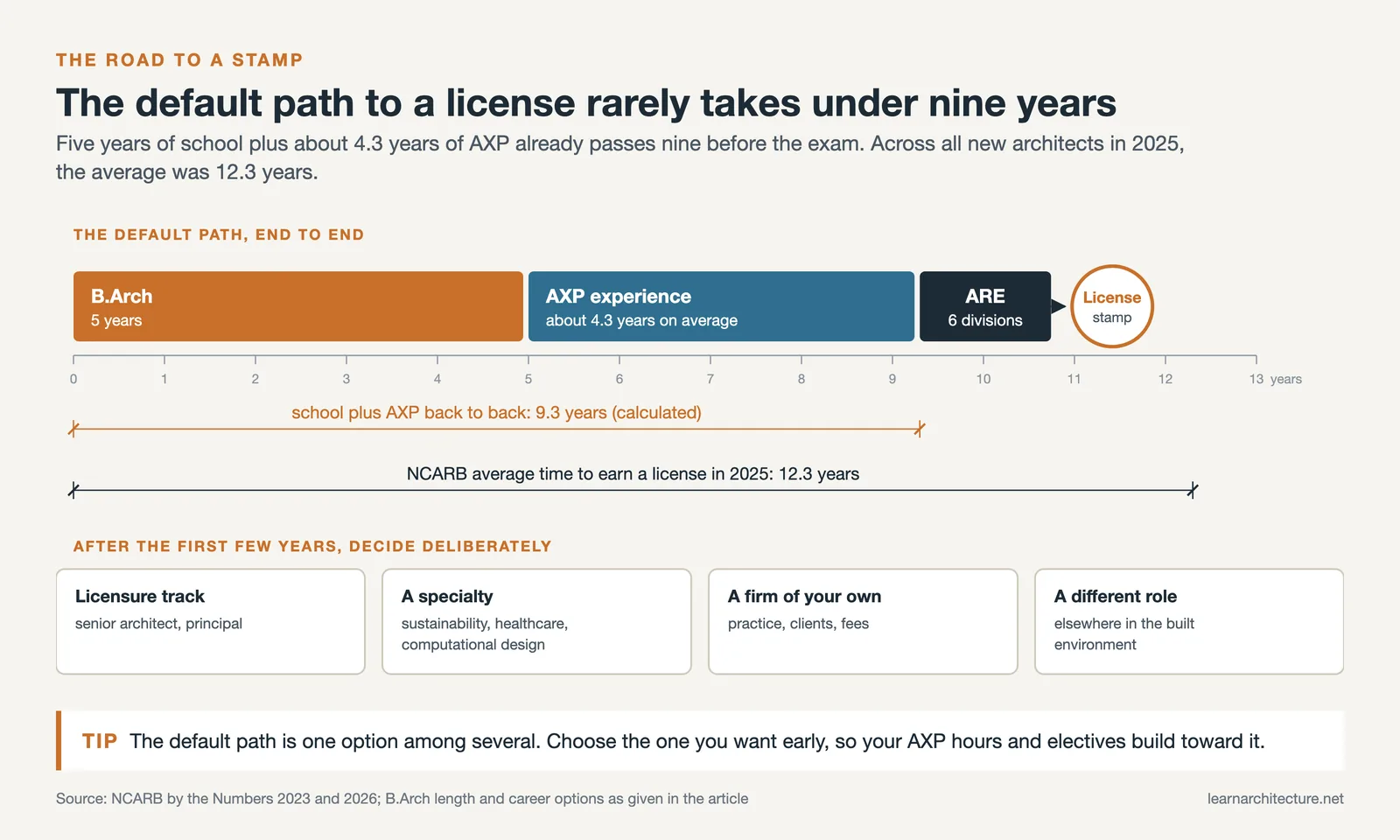
The fifth gap is the quietest and the most consequential. Architecture school provides structure: studios, deadlines, juries, semesters. Practice provides almost none of that. There is no sign-up sheet for the next stage of your career. Nobody assigns you a thesis on which kind of architect you want to become.
Most students leave school assuming the path is automatic: work at a firm, log AXP hours, take the ARE, become a licensed architect, eventually become a senior architect or principal. That path exists, but it is one of many, and the people who thrive in any of them are usually deliberate about the choice. The default path is rarely the optimal one for any individual.
Building Your Own Roadmap
Career planning in architecture is a skill, not a personality trait. A few practices that compound over time:
- Pick three architects whose careers you admire and reverse-engineer how they got there. Note where their first five years were spent
- Track what kinds of projects energize you and which ones drain you. After two years, the pattern is usually clear
- Decide deliberately whether you are working toward licensure, a specialty (sustainability, healthcare, computational design), a firm of your own, or a different role in the built environment
- Maintain relationships outside your immediate office. Architecture is a relationship-driven profession, and your network at year ten is mostly built in years one through five
If you are still weighing whether the traditional path is the right one for you, the perspective in is architecture a good career: pros, cons, and long-term outlook is a useful counterweight to the more idealized version of the profession that studios sometimes present.
Video: Things They Don’t Teach You About the Architecture Profession
For a longer-form take on this same question from a licensed architect’s perspective, this video by Dami Lee covers project scale, complexity, specialization, licensure, and money in roughly the same territory as this guide. It is worth watching once before you graduate and once after your first year in practice.
How to Bridge the Gap While You Are Still in Architecture School
None of these five gaps require you to leave school or wait for graduation. They reward small, consistent moves over five years more than they reward dramatic late-stage cramming.
The most effective students treat their education as the foundation, not the finished product. They take the studio work seriously, then add the layers school does not formally teach: a summer in a real firm, a self-imposed habit of reading codes and contracts, a portfolio that includes a buildable wall section alongside the hero render, a few mentors outside their school, and a clear-eyed view of what the next ten years actually look like. A strong student portfolio is one of the clearest signals to firms that you have started this work, since it shows both design ability and an awareness of what professional reviewers care about.
Architecture is a long career. The gap between school and practice is real, but it is also bridgeable, and the people who bridge it deliberately tend to look back on the transition as a stretch rather than a shock.
✅ Key Takeaways
- Architecture schools train designers; practice demands designers who also understand business, construction, communication, contracts, and self-directed careers.
- Business literacy is not optional. Understanding fees, billable hours, and project budgets shapes your trajectory inside any firm.
- Construction knowledge and technical detailing are flagged by practitioners as the largest single gap in early-career graduates.
- Communication and negotiation are skills, not personality traits, and can be practiced inside studio reviews and group projects.
- Codes, contracts, and liability deserve real attention before graduation, not after the first project crisis.
- No one will plan your architecture career for you. The graduates who thrive are the ones who plan deliberately and start early.
Information on building codes, professional contracts, and licensure varies by jurisdiction. Always verify specific requirements with your local licensing board, attorney, or licensed professional before relying on them for a project decision.
















Leave a comment