


Table of Contents Show
The best architecture schools share a common trait: they produce graduates who can think critically, build technically, and design with purpose. This list covers 15 leading architecture schools across North America, Europe, and Asia, ranked by program reputation, research output, studio culture, faculty, and real-world outcomes. Whether you’re applying for a B.Arch or an M.Arch, knowing what each school actually offers helps you make a far better decision than relying on rankings alone.
What Makes a Top Architecture School?
Reputation matters, but it doesn’t tell the full story. The strongest architecture schools consistently combine accredited degree programs with hands-on studio culture, access to practicing professionals, and a track record of placing graduates in competitive firms or graduate programs. Key factors to weigh include NAAB or RIBA accreditation, faculty research output, studio-to-student ratios, international partnerships, and the quality of the alumni network.
Accreditation is non-negotiable if licensure is your goal. In the United States, the National Architectural Accrediting Board (NAAB) accredits both the B.Arch and M.Arch degrees. In the UK and Commonwealth countries, the Royal Institute of British Architects (RIBA) sets the standard. Attending an unaccredited program can close doors later, especially if you plan to sit for the Architect Registration Examination (ARE).
💡 Pro Tip
When comparing architecture schools, request the most recent graduate outcomes report from each admissions office. These documents show where graduates actually work after completing the program, not just where the school says its alumni end up. A school with a strong list of partner firms or faculty with active practices is often more valuable than one with a higher academic ranking but weaker industry ties.
Top Architecture Schools in North America

1. Harvard Graduate School of Design (GSD): Cambridge, USA
The Harvard GSD is one of the most recognized schools of architecture globally. Its M.Arch program draws applicants from over 70 countries, and the faculty includes practitioners who have shaped contemporary discourse in urbanism, landscape, and design theory. The school’s interdisciplinary approach connects architecture students with urban planning, landscape architecture, and design engineering tracks, encouraging cross-studio collaboration.
Harvard GSD does not offer an undergraduate architecture degree. Applicants must hold a prior bachelor’s before entering the program, making it a post-professional destination for students who already hold architecture degrees, or a first professional program for those entering from an unrelated field. Research centers like the Harvard Center for Green Buildings and Cities give students access to funded, applied research.
📌 Did You Know?
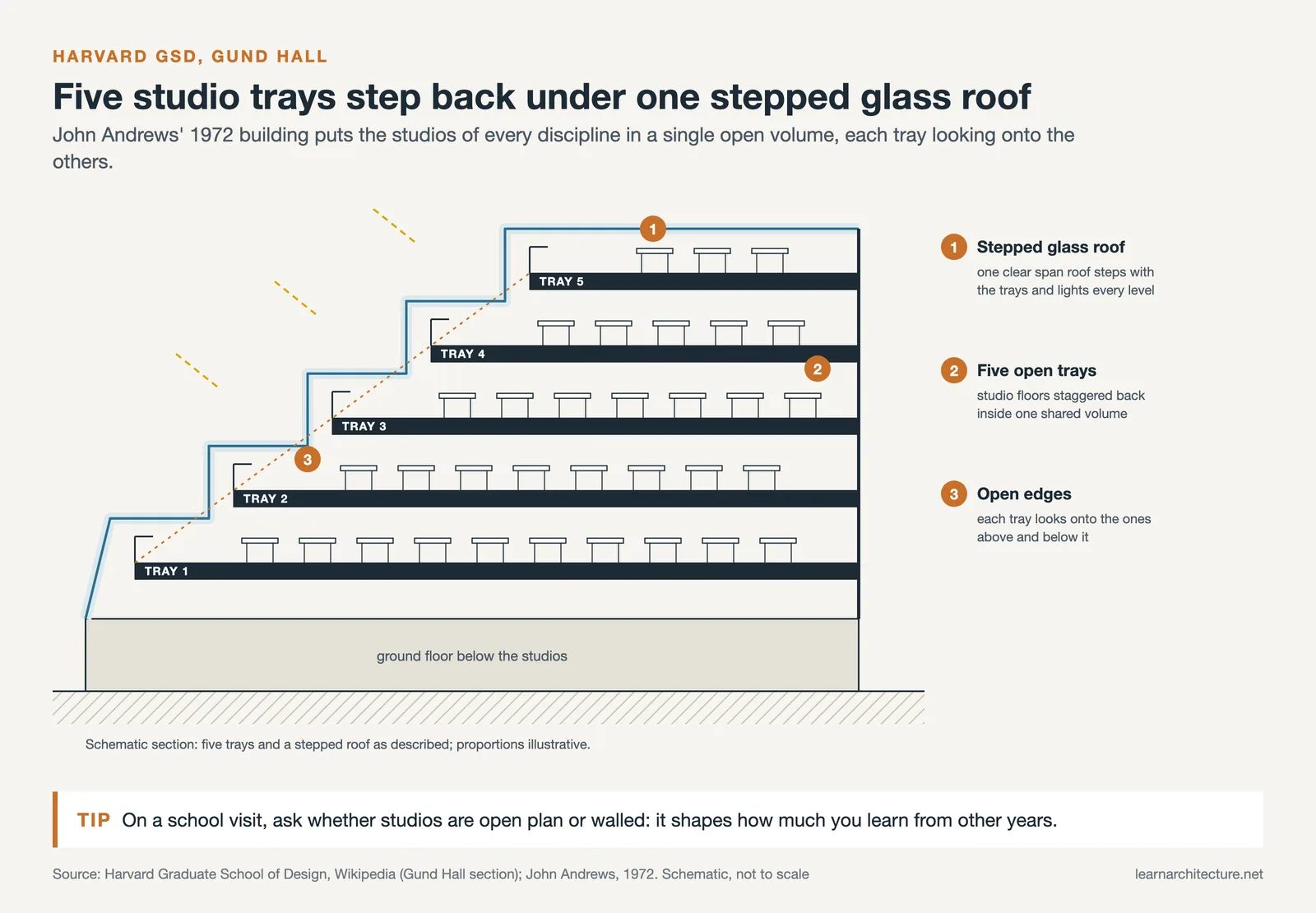
The Harvard GSD’s Gund Hall, designed by John Andrews and completed in 1972, houses one of the most iconic studio spaces in architectural education. Its open “tray” system stacks five studio floors in a continuous open-plan arrangement under a stepped glass roof, allowing students across all disciplines to work in full view of each other.
2. MIT School of Architecture and Planning: Cambridge, USA
MIT places a strong emphasis on technology, computation, and research in its architecture program. The school’s Media Lab and Design Lab give architecture students access to resources that few programs worldwide can match. Coursework integrates digital fabrication, parametric modeling, and building science alongside design studio. The M.Arch program at MIT is research-intensive; many graduates go on to PhD programs or take roles in research-led firms.
MIT’s architecture faculty includes leaders in computational design and climate-adaptive building systems. If you’re drawn to the intersection of architecture and engineering, or plan to work on large-scale infrastructure projects, MIT’s program offers a distinct focus that Harvard’s more theory-oriented curriculum does not.
3. Yale School of Architecture: New Haven, USA
Yale has built a reputation around design excellence and critical thinking. Its M.Arch program is studio-heavy, and the school has historically attracted faculty who are leading practitioners. Visiting critics and studio instructors at Yale have included figures such as Zaha Hadid, Frank Gehry, and Rem Koolhaas, bringing real-world professional context into the academic setting.
For students interested in architecture as a career in design-forward practices, Yale is consistently named among the top architecture schools in the world. The school’s gallery also hosts exhibitions that connect students to contemporary architectural debates.
4. Columbia University GSAPP: New York, USA
Columbia’s Graduate School of Architecture, Planning and Preservation (GSAPP) benefits enormously from its New York City location. Students have access to a dense professional network and ongoing construction projects that offer real-time case studies. The M.Arch program at Columbia tends toward theory and urban scale, making it a strong fit for students interested in cities, housing, and infrastructure.
Columbia also runs the Studio-X global network, connecting its students to satellite studios in cities including Rio de Janeiro, Mumbai, and Amman. This global exposure adds a dimension that many campus-bound programs lack.
⚠️ Common Mistake to Avoid
Many applicants choose architecture schools based on national rankings without checking whether the program is accredited in their target country for licensure. A highly ranked school in the US may not hold RIBA accreditation, which matters if you intend to practice in the UK or Australia. Always verify the program’s accreditation status against the licensing body in the country where you plan to work.
5. SCI-Arc (Southern California Institute of Architecture): Los Angeles, USA
SCI-Arc occupies a different position in the landscape of architecture schools. Founded in 1972 as an experimental alternative to established programs, it has maintained a culture of design risk-taking and theoretical exploration. The school offers both undergraduate and graduate architecture programs, along with a two-year M.Arch 2 for students who already hold an architecture degree.
SCI-Arc graduates tend to enter smaller, design-focused practices or start their own studios. The school draws heavily on Los Angeles’s film, technology, and cultural industries for interdisciplinary inspiration, which gives its curriculum a character quite different from East Coast programs.
Top Architecture Schools in Europe

6. ETH Zurich: Zurich, Switzerland
ETH Zurich consistently ranks among the top architecture schools in the world, particularly in technical and structural design. The school’s approach combines rigorous engineering principles with strong spatial design, producing graduates who are equally capable in construction technology and conceptual thinking. Programs are taught in German, though there are English-language options available at the master’s level.
ETH Zurich has produced notable alumni including Santiago Calatrava, who earned his civil engineering degree and doctorate there. Its research institutes, such as the Chair of Architecture and Urban Design, actively engage with real cities and ongoing planning challenges, giving students direct exposure to applied research.
7. Architectural Association (AA) School of Architecture: London, UK
The Architectural Association in London is one of the few independent architecture schools in the world. It does not form part of a larger university, which gives it unusual freedom in how it structures its curriculum. The AA’s unit system, where students choose a studio unit led by a specific tutor or pair of tutors with a declared intellectual agenda, creates an environment of focused research and debate.
Graduates of the AA have gone on to establish many of the most influential practices of the past 50 years, including Zaha Hadid Architects and Foreign Office Architects. The school’s international student body and London location make it particularly strong for students interested in global practice and cross-cultural design challenges. For those curious about architectural scholarships that support study in Europe, there are several funding options specifically targeting UK-based programs.
🎓 Key Insight
A good architecture school should make you uncomfortable enough to grow, but support you enough to take real risks.
That balance captures a genuine tension in architectural education: the most productive programs tend to challenge students well beyond their comfort zone while providing rigorous feedback structures. Schools like the AA and Bartlett have long built their identity around exactly this balance.
8. The Bartlett School of Architecture, UCL: London, UK
The Bartlett at University College London ranks among the top five architecture schools globally in multiple independent assessments. Its MArch program is known for encouraging formally ambitious and conceptually rigorous work, often at the speculative end of the design spectrum. The school’s research culture is strong, and many graduates pursue doctoral study or academic careers alongside professional practice.
The Bartlett’s Unit 14, Unit 22, and similar studio units have produced some of the most discussed student work of the past two decades. If you’re drawn to architecture that challenges boundaries between art, technology, and social critique, the Bartlett offers an environment well suited to that kind of exploration.
9. TU Delft Faculty of Architecture: Delft, Netherlands
TU Delft is one of the largest architecture faculties in Europe and consistently ranks among the best architecture schools in continental Europe. The program combines design with a strong emphasis on building technology and research methodology. A notable characteristic of TU Delft is its focus on the relationship between urban design and individual building scale, explored through its urbanism and landscape research clusters.
Programs at TU Delft are available in English at the master’s level, making it accessible to international students. The Netherlands’ reputation for innovative housing and urban planning gives students nearby case studies that are directly relevant to real-world design challenges.
10. École Polytechnique Fédérale de Lausanne (EPFL): Lausanne, Switzerland
EPFL’s architecture program sits within one of Europe’s leading technical universities. The school draws on the university’s strengths in engineering, materials science, and digital fabrication, making it a strong choice for students interested in advanced building systems or research-driven practice. EPFL’s campus and laboratories provide access to physical and computational testing resources that are rare in architecture schools.
Top Architecture Schools in Asia and the Pacific

11. National University of Singapore (NUS): Singapore
NUS consistently ranks as the top architecture school in Asia according to the QS World University Rankings by Subject. Its program covers both the built environment and tropical design with a rigorous technical foundation. Singapore’s position as a hub for large-scale urban development gives NUS students access to ongoing construction projects and professional firms that few programs can match in terms of sheer scale and diversity of typology.
The NUS Department of Architecture offers an integrated program from undergraduate through doctoral level, with a strong track record in research on high-density housing, urban heat, and sustainable building in tropical climates. For students interested in building a career in Southeast Asia or the Middle East, NUS’s alumni network and regional reputation carry significant weight.
🔢 Quick Numbers
- Harvard GSD receives approximately 1,100 applications annually for roughly 110 M.Arch places, an acceptance rate of around 10% (Harvard GSD, 2024)
- NUS ranked 1st in Asia and 11th globally for architecture and the built environment (QS World University Rankings by Subject, 2024)
- ETH Zurich ranked 4th globally for architecture in the same QS 2024 subject ranking, making it the top European institution for the subject
12. University of Tokyo: Tokyo, Japan
The University of Tokyo’s architecture program is one of the oldest and most respected in Japan, with a long tradition of producing practitioners who integrate craftsmanship with spatial theory. The program is conducted primarily in Japanese, which limits direct access for international students at the undergraduate level, though English-language graduate options exist through the university’s international research programs.
Japan’s architectural culture, which places great emphasis on detail, material honesty, and the relationship between indoor and outdoor space, is embedded in the University of Tokyo’s curriculum. Graduates regularly enter practices such as SANAA, Kengo Kuma and Associates, and Atelier Bow-Wow.
13. Tongji University: Shanghai, China
Tongji University is widely regarded as China’s leading school of architecture and is regularly cited among the top architecture schools in Asia. Its program covers design, urban planning, and landscape architecture within a large, well-funded faculty. The proximity to Shanghai’s development projects gives students rare exposure to large-scale urban transformation, from heritage renovation to new city development.
Tongji has built strong international partnerships with schools including TU Delft and ETH Zurich, and it hosts a significant number of international exchange students each year. If you’re interested in practicing at the scale of Chinese urban development, or in understanding the planning frameworks that are reshaping Asian cities, Tongji offers context that Western programs cannot replicate.
What to Look for Beyond Rankings
Studio Culture and Teaching Model
No ranking captures the day-to-day experience of being a student in a particular program. The studio is where architecture students spend the majority of their time, and the quality of feedback, the intellectual level of critique, and the culture of peer collaboration vary enormously between schools even within the same tier. Visit studios if you can. Talk to current students and recent graduates. Ask directly about the teaching-to-student ratio in design studio, not just in lecture courses.
Faculty Practitioners vs. Academics
Some programs are led primarily by full-time academics whose work centers on publications and theoretical research. Others draw heavily on visiting practitioners who bring active commissions into the classroom. Neither model is universally better, but your preference matters. If you want to produce built work early in your career, a program with strong ties to practice culture will serve you better than one focused almost entirely on theory and criticism. If you plan to pursue a doctorate or teach, the reverse may be true.
💡 Pro Tip
Ask admissions offices for the proportion of full-time faculty who maintain active architectural practices. A program with a high ratio of practicing architects in its faculty tends to keep its curriculum closer to real professional demands. This matters especially when you’re building a portfolio for job applications during and after the program.
Location and Professional Context
Where a school is located shapes the professional opportunities available during your studies. A program in New York, London, or Singapore places you within reach of large practices, specialized firms, and major construction projects. A school in a smaller city may offer a more focused studio environment but require more effort to build professional connections. Neither is automatically better; it depends on what kind of practice you want to enter. If you’re thinking through the full path from education to employment, the guide on architecture as a career covers the long-term picture, including licensure, earnings, and job market trends.
How to Choose Among the Top Architecture Schools

Applying to the best architecture schools in the world requires matching your goals to what each program actually delivers. A student interested in building technology and computational design will get more out of ETH Zurich or MIT than from Yale’s critique-heavy studios. A student drawn to socially engaged practice may find Columbia GSAPP or TU Delft a better fit than the more formally experimental environment at SCI-Arc.
Practical steps worth taking before you apply:
- Read the thesis work of recent graduates on each school’s website. This tells you more about the intellectual direction of a program than any marketing material.
- Check whether the school’s recent faculty hires align with the kind of practice you want to pursue.
- Research financial aid carefully. Total cost of attendance for M.Arch programs at US schools can exceed $80,000 per year including living costs. Many European schools charge significantly lower tuition for international students.
- Consider the scholarship opportunities for architecture students that are available specifically at each school and through external organizations.
The Architecture Review, ArchDaily, and the Association of Collegiate Schools of Architecture (ACSA) all publish resources that can supplement your research. For comparative data on global programs, the QS World University Rankings by Subject offers one reference point, though it should be read alongside qualitative assessments rather than treated as a definitive guide.
Additional Schools Worth Considering
14. Politecnico di Milano: Milan, Italy
Politecnico di Milano’s architecture faculty is one of the largest in Europe and has a strong record in industrial design, urban regeneration, and heritage conservation. Italy’s built environment, which spans classical antiquity to contemporary design, gives students a uniquely layered physical context for study. English-language M.Arch programs make it accessible to international students, and Milan’s position as a global design and fashion capital brings professional cross-pollination into the academic environment.
15. University of Melbourne: Melbourne, Australia
The Melbourne School of Design consistently ranks among the top architecture schools in the Southern Hemisphere. Its program combines design studio with a strong emphasis on sustainability, landscape, and urban policy. The school’s research output in urban heat, housing affordability, and mass timber construction reflects Australia’s specific environmental and social challenges. For students planning to practice in the Asia-Pacific region, Melbourne’s alumni network and RIBA/AACA accreditation open doors across Australia, New Zealand, and Southeast Asia.
For those beginning to think about what studying architecture education actually involves day to day, it is worth understanding the workload and skills expected before committing to any program.
✅ Key Takeaways
- Accreditation (NAAB in the US, RIBA in the UK) is the most critical non-negotiable factor when selecting an architecture school if licensure is your goal.
- Rankings give a starting point, but studio culture, faculty practice activity, and graduate outcomes are more reliable indicators of program quality for your specific goals.
- North American top schools (Harvard GSD, MIT, Yale, Columbia) are research-intensive and competitive; European schools (ETH Zurich, AA, Bartlett, TU Delft) often offer stronger value for international students in terms of tuition relative to reputation.
- Location matters practically: proximity to professional offices, construction sites, and design culture shapes what you can learn outside the classroom.
- Total cost of attendance, including living costs, varies dramatically between countries. European and Asian programs frequently cost significantly less than equivalent US programs.
















Leave a comment