


Table of Contents Show
Form finding in architecture is the process of discovering a structure’s optimal shape by allowing physical forces, material properties, and environmental conditions to guide the design. Rather than imposing a predetermined geometry onto a building, architects and engineers use form finding to let the structure reveal itself, producing architectural forms that are simultaneously efficient, expressive, and deeply rooted in logic. From Frei Otto’s tensile experiments to today’s computational simulations, this approach has redefined how we understand form and architecture as inseparable disciplines.
At its core, form finding challenges the conventional design workflow. Instead of sketching a shape and then engineering it to stand, the method inverts the process: gravity, tension, compression, and material behavior become the primary generators of form in architecture. The result is buildings and structures where every curve, angle, and surface responds to a real physical condition.

What Is Form Finding and Why Does It Matter?
Form finding is a design methodology rooted in structural engineering and experimental physics. It emerged from a simple observation: when materials are subjected to forces under specific boundary conditions, they naturally settle into shapes of minimal energy: shapes that distribute stress evenly and use material with remarkable efficiency. A hanging chain, for example, forms a catenary curve under gravity. Invert that curve, and you get an ideal arch that works entirely in compression.
This principle has been explored for centuries. Antoni Gaudí famously used hanging chain models to design the vaulted ceilings of the Sagrada Família and the Church of Colònia Güell. By suspending weighted strings from a frame and photographing the resulting curves upside down, Gaudí derived complex three-dimensional geometries that were structurally self-supporting. These were among the earliest examples of form architecture being generated through physical experimentation rather than stylistic imposition.
The importance of form finding lies in its ability to unite aesthetics and performance. When a building’s shape emerges from structural necessity, the architect forms a design language that communicates honesty: every sweep and fold has a reason. This contrasts sharply with purely decorative approaches where form is applied as ornament, disconnected from the forces acting on the structure.

Form Follows Function: The Philosophical Foundation
The phrase “form follows function,” coined by Louis Sullivan in 1896, established the intellectual groundwork for modern architecture’s relationship with structural expression. Sullivan argued that the shape of a building should arise from its intended purpose. While this principle originally addressed programmatic function (offices need open floor plans, theaters need raked seating), form finding extends the idea into the realm of physics. Here, architecture form and function are not just about how a space is used, but about how forces flow through a structure.
Understanding what is form and function in this expanded sense means recognizing that a catenary vault is not just beautiful; it is the shape that gravity demands. A soap film stretched across a wire frame is not merely elegant; it represents the surface of minimum area. Form finding, therefore, is the purest expression of the form and function definition: the geometry itself is the function, made visible.
This philosophy influenced generations of architects and engineers. Frei Otto, working at the Institute for Lightweight Structures in Stuttgart, spent decades exploring how natural phenomena (soap bubbles, spider webs, and branching patterns) could inform structural design. His work on the Munich Olympic Stadium (1972) demonstrated that tensile membrane structures could span enormous distances with minimal material, creating architecture form that appeared to float above the landscape.

Architectural Forms Shaped by Forces: Key Methods
Several distinct methods have been developed over the past century to discover optimal architectural forms. Each technique uses a different physical or computational principle, but all share the same goal: allowing forces to determine shape.
Physical Model Experiments
The oldest form-finding method involves building physical models and observing how materials behave under load. Gaudí’s hanging models and Otto’s soap film experiments belong to this tradition. By constructing scaled physical systems, architects can observe how gravity, surface tension, and pressure generate shapes in architecture that would be extremely difficult to calculate by hand. Physical models remain valuable today as intuition-building tools, even as digital methods have largely replaced them for precision work.

Computational Form Finding
With the rise of computational design in architecture, form finding has entered a new era. Techniques such as dynamic relaxation, force density method, and finite element analysis allow designers to simulate how thousands of nodes and elements settle into equilibrium under applied loads. Software platforms like Grasshopper for Rhino, Kangaroo Physics, and Karamba3D enable architects to perform real-time structural optimization, adjusting boundary conditions and material parameters to explore a wide range of possible forms.
Computational form finding is particularly powerful because it allows rapid iteration. An architect can test dozens of geometric variations in hours, comparing their structural performance, material usage, and visual qualities. This iterative process produces architect forms that are both highly optimized and aesthetically compelling, a combination that would be nearly impossible to achieve through manual drafting alone.
Material-Driven Design
Some contemporary practitioners approach form finding through material behavior itself. Timber, for instance, can be bent, laminated, and shaped under steam to create curved elements that follow the wood’s natural grain and stress patterns. Concrete can be cast in fabric formwork that deforms under the weight of the wet mix, producing organic, gravity-shaped surfaces. These material-driven approaches treat the construction process as a form-finding mechanism, where the material’s inherent properties become active participants in design.
Architecture Form in Practice: Landmark Projects
Form finding has produced some of the most iconic structures in modern architecture. The method’s influence is visible across scales, from small pavilions to large-span roofs and bridges.

The Mannheim Multihalle (1975), designed by Frei Otto and Carlfried Mutschler, used a timber gridshell construction method where a flat lattice of wooden laths was lifted into position and allowed to settle into a doubly curved shell form under its own weight. The resulting architecture form covered over 7,000 square meters with a structure just 50 millimeters thick, an extraordinary ratio of span to material depth that demonstrated the power of form-finding principles at an architectural scale.
More recently, the Mapungubwe Interpretation Centre in South Africa by Peter Rich Architects used timbrel vaulting, a form-found technique borrowed from Catalan masonry traditions, to create freeform shell structures built almost entirely from locally sourced materials. The project won the World Building of the Year award and showed that form finding is not limited to high-tech digital workflows; it can also be applied using low-tech, community-based construction methods.
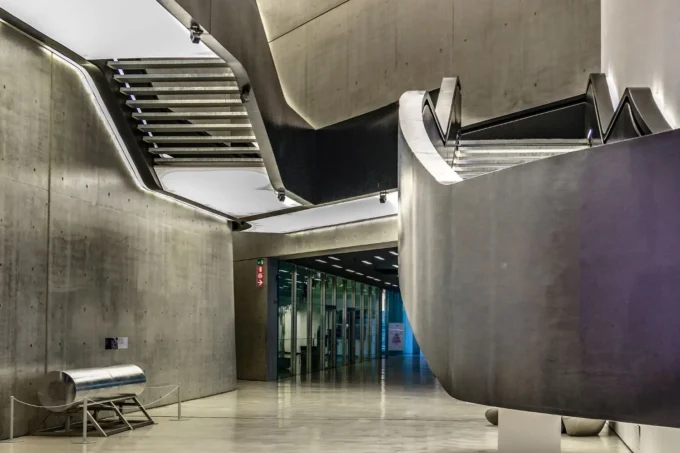
In the realm of parametric design, firms like Zaha Hadid Architects and BIG have embraced computational form finding to generate fluid, organic geometries that respond to site conditions, structural loads, and environmental data simultaneously. These projects illustrate how form and architecture can merge with data-driven optimization to produce buildings that are responsive, efficient, and visually striking.

Form Finding and Sustainable Design Expression
One of the most compelling arguments for form finding is its alignment with sustainable architecture. Structures shaped by forces inherently use less material than those designed with arbitrary geometries. A shell roof derived from form finding can span large distances using a fraction of the concrete or steel that a conventional flat slab would require. This material efficiency translates directly into lower embodied carbon, reduced construction waste, and lighter foundations.
Beyond material savings, form-found geometries often perform better thermally and acoustically. Curved surfaces can direct airflow for natural ventilation, distribute daylight more evenly, and reduce the need for secondary structural systems. When combined with environmental simulation tools, form finding becomes a holistic design strategy where structural logic, environmental performance, and design expression converge into a single, integrated process.
As the architecture and design community continues to confront the climate crisis, form finding offers a methodology grounded in efficiency and material intelligence. It reminds us that the most expressive architectural forms are often those that work hardest, where beauty is not added to structure, but emerges from it. For students and professionals exploring computational design careers, mastering form-finding techniques represents one of the most valuable intersections of engineering knowledge and creative ambition in contemporary practice.









Leave a comment