


Table of Contents Show
The House of the Seasons stands as an architectural experiment that fundamentally reimagines how buildings relate to climatic conditions. Located in Schwerte, Germany, this 235 m² cultural pavilion represents a bold exploration of sustainable design principles, deliberately abandoning the typical separation between interior environments and external weather patterns. Designed collaboratively by New Architekten and Jutta Albus Architektur, the structure completed in 2025 embodies the principles of Germany’s progressive “Building Type E” initiative, a movement gaining significant traction among architects and policymakers who advocate for reduced energy consumption through intelligent passive strategies rather than mechanical intervention.
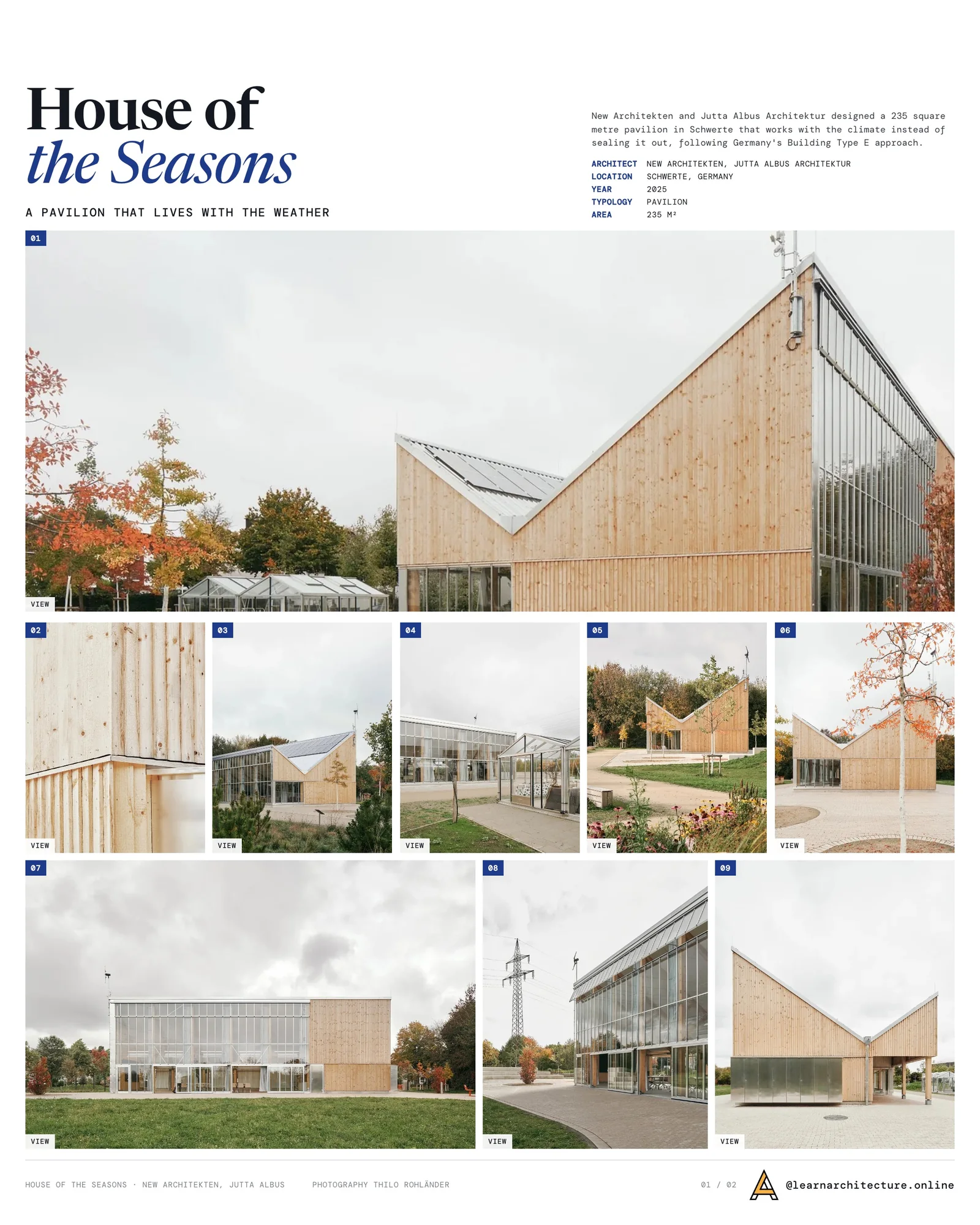
Rather than creating hermetically sealed spaces, this innovative pavilion design establishes an ongoing dialogue with its surrounding Climate Garden. The building responds organically to seasonal shifts, using spatial arrangement, careful orientation, substantial thermal mass, abundant natural light, and continuous ventilation to maintain equilibrium with nature throughout the entire calendar year. Photography by Thilo Rohländer captures this harmonious relationship between structure and landscape.

Passive Environmental Performance as Architectural Philosophy
At the conceptual heart of the House of the Seasons lies a commitment to passive environmental control mechanisms. The design team rejected conventional HVAC systems in favor of an architecture that breathes, adapts, and responds naturally to atmospheric changes. This approach aligns with emerging global trends in passive design architecture, where buildings function as environmental mediators rather than sealed containers.
A distinguishing characteristic involves the structurally independent flat roof slab, which remains physically detached from the enclosed volumes beneath. This architectural separation creates an uninterrupted pathway for air circulation, establishing continuous natural ventilation while simultaneously providing constant shade across the pavilion’s entire footprint. The resulting microclimate beneath the roof plane actively mitigates heat accumulation, substantially diminishes dependence on energy-intensive mechanical cooling systems, and elevates thermal comfort levels year-round without artificial intervention.
Opening locations were meticulously calculated to capture beneficial solar gain during winter months while strategically minimizing direct sun penetration throughout summer. This calibrated approach to energy-efficient design demonstrates how thoughtful solar orientation and precise fenestration can dramatically reduce a building’s operational energy requirements. The pavilion essentially functions as both protective shelter and responsive environmental machine, engineered to breathe synchronously with its natural surroundings rather than fighting against them.

Structural Rhythm and Spatial Transparency
The architectural vocabulary of the House of the Seasons emerges from rhythmic structural expression and deliberate formal restraint. Exposed slender steel columns establish a regular pattern that organizes the entire composition. These vertical elements, rendered visible rather than concealed, create a legible structural grid that visitors can immediately comprehend and appreciate. This honest expression of structural logic recalls principles established by the Bauhaus movement, where truth to materials and visible structure formed fundamental design tenets.
This structural rhythm operates simultaneously as technical solution and spatial organizer: a framework upon which the arrangement of internal volumes unfolds with precision. Beneath the generous roof plane, architecture achieves transparency and fluidity, eliminating hard boundaries between interior and exterior zones. The outcome becomes a pavilion that systematically blurs conventional thresholds, offering shaded transitional spaces and cultivating a persistent sense of permeability throughout the entire visitor experience.

Geometric Composition and Volumetric Strategy
Underneath the orthogonal structural grid of the roof, the building’s volumetric composition draws conceptual inspiration from Russian Suprematism, particularly that movement’s embrace of primary geometric forms and the visual tension generated through their juxtaposition. The placement of enclosed masses represents fragments of rectilinear geometry arranged abstractly yet intentionally. Their configuration avoids symmetry or predictable repetition, instead favoring a dynamic interplay of orientation, scale variation, and negative spatial volumes.
This compositional approach produces an ever-changing perception of the building depending on the observer’s viewpoint. As visitors move around the House of the Seasons, its form continuously transforms, revealing fresh alignments and spatial tensions with each new perspective. This quality converts the structure into an architectural composition perpetually in motion, a characteristic that resonates with contemporary discussions about shapes in architecture and their psychological impact on human perception.
According to Dezeen’s pavilion coverage, such experimental structures serve as testing grounds for architectural ideas that may eventually influence larger-scale projects.

Contextual Integration and Urban Sensitivity
Brooklin, predominantly a residential district, profoundly influenced the pavilion’s horizontal, low-profile implementation strategy. Eschewing bulky massing or vertical assertion, the design responds to its immediate urban context with calculated humility and restraint. The architectural presence reads as light, measured, and deliberately non-imposing, allowing the pavilion to merge seamlessly with the surrounding built fabric while simultaneously maintaining a distinct identity that signals its public function.
Visual fluidity supersedes monumentality throughout the design. The spatial strategy privileges openness over enclosure, resulting in a built form that communicates accessibility, discretion, and what might be termed “architectural silence”: a quiet confidence that doesn’t demand attention but rather invites exploration. This approach reflects broader European traditions of contextual architecture that prioritizes harmonious urban integration.

Material Palette and Tectonic Expression
The material selection reinforces the pavilion’s conceptual framework of transparency, lightness, and environmental responsiveness. Primary materials include wood and glass, both chosen for their specific performance characteristics and aesthetic qualities. Timber elements provide warmth and tactile richness while offering excellent thermal properties. Glass surfaces maximize visual connections between interior and exterior, dissolving traditional boundaries and inviting the surrounding landscape into the visitor experience.

The construction employed timber-frame construction techniques that showcase the building’s structural logic. Exposed beams and connections reveal how forces travel through the building, providing an educational dimension to the visitor experience. This tectonic honesty aligns with the project’s broader pedagogical mission as part of a Climate Garden, a place where architectural strategies for environmental responsibility become visible and understandable.

Cultural Significance and Design Initiative Context
The House of the Seasons must be understood within the context of Germany’s “Building Type E” initiative, which has garnered substantial support across political and professional spheres. This movement advocates for buildings that accept rather than resist climatic variations, questioning the post-war paradigm of total environmental control. As detailed in The Architectural Review, Type E buildings challenge conventional comfort standards and energy expenditures.
The design teams (Fritz Keuthen and Michael Weichler from New Architekten, working alongside Jutta Albus Architektur, with landscape architecture by Förder Landschaftsarchitekten) created more than a simple pavilion. They produced an applied architectural research project that tests theoretical propositions about sustainable architecture’s future direction. The pavilion serves educational purposes, demonstrating to visitors how passive strategies can maintain comfortable conditions without mechanical systems.
Similar experimental approaches can be observed in contemporary pavilions worldwide, as documented by Designboom’s pavilion architecture archive, where architects test innovative ideas at smaller scales before implementing them in permanent structures.

Performance Outcomes and Visitor Experience
The pavilion’s interior deliberately eschews separation from external climatic conditions, instead responding to them through carefully orchestrated passive strategies. During summer months, the detached roof slab and strategically positioned openings create natural convection currents that exhaust warm air while drawing cooler air through the structure. Winter operation reverses this strategy, capturing solar heat gain through precisely calculated glazing positions while thermal mass stores and gradually releases accumulated warmth.
This seasonal responsiveness creates a dynamic visitor experience that changes throughout the year, reinforcing awareness of temporal cycles and environmental conditions. Rather than providing homogeneous “comfort” regardless of season, the House of the Seasons offers appropriately modulated conditions that maintain connection with outdoor patterns. This approach recalls traditional pavilion architecture that worked with rather than against natural forces.
The building serves multiple programmatic functions within the Climate Garden complex, accommodating educational activities, exhibitions, and community gatherings. Its flexible interior organization, free from fixed partitions or predetermined spatial hierarchies, supports diverse uses throughout different seasons. This programmatic adaptability extends the building’s relevance and utility, ensuring it remains actively engaged with its community rather than serving as merely a symbolic gesture toward sustainability.
Photography: Thilo Rohländer


- Building Type E Germany
- climate pavilion
- climate-responsive architecture
- experimental architecture Schwerte
- House of the Seasons
- Jutta Albus Architektur
- Natural Ventilation Architecture
- New Architekten
- passive design architecture
- passive environmental strategies
- Schwerte cultural pavilion
- seasonal building Germany
- Sustainable pavilion design
- thermal mass design









Leave a comment