


Table of Contents Show
On the rugged coastline of Northern Norway, the Holmøy Production Facility redefines what industrial architecture can be. Designed by Snøhetta as part of a long-term collaboration with Holmøy Maritime, the project demonstrates how production environments can be transparent, humane, and environmentally responsible while still operating at an advanced technical level. Located in Liland outside Sortland, the facility is not only a place for seafood processing, but also a spatial statement about dignity in labor, openness in industry, and the role architecture can play in strengthening local identity.
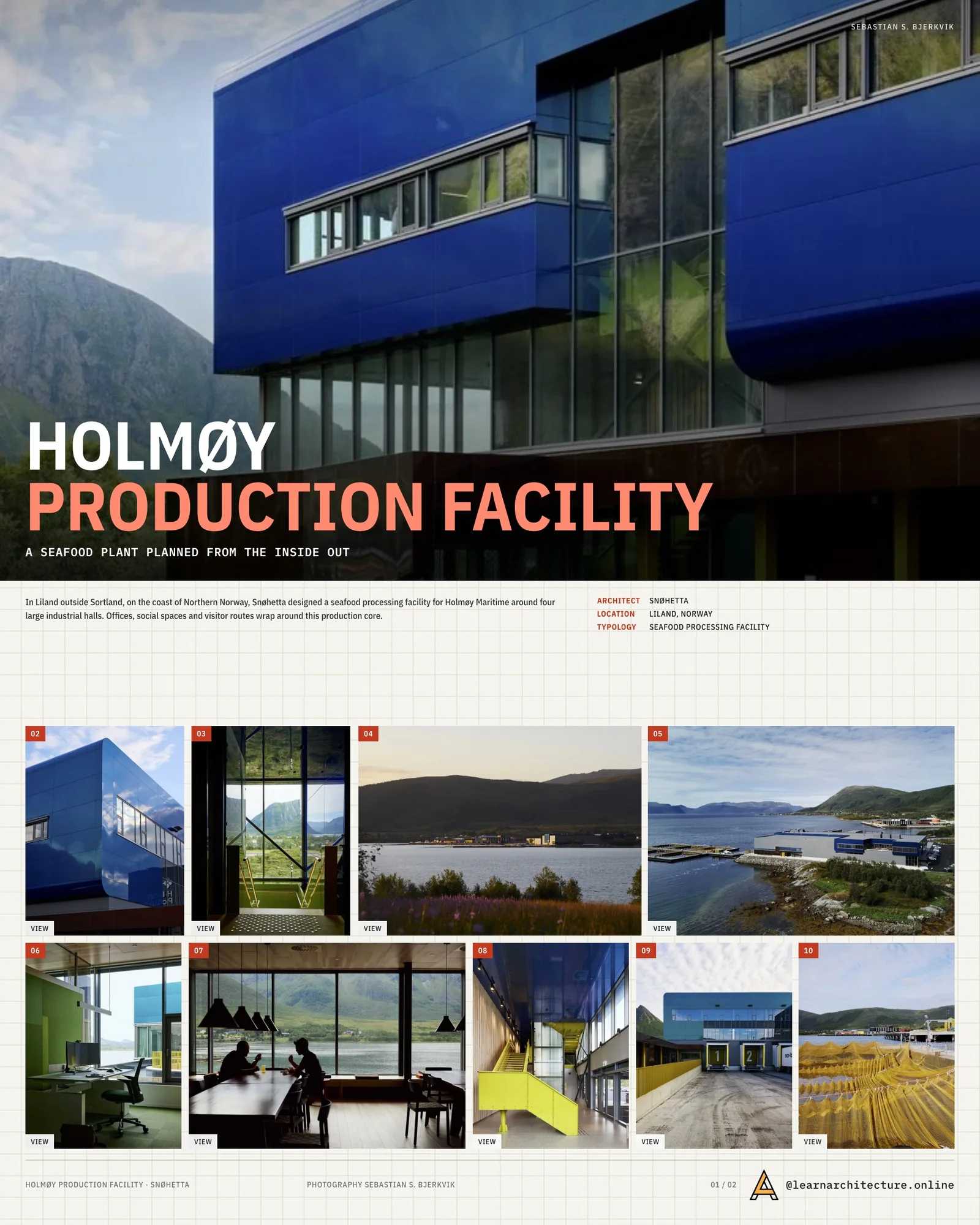
From the earliest design phases, the building was envisioned as more than an efficient container for machinery. Instead, it became an architectural ecosystem where production flow, employee well-being, visitor experience, sustainability strategies, and aesthetic expression are deeply interconnected. The result is a facility that balances performance with presence, offering both functionality and meaning.

Architecture Shaped by Production Logic
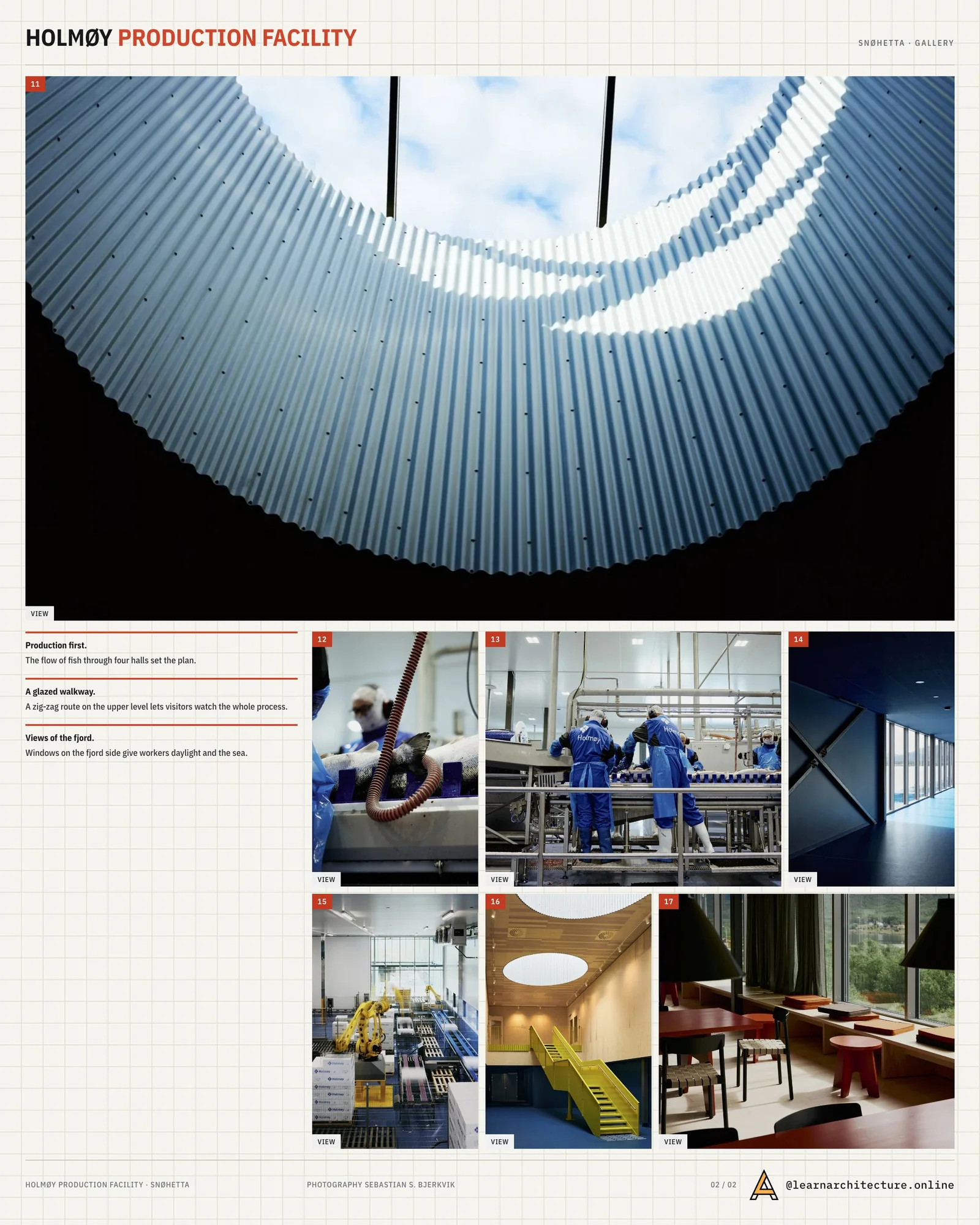
The spatial organization of the building was developed from the inside out. Rather than imposing form first, Snøhetta prioritized the technical and logistical requirements of fish processing, allowing the production sequence to guide architectural decisions. Four large industrial halls form the core of the facility, with the fish moving through them in a carefully choreographed flow from arrival to processing and distribution.
Once this internal logic was established, the surrounding architectural program, including administration, social spaces, circulation, and visitor functions, was formed around the production core. This approach ensured clarity of movement, intuitive orientation, and efficient operational performance. Wide corridors, legible pathways, and controlled access zones make the facility easy to navigate for workers, management, and visitors alike, transforming what could have been a closed industrial box into a legible spatial system.

Transparency as Spatial and Ethical Principle
One of the defining characteristics of the Holmøy Production Facility is its commitment to transparency, both literally and conceptually. Large glazed surfaces bring daylight deep into the production halls, challenging the conventional idea that industrial spaces must be sealed, artificial environments. Instead, natural light becomes an active architectural material, enhancing orientation, comfort, and atmosphere.
Transparency is also embedded in the visitor experience. A glazed, zig-zagging walkway on the upper level allows guests to observe the entire production process from above, turning the building into a pedagogical tool as well as a working facility. This gesture reinforces the idea of openness in food production, allowing the public to understand how seafood is processed while maintaining strict hygiene and operational standards.
Equally important is the connection to the surrounding landscape. On the side facing the fjord, windows frame views of the sea, offering workers visual relief and grounding the industrial process within its environmental origin. The building thus becomes a mediator between nature and production, rather than a separation between the two.

Prioritizing Well-Being in Industrial Workplaces
Snøhetta’s design places unusual emphasis on the daily experience of the people who work inside the facility. Employee areas, including offices, break rooms, dining spaces, and management zones, are designed as open, light-filled environments with generous glazing and high-quality materials. These spaces are not treated as secondary to production, but as equally essential components of the building’s identity.
Three large skylights introduce daylight deep into the structure, ensuring that even internal areas maintain a connection to natural rhythms. Break areas are deliberately designed to contrast with the technical intensity of the production halls. Warm lighting, timber surfaces, and carefully chosen colors create environments that feel restorative rather than institutional. This contrast supports mental well-being and reinforces the idea that architecture can actively improve working conditions, even in highly industrial contexts.

Sustainable Strategies Embedded in Infrastructure
Environmental responsibility is not applied superficially, but integrated directly into the building’s technical systems. The facility uses seawater for both heating and cooling, in combination with a heat exchanger and heat pump system. Filtered seawater is also used within the production process itself, requiring several kilometers of pipelines to be installed beneath the fjord outside the plant.
This strategy significantly reduces energy consumption while anchoring the building’s performance within its natural context. The architecture does not merely sit beside the landscape; it actively engages with it. By utilizing the thermal properties and abundance of seawater, the building becomes a responsive organism within its ecosystem rather than a resource-intensive intrusion.

Color, Identity, and Wayfinding
The visual identity of the Holmøy Production Facility is carefully calibrated through color and graphic design. Externally, the façade is composed around three main colors: a deep, reflective blue that mirrors sea and sky, complemented by ochre yellow and brown-orange tones derived from the shoreline landscape. The building thus changes character throughout the day as light and weather shift, reinforcing its connection to place.
Inside, color becomes a navigational and experiential tool. The production floors use blue hygiene surfaces, while the viewing corridors adopt darker tones to emphasize contrast with the brightly lit halls. Administrative areas are finished in green hues and natural pine, while the canteen and social spaces are marked by warmer red tones. These transitions help structure perception and movement while subtly influencing mood and behavior.
Wayfinding extends this identity further. Snøhetta Design developed a graphic language based on shells, fish bones, and maritime symbols, integrating signage seamlessly into the architectural experience. Typography inspired by industrial and nautical traditions reinforces the building’s cultural grounding without resorting to nostalgia.

Conclusion
The Holmøy Production Facility exemplifies how industrial architecture can transcend efficiency to become a meaningful civic and environmental contribution. Through a holistic design approach, Snøhetta delivers a building that supports advanced production while prioritizing transparency, sustainability, and human experience. It stands as a powerful reminder that even highly technical infrastructure can carry architectural dignity, offering not just a workplace, but a spatial identity rooted in community, landscape, and care.
Photography: Sebastian S. Bjerkvik


- Adaptive Industrial Spaces
- Architectural Identity
- Architectural Innovation
- Architectural Wayfinding
- Architecture and landscape
- Architecture and Wellbeing
- Architecture for Industry
- Architecture in Norway
- Contemporary Industrial Design
- Factory Design
- Holmøy Production Facility
- human-centered design
- Industrial Architecture
- Nordic Architecture
- Seawater Energy System
- Snøhetta architecture
- Sustainable Architecture
- Sustainable Building Design
- Transparent Architecture
- Workplace Architecture










Leave a comment