


Table of Contents Show
In the heart of Odense, Denmark’s third-largest city, a remarkable architectural achievement stands as testimony to the evolving relationship between modern construction and environmental responsibility. WoodHub, conceived by the renowned firm C.F. Møller, represents the nation’s most extensive timber-constructed office facility. This 36,500-square-meter development consolidates several Danish government institutions beneath a single roof, establishing an unprecedented standard for sustainable architecture at scale.
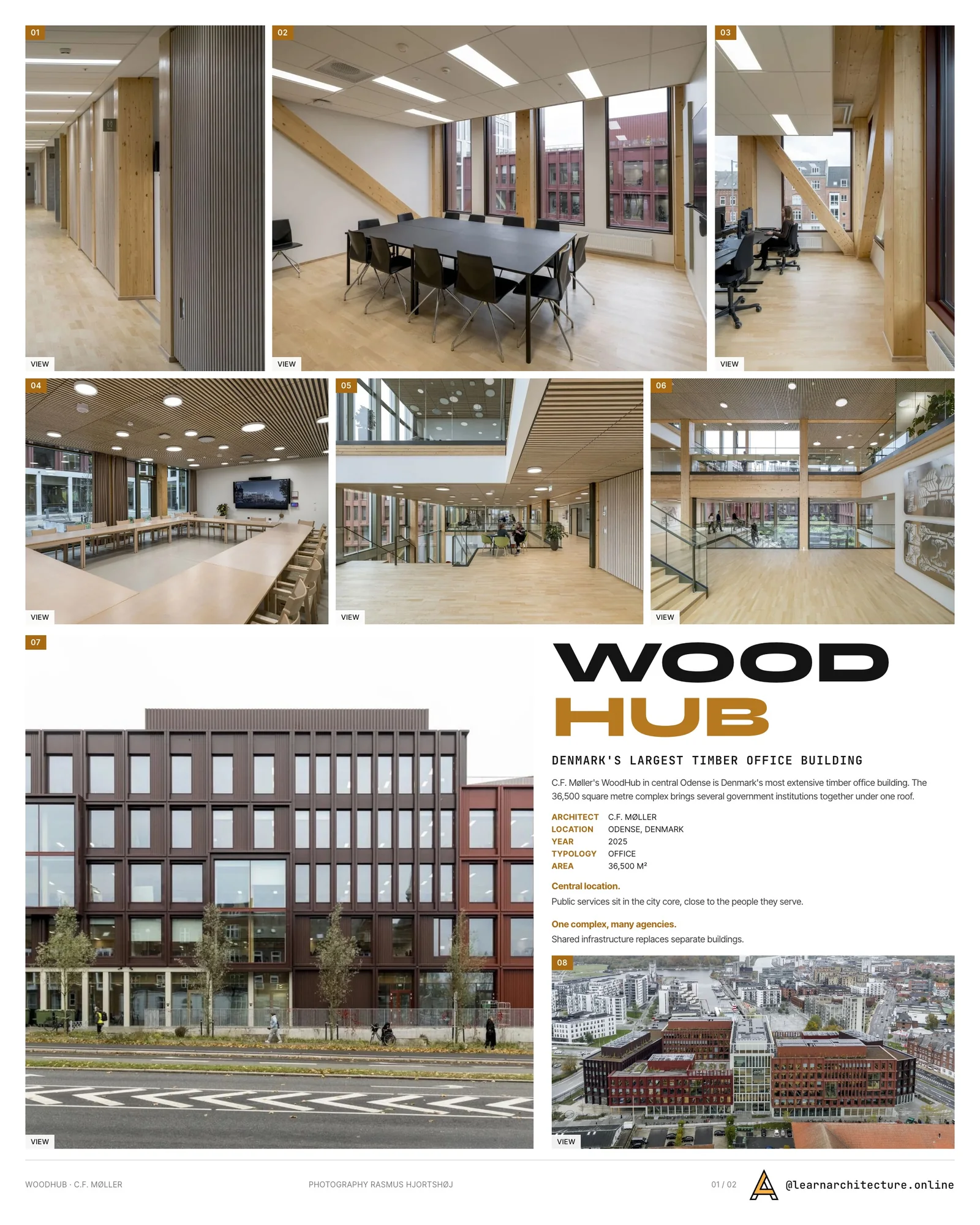
Completed in 2025, this visionary project transcends conventional building practices by demonstrating that substantial governmental operations can flourish within environmentally conscious frameworks. The structure’s significance extends beyond its physical dimensions; it embodies Denmark’s commitment to reducing carbon emissions in the built environment while maintaining functional excellence.

Architectural Vision and Urban Integration
The building’s strategic placement within Odense’s urban core reflects careful consideration of civic connectivity and accessibility. Rather than positioning this governmental hub at the periphery, architects deliberately chose a central location to strengthen relationships between public services and the communities they serve. This decision reinforces the notion that office buildings should actively contribute to urban vitality rather than exist as isolated administrative enclaves.
C.F. Møller’s design philosophy emphasizes spatial coherence and organizational efficiency. By housing multiple agencies within one integrated complex, WoodHub eliminates redundant infrastructure while fostering interdepartmental collaboration. The architectural language speaks to contemporary Scandinavian sensibilities: clean lines, rational organization, and an honest expression of structural elements combine to create a workspace that feels both professional and welcoming.

Timber as Structural Innovation
The decision to employ wood as the primary construction material represents more than aesthetic preference; it constitutes a fundamental rethinking of how large institutional buildings can be realized. Mass timber construction offers compelling environmental advantages over traditional concrete and steel methodologies. Trees sequester carbon dioxide during growth, effectively storing atmospheric carbon within the building’s structural elements. This biological carbon capture transforms the structure into a long-term carbon reservoir rather than a source of emissions.
According to research from ArchDaily’s timber architecture collection, wooden construction typically requires less energy-intensive manufacturing processes compared to conventional materials. The thermal properties of timber also contribute to superior indoor environmental quality, naturally regulating humidity and temperature fluctuations. These characteristics align perfectly with contemporary expectations for workplace wellness and comfort.
WoodHub’s structural system employs engineered timber products, including cross-laminated timber (CLT) and glue-laminated timber (glulam), materials that combine traditional wood’s warmth with modern performance capabilities. These prefabricated components allowed for rapid, precise assembly while minimizing construction waste. The visible wooden elements throughout the interior spaces create a tangible connection to natural materials, fostering a sense of calm and grounding rarely found in conventional office environments.

Spatial Organization and Functional Planning
The interior layout reflects extensive analysis of governmental workflow patterns and collaboration requirements. Contemporary workplace design prioritizes flexibility, recognizing that organizational needs evolve over time. WoodHub accommodates this reality through modular planning strategies that allow spaces to be reconfigured without major structural interventions.
Central circulation zones encourage spontaneous interaction between departments while clearly defined work areas provide focused environments for concentrated tasks. Meeting facilities range from intimate conference rooms to larger assembly spaces, supporting diverse communication modes. Natural light penetration was prioritized throughout the planning process, with strategic window placement ensuring that daylight reaches deep into the floor plates. This reduces artificial lighting demands while supporting occupant circadian rhythms, a critical factor in workplace health and productivity.
The building’s vertical organization follows intuitive logic, with public-facing services concentrated on lower levels and more specialized administrative functions positioned higher in the structure. This arrangement improves visitor navigation while allowing staff to move efficiently between departments.

Environmental Performance and Sustainability Metrics
Beyond its material selection, WoodHub incorporates numerous systems that minimize operational environmental impact. The building envelope achieves exceptional thermal performance through carefully detailed insulation strategies and high-performance glazing. This reduces heating and cooling energy consumption, a particularly significant consideration in Denmark’s variable climate, where winters demand substantial heating while summers increasingly require cooling capacity.
Mechanical systems employ heat recovery ventilation, capturing thermal energy from exhaust air to precondition incoming fresh air. This seemingly simple technology dramatically reduces the energy penalty associated with adequate ventilation rates. Renewable energy integration further diminishes the facility’s carbon footprint, though specific details about solar photovoltaic or geothermal installations were not extensively documented in available project information.
As explored in research on sustainable construction materials, the use of locally sourced timber reduces transportation-related emissions while supporting regional forestry economies. Denmark’s well-managed forest resources ensure that the timber extraction occurred within frameworks promoting long-term forest health and regeneration.

Construction Methodology and Technical Innovation
Realizing a timber structure of this magnitude required sophisticated engineering solutions and meticulous construction coordination. NCC served as the main contractor, bringing extensive experience in complex timber assemblies to the project. Dezeen’s coverage of mass timber projects highlights how such buildings demand different construction sequencing compared to traditional techniques, with prefabrication playing a crucial role in quality control and schedule adherence.

The modular nature of engineered timber components allowed much of the structural assembly to occur with minimal on-site fabrication. This approach reduces weather-related delays while improving construction site safety: timber elements are lighter than equivalent concrete or steel components, simplifying lifting operations and reducing equipment requirements. The precision inherent in factory fabrication also minimizes gaps and misalignments that can compromise thermal performance and aesthetic finish.
Fire safety considerations receive particular attention in timber construction, given wood’s combustibility. Modern engineered timber behaves predictably during fire events, with outer layers charring at controlled rates while maintaining structural capacity for extended periods. This phenomenon, combined with compartmentalization strategies and advanced detection systems, ensures that timber buildings can meet or exceed safety standards established for conventional construction types.

Interior Environment and Occupant Experience
The human experience within WoodHub distinguishes it from typical governmental office buildings. Exposed wooden surfaces create acoustic environments that feel noticeably different from hard-surfaced concrete or gypsum interiors. Wood naturally absorbs and diffuses sound waves, reducing the harshness of reflected noise while maintaining appropriate speech intelligibility, a crucial consideration in open-plan work environments.
Biophilic design principles, the integration of natural elements and patterns into built environments, are inherently embedded in timber construction. Research consistently demonstrates that visual and tactile connection with natural materials reduces stress responses and improves cognitive function. Occupants of WoodHub benefit from these effects throughout their daily routines, potentially translating to improved job satisfaction and reduced absenteeism.
The building’s lighting design complements the warm tones of exposed timber, with carefully positioned fixtures highlighting wood grain patterns while providing functional illumination. Common areas incorporate varied seating arrangements, acknowledging that modern work involves multiple postures and settings beyond the traditional desk configuration. These considerations reflect broader trends in commercial architecture toward environments that support wellbeing alongside productivity.

Cultural and Policy Context
WoodHub’s realization occurs within a supportive regulatory framework that encourages timber construction innovation. Danish building codes have evolved to accommodate mass timber while maintaining rigorous safety and performance standards. This policy environment, combined with public sector willingness to serve as early adopters of sustainable technologies, creates conditions where ambitious projects can transition from theoretical proposals to physical reality.
The project aligns with broader European Union objectives regarding carbon neutrality and circular economy principles. As outlined in resources from Designboom’s timber architecture archive, timber buildings offer compelling pathways toward decarbonizing the construction sector, which accounts for roughly 40% of global carbon emissions when considering both operational energy use and embodied carbon in materials.
By demonstrating that governmental operations can successfully occupy timber structures of this scale, WoodHub potentially influences future public building procurement decisions across Denmark and beyond. The project serves as a case study for other jurisdictions considering similar approaches to reducing their built environment carbon footprints.

Legacy and Future Implications
WoodHub’s completion marks a significant milestone in the evolution of sustainable institutional architecture. It challenges persistent misconceptions about timber’s suitability for large-scale construction while proving that environmental considerations need not compromise functional requirements or aesthetic quality. The building establishes benchmarks that subsequent projects will reference and potentially exceed as techniques and technologies continue advancing.
The structure’s influence extends beyond Denmark’s borders, contributing to global conversations about material selection and carbon accounting in construction. As climate imperatives intensify, the precedents established by projects like WoodHub become increasingly relevant to architectural practice worldwide. The successful integration of multiple government agencies within a timber framework demonstrates organizational flexibility, dispelling concerns that unconventional construction approaches might constrain institutional operations.
Photography by Rasmus Hjortshøj captures the building’s architectural character and material qualities, documenting how theoretical sustainability principles manifest in tangible architectural form. These images serve educational purposes beyond mere project documentation, helping broader audiences understand timber construction’s aesthetic and functional potential.
WoodHub represents more than an individual building achievement; it embodies a fundamental shift in how societies conceptualize the relationship between governmental infrastructure and environmental stewardship. As urban populations continue expanding and climate change demands urgent response, such projects illuminate pathways toward built environments that enhance rather than degrade ecological systems. The lessons embedded in WoodHub’s design, construction, and occupation will continue informing architectural practice for decades to come, establishing timber construction as a viable, desirable option for significant institutional buildings worldwide.
Photography: Rasmus Hjortshøj
- C.F. Møller architects
- contemporary timber architecture
- Danish green architecture
- eco-friendly office building
- government building Odense
- large-scale timber structure
- low-carbon building design
- mass timber construction
- mass timber office
- Scandinavian sustainable design
- Sustainable office design
- timber construction innovation
- timber office building Denmark
- wooden architecture Denmark
- WoodHub Odense












Leave a comment