


Table of Contents Show
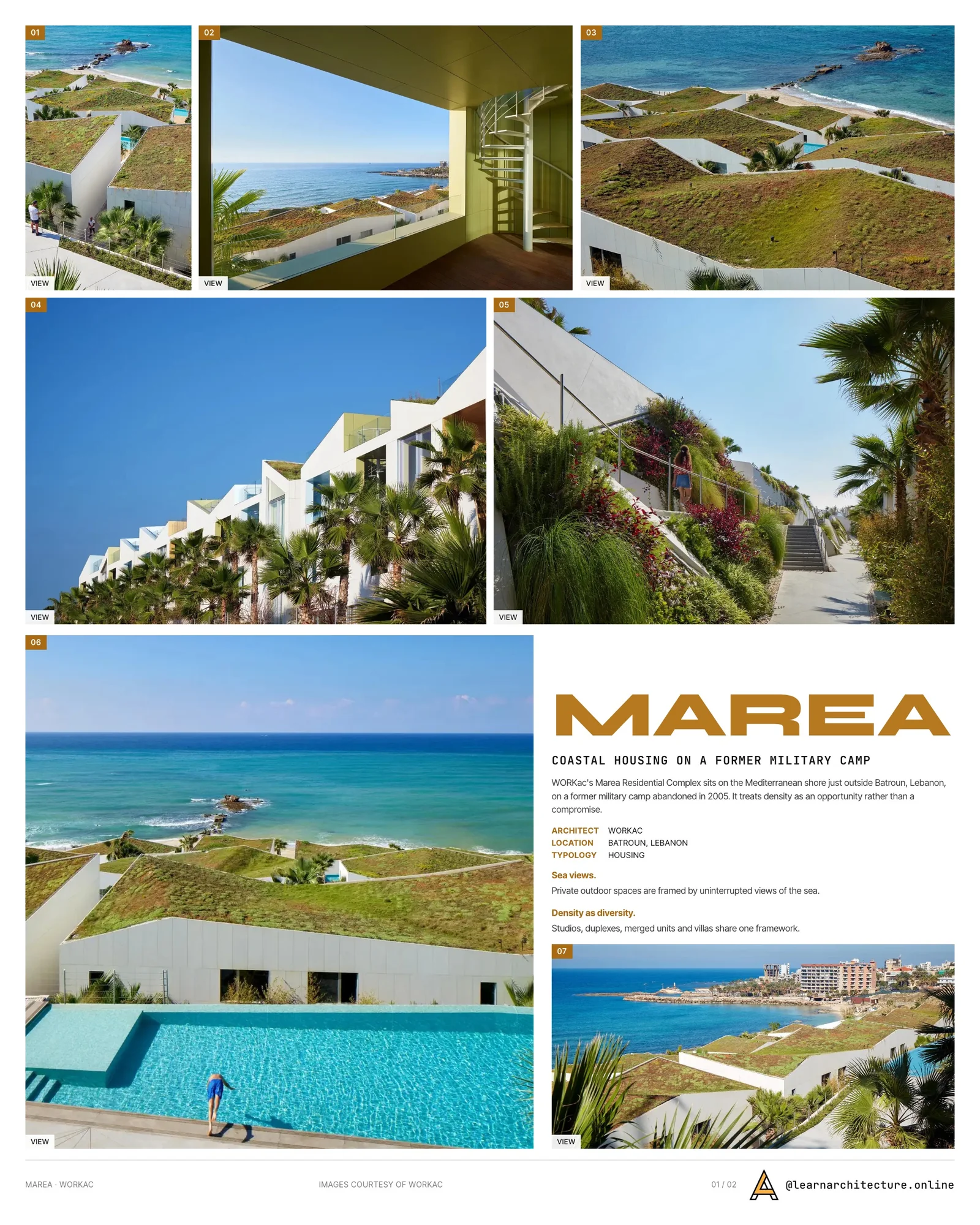
Located on the Mediterranean shoreline just outside Batroun, one of the world’s oldest continuously inhabited cities, Marea Residential Complex by WORKac proposes a radically different model for coastal housing in Lebanon. Rather than treating density as a compromise, the project embraces it as an architectural opportunity, one that balances collective infrastructure with generous private outdoor spaces, all framed by uninterrupted views of the sea. Marea is both a residential development and a landscape-driven urban experiment, reshaping how multi-family living can unfold along a steep coastal terrain.

A Site Marked by History, Memory, and Possibility
The land on which Marea stands carries a layered and complex history. During the Syrian occupation, the site functioned as a military camp, later abandoned in 2005. What remained was a fragmented landscape of concrete remnants, rusted steel, temporary tents, and debris. Yet even amid this destruction, one constant endured: the vast, open view of the Mediterranean. For Chafic Saab, the project’s owner, this persistent horizon symbolized optimism and the potential for renewal.
At the time of Saab’s first visit, Batroun itself was largely overlooked. Perceived as distant from Beirut and psychologically associated with former occupation zones, it was not considered a prime location for development. Traditionally, second homes favored mountain settings over the coast. Over the past fifteen years, however, driven in part by strong local leadership and growing tourism, Batroun has undergone a transformation. Marea emerged directly from this moment of transition, reflecting both personal commitment and urban foresight.

Density as Diversity: A New Housing Model for Lebanon
Unlike conventional developments that rely on repetition, Marea deliberately celebrates diversity in housing types. The project combines small studio apartments, duplexes, merged units, and standalone villas within a single cohesive framework. When WORKac was commissioned in 2017, the architects responded by leaning into density: not flattening it, but layering it both socially and spatially.
The goal was clear: ensure that every unit, regardless of size, enjoys the best possible relationship to the sea. Housing density here is not achieved through vertical stacking alone, but through terracing, orientation, and shared circulation systems that distribute views and light equitably across the site.

Architecture as a Reflection of Lebanese Landscape
Marea also seeks to capture what is most distinctive about Lebanon’s geography: the intense compression between mountain and sea. This idea becomes legible in the project’s architectural language. Triangulated green roofs cascade down the slope, forming an undulating topography that mirrors the natural descent toward the shoreline. Architecture and landscape are inseparable; one continuously folds into the other.
The complex comprises sixty residential units arranged across four terraced rows stepping toward the beach. Smaller studio units occupy the uppermost levels, while larger homes (townhouses, semi-detached dwellings, and individual houses) gradually appear closer to the water. This progression aligns scale with proximity to the sea while maintaining coherence across the whole development.

Shared Access and Collective Infrastructure
Despite the variation in unit sizes, access to the Mediterranean remains collectively shared. A network of ramps, stairs, and pedestrian streets connects all residences directly to the public beach, reinforcing a sense of equality and openness. The circulation system encourages movement through the site rather than around it, allowing daily life to unfold within shared spatial sequences.

Vehicular presence is intentionally minimized. Movement is limited primarily to golf carts, while parking, water cisterns, and storage spaces are concealed underground. This decision preserves the pedestrian character of the development and allows the surface of the site to be fully dedicated to landscape, social interaction, and outdoor living.

When Landscape Becomes Architecture
At Marea, landscape design does not act as a backdrop; it is a primary architectural element. Homes are embedded within a complex geometry of planted, triangulated folds that define streets, patios, terraces, and swimming pools. These folds generate shaded walkways, intimate outdoor rooms, and lush planting beds that soften the density and enhance privacy.
The result is an inhabited landscape where built form and vegetation operate as a single system. Roofs become gardens, circulation paths become social streets, and topography becomes both structure and spatial organizer.

Privacy Within a High-Density Community
While Marea promotes collectivity, it also carefully protects individual privacy. Every unit features a double-height living space that opens onto a private patio or roof deck. These outdoor spaces are paired with either private or shared swimming pools, offering residents control over how they engage with their surroundings.
Circulation occurs along narrow, cascading streets reminiscent of historic Mediterranean hill towns. As residents move through the site, moments of encounter naturally arise: neighbors greeting one another, casual conversations unfolding along the way. Community here is not imposed, but gently encouraged through spatial proximity and shared experience.

A Living Community and Urban Destination
Despite the profound economic, political, and social crises Lebanon has faced since 2020, Marea is now fully occupied. It has evolved into a thriving residential community, with a mix of full-time residents and seasonal inhabitants. The project stands as a working model of how dense residential development can foster belonging without sacrificing individuality.
The shared beachfront restaurant has further extended Marea’s role beyond housing. It has become a destination in its own right, attracting visitors from across the country and activating the site’s streets and pathways in the evenings. In this way, the complex gains an almost urban vitality, blurring the line between private development and public life.

A New Paradigm for Coastal Living
Marea Residential Complex demonstrates that density, when thoughtfully designed, can be both humane and enriching. By weaving architecture into landscape, prioritizing shared access to nature, and honoring individual difference, WORKac delivers a powerful example of contemporary Mediterranean living. It is a project rooted in optimism, one that transforms a site marked by conflict into a place defined by community, openness, and possibility.
Photography: Courtesy of WORKac


- Architecture and landscape融合
- Batroun housing project
- Coastal housing Lebanon
- Community-focused housing
- Contemporary Lebanese architecture
- Experimental housing typologies
- High-density housing design
- Landscape-integrated architecture
- Marea Residential Complex
- Mediterranean hill town design
- Mediterranean residential architecture
- Modern housing on slopes
- Multi-family housing project
- Private terraces architecture
- Residential masterplan design
- Seaside residential development
- Sustainable coastal design
- Terraced residential design
- Urban density architecture
- WORKac architects







Leave a comment