


Table of Contents Show
NEO by 1X is a humanoid robot designed specifically for home use, which 1X markets as the world’s first consumer-ready humanoid. Launched for pre-order in October 2025 by Palo Alto-based 1X Technologies, it combines a soft, tendon-driven body with onboard AI to handle household chores, answer questions, and learn new tasks over time. Early Access units are priced at $20,000, with U.S. deliveries beginning in 2026.

What Is NEO by 1X Technologies?
For decades, the idea of a robot doing the dishes or folding laundry lived squarely in science fiction. NEO by 1X Technologies is the most serious attempt yet to make that a reality. Founded in 2014 by Norwegian roboticist Bernt Børnich under the original name Halodi Robotics, 1X Technologies spent years building proprietary actuation systems before pivoting entirely to home humanoids in 2022.
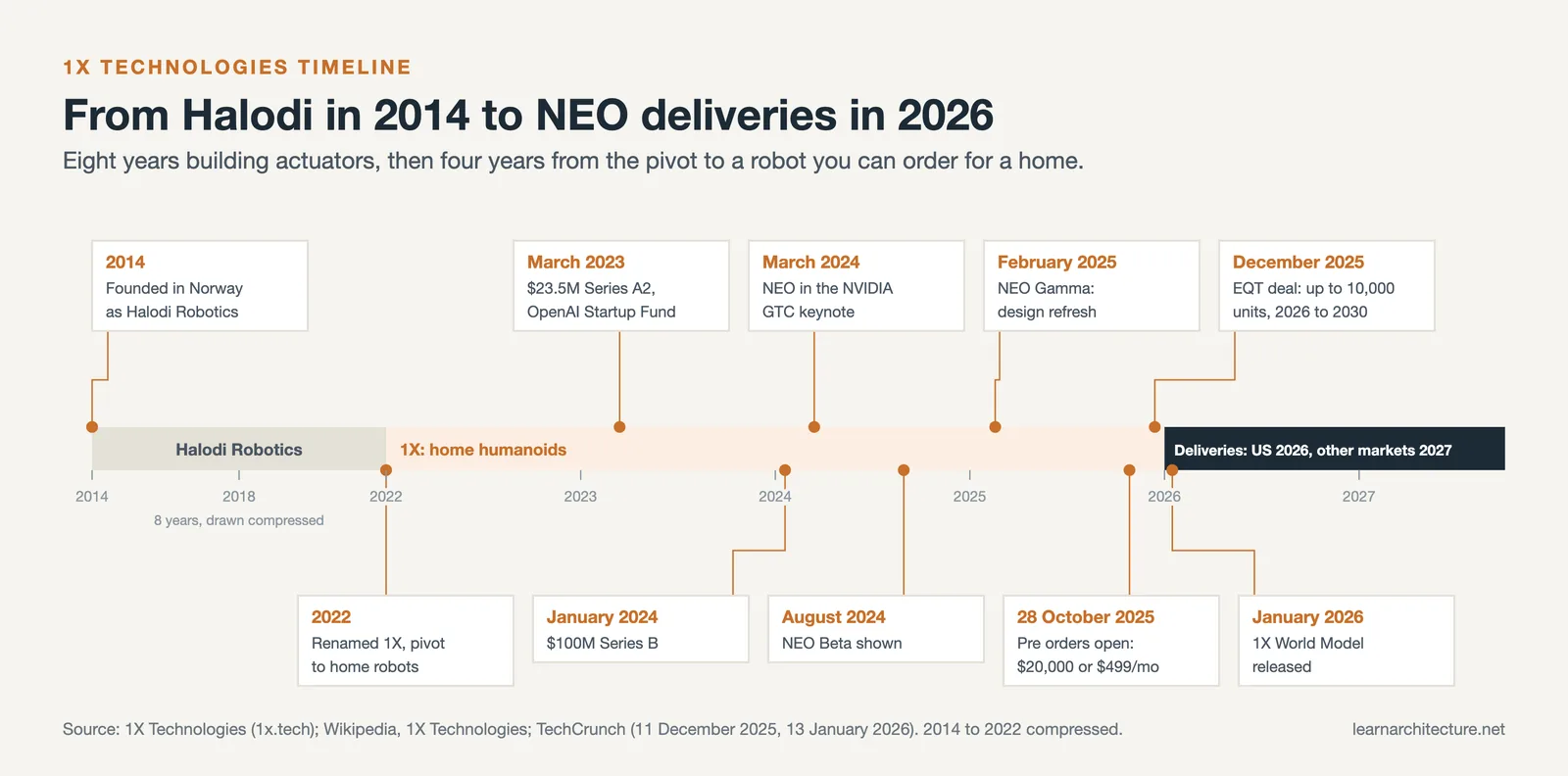
The result is NEO, a 5-foot-6, 66-pound bipedal robot that walks, talks, and handles basic household tasks. It debuted publicly as NEO Beta in August 2024, went through a design refresh as NEO Gamma in February 2025, and launched for consumer pre-order on October 28, 2025. The company positions it as the first humanoid robot that is genuinely purchasable and shippable to a private home, rather than a research prototype or industrial tool.
1X Technologies has raised substantial funding to support this ambition. A $23.5 million Series A2 round led by the OpenAI Startup Fund in 2023 was followed by a $100 million Series B in 2024. The company also maintains a strategic partnership with NVIDIA, whose CEO Jensen Huang featured NEO in the GTC 2024 keynote alongside robots from Boston Dynamics, Figure AI, and Agility Robotics.
💡 Pro Tip
If you are considering an Early Access pre-order, note that 1X requires a $200 refundable deposit to hold your place. The $20,000 purchase price locks in priority delivery in 2026, but for those who prefer to wait, a $499/month subscription option is planned for a later ship date. Evaluate both carefully since the subscription model commits you to long-term payments rather than outright ownership.

NEO Robot by 1X: Hardware Specs and Design
The hardware behind neo robot by 1x is engineered around one central idea: a robot safe enough to share a kitchen or living room with. Most humanoid robots are built with rigid, high-torque actuators that make them fast and strong but also capable of serious injury if something goes wrong. 1X took a different path.
NEO uses a patented Tendon Drive system, inspired by the human musculoskeletal system, that drives its joints through tendon-based transmissions rather than direct motor-to-joint coupling. The result is a robot that moves with a soft, compliant quality, absorbing impact and yielding when it encounters resistance. Its entire body is wrapped in a custom 3D lattice polymer structure, hiding pinch points and cushioning contact during interactions with people.
Key published specifications from 1X Technologies include:
| Specification | Value |
|---|---|
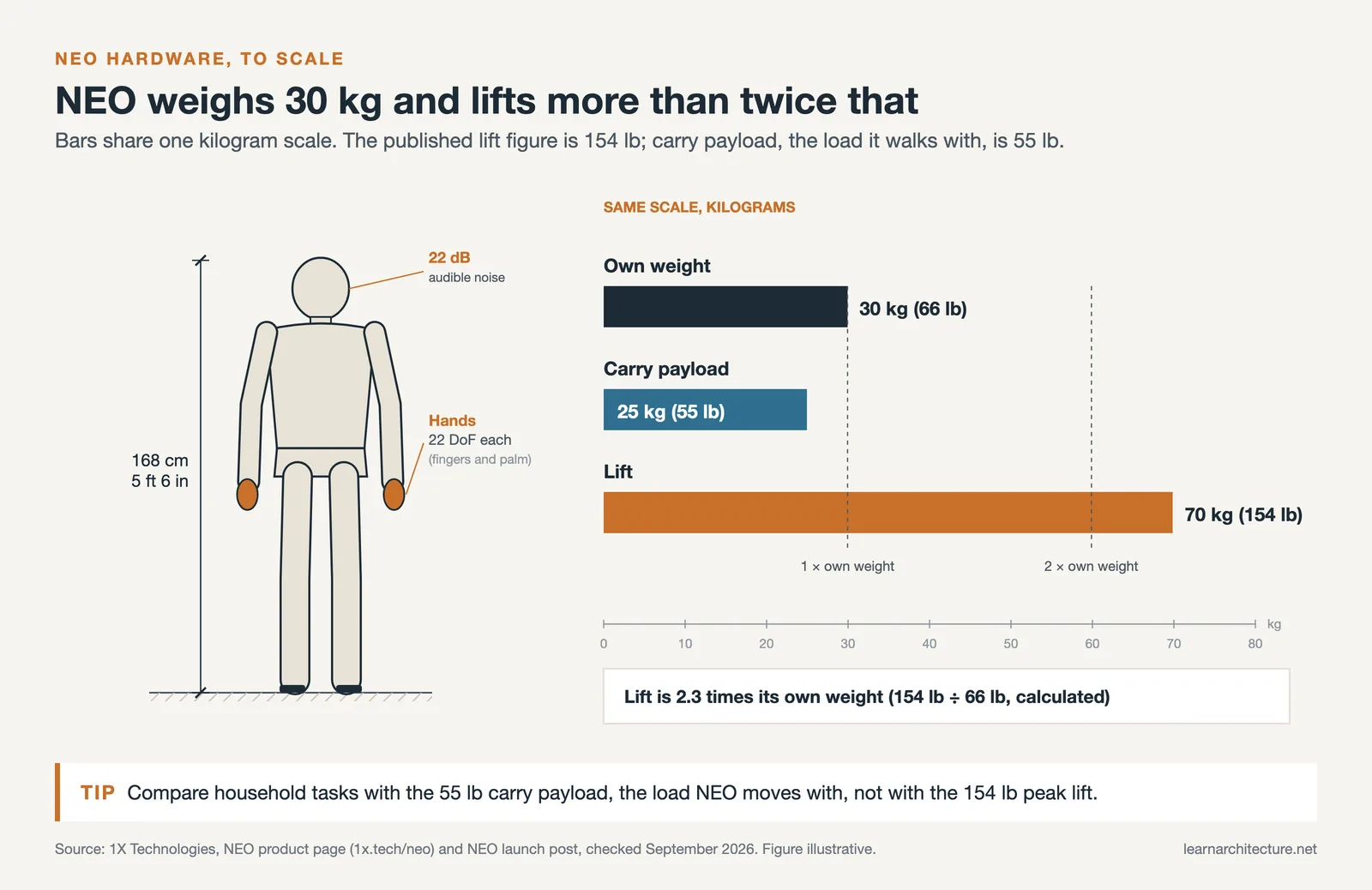
| Height | 5 ft 6 in (168 cm) |
| Weight | 66 lbs (29.94 kg) |
| Lift Capacity | Over 150 lbs (68 kg) |
| Carry Payload | 55 lbs (24.95 kg) |
| Hand Dexterity | 22 Degrees of Freedom (DoF) |
| Noise Level | 22 dB (quieter than a refrigerator) |
| Connectivity | WiFi, Bluetooth, 5G |
| Colors Available | Tan, Gray, Dark Brown |
The hands are one of the most technically ambitious aspects of the design. With 22 degrees of freedom per hand, 1X claims human-level dexterity, meaning NEO can manipulate objects with a range of grip types close to what a person uses when folding clothes or picking up a glass. Whether this translates cleanly to real home environments at scale is something only the 2026 deployment will confirm.
📌 Did You Know?
Despite weighing just 66 pounds, NEO by 1X can lift more than 150 pounds, meaning it can lift well over twice its own body weight. This strength-to-weight ratio, combined with its 22 dB noise level quieter than a typical refrigerator, is a deliberate engineering choice to make the robot both useful and unobtrusive in a home environment.

The 1X World Model: How NEO Thinks and Learns
Hardware alone does not make a useful home robot. The cognitive layer powering neo by 1x technologies is the 1X World Model, announced in January 2026 as the AI backbone of the robot’s intelligence. Unlike earlier approaches that relied heavily on human teleoperators to collect training data, the 1X World Model enables NEO to learn new tasks by watching video, including video from the internet, and applying that understanding to the physical world.
The system works through a combination of visual prompts and a physics-based model. A user gives NEO a text or voice instruction. The robot uses what it currently sees to visualize how a sequence of future actions might unfold, then an inverse dynamics model translates those planned actions into precise physical movements. This process is called the 1X World Model in internal documentation and was demonstrated handling tasks such as removing an air fryer basket, placing toast in a toaster, and retrieving objects for users from different rooms.
An AI researcher at 1X, Daniel Ho, explained the significance of this approach: with the 1X World Model, even prompts involving objects or situations NEO has never encountered before can be attempted through generalization from video data rather than explicit prior training. That said, early reports from TechCrunch clarify that current autonomous capability is still limited to relatively simple tasks. The framework is better understood as a foundation for growth than a fully autonomous system today.
NEO’s conversational AI runs on a built-in large language model (LLM), allowing voice-based interaction without a phone or screen intermediary. Features include Audio Intelligence (knows when it is being addressed), Visual Intelligence (uses what it sees to add context to conversations), and Memory (recalls past interactions to personalize responses over time). The companion app provides remote scheduling, task management, and even VR-based piloting from anywhere in the world.
🎓 Expert Insight
“After years of developing our World Model and making NEO’s design as close to human as possible, NEO can now learn from internet-scale video and apply that knowledge directly to the physical world.”
Bernt Børnich, Founder and CEO, 1X Technologies
This approach, learning from video rather than exclusively from robot-collected data, is a meaningful architectural departure. It means the speed of NEO’s improvement is partly tied to the quality of general video model research across the industry, not just to the hours 1X’s own robots spend in homes.
What Can NEO Actually Do at Home?
The 1X neo home robot ships with what the company calls foundational autonomy, meaning it handles a set of defined tasks on day one and expands its abilities through continued use and software updates. On launch, NEO can open doors for guests, retrieve items from around the home, turn off lights, and perform basic tidying.
The Chores feature lets owners create a task list, schedule a time, and return to a tidier space. More complex chores, like folding laundry or organizing shelves, are also listed as capabilities, though the degree of reliability in unstructured real-world environments is still being tested. For tasks NEO does not know, owners can schedule a “1X Expert,” a remote human operator from the company who guides the robot through the task while NEO learns it for future attempts.
This human-in-the-loop aspect is the most significant caveat of the current product. 1X CEO Bernt Børnich was transparent with the Wall Street Journal during hands-on testing: early 2026 buyers must accept that human teleoperators will sometimes control the robot while viewing the interior of their home. The company frames this as a necessary step to build the training data that leads to full autonomy, but for privacy-conscious buyers it is a real consideration. 1X addresses this with “no-go zones” that restrict the robot from entering certain areas and the option to blur faces in its visual field.
⚠️ Common Mistake to Avoid
Many early reports describe NEO as fully autonomous. It is not, at least not yet. During 2026 deliveries, NEO relies on a mix of onboard AI and remote human supervision for complex or unfamiliar tasks. Buying NEO expecting a fully self-directed robot today will lead to disappointment. Think of early 2026 ownership more like participating in a paid AI training program that also happens to do some of your chores, with autonomy increasing over the product’s lifetime.

How Much Does the 1X NEO Robot Cost?
The 1x neo robot price is structured around two models. The Early Access purchase option is $20,000 upfront with a $200 refundable deposit, which secures priority delivery in the United States in 2026. A subscription model at $499 per month with a six-month minimum commitment will be offered for a later ship date and positions NEO as a service rather than a one-time purchase.
For context, this places NEO far above other home automation devices. Premium robot vacuums from brands like Roborock retail around $1,400. Even high-end smart home systems rarely approach the five-figure range. The $20,000 price reflects both the genuine complexity of the hardware and the early-adopter premium common in nascent consumer robotics categories.
1X plans to begin U.S. deliveries in 2026 and expand to other markets starting in 2027. A separate commercial deal announced in December 2025 involves shipping up to 10,000 NEO units between 2026 and 2030 to portfolio companies of EQT, a large Swedish investment firm, for manufacturing and logistics applications. This dual-track strategy, consumer and enterprise, gives 1X a broader deployment surface to gather real-world data and refine the robot’s capabilities faster.
🔢 Quick Numbers
- $20,000: Early Access purchase price for NEO (1X Technologies, October 2025)
- $499/month: Subscription option, available at a later ship date (1X Technologies, October 2025)
- 10,000 units: NEO robots committed via 1X and EQT strategic partnership for 2026 to 2030 (TechCrunch, December 2025)
- $300 to $400 billion: Projected humanoid and service robot market size within a decade (Morgan Stanley, 2025)
NEO Humanoid Robot 2026: What the Architecture and Design Industries Should Know
The conversation around neo humanoid robot 2026 is not purely a consumer technology story. For architects, interior designers, and spatial planners, a robot that lives and moves inside a home at human scale raises questions that go well beyond gadgetry. How does a 5-foot-6 bipedal robot change the functional requirements of a kitchen? What does clear circulation space look like when the household includes a machine that walks, reaches overhead, and navigates doorways?
These are not hypothetical. NEO’s dimensions align closely with those of a compact adult, meaning standard residential ergonomics, counter heights, door clearances, and turning radii designed for people, will work for NEO too. But the presence of a robot that self-docks at a charging station, operates in defined zones, and communicates its state through visual indicators will likely influence how designers think about service areas, utility nooks, and sightlines in homes built or renovated to accommodate one.
The broader parallel to smart and adaptive architecture is worth noting. As home environments become more instrumented, with NEO adding a mobile AI agent to the mix alongside fixed sensors and automation systems, the home moves further toward a responsive, data-generating ecosystem. Architects working on smart home integration or accessible design for aging-in-place clients will find humanoid robots like NEO increasingly relevant to their spatial decisions.
The material and acoustic implications are also tangible. At 22 dB, NEO operates more quietly than most household appliances. Its soft polymer body reduces impact noise during normal movement. These are not incidental features; they reflect a deliberate design philosophy aimed at making a robot comfortable to live with, which is exactly the standard a well-designed room should meet.
For architects interested in how AI in architecture is reshaping both tools and the built environment itself, the NEO launch signals that AI-driven physical agents are moving from industry floors to living rooms faster than most anticipated. The design of space, and the tools architects use to envision it, are both being reshaped by the same technological wave.
💡 Pro Tip
When designing or renovating a home with future robot companions in mind, treat the charging station as a piece of furniture, not an afterthought. A dedicated nook with power access, visual separation from main living areas, and clear sightlines to key rooms (kitchen, hallway, entry) will make a robot like NEO far more functional without cluttering the space. The 22 dB operation level means acoustic separation is not a requirement, but visual integration matters for both usability and aesthetics.

NEO vs. Competing Humanoid Robots in 2026
1X is not the only company pursuing the home humanoid market, but it opened consumer pre-orders at a published $20,000 price with a specific 2026 delivery commitment. Understanding where neo by 1x sits relative to its competition helps frame what makes it genuinely distinct.
| Robot | Company | Primary Target | Consumer Pre-order |
|---|---|---|---|
| NEO | 1X Technologies | Home use | Open ($20,000) |
| Optimus | Tesla | Industrial, future home | Not yet available |
| Figure 02/03 | Figure AI | Manufacturing | Not available |
| Digit | Agility Robotics | Logistics/warehouse | Not available |
Tesla’s Optimus program remains the most closely watched competitor for eventual home deployment, but it has not announced a consumer purchase option as of early 2026. Figure AI’s robots are deployed at BMW manufacturing facilities and in logistics, with home testing still in earlier stages. 1X’s deliberate focus on the home, rather than trying to serve both industrial and domestic markets simultaneously, gives it a more coherent design philosophy and a head start in collecting the type of unstructured, home-environment data needed for genuine domestic autonomy.
The privacy trade-off distinguishes NEO from many competitors too. Human teleoperation during early deployment is not unique to 1X, but few companies have been as upfront about it. That transparency is either reassuring or disqualifying depending on your perspective, and it is a factor worth weighing carefully before pre-ordering.
Final Thoughts on the 1X NEO Consumer Robot
The neo by 1x launch in October 2025 marks a genuine inflection point in humanoid robotics, not because the robot is fully autonomous today, but because it exists as a real, purchasable product with published specifications, a defined price, and a committed delivery window. That transition from research to product is the hard part, and 1X has cleared it.
For architects and designers, NEO represents something worth watching closely: a spatially-aware, AI-powered agent that will live inside residential buildings and interact with the built environment at human scale. The implications for spatial design, accessibility, home automation integration, and even the aesthetics of domestic interiors are only beginning to take shape.
For prospective buyers, the honest framing is this: early 2026 ownership is an investment in a platform that will grow, not a purchase of a finished product. The $20,000 price, the human supervision requirement, and the limited initial task set are all real limitations. But the hardware quality, the AI architecture behind the 1X World Model, and the company’s OpenAI-backed funding base suggest the foundation is solid enough to build something genuinely transformative on.
✅ Key Takeaways
- NEO by 1X Technologies launched for pre-order in October 2025 at $20,000, with U.S. deliveries beginning in 2026; 1X markets it as the first consumer-ready humanoid robot.
- The 1X World Model AI allows NEO to learn new tasks from video data, enabling it to attempt unfamiliar actions even without explicit prior training, though full autonomy is still developing.
- Early 2026 units use a mix of onboard AI and remote human supervision for complex tasks; buyers should understand this transparency before pre-ordering.
- For architects and designers, NEO signals that AI-powered physical agents at human scale will become a genuine consideration in residential spatial design, accessibility planning, and smart home integration.
- NEO’s soft tendon-driven body, 22 dB noise level, and human-matching dimensions reflect a deliberate philosophy of designing a robot that fits into a home rather than demanding the home adapt to it.
Price and availability information is based on 1X Technologies’ published pre-order details as of late 2025. Specifications and delivery timelines may change. Verify current details at 1x.tech/neo before purchasing.













Leave a comment