


Table of Contents Show
Architect portfolio websites in 2026 are no longer optional. They are the first impression most clients, hiring managers, and academic reviewers form before any conversation happens. A strong site combines a curated selection of projects, clean navigation, fast mobile performance, and a clear point of view that separates one practice from the next.

Why Architect Portfolio Websites Matter More Than Ever
A static PDF still has its place for applications and interview rooms, but a public site does something a PDF cannot: it can be found, shared, and updated without re-sending files. Searchable architect portfolios shape hiring shortlists, client briefs, and even press inquiries. For many small and mid-sized practices, the website is now the first thing a prospective client reviews before making contact.
This shift means the architect portfolio website is doing two jobs at once. It functions as a marketing surface and as professional credibility. Visitors expect it to load in under three seconds, work on a phone, and tell them within ten seconds what kind of work the practice does best.
💡 Pro Tip
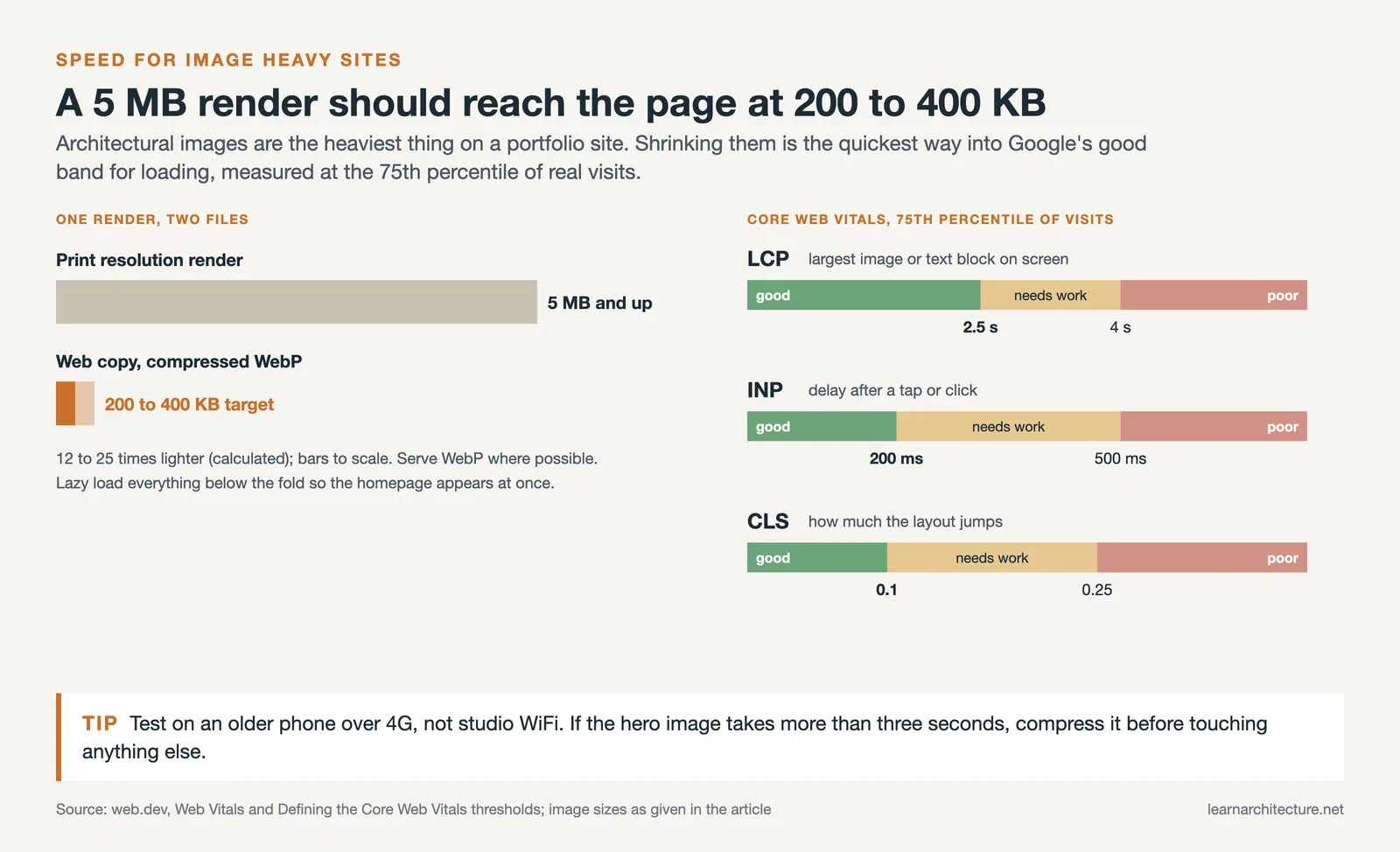
When auditing your own architect portfolio website, open it on a 4-year-old phone over a 4G connection, not your studio Wi-Fi. If hero images take more than three seconds to render, compress them before doing anything else. Slow image loading is the single most common reason visitors leave architect sites before reaching the project pages.
What Makes an Architect Portfolio Website Work in 2026
The best architect portfolio websites share a small set of structural decisions. They lead with one or two strong projects rather than a wall of thumbnails. They keep navigation flat, usually no more than five top-level items. They give each project its own page with a consistent template covering brief, site, drawings, and finished images. And they treat typography and white space with the same care as the buildings themselves.
For a closer look at how leading practices handle this, the examples in our review of the best architecture portfolios show how studios like EPT Design, Norm Architects, and Saunders Architecture use full-bleed imagery, layered photography, and tonal contrast to set mood before a single word is read.
1. Lead With Your Strongest Project, Not Your Newest
Hiring managers often form an opinion within the first two scrolls. The opening section of your site should feature the project that best represents the work you want more of, even if it is two years old. Newer work that is weaker dilutes the first impression. Our step-by-step portfolio guide covers this principle in more depth for both PDF and web formats.
2. Keep Navigation to Five Items or Fewer
A typical effective structure looks like this: Work, About, Process, Press, Contact. Anything beyond that begins to bury content. If you offer multiple service types, group them under Work as filterable categories rather than separate menu items.
3. Build a Consistent Project Page Template
Every project page should answer the same questions in the same order: what was the brief, where is the site, who was the client, what did you design, and what was the outcome. Reviewers comparing five sites in an afternoon appreciate predictability. The visual content can vary, but the information architecture should not.
🎓 Expert Insight
“Architecture is really about well-being. I think that people want to feel good in a space.” Zaha Hadid
The same idea applies to portfolio websites. Visitors should feel oriented and at ease, never lost. A site that takes more than two clicks to reach a project page is working against you, no matter how striking the imagery.
How to Choose the Right Platform for Your Portfolio Architect Website
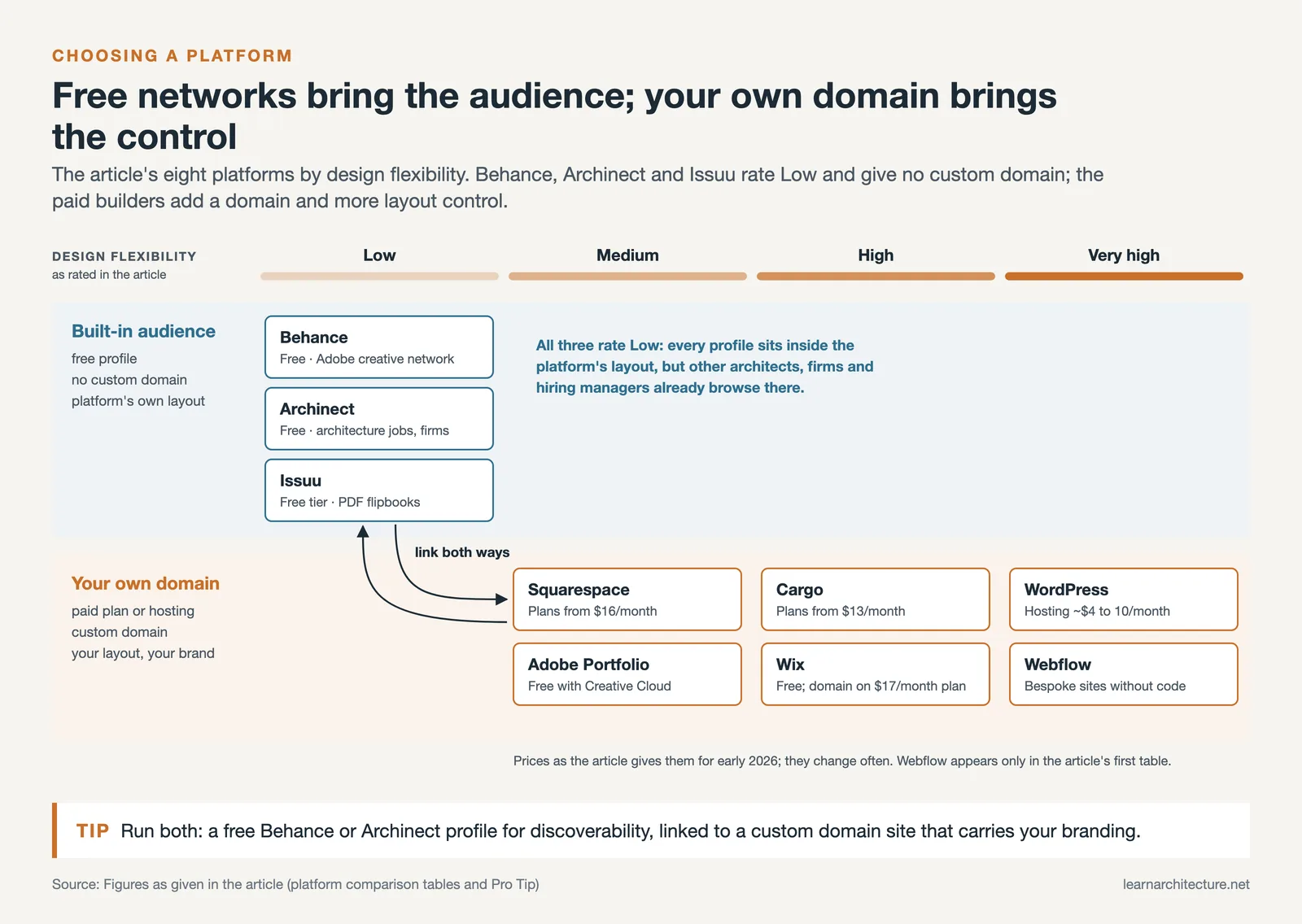
Platform choice usually comes down to three trade-offs: how much design control you need, how much you want to maintain, and where your audience already is. There is no single best option. The right answer depends on whether you are a sole practitioner, a small studio, or a student building a first online presence.
Comparison of Common Platforms for Architect Portfolio Websites
The table below summarises the main platforms used by working architects, based on user-facing features and typical pricing as of early 2026. Pricing tiers and features change frequently, so confirm directly with each provider before committing.
| Platform | Starting Price | Custom Domain | Best For | Design Control |
|---|---|---|---|---|
| Behance | Free | No | Students, early-career visibility | Low |
| Archinect | Free | No | Networking, job search | Low |
| Issuu | Free (limited) | No | PDF portfolio sharing | Low |
| Adobe Portfolio | Free with CC | Yes | Adobe CC subscribers | Medium |
| Squarespace | $16/month | Yes | Solo architects, small studios, image-led portfolios | Medium |
| Cargo | $13/month | Yes | Designers wanting layout freedom, editorial layouts | High |
| Wix | Free / $17/month | Paid plans only | Beginners, maximum flexibility | High |
| Webflow | $15/month (billed yearly) | Yes | Studios with bespoke design needs, without writing code | Very High |
| WordPress | About $4 to $10/month (hosting) | Yes | Larger firms combining portfolio with blog or press | Very High |
For most architects, the choice narrows quickly. If you want to be online by next week with minimal fuss, Squarespace or Cargo will get you there. If you want a site that grows with the practice and integrates with editorial content or a journal, WordPress or Webflow are stronger long-term bets. Behance remains a useful supplementary surface for visibility, particularly for emerging architects.
Architect Portfolio Examples That Set the Standard
Looking at real architect portfolio examples is the fastest way to calibrate your own work. The patterns repeat across scales. Boutique firms tend to use minimal navigation and large hero imagery. Larger practices balance project depth with team and press content. Solo architects often lean on a single editorial column structure that reads more like a journal than a corporate site.
Useful reference points include the personal sites of practices known for clear digital presentation, including BIG (big.dk), Snøhetta (snohetta.com), and Foster + Partners (fosterandpartners.com). Each handles project navigation differently, and comparing them side by side reveals how much identity comes from layout decisions rather than image quality alone.
🏗️ Real-World Example
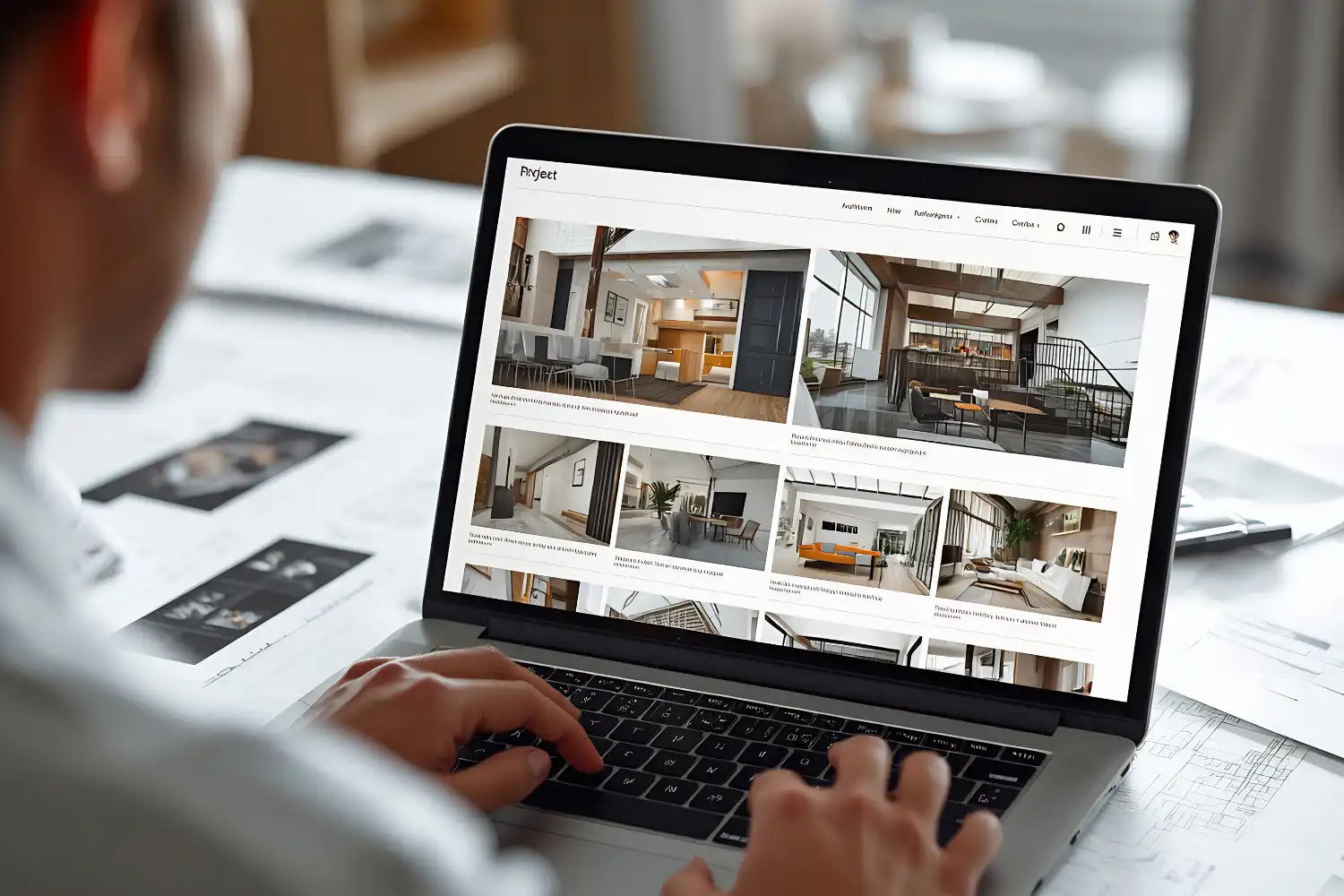
Norm Architects (Copenhagen): Their site uses layered photography and varied image dimensions to create depth across a single scrolling project page. Each project loads as a curated visual essay rather than a thumbnail grid, and the navigation contains only four top-level items. The result is a portfolio architect website that reads as confidently edited rather than densely packed.
Architect Job Portfolio vs Client Portfolio: What Is Different?
Architect portfolio websites built for job applications and client acquisition are not the same. The differences are subtle but consequential, and the most common mistake is treating one site as if it can do both jobs equally well. Our step-by-step architectural portfolio guide walks through how to tailor content for each audience.
An architect job portfolio is read by hiring managers and design directors. They want technical proficiency, drawing quality, evidence of process, and the ability to work across scales. Many will look specifically for construction details, sections, and BIM output.
A client-facing site is read by people who often cannot read a construction drawing. They want to see finished spaces, understand what kind of buildings you make, and feel confident you can guide them through the process. Renderings and photographs do most of the heavy lifting.
⚠️ Common Mistake to Avoid
Many architects merge these two audiences into one cluttered site. The result is a homepage that overwhelms clients with technical sheets and underwhelms hiring managers with marketing copy. The cleaner solution is to keep one public client-facing site and maintain a separate password-protected page or downloadable PDF for job applications, linked only from your CV.
How to Approach a Landscape Architect Portfolio Website
A landscape architect portfolio sits in a related but distinct category. The medium is harder to photograph at a single moment because the work changes with seasons, weather, and growth. The best landscape architect portfolio websites address this directly. They include time-based imagery (the same view across seasons), site plans with clear scale, and ecological data alongside aesthetic shots.
Drawing types also shift. Sections that show planting strategy, hydrology, and topography matter as much as renderings of paved surfaces. If your work is largely landscape-led, do not borrow the structure of an architectural firm site. Build one that shows the systems behind the visible surface. The American Society of Landscape Architects (asla.org) maintains a public awards archive that is a useful reference for how landscape work is presented at the highest level.

Mobile, Speed, and SEO: The Technical Foundation
A beautifully designed architect portfolio website fails if it loads slowly, breaks on a phone, or cannot be found. These three foundations are non-negotiable in 2026.
Mobile-First Layout
More than half of first-time visitors to architect portfolio websites arrive on a phone. Hero images that look stunning on a 27-inch monitor often crop awkwardly on a 6-inch screen. Test every project page on a phone before launch. Headlines, image captions, and contact details should all be legible without pinching.

Image Compression and Loading
Architectural imagery is heavy by nature. Renders and photographs at print resolution can easily exceed 5 MB each. For web use, aim for 200 to 400 KB per image after compression, served as WebP where possible. Lazy-load images below the fold so the homepage feels instant. Our portfolio tips guide covers file specifications in more detail for both web and PDF use.
Searchable Without Being Spammy
SEO for architects is mostly about being clear. Use your firm name in page titles, write project pages with descriptive headings (not “Project 1”), and include the city and project type in the page text. Avoid keyword stuffing. Search engines now reward clarity and depth far more than keyword density.
📐 Technical Note
Google’s Core Web Vitals are the practical performance benchmarks to design against. Aim for Largest Contentful Paint under 2.5 seconds, Interaction to Next Paint under 200 milliseconds, and Cumulative Layout Shift below 0.1. These thresholds are documented in Google’s web.dev guidance and directly affect both user experience and search ranking.

An Architect Portfolio Sample Structure That Works
If you are starting from a blank page, the structure below is a reliable baseline. It works for solo architects, small studios, and student portfolios moving online for the first time.
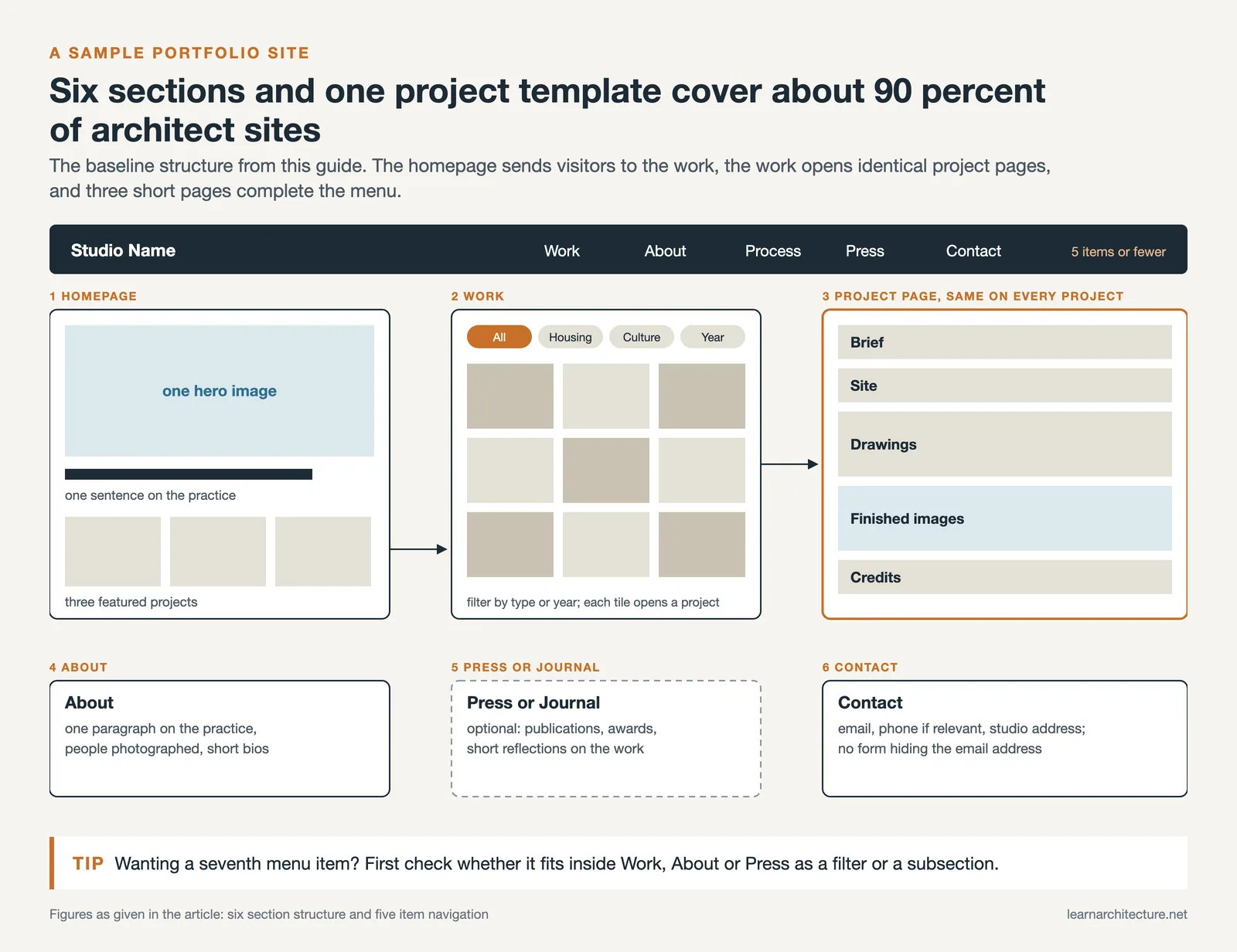
- Homepage: One hero image, one sentence positioning the practice, three featured projects.
- Work: A grid or list of projects, filterable by type or year. Each item links to a project page.
- Project pages: Brief, site, drawings, finished images, credits. Same structure across every project.
- About: One paragraph on the practice, photographs of the people behind it, a short biography for each principal.
- Press or Journal: Optional but valuable. Lists publications, awards, or short written reflections on the work.
- Contact: Email address, phone if relevant, studio address. Avoid contact forms that obscure the underlying email.
This six-section model handles around 90% of cases. If you find yourself wanting a seventh menu item, look first at whether it can live inside one of the existing six.
💡 Pro Tip
Treat your contact page as a real page, not a form. Include a direct email, a one-line note on what types of project you take on, and an indicative timeline for response. Architects who reply within 48 hours convert significantly more inquiries than those whose contact pages feel like a black box.
Updating and Maintaining Architect Portfolio Websites
The most overlooked part of architect portfolio websites is what happens after launch. A site that has not been touched in three years quietly damages credibility. Visitors notice old copyright dates in the footer, broken project links, and outdated team photos. Treat the site as a living document.
A practical rhythm is one substantive update per quarter. Add a new project, retire one weak project, refresh the homepage hero if the lead project has changed, and check that all links still work. Once a year, take a longer look at the structure. As the practice evolves, the site should evolve with it. Our ultimate architecture portfolio guide covers update strategy in more depth.
A Closer Look at Each Portfolio Platform

Behance
Behance is Adobe’s creative network, and it remains one of the most popular free architecture portfolio websites globally. You upload projects as “cases” with images, descriptions, and tags. Other designers can appreciate, comment on, and share your work, which gives new portfolios organic visibility. Behance integrates directly with Adobe Creative Cloud, so you can publish layouts from InDesign or Photoshop without exporting separately.
The downside is that your portfolio lives within Behance’s layout. You cannot customize fonts, navigation structure, or page templates. Every profile looks similar, which makes it harder to stand out visually. Still, for architecture students building their first student portfolio, Behance offers zero-cost exposure to a massive creative audience.
Archinect
Archinect is a platform built specifically for the architecture community. It combines portfolio hosting with job boards, firm directories, school listings, and editorial content. Creating a portfolio profile is free, and your work appears alongside other architects, which helps with networking and discoverability within the profession.
Archinect’s design options are limited compared to standalone website builders, but the built-in professional network makes it a strong choice for anyone actively job hunting. Firms regularly browse Archinect profiles when hiring, and the platform’s editorial team features standout portfolios in their content.
Issuu
Issuu converts PDF portfolios into flipbook-style digital publications. If you have already designed your portfolio in InDesign or Illustrator, Issuu lets you upload the PDF and share it as an interactive document with page-turn animations and zoom functionality. The free tier allows limited uploads, while paid plans add analytics and custom branding.
Issuu is not a traditional website builder. It works best as a supplement to another portfolio website or as a quick way to share a polished PDF online. Many architecture schools recommend Issuu for thesis presentations and graduate portfolios because the reading experience closely mirrors a printed book.
💡 Pro Tip
Pair a free Behance or Archinect profile with a custom domain portfolio on Squarespace or Cargo. The free profile brings discoverability through the platform’s built-in audience, while the custom site gives you full control over branding and layout. Link them to each other so visitors can move between the two.
Squarespace
Squarespace is one of the most widely used website builders for architecture portfolios. Its templates are clean and image-forward, which suits project-based layouts. The drag-and-drop editor requires no coding, and built-in SEO tools help your portfolio appear in search results. Plans start at $16 per month, and all include SSL, mobile optimization, and analytics.
Squarespace works well for both students and established firms. The platform handles image galleries, embedded videos, and contact forms without plugins. Its main limitation is flexibility: customization beyond the template structure requires CSS overrides, which can be tricky for non-developers.
Cargo
Cargo targets designers and artists specifically. Its templates lean toward editorial, grid-heavy layouts that suit architectural photography and diagrams. Cargo offers more typographic and layout control than Squarespace, but with a steeper learning curve. Pricing starts at $13 per month.
Adobe Portfolio
Adobe Portfolio is included free with any Adobe Creative Cloud subscription. If you already pay for Photoshop or the full Creative Cloud suite, you can build a portfolio website at no extra cost. It connects to Behance, so projects sync between both platforms automatically. Templates are minimal and clean, though customization options are more limited than Squarespace or Cargo.
Wix
Wix offers a free tier with Wix branding and paid plans starting at $17 per month for a custom domain. Its drag-and-drop editor is the most flexible among mainstream website builders, allowing pixel-level placement of elements. Wix includes strong SEO tools and an app market for added functionality. The free plan works for testing, but the ads and subdomain make it unsuitable for professional use.
WordPress
Self-hosted WordPress gives you the most control over your architecture portfolio website. You can choose from thousands of themes, add plugins for galleries and SEO, and host on your own domain. The trade-off is setup complexity: you need to purchase hosting separately, install WordPress, configure themes, and maintain updates. For architects comfortable with basic web management, WordPress is the most scalable long-term option.
For a deeper look at what projects to include once your site is live, the best architecture portfolio examples guide breaks down layout strategies and content selection from real portfolios.
📌 Did You Know?
Archinect was founded in 1997, making it one of the oldest architecture-specific online communities still active today. Its job board and portfolio features are used by firms in over 120 countries, and the platform has published over 100,000 editorial pieces on architecture culture and practice.
✅ Key Takeaways
- Architect portfolio websites work hardest in the first two scrolls, so lead with your strongest project rather than your newest.
- Keep navigation flat (five items or fewer) and use a consistent project page template across every entry.
- Choose your platform based on how much you want to maintain: Squarespace and Cargo for speed, WordPress and Webflow for long-term flexibility.
- Treat job-application portfolios and client-facing portfolios as separate audiences, even if they share the same content library.
- Mobile speed, image compression, and clear search-friendly copy are non-negotiable foundations in 2026.
- Update the site quarterly so it grows with the practice rather than freezing at the moment of launch.
Final Thoughts
An architect portfolio website is the most leveraged piece of marketing most practices ever build. It works for you while you sleep, while you draw, and while you sit in client meetings. The studios that treat it seriously, refresh it regularly, and resist the urge to over-design it consistently win more of the work they actually want. Build a site that is honest, fast, and edited, and the projects will do the rest.
Platform pricing and feature comparisons reflect publicly available information at the time of writing and may change. Always verify current details directly with each provider before subscribing.












Leave a comment