


Table of Contents Show
Architecture is evolving, and computational design is at the heart of this transformation. By blending creativity with advanced algorithms, we’re able to explore innovative solutions that were once unimaginable. This approach allows us to push boundaries, creating structures that are not only functional but also breathtakingly unique.
With computational tools, we can analyze complex data, optimize designs, and streamline workflows like never before. It’s not just about aesthetics; it’s about efficiency, sustainability, and adaptability. As architecture faces new challenges, from urbanization to climate change, computational design equips us with the tools to design smarter and build better.

What Is Computational Design In Architecture?
Computational design in architecture uses algorithms, parametric modeling, and data-driven processes to generate and optimize building designs. This approach leverages computational power to solve complex challenges and create efficient, adaptive, and innovative architectural solutions.
Designers rely on parametric tools, such as Grasshopper and Dynamo, to connect design variables dynamically, making adjustments seamless. For example, the geometry of a facade can adapt automatically to solar orientation, improving energy efficiency while maintaining aesthetic intent.
Data analysis plays a critical role in computational design, providing insights into environmental factors, material performance, and user behavior. For instance, simulations for wind flow and daylight help architects refine spatial layouts and structure orientations for optimal performance.
Algorithm-driven design enhances creativity by exploring thousands of iterations that would be impractical manually. This enables the discovery of unexpected forms and structures, such as the asymmetrical roof forms found in advanced stadium designs or the optimization of structural load distribution in skyscrapers.
Computational processes integrate seamlessly with Building Information Modeling (BIM), streamlining collaboration and communication between stakeholders. Automated workflows reduce redundancies, ensuring designs remain aligned with engineering, construction, and sustainability goals.
Key Technologies Behind Computational Design
Computational design relies on advanced technologies to merge creativity with precision. These technologies enhance efficiency, adaptability, and innovation in architectural design.

Parametric Design Tools
Parametric design tools dynamically connect variables in architectural models. Tools like Grasshopper for Rhino and Dynamo for Revit enable architects to create responsive, adaptable designs by adjusting parameters. For example, altering dimensions in a parametric model updates all dependent components instantly, ensuring cohesive designs. These tools support iterative design processes, helping architects optimize layouts and integrate environmental considerations seamlessly.
Algorithmic Modeling
Algorithmic modeling uses algorithms to generate complex and innovative architectural forms. Architects employ scripting environments, such as Python or C#, within design platforms to create patterns, structures, and responses that adapt to site-specific variables like wind or sunlight. This approach expands design exploration by automating repetitive tasks and testing numerous iterations rapidly. For instance, algorithms can simulate structural performance before physical construction begins, reducing errors and material use.
Artificial Intelligence And Machine Learning Applications
Artificial intelligence (AI) and machine learning (ML) enhance computational design by processing large datasets to identify patterns and optimize outcomes. AI-driven tools analyze environmental data, user behavior, and energy consumption to support sustainable design solutions. ML algorithms refine predictions in real time, enabling architects to simulate building performance or predict material durability. Autodesk’s BIM 360, for example, runs automated clash detection between coordinated models, while its Construction IQ module uses machine learning to predict and prioritize risks to cost, schedule, quality, and safety.
Parametric, Generative, Algorithmic: Telling Them Apart
These three terms are used interchangeably and mean different things. The distinction is worth holding onto, because it decides which tool solves which problem.
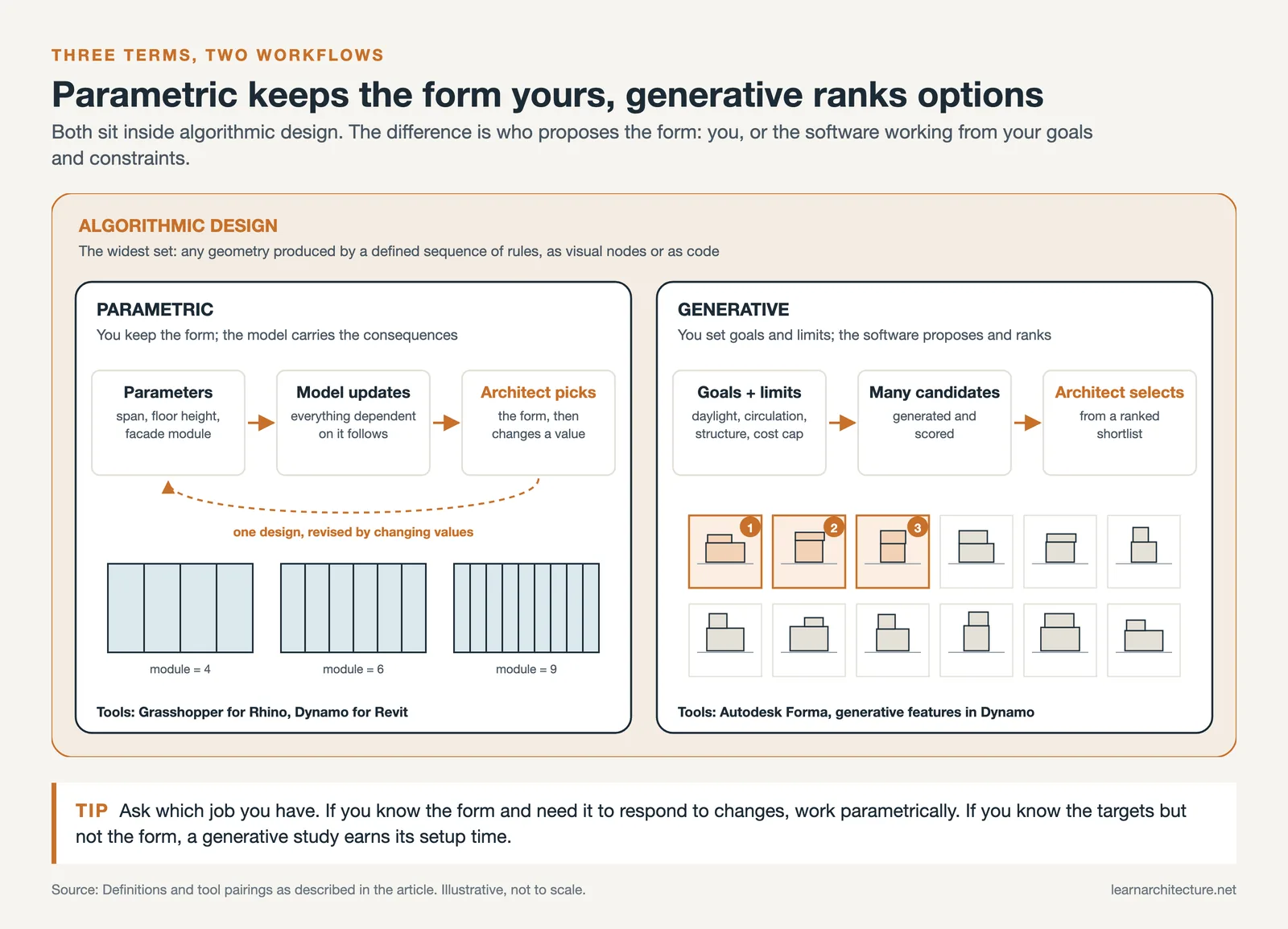
Parametric design builds a model from relationships rather than fixed coordinates. Change a parameter, a span, a floor height, a facade module, and everything dependent on it updates. You still decide the form; the model handles the consequences of changing your mind. This is what most architects mean when they say computational design, and Grasshopper for Rhino is where most of them do it.
Generative design inverts the relationship. Instead of drawing a form and testing it, you define goals and constraints, daylight targets, circulation efficiency, structural depth, cost ceiling, and the software produces many candidate solutions and ranks them. You are selecting rather than drawing. This is the approach behind tools such as Autodesk Forma and the generative capabilities in Dynamo.
Algorithmic design is the broadest of the three and describes any process where geometry is produced by a defined sequence of rules, whether written as visual nodes or as actual code. Parametric and generative design are both algorithmic. The term matters most when the rules are complex enough that the architect is genuinely programming rather than assembling components.
A note on vocabulary: computational architecture and computational design in architecture are used to mean the same field, though the second is more precise, since the first can also refer to the architecture of computing systems. Both describe the practice of designing with rules, parameters and code rather than with fixed geometry alone.
The Tools, and How to Actually Learn Them
The software landscape is narrower than it appears. Grasshopper, the visual programming environment bundled with Rhino, is the default entry point and remains the most widely used tool in architectural practice, with a plugin ecosystem covering structural analysis, environmental simulation and physics-based form finding. Dynamo plays the equivalent role inside Revit, which makes it the practical choice where the work has to end up in a BIM model. Python appears in both and becomes necessary once a definition outgrows what nodes can express readably.
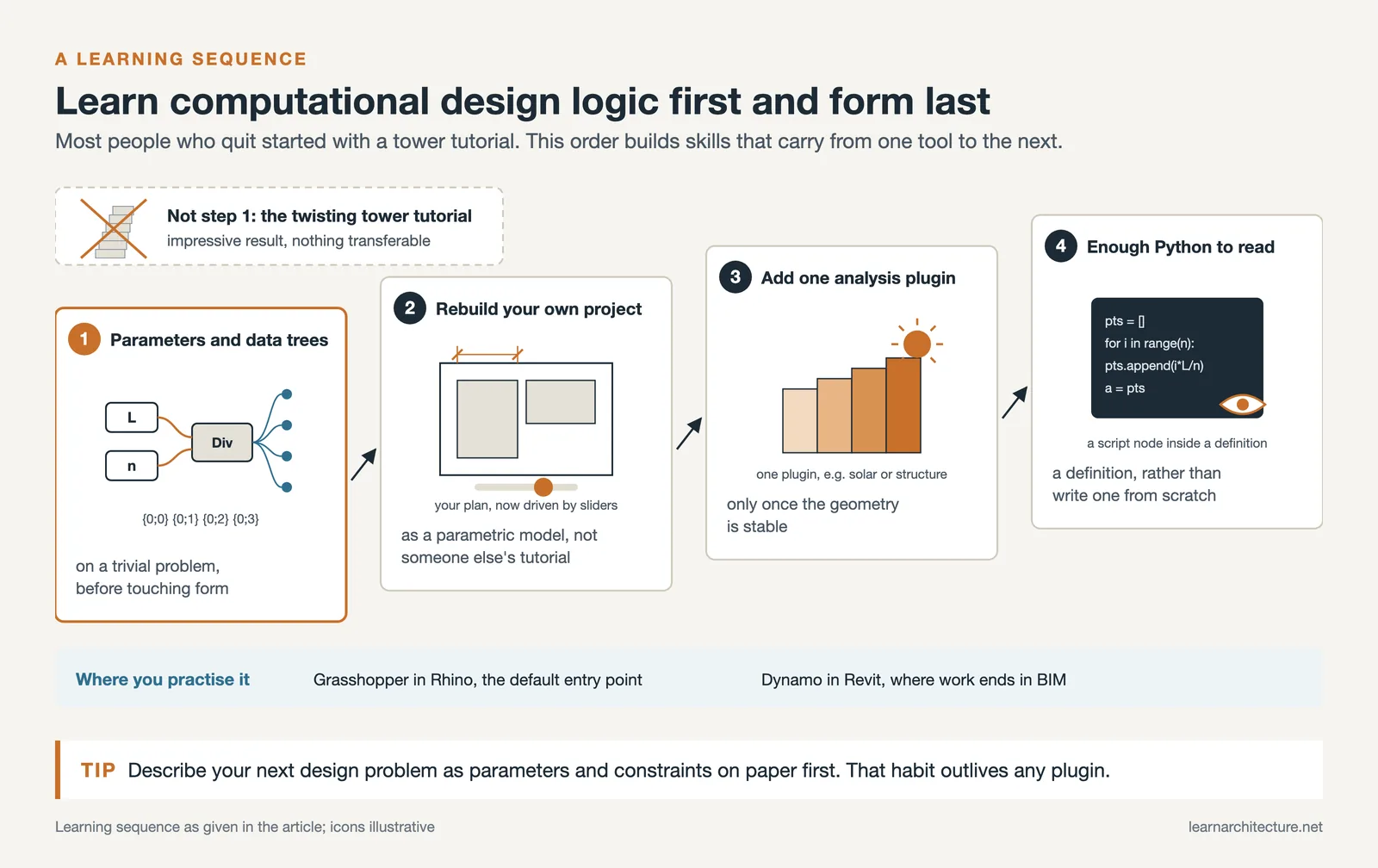
A realistic learning sequence
Most people who abandon computational design do so because they started with a tutorial that produced an impressive twisting tower and taught them nothing transferable. A more reliable sequence: learn the logic of parameters and data trees on a trivial problem before touching form; rebuild something from your own project as a parametric model rather than following someone else’s; add a single analysis plugin once the geometry is stable; and learn enough Python to read a definition rather than to write one from scratch.
The skill is more durable than the software. Practices adopt and abandon plugins constantly, but an architect who understands how to describe a design problem as parameters and constraints carries that between tools, and increasingly into AI-assisted design tools, which ask the same question in a different vocabulary.
Benefits Of Computational Design In Architecture
Computational design in architecture offers transformative advantages by leveraging algorithms, data, and parametric tools. These benefits enhance design processes while addressing contemporary architectural challenges.

Enhanced Efficiency And Precision
Computational design increases precision by automating complex calculations and tasks. For example, algorithmic modeling evaluates structural feasibility and optimizes spatial layouts, reducing errors and manual adjustments. Parametric tools like Grasshopper enable real-time updates across models, minimizing inefficiencies. By streamlining workflows, we achieve faster project completions with detailed accuracy.
Sustainable And Innovative Solutions
This approach integrates environmental data to ensure sustainable outcomes. Tools like Autodesk Insight assess factors such as energy performance and material usage to create resource-efficient designs. Algorithm-driven modeling allows experimentation with unconventional forms, fostering innovation in structural aesthetics. Using AI, we refine solutions to balance sustainability and creativity in every project.
Improved Collaboration Among Stakeholders
Computational design facilitates seamless collaboration by centralizing data within platforms like BIM. Real-time updates ensure architects, engineers, and contractors remain aligned throughout each project phase. Enhanced data visualization clarifies design intent for stakeholders, helping resolve conflicts faster. This integrated framework strengthens our communication, ensuring coherent and efficient teamwork.
Challenges And Limitations
While computational design revolutionizes architecture, it presents distinct challenges that impact its adoption and application. Addressing these limitations helps architects harness its full potential effectively.

Steep Learning Curve
Mastering computational design tools requires significant time and effort. Advanced software like Rhino, Grasshopper, and Dynamo demands expertise in algorithmic thinking and programming. This complexity often deters professionals accustomed to traditional methodologies. Providing training and integrating user-friendly interfaces can mitigate this barrier, but the adoption process remains gradual.
Integration With Traditional Practices
Bridging computational workflows with established architectural practices is difficult. Traditional methods rely on manual drafting and linear design processes, while computational tools emphasize iterative and dynamic approaches. Aligning these paradigms can cause friction during project execution, particularly when team members lack familiarity with hybrid workflows. Ensuring seamless collaboration between teams using both practices necessitates extensive planning and robust coordination tools.
Data Privacy And Security Concerns
Computational design relies heavily on data, exposing businesses to potential privacy and security threats. Sensitive client information, environmental data, and proprietary design algorithms stored on digital platforms are vulnerable to breaches and cyberattacks. Protecting intellectual property and adhering to data compliance standards require architects to invest in secure software and adopt stringent cybersecurity measures, which can increase project costs.
Case Studies Of Computational Design In Architecture
Computational design has reshaped architecture by enabling groundbreaking solutions and innovative forms. Below, we explore notable projects and emerging trends driven by computational methods.

Iconic Architectural Projects
- The Heydar Aliyev Center, Baku
Designed by Zaha Hadid Architects, this project employed parametric modeling to create a fluid, continuous form that seamlessly integrates the interior and exterior. Computational tools allowed precise shaping and manipulation of the curves, optimizing both aesthetics and structural performance.
- Conifera, Milan
Designed by Mamou-Mani for COS and shown at Palazzo Isimbardi during Salone del Mobile 2019, Conifera was assembled from 700 interlocking modular bio-bricks, 3D printed from a compostable blend of wood and sugar-based bioplastic. A parametric process linked the size of the modules to the palazzo’s architectural features, and the lattice geometry optimized material use while letting light pass through the structure.
- The Edge, Amsterdam
Widely recognized as one of the most sustainable buildings, The Edge used computational design to optimize energy efficiency. By integrating data-driven analysis, the architects positioned photovoltaic panels and ventilation systems to align with natural light and wind patterns, reducing energy consumption.
- Gardens by the Bay, Singapore
This iconic project used advanced algorithms to simulate environmental conditions and optimize the cooling and shading effects. The result is a sustainable microclimate within the domes, enhancing plant biodiversity while minimizing energy usage.
Emerging Trends And Innovations

- Generative Design
Architects increasingly employ generative design, a computational process that explores numerous design permutations based on input constraints. Tools like Autodesk Generative Design allow us to optimize layouts for energy efficiency and structural integrity while maintaining creative freedom.
- Responsive Architecture
Adaptive building designs, such as facades that respond to sunlight, rely heavily on computational tools. For example, the Al Bahar Towers in Abu Dhabi feature dynamic sunscreen patterns controlled by algorithms to improve energy performance.
- Robotics And 3D Printing
Robotic automation and 3D printing are transforming construction workflows. Innovations have emerged, such as large-scale 3D-printed structures and robot-assisted brick laying, reducing labor costs and construction timelines.
- AI-Driven Urban Planning
AI applications, integrated with computational design, support large-scale urban planning. For instance, combining machine learning with parametric tools streamlines site analysis, zoning, and traffic flow optimization, enabling smarter cities.
These examples showcase the broad potential of computational design to solve complex architectural challenges and usher in novel approaches to design and construction.
Future Prospects Of Computational Design
Computational design is poised to redefine architecture, with advancements driving its adoption across diverse applications. Emerging tools and technologies, such as AI-enhanced algorithms and generative design systems, pave the way for unprecedented innovations in building processes. These systems analyze vast quantities of data to create optimized solutions tailored to environmental, structural, and experiential needs.
Sustainability will play a central role in future computational advancements. Predictive modeling combined with real-time monitoring can enhance energy efficiency, reduce material waste, and promote circular construction practices. For example, AI-driven platforms may forecast long-term environmental impacts, enabling architects to select sustainability-friendly design pathways.
Integration of robotics and automation offers promising possibilities for streamlining construction techniques. 3D printing technologies and robotic assembly systems are advancing, capable of producing complex structures directly from parametric models. This reduces construction time and labor dependency while maintaining design precision.
Interdisciplinary collaboration is another significant focus. Advances in Building Information Modeling (BIM) and shared digital workflows enhance cooperation among architects, engineers, and constructors, bridging the gap between creativity and practicality. As technology evolves, we expect virtual and augmented reality tools to further enhance stakeholder engagement and decision-making.
Urban planning stands to benefit immensely from computational approaches. AI-powered simulations can optimize land use, transportation networks, and public spaces, addressing urban challenges like congestion and resource distribution. Additionally, adaptive design frameworks will help create smart cities that respond dynamically to real-time data and user demands.
Education and accessibility will influence how computational design shapes the future. Simplified interfaces and expanding training programs will democratize these tools, allowing more architects and firms to transition from traditional methods. Open-source platforms may further accelerate widespread implementation.
As computational design continues to integrate innovative technologies and methodologies, its application in solving architectural and environmental challenges will expand rapidly, fostering creativity, efficiency, and sustainability.

Frequently Asked Questions
What is computational architecture?
Computational architecture, more precisely called computational design in architecture, is the practice of generating and testing designs using rules, parameters and code rather than fixed geometry alone. Instead of drawing a single fixed outcome, the architect builds a model of relationships that can produce many outcomes and be tested against performance criteria. The term is occasionally confused with the architecture of computing systems, which is a different field entirely.
What is the difference between parametric and generative design?
In parametric design you decide the form and the model manages the consequences: change a parameter and everything dependent on it updates. In generative design you define goals and constraints instead, and the software produces and ranks many candidate solutions for you to choose between. Parametric design keeps authorship of the form with the architect; generative design moves it toward selection from options the machine proposed.
Do I need to learn coding for computational design?
Not to start. Grasshopper and Dynamo are visual programming environments where you connect components rather than write syntax, and a great deal of professional work never goes further. Python becomes worth learning at the point where a definition grows complex enough that reading it as nodes is harder than reading it as text, which usually arrives sooner than people expect but later than they fear.
Which software is used for computational design in architecture?
Grasshopper, bundled with Rhino, is the default and the most widely used in practice, with plugins covering structural analysis, environmental simulation and physics-based form finding. Dynamo does the same job inside Revit, which makes it the practical choice when the result has to become a BIM model. Autodesk Forma covers generative site and massing studies. Python underlies and extends all of them.
Is computational design only for complex or freeform buildings?
No, though that is where it is most visible. The everyday value is in repetitive coordinated work: facade panelisation, unit layouts across many floors, stair and ramp geometry, daylight testing across variants. A parametric model earns its cost on any project where a decision has to be revisited, which is nearly all of them, and the return has more to do with how often the design changes than with how curved it is.
Conclusion
Computational design in architecture represents a pivotal shift, merging technology with creativity to address modern design complexities. By leveraging advanced tools like parametric modeling, algorithmic systems, and AI-driven processes, we enable architects to design with greater precision, sustainability, and adaptability. These methods streamline workflows, optimize performance, and foster innovation across the architectural landscape.
Although challenges like steep learning curves, integration hurdles, and data security risks exist, continuous advancements in technology and education are minimizing their impact. Iconic projects such as the Heydar Aliyev Center and Gardens by the Bay demonstrate its transformative potential, while emerging trends like robotics and generative design hint at a promising future.
With its focus on efficiency, collaboration, and sustainability, computational design is redefining how we approach architecture, offering tools to meet global challenges like urbanization and climate change with smarter, more resilient solutions.
- advanced architectural modeling
- AI in Architecture
- AI-powered architectural design
- algorithmic architecture
- Architectural Technology
- architecture and machine learning
- automation in architecture
- BIM in architecture
- computational architecture
- computational design in architecture
- data-driven design
- digital design tools
- digital fabrication
- Future of Architecture
- generative design
- innovative design techniques
- modern building practices
- parametric design
- smart building design
- sustainable computational design











Leave a comment