


Table of Contents Show
In the sunlit countryside between Lecce and Vernole, where ancient olive groves stretch toward the Adriatic Sea, a forgotten agricultural structure has been granted a second life. Masseria Caronte, a historic farmhouse once dedicated to sheep rearing and textile production, now stands as a thoughtful example of adaptive reuse and historic preservation. Completed in 2025 by Margine, a studio led by architects Giulio Ciccarese and Valentina Pontieri, this 500-square-meter project demonstrates how contemporary intervention can honor the past while serving modern needs.
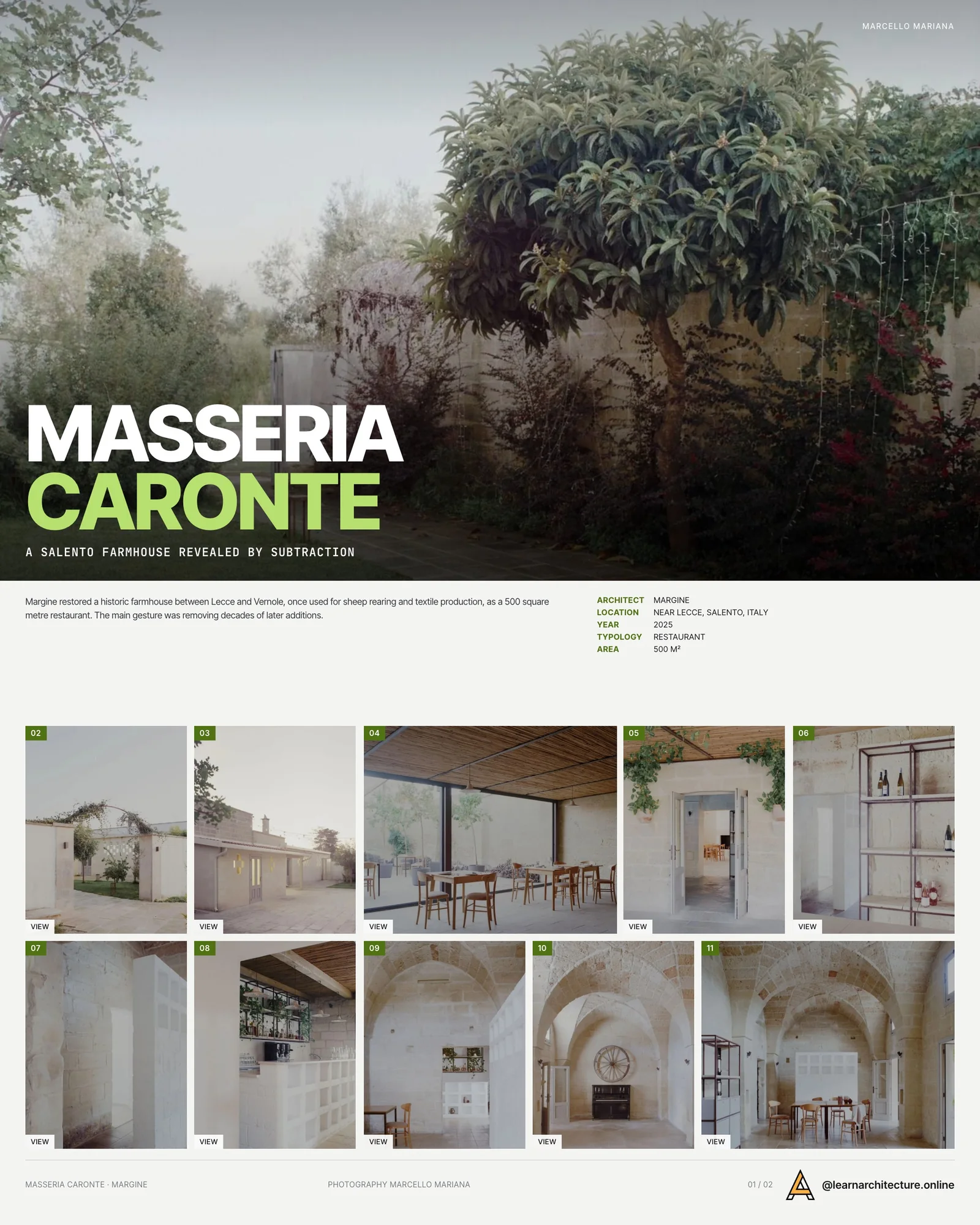
The journey from abandonment to renewal required careful archaeological work, stripping away accumulated modifications to expose the building’s original essence. What emerged was not merely a restaurant, but a meditation on memory, materiality, and the enduring value of rural craftsmanship in an increasingly urbanized world.

Excavating Architectural Memory Through Subtraction
Rather than imposing a new vision, Margine’s approach centered on revealing what already existed beneath layers of haphazard additions. Decades of piecemeal alterations had obscured the masseria’s authentic character, transforming it into a palimpsest of conflicting interventions. The architects’ primary gesture was one of removal: a deliberate act of subtraction that allowed the building’s inherent dignity to resurface.
This methodology aligns with contemporary thinking about architectural restoration, where preservation is understood not as freezing time but as facilitating dialogue between past and present. By eliminating superfluous structures, the team created spatial clarity while maintaining the masseria’s fundamental organization: thick load-bearing walls, barrel-vaulted ceilings, and the characteristic rhythm of rural Salento construction.
The decision to work through reduction rather than addition reflects a growing awareness within architecture that sustainability often means working with what exists. The project demonstrates how sensitive intervention can be more powerful than dramatic transformation, allowing history to remain legible without becoming nostalgic pastiche.

Material Authenticity and Craft Traditions
Stone dominates the material palette, as it must in any honest engagement with Salento’s building traditions. The region’s golden limestone, locally known as pietra leccese, appears throughout, its warm hue shifting subtly as light moves across surfaces throughout the day. These walls, some exceeding one meter in thickness, provide not only structural integrity but also thermal mass, passively moderating interior temperatures in the Mediterranean climate.
Margine collaborated extensively with local artisans, recognizing that authentic restoration requires more than correct materials; it demands traditional techniques executed by skilled hands. Falegnameria Maggio supplied custom woodwork, including doors and furniture that respect vernacular proportions while meeting contemporary functional requirements. Metra and Savoia contributed specialized elements, ensuring that modern insertions would harmonize with historic fabric.
This commitment to material authenticity extends beyond aesthetics. By engaging regional craftspeople and sourcing locally, the project strengthens economic networks and preserves endangered skills. In an era of global standardization, such localized production represents both cultural resistance and practical sustainability.

Spatial Organization and Functional Adaptation
The transformation from agricultural facility to dining establishment required careful reconsideration of interior organization. Original vaulted spaces, once used for wool processing and animal housing, now accommodate dining areas, kitchen facilities, and service zones. The architects preserved the building’s sequential spatial logic while introducing necessary infrastructure.
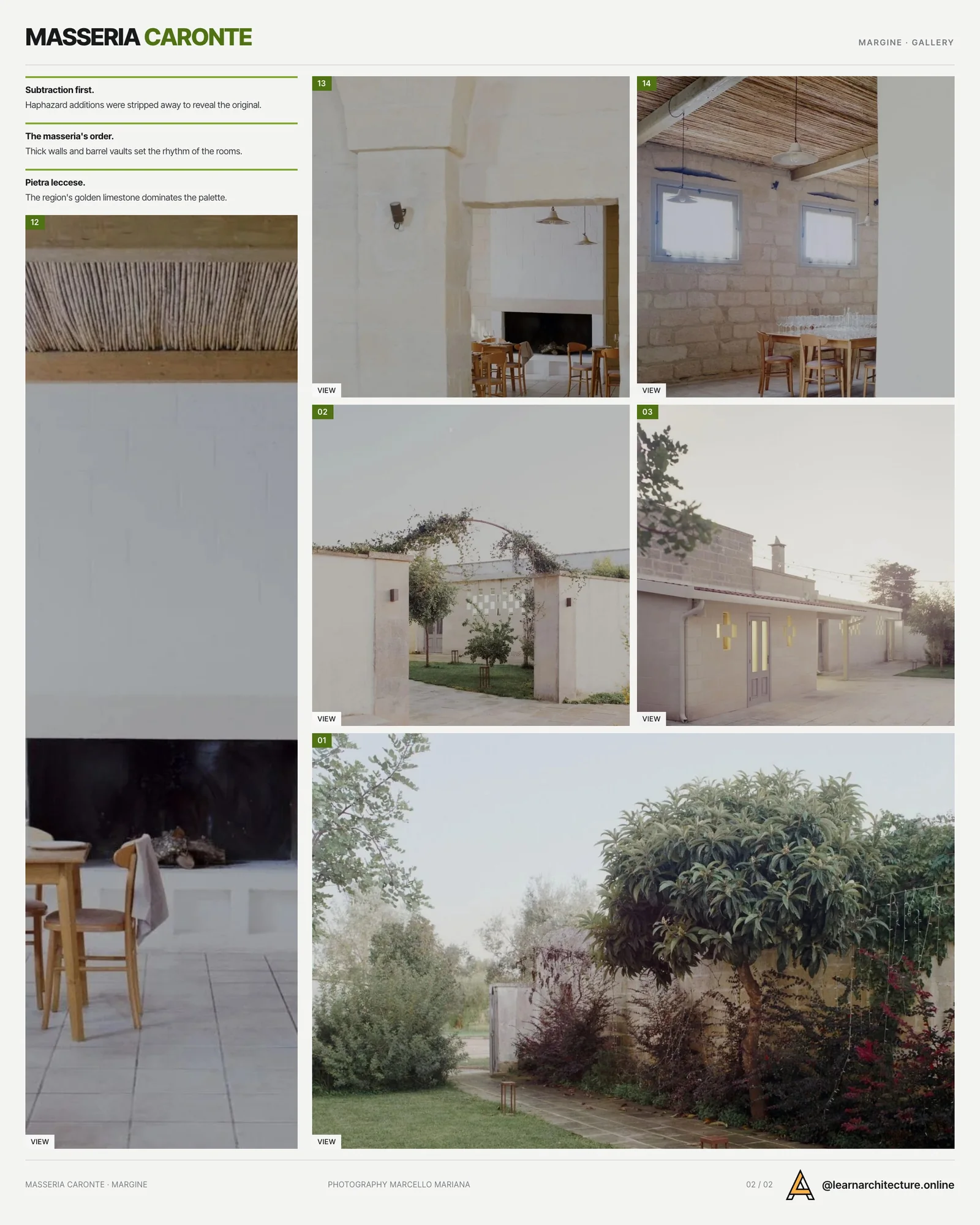
Vaulted ceilings remain exposed, their masonry curves creating an undulating rhythm overhead. These structural elements, typical of historic European architectural traditions, now frame contemporary dining experiences. The interplay between massive walls and refined furnishings establishes productive tension: neither element dominates, creating instead a balanced composition where old and new coexist respectfully.
Natural light penetration was enhanced through careful window placement, maintaining the masseria’s characteristic small openings while maximizing daylight entry. This approach respects the building’s defensive origins (rural structures in Salento were often fortified against raids) while ensuring contemporary comfort standards.

Cultural Continuity in Contemporary Context
Masseria Caronte’s significance extends beyond architectural quality to address broader questions about rural heritage in southern Italy. The Salento region contains hundreds of abandoned agricultural structures, remnants of an agrarian economy that has largely disappeared. Many face demolition or collapse; others are converted insensitively, their character erased in pursuit of fashionable aesthetics.
This project offers an alternative model, one that recognizes historical buildings not as obstacles to progress but as resources for sustainable development. By converting the masseria into a restaurant, the clients created economic viability while maintaining cultural connection. Diners experience not merely a meal but immersion in Salento’s agricultural past, mediated through thoughtful architectural curation.
The project resonates with international examples of adaptive reuse, from mills converted to museums to warehouses transformed into housing. Each demonstrates that the most sustainable building is often the one already built, provided intervention respects inherent character while accommodating new function.

Regional Identity Through Architectural Expression
Margine’s design philosophy emphasizes contextual sensitivity, an approach that rejects imported formal languages in favor of responses rooted in place. For Masseria Caronte, this meant studying Salento’s vernacular traditions: asymmetrical compositions, limited ornamentation, practical materiality, and spaces shaped by climate and custom rather than theoretical abstraction.
The architects’ restraint allows the building itself to communicate. Patinated surfaces bear witness to time; irregularities in stonework reveal human craftsmanship; spatial sequences reflect agricultural workflows now obsolete but still architecturally present. This isn’t preservation as museum display but as living continuity, where past informs present without constraining it.
Such work requires both technical skill and cultural understanding, qualities increasingly rare in an architectural culture often oriented toward novelty and individual expression. Masseria Caronte suggests that profound architecture can emerge from listening rather than pronouncing, from revealing rather than inventing.

Sustainable Practices and Future Implications
The project’s environmental credentials extend beyond material reuse. By maintaining existing structure, Margine avoided the massive carbon footprint associated with demolition and reconstruction. The building’s thick walls provide natural insulation, reducing mechanical heating and cooling requirements. Local sourcing minimized transportation impacts while supporting regional economies.
These benefits exemplify what practitioners call “embodied energy conservation”, recognizing that the greenest building material is often what already exists. As architecture confronts climate urgency, projects like Masseria Caronte demonstrate that historical preservation and environmental responsibility are not competing priorities but aligned objectives.
Looking forward, the project establishes a template potentially applicable throughout southern Italy and Mediterranean Europe, where countless rural structures await sensitively imagined futures. Each represents an opportunity not merely to conserve buildings but to maintain cultural landscapes and sustainable building practices developed over centuries.
Photography: Marcello Mariana
- adaptive reuse Italy
- agricultural heritage preservation
- historic building renovation
- Italian countryside architecture
- Italian vernacular architecture
- Lecce region architecture
- Margine architecture
- Masseria Caronte
- Puglia restoration project
- restaurant architecture Italy
- rural architecture Italy
- Salento farmhouse restoration
- stone architecture restoration
- traditional farmhouse conversion
- Vernole restaurant design









Leave a comment