


Table of Contents Show
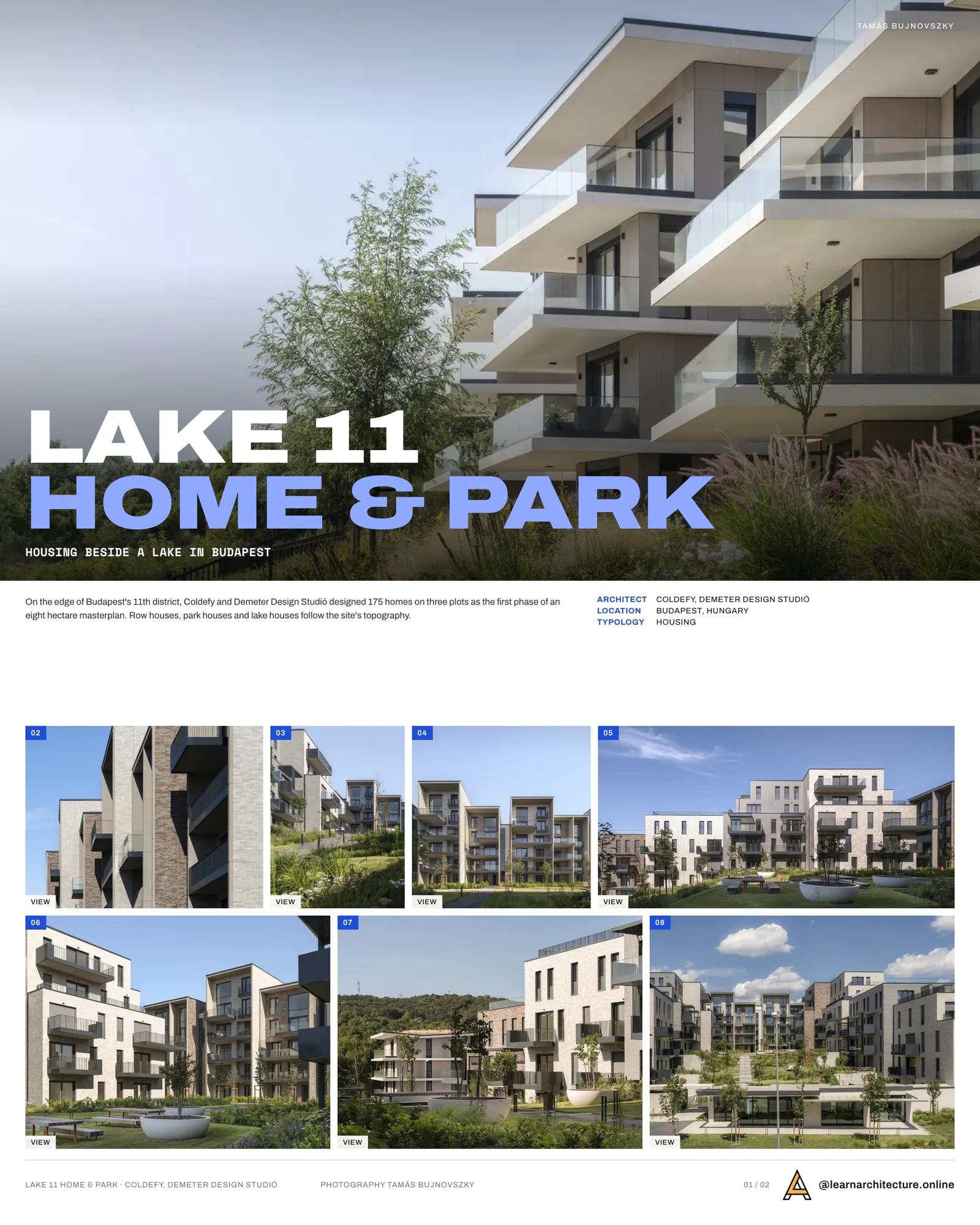
Designed by Coldefy in collaboration with Demeter Design Studió (DDS), Lake 11 Home & Park marks a new chapter in residential architecture on the edge of Budapest’s 11th district. Located beside a natural lake and embedded within an eight-hectare masterplan, the development rethinks contemporary housing by carefully balancing density, landscape, sustainability, and community life. The first completed phase introduces a thoughtful residential environment that brings nature and everyday living into close dialogue, while remaining well connected to the city center.

A Masterplan Shaped by Landscape and Topography
Coldefy and DDS were selected through a competitive process to design 175 homes across three plots, forming the first phase of a wider development that will ultimately deliver 897 residences. The masterplan responds directly to the site’s varied topography, organizing buildings into distinct yet complementary typologies.
At the highest northern edge, row houses are positioned to enjoy elevated views across the landscape. To the east and west, park houses frame a central green heart, shaping a residential parkscape defined by openness and shared outdoor space. Along the southern boundary, lake houses sit closest to the water’s edge, establishing a strong connection between architecture and the lake environment. This layered organization ensures visual permeability, generous spacing, and a gradual transition from urban edge to natural landscape.

Diverse Residential Typologies for Changing Lifestyles
The scheme offers a mix of one- to four-bedroom apartments, distributed across three main typologies and designed with flexible layouts that respond to evolving patterns of living and working. Rather than replicating single-family housing models, Lake 11 proposes a sustainable alternative that combines compact footprints with spatial generosity.
These adaptable homes acknowledge contemporary realities: remote work, shifting family structures, and the need for multifunctional interiors, while maintaining a strong relationship to outdoor space. Each apartment includes a private balcony or terrace, allowing residents to extend daily life into the open air.

Architecture in Dialogue with Nature
A core principle of the project is Coldefy’s long-standing ethos that architecture woven with nature enhances well-being and quality of life. Building volumes step back in response to the terrain, reducing the perceived density of the development and ensuring sunlight reaches both homes and communal spaces.
Large openings frame views toward the lake and surrounding greenery, while careful orientation minimizes direct overlooking between neighboring buildings. This strategy creates a sense of privacy without isolation, reinforcing the feeling of living within a shared landscape rather than a conventional housing estate.

Sustainability as Infrastructure, Not Add-On
Sustainability is embedded at an infrastructural level, reflecting developer Atenor’s commitment to long-term environmental responsibility. Lake 11 operates with a fossil fuel-free heating and cooling system, based on an innovative open geothermal network.
Soil probes drilled to a depth of 150 meters act as seasonal thermal reservoirs. In winter, heat extracted from the ground is distributed through heat-emitting surfaces within the apartments. In summer, excess heat is absorbed by the system and returned to the earth. This cyclical approach reduces emissions, increases energy efficiency, and ensures long-term operational resilience.
Complementing this system are green roofs, rainwater retention strategies, and porous paving, all contributing to reduced runoff, improved microclimate, and enhanced biodiversity.

Landscape Design and Community Life
Landscape plays a central role in shaping everyday experience at Lake 11. Terraces, biodiversity corridors, and planting with local flowering species encourage pollination and reinforce ecological continuity across the site. Pedestrian and cycle paths weave through the development, prioritizing slow movement and social interaction over car dominance.
Generous shared seating areas and colorful outdoor furniture are integrated throughout the park, offering informal gathering spaces that invite residents outdoors. The careful sequencing of public, semi-public, and private zones helps foster a strong sense of community while respecting individual privacy.

Material Strategy and Architectural Identity
Given the scale of the development, material variation is used deliberately to break down volume and create distinct identities across the site. A unified mineral cladding strategy ensures overall coherence, while subtle differences distinguish each building type.

The row and park houses feature textured brick façades in warm, varied tones, giving a sense of permanence and tactile richness. In contrast, the lake houses adopt fibre cement panels combined with aluminium details and exposed concrete, resulting in a more refined, contemporary expression aligned with their waterfront setting. This calibrated material palette helps the architecture sit comfortably within the natural landscape while avoiding monotony.

Comfort, Storage, and Everyday Practicality
Beyond spatial quality, practical considerations are integral to the project’s livability. Each apartment is provided with an additional private storage unit in the basement, alongside secure shared spaces for bicycle and buggy parking. These amenities support long-term residential comfort and encourage sustainable mobility.
Interiors are conceived as calm, light-filled environments, where neutral materials and generous glazing emphasize connection to the outdoors while allowing residents to personalize their homes.

A Future-Oriented Residential Vision for Budapest
When fully completed, Lake 11 Home & Park will represent one of the most ambitious contemporary residential developments in Budapest, offering an alternative vision for urban growth. By combining density with openness, private life with shared landscapes, and architectural rigor with environmental responsibility, the project redefines what lakeside living can mean within a metropolitan context.
Initiated during the COVID-19 lockdowns, the development reflects a broader rethinking of the home, not as an isolated retreat, but as part of a collective, adaptable living environment connected to nature and community. Lake 11 demonstrates how housing can respond thoughtfully to both present needs and future urban challenges.
Photography: Tamás Bujnovszky
- Apartment design Budapest
- Budapest real estate architecture
- Coldefy Architects
- community-focused architecture
- Contemporary housing Hungary
- Demeter Design Studio
- Eco-friendly housing Europe
- Geothermal residential buildings
- Green residential development
- Housing and landscape integration
- Lake 11 Home & Park
- Lakeside housing development
- Landscape-integrated architecture
- Mixed residential typologies
- Modern apartment buildings
- Post-pandemic housing design
- Residential architecture Budapest
- sustainable housing design
- sustainable urban living
- Urban housing masterplan









Leave a comment