


Table of Contents Show
An architecture feasibility study is the single most important step you can take before committing real money to a building project. It answers a straightforward question: can this project actually be built on time, within budget, and in compliance with local regulations? If the answer is no, you find out early, adjust your plans, and avoid sinking resources into a doomed concept. If the answer is yes, you move forward with data-backed confidence.
This process sits squarely in the pre-design phase, before any schematic drawings or contractor negotiations happen. Architects, developers, and investors all rely on this evaluation to separate viable projects from risky ones. Whether you are planning a mixed-use development in a dense urban area or a single-family custom home on a tricky hillside lot, the feasibility study gives you a clear picture of what is possible.
Below, you will find a step-by-step breakdown of how a feasibility study architecture process works, what each phase covers, and how the final report shapes every decision that follows.

What Is a Feasibility Study in Architecture?
A feasibility study in architecture is a structured evaluation that examines whether a proposed construction project can succeed given the constraints of the site, the budget, the regulatory environment, and the available technology. It typically covers site conditions, zoning codes, financial projections, design options, and risk factors. The study results are compiled into a formal report that guides decision-making for all stakeholders.
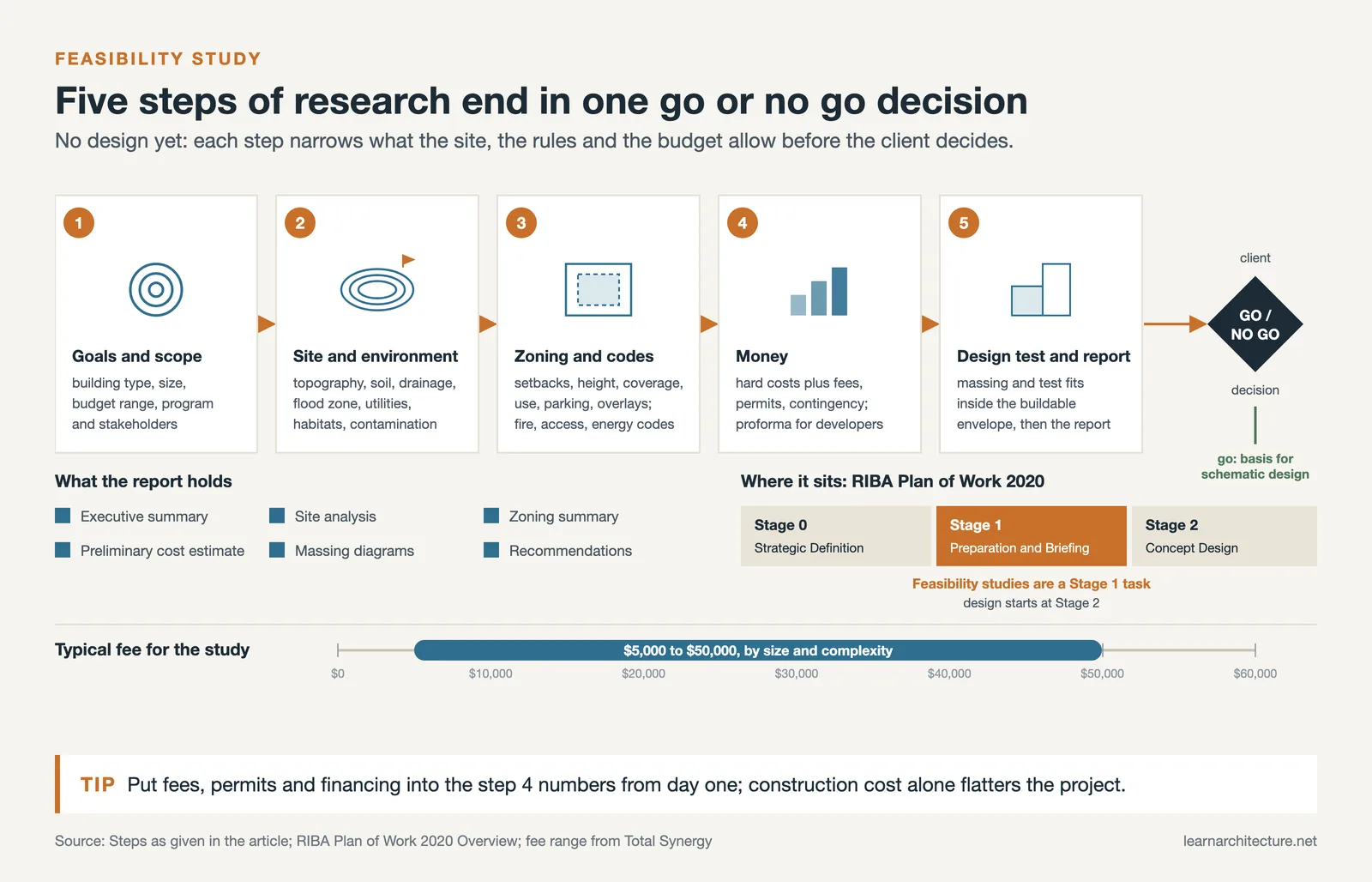
This is not a design exercise. While early massing studies and site sketches may be included, the primary goal is research and analysis. The architect coordinates the process but works alongside civil engineers, environmental consultants, surveyors, and sometimes financial advisors. According to the RIBA Plan of Work 2020, feasibility studies are a Stage 1 task, carried out during project briefing after strategic definition at Stage 0 and before concept design begins at Stage 2.
The American Institute of Architects (AIA) similarly positions feasibility assessment within the pre-design services phase, emphasizing that it is a supplemental service separate from standard architectural contracts.

Why Construction Feasibility Matters Before Design Begins
Skipping a construction feasibility study is one of the most expensive mistakes a developer or building owner can make. Problems that surface during construction, such as unexpected soil conditions, utility access issues, or zoning violations, cost exponentially more to resolve than they would during the planning stage.
A well-executed feasibility study does several things simultaneously. It validates that the project goals are achievable within the site’s physical and regulatory constraints. It uncovers risks early enough to allow course correction. And it produces documentation that lenders and investors require before approving financing.
For developers working on multi-unit residential or commercial projects, the construction feasibility study also feeds directly into the financial proforma. The study helps determine achievable unit counts, parking ratios, buildable area, and height limits, all of which determine whether the project pencils out financially.
The 5-Step Architecture Feasibility Study Process
While every project has unique conditions, the architectural feasibility study process follows a consistent structure. Here are the five core steps that most firms use to evaluate project viability.

Step 1: Define Project Goals and Scope
Before any research begins, the architect meets with the client to establish clear objectives. What type of building is planned? How large does it need to be? What is the preliminary budget range? Are there specific functional requirements, such as a certain number of residential units, parking spaces, or retail square footage?
This step also identifies stakeholders and their interests. A developer building speculative housing has different priorities than a school district planning a new campus. The project scope sets boundaries for the entire study and ensures that the evaluation stays focused on what matters most to the client.
Step 2: Site Evaluation and Environmental Assessment
The site evaluation examines the physical characteristics of the land. Architects and engineers assess topography, soil stability, drainage patterns, flood zone status, and access to utilities such as water, sewer, and electricity. Environmental impact factors, including protected habitats and contamination risks, are also reviewed at this stage.
According to guidelines published by the U.S. Environmental Protection Agency (EPA), early environmental screening helps prevent costly remediation during construction and ensures compliance with federal and state regulations.
Site visits are essential. Aerial imagery and GIS data provide useful context, but nothing replaces walking the property, observing drainage during rain events, and understanding how the surrounding neighborhood functions. A thorough site analysis at this stage prevents surprises later.
Step 3: Zoning and Regulatory Research
Zoning codes dictate what can and cannot be built on a given parcel. The architect investigates setback requirements, height restrictions, lot coverage limits, use classifications, and parking mandates. Some municipalities also impose special overlays for historic districts, floodplains, or transit corridors.
This feasibility research extends beyond zoning. Building codes, fire safety requirements, accessibility standards (such as ADA compliance in the United States), and energy codes all influence the project’s design parameters. Identifying these constraints early allows the team to design within them rather than discovering violations during the permitting process.
Some jurisdictions offer development incentives, including density bonuses for affordable housing, tax increment financing (TIF), historic tax credits, or sustainability bonuses. A skilled architect knows to research these opportunities as part of the feasibility study format, since they can significantly affect project economics.

Step 4: Financial Analysis and Cost Estimation
The financial component of the study answers a critical question: does the project make economic sense? Architects work with cost estimators and sometimes financial consultants to develop preliminary budgets covering construction costs, professional fees, permitting expenses, and contingency allowances.
For development projects, this step includes a basic proforma analysis comparing projected costs against expected revenue. The goal is not to produce a final budget but to determine whether the project is financially viable at a high level. If estimated construction costs exceed the budget by a wide margin, the team can explore cost-saving alternatives before investing in full design work.
Step 5: Design Testing and Final Report
With site data, regulatory constraints, and budget parameters in hand, the architect develops preliminary massing studies and site plans. These are not finished designs. They test whether the program (the required spaces and functions) can fit within the site’s buildable envelope.
Massing studies explore options such as building footprint placement, floor count, and overall building volume. For residential developments, test-fit plans show approximate unit layouts to confirm achievable density. For commercial projects, the focus might be on floor plate efficiency, loading access, or parking structure placement.
All findings are compiled into a feasibility study report. A typical report includes an executive summary, site analysis documentation, zoning summary, preliminary cost estimates, massing diagrams or renderings, and recommendations for next steps. This document becomes the foundation for the client’s go/no-go decision and, if the project proceeds, the basis for schematic design.

Key Components of a Feasibility Study Format
Typical Feasibility Study Report Contents
The structure of a feasibility study format varies by firm and project type, but most reports follow a similar outline. The table below summarizes what you can expect to find in a well-prepared document.
| Report Section | What It Covers | Why It Matters |
|---|---|---|
| Executive Summary | High-level overview, key findings, go/no-go recommendation | Gives stakeholders a quick snapshot for decision-making |
| Site Analysis | Topography, soil, drainage, utilities, environmental factors | Identifies physical constraints and opportunities on the land |
| Zoning and Regulatory Review | Setbacks, height limits, use classifications, code requirements | Confirms what is legally permissible on the site |
| Financial Feasibility | Preliminary cost estimates, proforma overview, funding options | Determines if the project is economically viable |
| Design Options | Massing studies, site plans, test-fit layouts, renderings | Shows what can physically fit on the site within constraints |
| Risk Assessment | Regulatory risks, market risks, construction risks, mitigation plans | Prepares the team for potential obstacles and uncertainties |
| Recommendations | Next steps, preferred approach, alternative options | Provides a clear path forward based on findings |
Feasibility Study vs. Site Analysis: What Is the Difference?
These two terms are often used interchangeably, but they are not the same thing. A site analysis focuses on the physical and environmental attributes of a property: topography, soil conditions, sun path, wind patterns, vegetation, and access points. It tells you what the land is like.
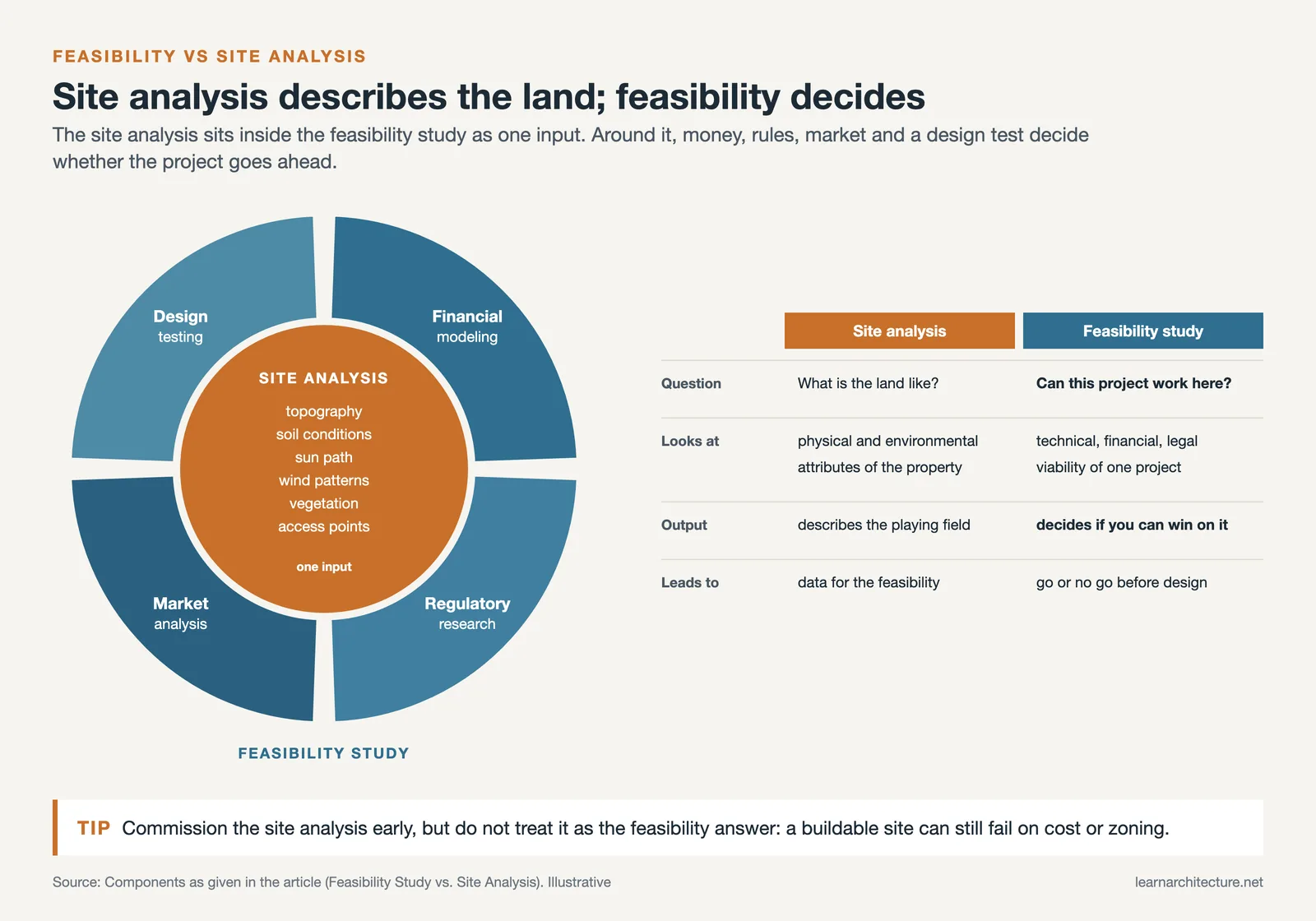
An architecture feasibility study goes further. It evaluates whether a specific project is technically, financially, and legally viable on that site. The site analysis is one input into the broader feasibility assessment. You need the site data to make informed feasibility judgments, but the feasibility study also incorporates financial modeling, regulatory research, market analysis, and design testing.
Think of it this way: a site analysis describes the playing field, while the feasibility study determines whether you can win the game on that field with your specific team and strategy.

Who Conducts a Construction Feasibility Study?
The lead architect or design firm typically coordinates the study, but the process requires a multidisciplinary team. Depending on the project’s complexity, the team may include civil engineers for grading and utility analysis, geotechnical engineers for soil testing, environmental consultants for contamination or habitat assessments, surveyors for boundary and topographic data, and cost estimators for preliminary budgeting.
For larger developments, market researchers and financial analysts may also contribute. The architect serves as the central coordinator, synthesizing inputs from all disciplines into a coherent report. The Procore construction resource library notes that successful feasibility studies require collaboration between the developer, civil engineer, and architect from the earliest stages.
Feasibility study costs vary based on project scale and complexity. According to industry data published by Total Synergy, architectural feasibility studies typically range from $5,000 to $50,000, covering site analysis, regulatory research, design considerations, and financial evaluations.
When Should You Commission a Feasibility Study?
The short answer: as early as possible. Ideally, a feasibility study should begin before you finalize a land purchase. Running the study before closing on a property can reveal constraints that fundamentally alter the project’s viability or budget. If the findings are unfavorable, you walk away having spent a fraction of what the full project would have cost.
For projects on owned land, the study should happen before engaging an architect for full design services. The feasibility research creates a solid foundation for the schematic design phase, ensuring that the design team starts with accurate constraints and realistic expectations.
There are also cases where feasibility studies are repeated during a project. A developer who receives a planning rejection, for example, may commission a new study to explore alternative approaches based on the planning authority’s feedback. Similarly, changes in market conditions or building codes can trigger a reassessment of a project that was previously deemed viable.
Cost figures mentioned in this article are approximate and vary by region, project scope, and the consultants involved. Always obtain project-specific quotes from qualified professionals.

Frequently Asked Questions
How long does an architectural feasibility study take?
The timeline depends on project scale and complexity. A straightforward residential feasibility study may take two to four weeks, while a large commercial or mixed-use development study can require two to three months. Factors like the availability of existing surveys, the complexity of local zoning codes, and the number of consultants involved all affect duration.
What is the difference between a feasibility study and a feasibility analysis?
A feasibility study is the broader evaluation that produces a final report with recommendations. A feasibility analysis refers to the specific methods, data collection, and evaluation processes used within that study. In practice, the analysis feeds into the study. Some firms use the terms interchangeably, but technically the study is the output and the analysis is the process.
Can a small residential project benefit from a feasibility study?
Yes. Even for single-family homes, a feasibility study can confirm that your intended design fits the site, complies with zoning, and falls within your budget. This is especially valuable for challenging lots with steep slopes, setback limitations, or environmental constraints. The cost of a basic residential feasibility study is modest compared to the expense of discovering problems during construction.
What happens if the feasibility study shows the project is not viable?
A negative result is still a valuable outcome. It means you identified a critical problem before spending significant resources on design and construction. Depending on the issue, you may be able to adjust the project scope, change the site, modify the budget, or explore alternative design approaches. The study gives you the information needed to make that decision with clarity.
Is a feasibility study required by law?
In most jurisdictions, feasibility studies are not legally mandatory. However, many lenders and investment groups require one as a condition of financing. Some public agencies also require feasibility documentation for publicly funded projects. Even when not required, the study is widely recognized as best practice by organizations such as RIBA and AIA.









Leave a comment