



Table of Contents Show
Architectural design classes in the USA are studio-based courses inside NAAB-accredited B.Arch and M.Arch programs that teach students how to develop, draw, model, and defend a building design. The strongest programs combine rigorous studio work with structures, history, technology, and professional practice. This guide ranks ten of the best.
The right architectural design classes shape how you think about space and how prepared you are for the Architect Registration Examination (ARE). Below we break down ten US programs that consistently rank near the top across QS World University Rankings 2026, ARE 5.0 pass rates published by NCARB, and employer surveys.
How We Selected These Programs
No single ranking captures the full picture. The DesignIntelligence survey, long the dominant US ranking, was suspended in 2022 after deans from more than a dozen leading schools criticized its methodology. The most reliable approach is to triangulate across QS World University Rankings 2026, NCARB ARE 5.0 pass rates, accreditation status verified through the National Architectural Accrediting Board (NAAB), and employer hiring surveys. Whichever school you target, your architecture portfolio will be read first, so it is worth shaping early.
💡 Pro Tip
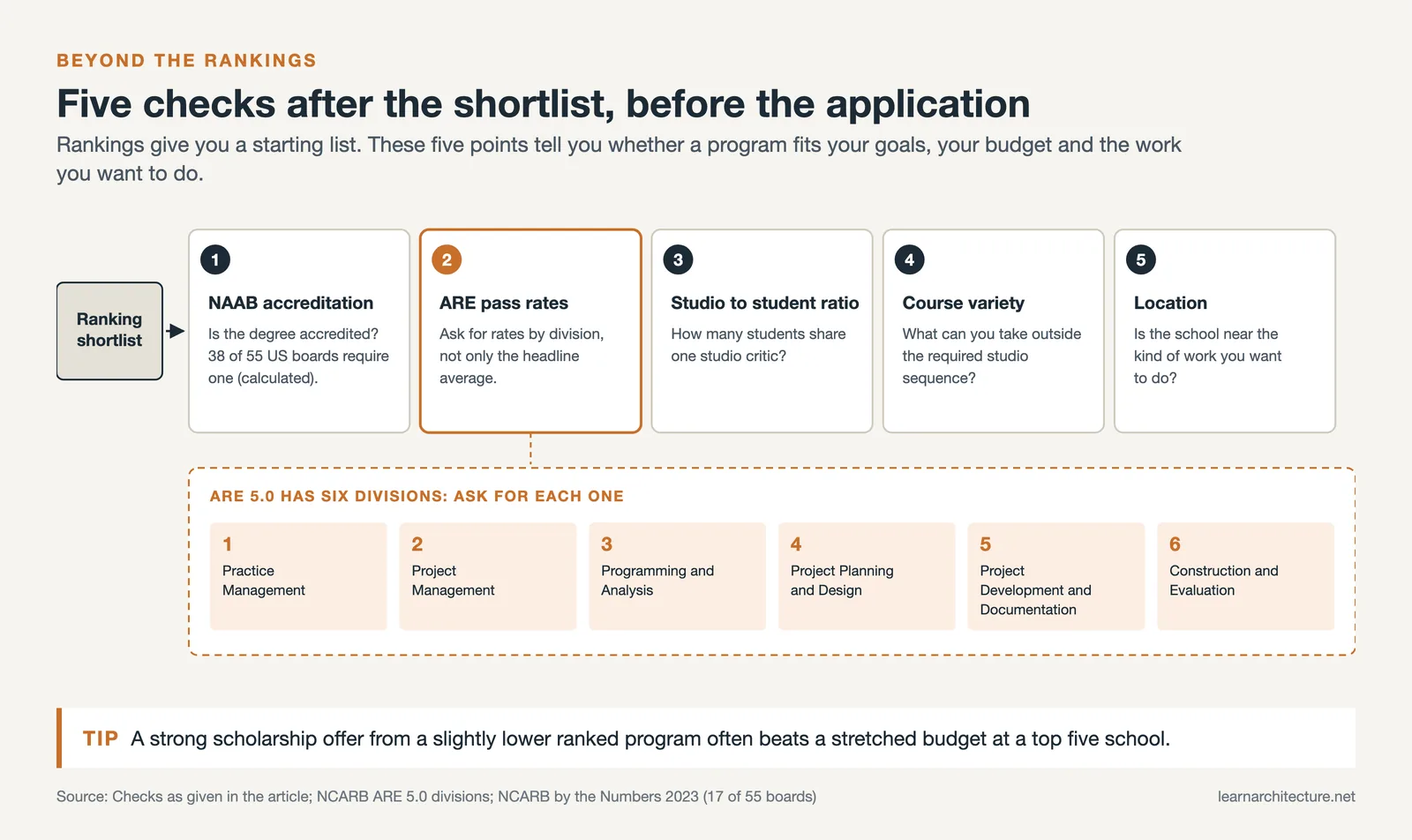
When comparing programs, ask each school for ARE pass rates by division, not just the headline average. The breakdown shows which professional skills the curriculum actually reinforces, since a high Practice Management rate signals different strengths from a high Project Planning & Design rate.

1. Massachusetts Institute of Technology (MIT)
MIT’s School of Architecture and Planning is ranked first in the US and second in the world for architecture by the QS World University Rankings by Subject 2026. The school is historically significant as the home of the first university architecture curriculum in the United States, founded by William Robert Ware in 1865. The M.Arch program leans heavily into computational design, building technology, and environmentally driven research, with studios that often partner directly with engineering and material-science labs. Best for students who want a research-driven, technology-forward studio culture.
2. Harvard Graduate School of Design (GSD)
Harvard GSD’s M.Arch I is one of the most influential design programs in the country, anchored by the rigorous studio sequence in Gund Hall. The school groups architecture, landscape architecture, and urban planning under one roof, and design studios regularly intersect with neighbouring disciplines. Faculty often run influential practices, so students are critiqued by working architects, not only academics. Best for students who want exposure to leading practitioners and a curriculum that treats architecture as a civic discipline.

3. Yale School of Architecture
Yale runs both an undergraduate major within Yale College and a three-year M.Arch I program. Its design studios feature visiting critics each semester, with each studio led by a different practitioner. The “Building Project,” which sends first-year M.Arch students to design and physically construct a house in New Haven, is one of the few full-scale build experiences embedded in any US graduate curriculum. Best for students who want both intellectual range and tangible construction experience.
4. Columbia University GSAPP
Columbia’s Graduate School of Architecture, Planning and Preservation is closely associated with experimental and digitally driven design. Studios are organized around faculty-led options that change each semester, and the school has long been at the front of integrating computational tools and AI workflows into the design process. New York City functions as a live laboratory. Best for students drawn to digital craft, theory, and an intense urban context.
5. Cornell University AAP
Cornell’s College of Architecture, Art, and Planning offers a five-year B.Arch consistently cited as a top US undergraduate program. The program is studio-intensive from the first semester, and the curriculum spans architectural design, theory, technology, structural systems, and professional practice. Cornell graduates are well represented in major US firms. Best for high school students who want a professional architecture degree and a hiring pipeline into established practices.
6. UC Berkeley (CED)
UC Berkeley’s College of Environmental Design houses one of the leading public-university architecture programs in the country. Its studios are taught alongside landscape architecture and city planning students, which builds an environmental-systems perspective into design thinking from year one. As a public school, CED also offers a meaningfully different cost structure for California residents, especially when paired with a strong architecture scholarship. Best for students who want a research-intensive program at public-university tuition.

7. Princeton University School of Architecture
Princeton’s program is small and theory-heavy. Studios are paired with an unusually strong emphasis on history, philosophy, and architectural writing. Cohorts are tiny, so faculty access is among the highest in the country, and student culture is well documented through chapters of the American Institute of Architecture Students (AIAS). Best for students who want a deeply intellectual program and plan to combine practice with academic research.
8. Rice University School of Architecture
Rice runs both a B.Arch and M.Arch and consistently posts one of the highest ARE 5.0 pass rates in the country, around 76% based on multi-year data. The B.Arch includes a required preceptorship year in which students take a paid position at a working architecture firm before completing the degree, which gives graduates real built work to feature in an architecture student portfolio. Best for students who want a small program with strong licensure outcomes.
9. University of Notre Dame School of Architecture
Notre Dame is distinctive among top US programs for its commitment to classical and traditional architecture, taught as a working design language alongside contemporary practice. All B.Arch students spend their third year at the school’s Rome Studies Program. The program also has the highest five-year average ARE pass rate among major US schools, around 78%, computed from NCARB data. Best for students interested in classical or traditional design vocabularies.
10. Southern California Institute of Architecture (SCI-Arc)
SCI-Arc is the outlier on this list. It is an independent, single-program school in downtown Los Angeles offering a B.Arch, M.Arch, and several post-professional degrees. Studios are formally adventurous and unapologetically experimental, often using advanced fabrication, robotics, and computational design as core tools. Best for students who want an independent design school environment focused entirely on architecture.

Comparison Table: Top 10 US Architecture Programs
| School | Degrees | Studio Focus | Best For |
|---|---|---|---|
| MIT | M.Arch | Research, technology | STEM-oriented students |
| Harvard GSD | M.Arch I, II | Urban, civic | Civic-minded designers |
| Yale | B.A., M.Arch I | Critic-led, build project | Hands-on intellectuals |
| Columbia GSAPP | M.Arch | Digital, theoretical | Digital-craft designers |
| Cornell AAP | B.Arch, M.Arch | Concept-to-construction | Direct-to-firm trajectory |
| UC Berkeley | B.A., M.Arch | Environmental | Climate-focused students |
| Princeton | A.B., M.Arch, Ph.D. | Theory, history | Academic-track designers |
| Rice | B.Arch, M.Arch | Practice, preceptorship | Licensure-focused students |
| Notre Dame | B.Arch, M.Arch | Classical, Rome year | Traditional design |
| SCI-Arc | B.Arch, M.Arch | Experimental, fabrication | Avant-garde designers |
What to Look for Beyond the Rankings
Rankings give you a starting list, but they cannot tell you whether a program fits your goals. After narrowing your shortlist, evaluate each school on five points: NAAB accreditation, ARE 5.0 pass rates by division, studio-to-student ratio, course variety outside the core sequence, and location relative to the work you want to do. A strong scholarship offer from a slightly lower-ranked program often beats a stretched budget at a top-five school.
⚠️ Common Mistake to Avoid
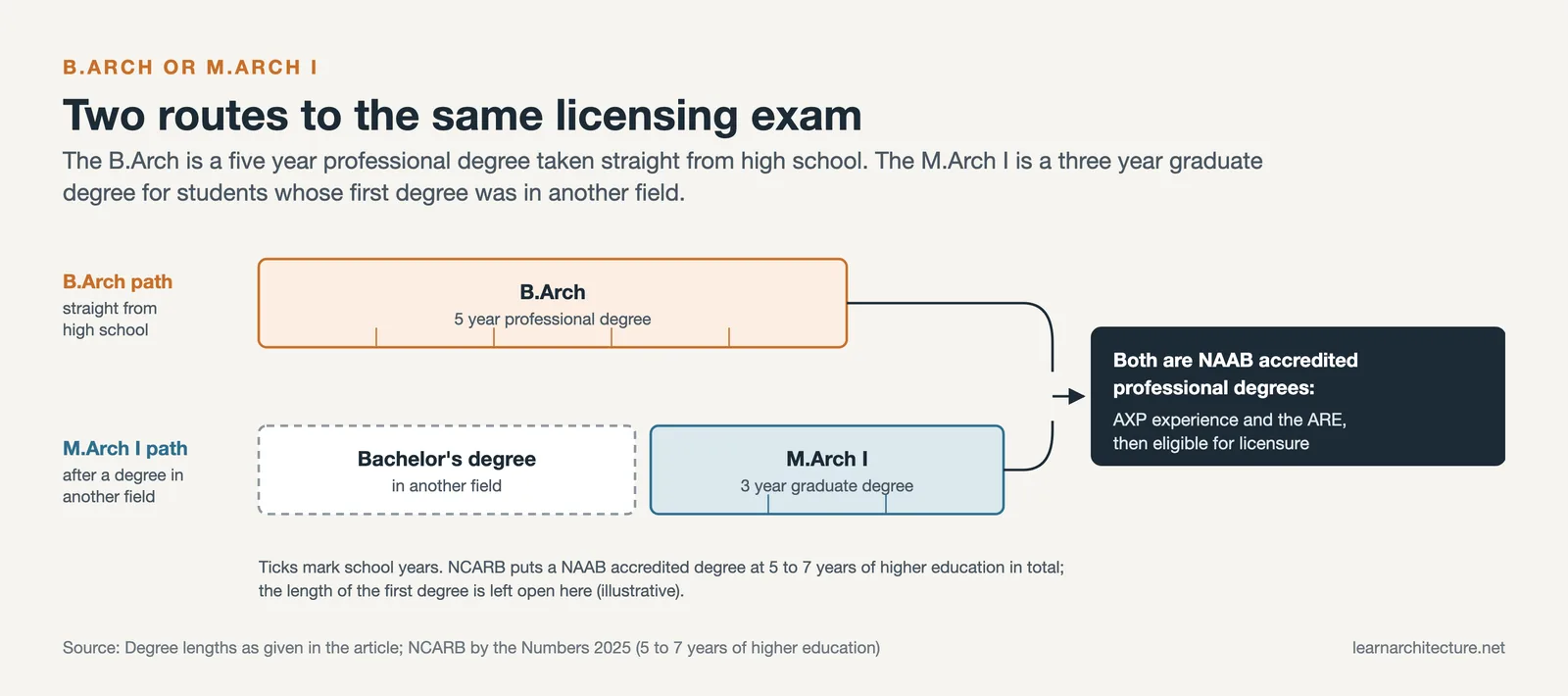
Many applicants treat the B.Arch and M.Arch as interchangeable. They are not. The B.Arch is a five-year professional degree taken straight from high school. The M.Arch I is a three-year graduate degree designed for students whose undergraduate degree was in another field. Both lead to licensure eligibility, but the application process and student demographics differ significantly.
Application strength matters too. The portfolio is read first, often in less than fifteen minutes, so the strongest projects should sit at the front. For students still weighing the field overall, the long-term outlook for an architecture career and the question of whether to become an architect cover trade-offs not visible from a brochure.

Frequently Asked Questions
How much do architectural design classes in top US programs cost?
Tuition varies widely. Private programs at Harvard, Yale, Columbia, and Princeton typically run $60,000 to $75,000 per year before living expenses. Public programs like UC Berkeley are significantly cheaper for in-state residents. Always verify current figures directly with each school, since published tuition rarely includes studio fees, materials, and required field trips.
Are online architectural design classes worth it?
Online courses can be useful for skill-building, especially software training in Revit, Rhino, or AutoCAD, and for short continuing-education modules. However, full NAAB-accredited degrees are very rarely offered fully online because studio learning depends on in-person critique. If your goal is licensure, prioritize an accredited residential or hybrid program.
Which US architecture school has the highest ARE pass rate?
Notre Dame consistently posts the highest ARE 5.0 pass rate among major schools, around 78% on a five-year average across all six exam divisions, computed from NCARB data. Rice follows at around 76%. Pass rates fluctuate year to year, so check the most recent NCARB data before drawing conclusions.
Tuition figures, ARE pass rates, and program structures change year to year. Verify current information with each school and with NCARB before making application decisions.











Leave a comment