



Table of Contents Show
Scholarships architecture students rely on in the USA range from $5,000 single-year tuition awards to multi-year packages worth $20,000 and travel fellowships up to $50,000. The eight programs below are among the most respected and consistently funded options for 2026, covering undergraduate, graduate, and post-graduation stages of architectural education.
Architecture school is one of the most expensive paths in higher education. Tuition aside, you also pay for studio supplies, model materials, expensive software licenses, printing, books, and computer hardware capable of running rendering tools. For most students, a single national scholarship will not cover the full bill, but layering two or three smaller awards with school-level financial aid can make a real difference. The list below focuses on programs that publish clear eligibility rules, run on a predictable annual cycle, and are administered by organizations connected to the AIA, NAAB-accredited schools, or major architecture firms.
💡 Pro Tip
Treat scholarship applications like a portfolio review with a deadline. Reviewers read dozens of similar essays, and generic statements about loving design rarely land. Anchor your personal statement to a specific studio project, a research interest, or a problem you have actually worked on. The applications that win are the ones that show a clear point of view, not the ones that list the most accolades.
How Architecture Scholarships in the USA Are Structured

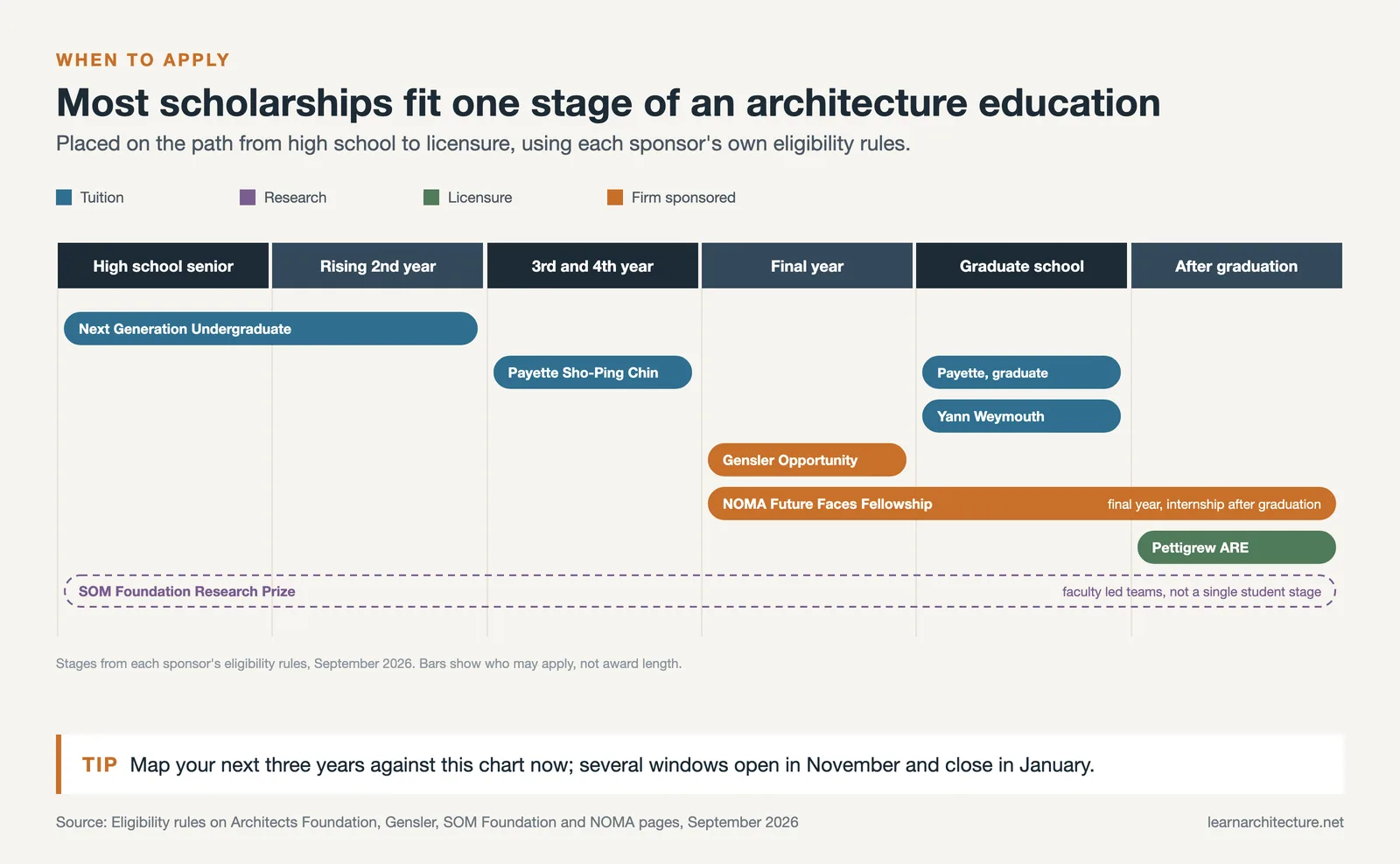
Before looking at specific awards, it helps to understand how the funding landscape is organized. Architecture scholarships in the United States generally fall into four buckets, and most programs sit in only one of them.
Tuition awards go directly to the school’s financial aid office and are credited against your bill for an academic year. They typically require enrollment in a NAAB-accredited program, the accreditation body recognized for architecture in the US, and most are restricted to undergraduate or master’s students. Travel fellowships, by contrast, fund a defined research trip after graduation or during a thesis year. They tend to be more competitive but often carry larger amounts because they cover both stipend and travel costs.
The third category is licensure support. Programs like the Jason Pettigrew Memorial ARE Scholarship help recent graduates pay for the Architect Registration Examination, which has six divisions and adds up to thousands of dollars in fees and study materials. The fourth category is firm-sponsored scholarships, often tied to a paid summer internship at the sponsoring firm. These are increasingly common at large practices like Gensler and offer both money and a direct route into a working studio.
🔢 Quick Numbers
- NAAB enrollment exceeded 33,000 students in the 2023 to 2024 academic year, with nearly 7,000 graduates (ScholarshipsandGrants.us policy brief, 2025)
- Average student-loan burden for recent architecture graduates is around $40,000, compared to about $29,000 for all Class of 2017 borrowers, an earlier and broader cohort, so the gap is indicative rather than like for like (AIA issue brief cited in ScholarshipsandGrants.us, 2025)
- Average time to architectural licensure in the US is approximately 12.9 years, with roughly 36 to 38% of candidates exiting the path over a 10-year period (NCARB data referenced in ScholarshipsandGrants.us, 2025)
1. Architects Foundation Next Generation Scholarship
The Architects Foundation, the philanthropic partner of the American Institute of Architects, runs what is arguably the most established scholarship pipeline in US architecture. The Next Generation Scholarship, formerly known as the Diversity Advancement Scholarship, is its flagship undergraduate program. It provides up to $20,000 in total funding, paid out over multiple years (up to four), and is open to high school seniors entering NAAB-accredited programs as well as transfer students and rising second-year students.
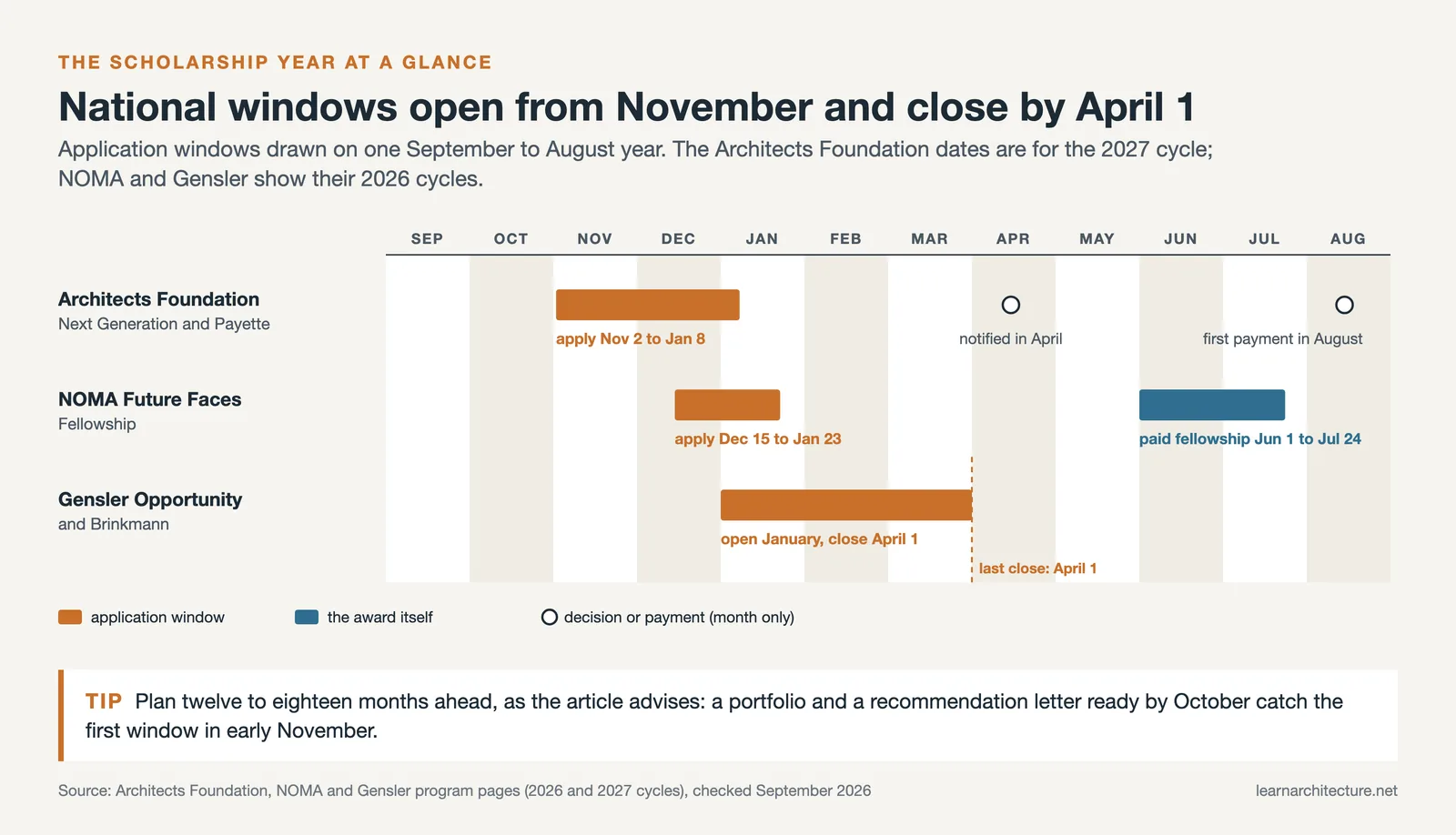
Selection emphasizes both academic promise and financial need, and recipients are connected to mentors through the AIA network. According to ScholarshipsandGrants.us, the application window historically runs November through January, with the cycle for 2026 opening in fall 2025. Because this scholarship renews across multiple academic years, it carries more weight than most one-off awards and is worth prioritizing if you are still early in your degree.
2. Payette Sho-Ping Chin Memorial Academic Scholarship

The Payette Sho-Ping Chin Memorial Academic Scholarship is administered by the Architects Foundation in partnership with Payette, a Boston-based firm known for healthcare and laboratory architecture. It is a $10,000 award supporting a woman studying architecture within a NAAB-accredited bachelor’s or master’s degree program. The recipient also receives mentorship from a senior Payette leader for the scholarship year.
The scholarship honors the legacy of Sho-Ping Chin, FAIA, a long-time principal at Payette who helped shape the national discourse for women in design. According to the Architects Foundation, eligibility extends to third- and fourth-year women architecture students in NAAB-accredited undergraduate programs, as well as women at any level of graduate study in a NAAB-accredited program. The application window typically opens in November and closes in January.
3. Yann Weymouth Graduate Scholarship
The Yann Weymouth Graduate Scholarship is another Architects Foundation program, focused specifically on graduate-level work that sits at the design intersection of sustainability, resilience, wellness, and beauty. Recipients receive $5,000 toward tuition and fees, plus mentorship from Yann Weymouth himself for the scholarship year.
The award honors Yann Weymouth, AIA, who served as chief of design for I.M. Pei on the National Gallery of Art East Wing in Washington, DC, and the Grand Louvre Project in Paris. The scholarship is open to graduate students whose portfolios demonstrate a clear thematic focus rather than a scattered range of work. If your thesis or studio research is rooted in performance-driven, environmentally responsive design, this is one of the more thematically specific scholarships you can apply for.
🎓 Expert Insight
“Architecture should speak of its time and place, but yearn for timelessness.” Frank Gehry, quoted in Home (1993)
Gehry’s reminder is useful framing for a scholarship application. Reviewers want to see that you understand both the moment you are designing in and the broader concerns of the field. A personal statement rooted in a specific contemporary problem, paired with a clear sense of architectural history, signals exactly that.
4. Gensler Brinkmann Scholarship and Opportunity Scholarship

Gensler, one of the largest architecture and design firms in the world, runs two major US scholarship programs. The Brinkmann Scholarship, established in 1999 in memory of former Gensler principal Donald G. Brinkmann, supports students in their final year of a US not-for-profit interior design program. The Opportunity Scholarship + Design Challenge funds architecture students enrolled in their final year of a NAAB-accredited program.
According to Gensler’s published program details, the Opportunity Scholarship awards over $60,000 in total scholarships annually, distributed across about 15 emerging designers, with applications due by April 1, 2026. Awards include academic tuition scholarships, micro-scholarships for books and materials, and opportunities for summer internships at Gensler offices. Applicants must submit a resume, portfolio, personal impact statement, letter of recommendation from their dean or chair, and a Design Challenge sketch.
5. SOM Foundation Research Prize
The Skidmore, Owings & Merrill Foundation operates the longest-running travel fellowship program in US architectural education. Established in 1979 by SOM, the Foundation now offers several awards, but the Research Prize is the headline program. Each year, two $30,000 prizes are awarded to faculty-led interdisciplinary teams based in the United States to conduct original research that contributes to the SOM Foundation’s defined annual topic.
Earlier programs administered by the Foundation, like the SOM Prize and the Travel Fellowship, awarded individual graduating students with $50,000 and $20,000 respectively for in-depth research and international travel. Today, the Structural Engineering Fellowship offers $20,000 annually to a graduating US-based student specializing in structural engineering. According to the SOM Foundation, applicants and recipients have included graduates from MIT, Columbia, Virginia Polytechnic, and other accredited US schools, and US citizenship is not required for most of these awards.
⚠️ Common Mistake to Avoid
Many international students assume they cannot apply to US-based architecture scholarships. That is incorrect for a substantial portion of awards. Programs like the SOM Foundation Research Prize do not require US citizenship; they require enrollment in an accredited US institution. The Architects Foundation scholarships covered here, by contrast, require US citizenship or permanent residency. Always read the eligibility section in full instead of relying on the headline.
6. KPF Traveling Fellowship

The Kohn Pedersen Fox Foundation operates a partner-school traveling fellowship that has funded student travel for several decades. Each year, KPF presents three $10,000 awards to students in their penultimate year at one of the design schools the firm partners with. According to KPF’s published submission guidelines, the goal of the award is to allow students to broaden their education through a summer of travel before their final year.
The selection process is run as a juried competition, with the panel composed of two KPF principals and three outside critics. Applicants submit a fifteen-page portfolio of solo work, executed entirely by the student rather than in a professional office. Eight thousand dollars is paid up front, with the remaining $2,000 issued after the fellow submits a written report covering the trip, places visited, and lessons learned. Because nominations are made through partner schools rather than directly by students, the first step is checking with your department chair to confirm whether your school is on the partner list.
7. NOMA Future Faces Fellowship
The National Organization of Minority Architects (NOMA) runs the NOMA Future Faces Fellowship (NFF) in partnership with the AIA Large Firm Roundtable. Unlike the tuition-focused programs above, the NFF places architecture students enrolled in their final year at a NAAB-accredited program in an eight-week paid architectural internship after graduation, hosted by leading firms across the United States.
According to NOMA, the 2026 fellowship runs from June 1 through July 24, 2026, as a full-time, in-person internship. Applicants must be registered student members of NOMA and demonstrate active engagement with a chartered NOMAS chapter on their campus. Students from the seven NAAB-accredited Historically Black Colleges and Universities are particularly encouraged to apply. Fellows who later complete the requirements for licensure within five years of finishing the fellowship are eligible for additional licensure support, an explicit attempt to address the documented attrition rate from school to professional registration.
8. AIA New York Eleanor Allwork Scholarship

The Allwork Scholarship is one of the longest-running regional architecture scholarships in the country and a strong example of why local awards are worth applying to alongside national ones. Established in the early 1980s by architect Ronald Allwork, the scholarship is administered by the Center for Architecture and AIA New York. According to the Center for Architecture, the program supports students seeking their first professional degree in architecture from a NAAB-accredited school within the State of New York.
According to AIA New York, the scholarship offers multiple awards of up to $7,500 each, with the potential for an honors grant of up to $10,000. Students must be nominated by the dean or chair of their school of architecture. Recent recipients have included students from Pratt Institute, the City College of New York, the University at Buffalo, Cooper Union, Cornell, and Columbia, which gives a sense of which programs treat the nomination process seriously. If you study at a New York-based NAAB-accredited program, this should be on your shortlist regardless of what national awards you also apply for.
How These Architecture Scholarships Compare
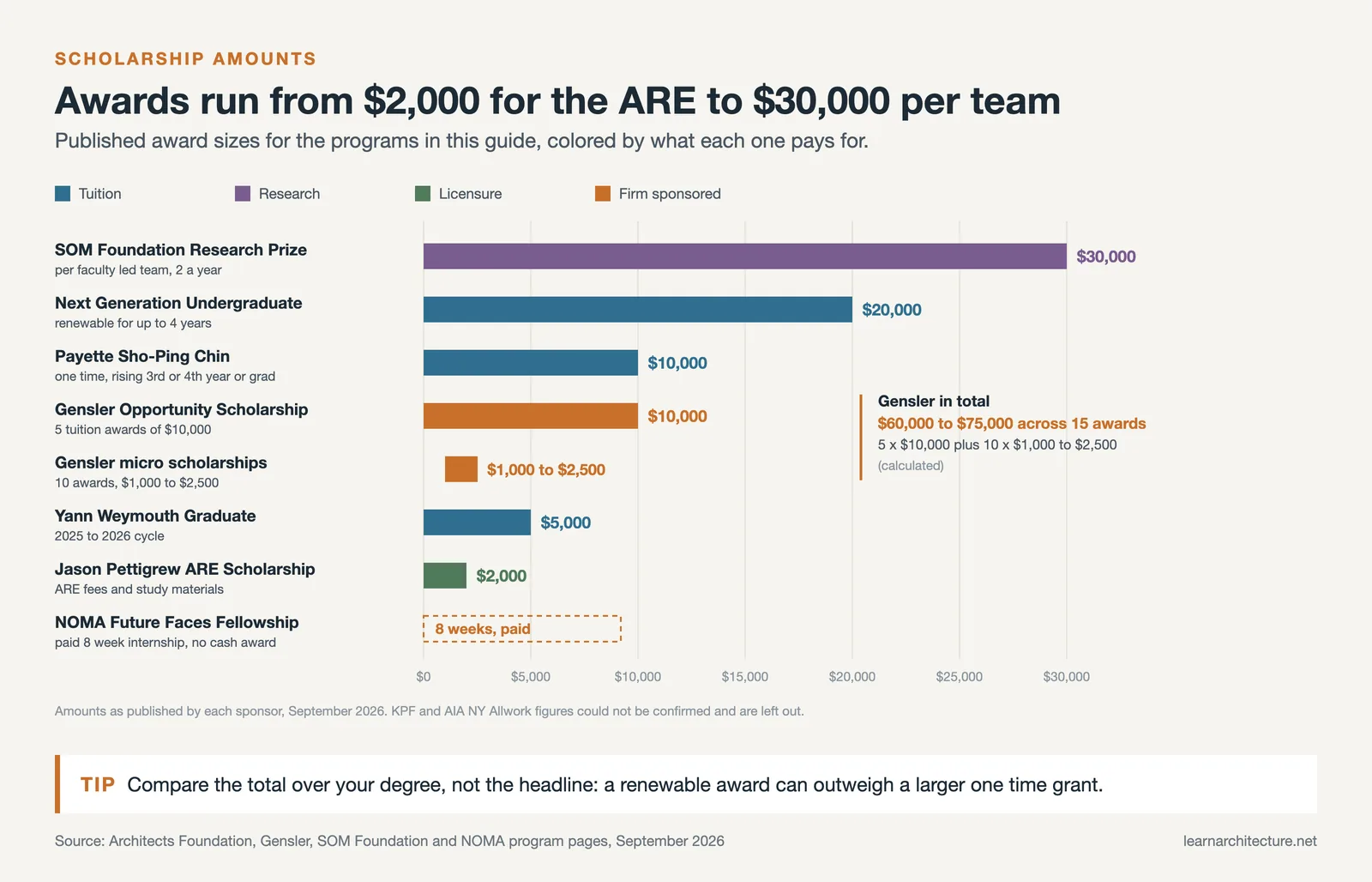
The eight programs above target different stages of education, types of students, and funding needs. The table below summarizes the practical differences so you can build a shortlist that matches your situation.
| Scholarship | Award Amount | Stage | Best For |
|---|---|---|---|
| Next Generation Scholarship | Up to $20,000 (multi-year) | Undergrad / transfer | Long-term tuition relief |
| Payette Sho-Ping Chin | $10,000 | Undergrad (3rd/4th yr) or grad | Women in NAAB programs |
| Yann Weymouth Graduate | $5,000 | Graduate | Sustainability-focused work |
| Gensler Opportunity Scholarship | $60,000+ pool, ~15 awards | Final year NAAB | Tuition + summer internship |
| SOM Foundation Research Prize | $30,000 per team | Faculty-led teams (US) | Interdisciplinary research |
| KPF Traveling Fellowship | $10,000 (3 awards) | Penultimate year (partner schools) | Summer travel research |
| NOMA Future Faces Fellowship | Paid 8-week internship | Final-year NAAB | Internship for architecture students in USA |
| AIA NY Eleanor Allwork | Up to $7,500 (honors up to $10,000) | Undergrad / grad in NY State | Regional NY-based students |
Notice how only the NOMA Future Faces Fellowship explicitly bundles a paid internship into its structure. If hands-on practice experience is your priority, that is the program that addresses both the funding gap and the practice gap at the same time. For purely tuition-focused support, the Architects Foundation pipeline (Next Generation, Payette Sho-Ping Chin, Yann Weymouth) is the most consistent annual cycle to plan around.
How to Build a Stronger Application

Most national architecture scholarships evaluate four components: portfolio, personal statement, academic record, and letters of recommendation. The relative weighting varies, but the patterns reviewers complain about are similar across programs.
The portfolio is where most strong candidates lose ground. A scholarship portfolio is not the same as a graduate school portfolio. Reviewers spend a few minutes per submission, so density and clarity matter more than volume. Three to five carefully presented projects, with clear diagrams and a short written argument for each, consistently outperform a fifteen-project document with thin descriptions. If you are still building the document you will need for these applications, the guide to projects worth including in an architecture student portfolio covers what reviewers actually respond to.
The personal statement should answer one specific question: why does this scholarship align with where you are going as a designer? Generic statements about loving architecture or wanting to help communities rarely distinguish candidates. References to a specific thesis direction, a design problem you are working on, or a particular aspect of practice you plan to pursue are far more memorable. Students who have completed an internship before applying tend to write more sharply about practice intent, which is why having relevant experience documented in your application matters. The step-by-step internship guide on Learn Architecture covers how to secure that experience and frame it in writing.
💡 Pro Tip
Letters of recommendation make or break borderline applications. A generic letter from a professor who barely knows your work is worse than no letter at all. Approach faculty members early, share the scholarship description, and remind them of one or two specific projects or moments from your studio work that they could speak to. The Architects Foundation explicitly notes that generic letters are not well received by reviewers.
What Else to Consider Beyond These Eight Scholarships
The eight programs above are a strong starting list, but they are not the entire field. Most state AIA components run their own annual scholarship cycles, often funded jointly with AIA National’s Component Matching Scholarship Grant Program. Awards from chapters like AIA Rochester, AIA New York State, and AIA West Virginia typically range from $1,000 to $5,000 and are far less competitive than the national programs because the applicant pool is smaller.
Specialty awards add another tier. The Tom Cory Scholarship from the Architectural Precast Association covers precast-focused work, the AISC Student Design Competition recognizes steel-related projects with cash prizes, and the ACSA-sponsored COTE Top Ten for Students competition gives climate-focused studio projects national exposure. None of these programs exclude general architecture students; they reward portfolios that engage substantively with their topic. If your studio work has a clear thematic focus, applying to two or three specialty awards often yields better results than competing for a single high-profile national scholarship.
For graduate students aiming at named programs, institutional aid through Harvard GSD, Yale SoA, Columbia GSAPP, and similar schools usually exceeds anything available through external scholarships. The financial aid office, fellowship pool, and teaching assistantships at these schools combined can cover a substantial portion of tuition. External scholarships are then used to fill the remaining gap rather than serving as your primary funding source. Students considering this path benefit from understanding how master’s programs structure aid, which the article on succeeding in architectural graduate programs covers in more detail.
✅ Key Takeaways
- The Architects Foundation pipeline (Next Generation, Payette Sho-Ping Chin, Yann Weymouth) is the most consistent annual scholarship cycle for NAAB-accredited students in the US.
- Travel fellowships from SOM and KPF carry larger amounts but require strong solo portfolio work and, in KPF’s case, school-level nomination.
- Fully funded architecture scholarships for international students in USA are rare in name, but several US-based programs do not require citizenship and are open to anyone enrolled in an accredited US institution.
- The NOMA Future Faces Fellowship is the strongest option if a paid internship for architecture students in USA is your priority alongside funding.
- Regional and specialty scholarships (AIA chapter awards, ACSA competitions, firm-sponsored programs) are less competitive than national programs and worth applying to in parallel.
- The application components that move the needle are a focused portfolio, a specific personal statement, and recommendation letters from faculty who genuinely know your work.
Final Thoughts
The realistic path for most students is layered funding rather than a single windfall. Combining institutional aid from your school, one or two of the larger national scholarships above, and a regional or specialty award typically produces stronger results than chasing the single biggest award you can find. Plan applications twelve to eighteen months ahead of your target academic year, since most national deadlines fall before university financial aid decisions are finalized. Architecture education is expensive, but the funding does exist for students who treat the application process with the same care they bring to studio work.
Disclaimer: Award amounts, eligibility criteria, and application deadlines change between cycles. Always verify the current details on the program’s official website before submitting your application. The information here reflects published program details available at the time of writing.
- Architecture scholarships for international students
- architecture scholarships for international students in usa
- Architecture Student Scholarships
- fully funded architecture scholarships for international students in usa
- internship for architecture students in usa
- scholarship for architecture students
- scholarship for architecture students international
- scholarships for architecture students
- scholarships for architecture students in usa











Leave a comment