


Table of Contents Show
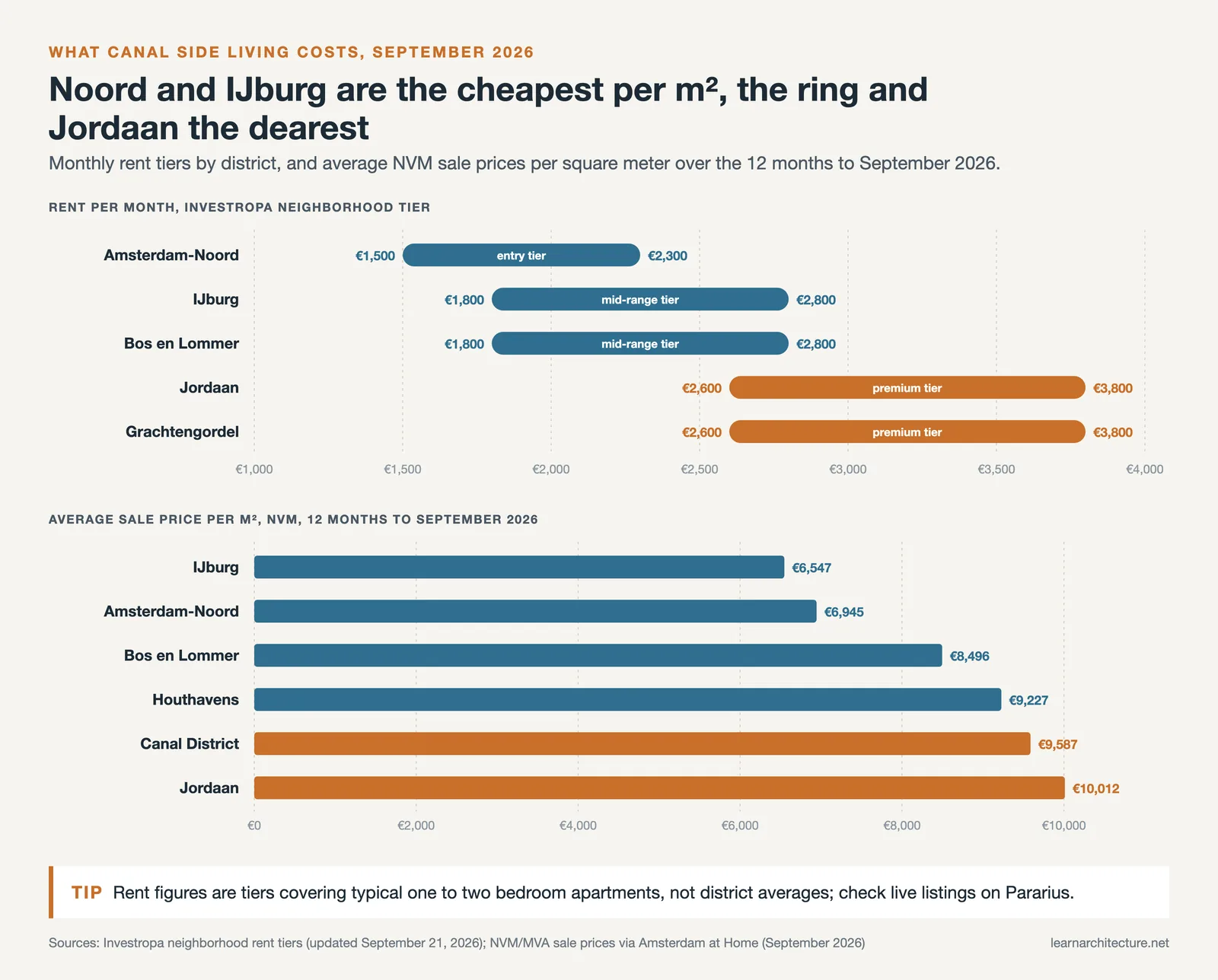
Cheap canal-side apartments in Amsterdam do exist, but they sit outside the famous 17th-century Grachtengordel and cluster around secondary waterways in Amsterdam-Noord, Bos en Lommer and IJburg. In these areas, studio and one-bedroom units on smaller canals or waterfronts typically rent within Investropa’s entry and mid-range tiers of about €1,500 to €2,800 per month, while NVM sales over the 12 months to September 2026 averaged €6,547 per m² in IJburg and €6,945 in Amsterdam-Noord, against €9,587 in the Canal District, as of September 2026 (Amsterdam at Home).
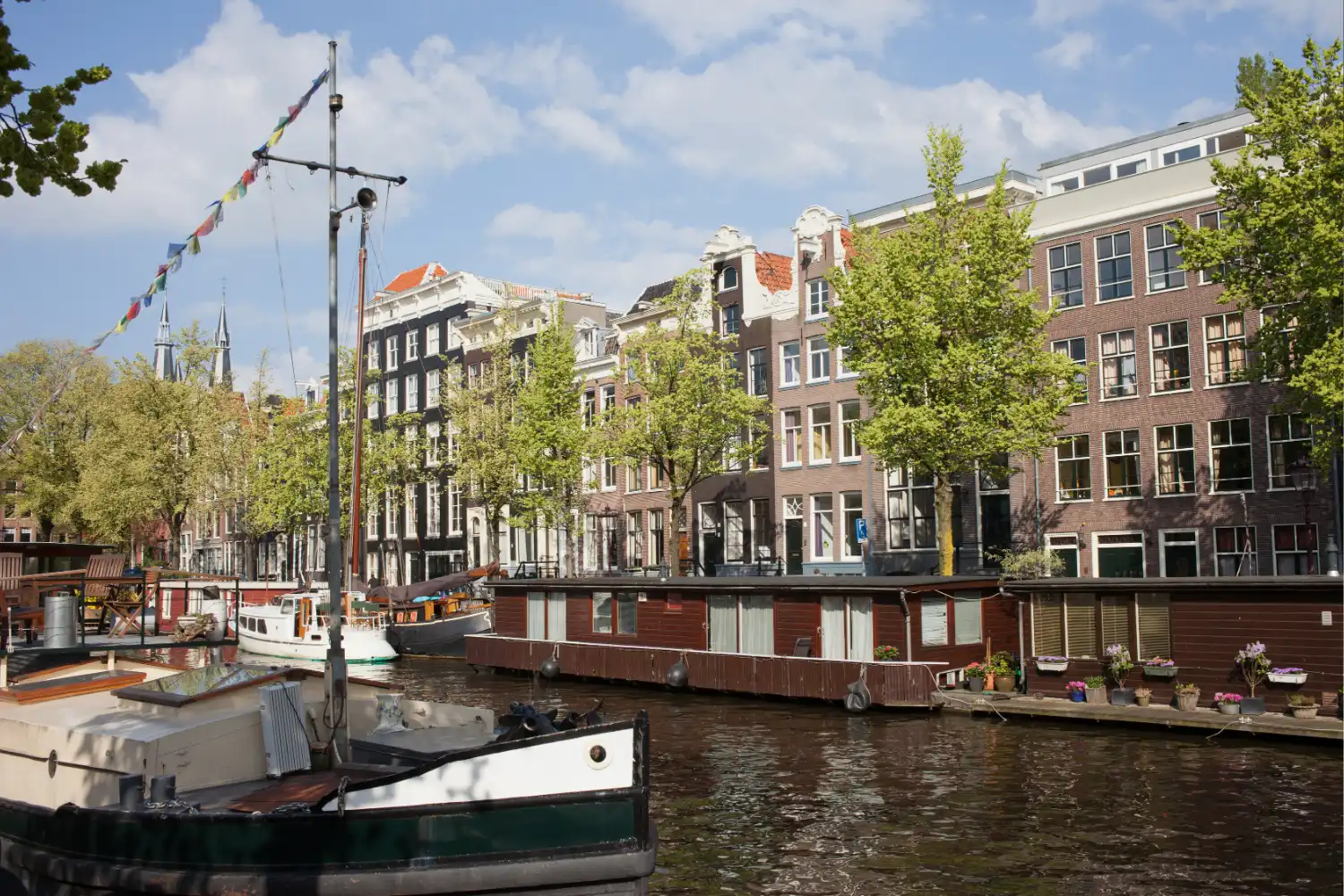
Amsterdam’s canals are so tightly woven into the city that the word “canal-side” can mean very different things depending on where you stand. A view over the Prinsengracht in the UNESCO-protected Seventeenth-Century Canal Ring will never be cheap. But the city has dozens of smaller canals, reclaimed docks, and newer waterways where apartments sit directly on the water at a fraction of the price. This guide covers where those apartments are, what the architecture actually looks like, and the realistic numbers you should expect.
What Counts as a Canal-Side Apartment in Amsterdam?
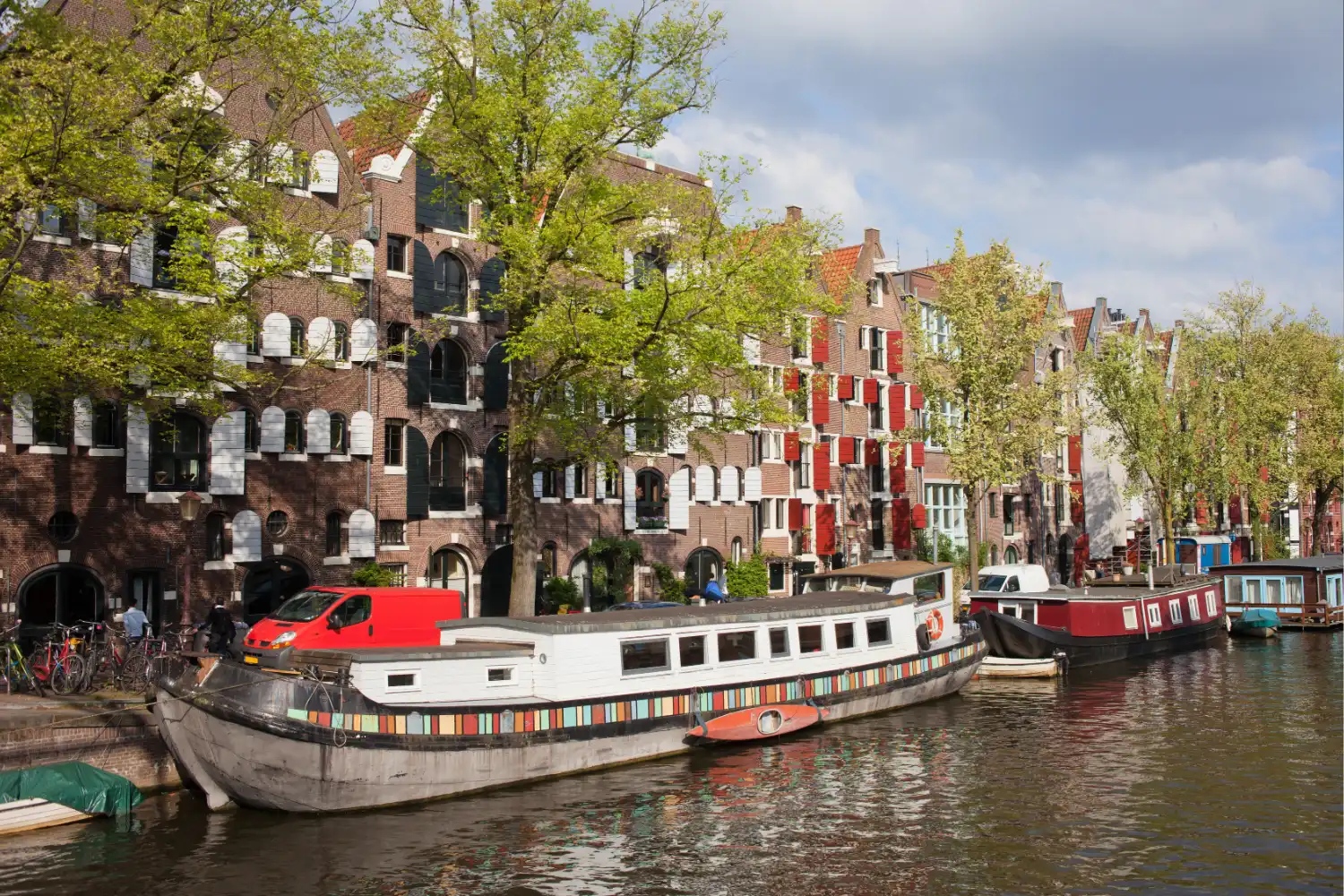
A canal-side apartment is any residential unit with a facade, entrance, or primary view facing a canal, gracht, singel, or reclaimed waterway. Amsterdam has more than 100 kilometers of canals and around 1,500 bridges, so waterfront adjacency is more common than in most European cities. The price difference between a gracht view and a street view in the same building can be 15 to 25 percent.
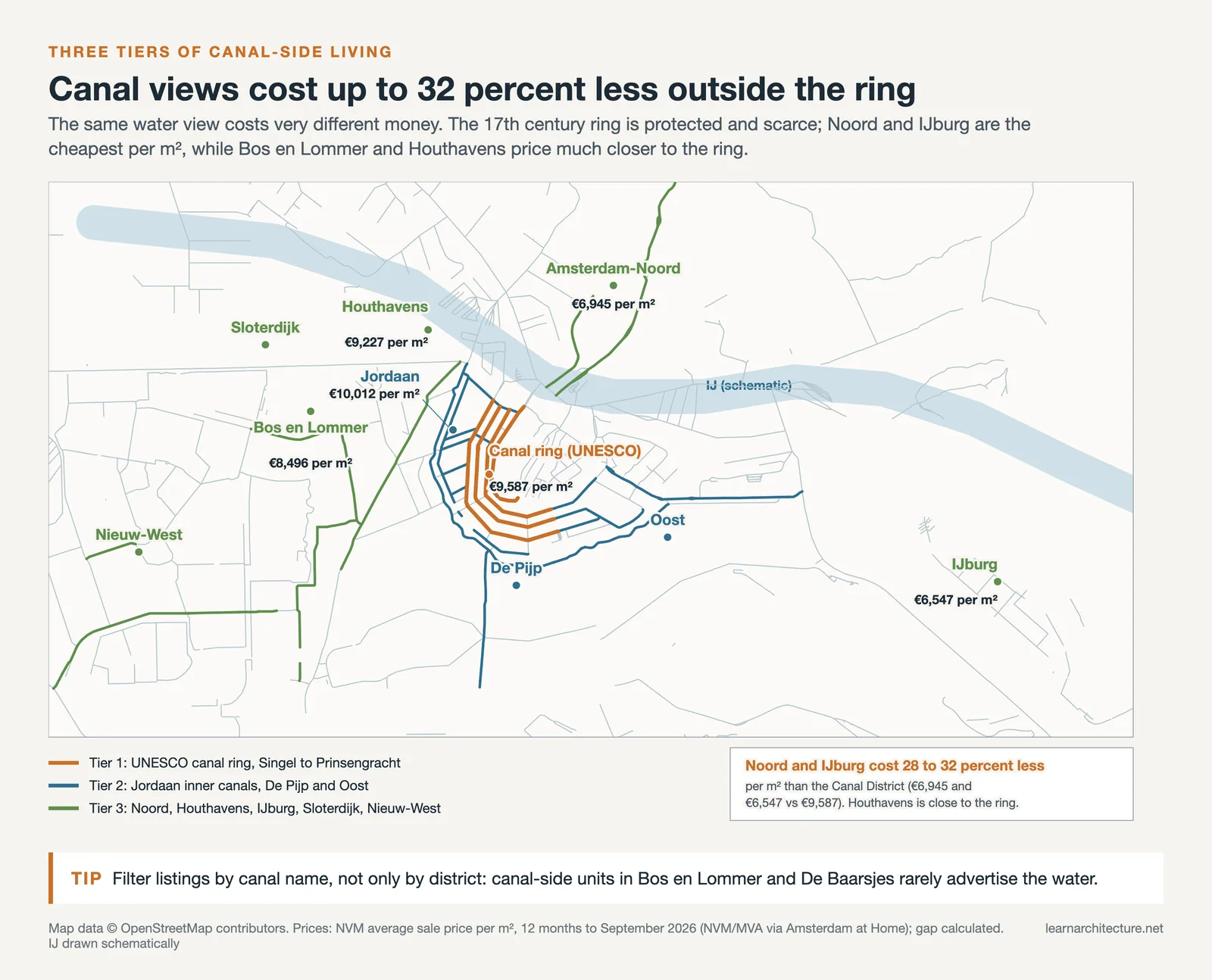
Not all canal-side addresses are equal, though. There are three main tiers. The first is the UNESCO-listed canal ring, covering Herengracht, Keizersgracht, Prinsengracht, and the Singel, where buildings are protected monuments and prices are extreme. The second tier covers Jordaan’s smaller internal canals (Bloemgracht, Egelantiersgracht, Brouwersgracht edges) and the 19th-century canals of De Pijp and Oost. The third tier, and the one that matters most for this article, covers post-industrial waterfronts and outer-ring canals in Amsterdam-Noord, Houthavens, IJburg, Sloterdijk, and parts of Nieuw-West.
💡 Pro Tip
When viewing an Amsterdam canal apartment, always ask which side of the building the unit faces and on what floor. A back unit on the first floor with a courtyard view and a front unit on the fourth floor with a full gracht view can have the same square meter price but feel like completely different homes. Noise from bridges, tour boats, and terraces also varies hugely between low and high floors.
Why Are Canal-Side Apartments Expensive in the First Place?
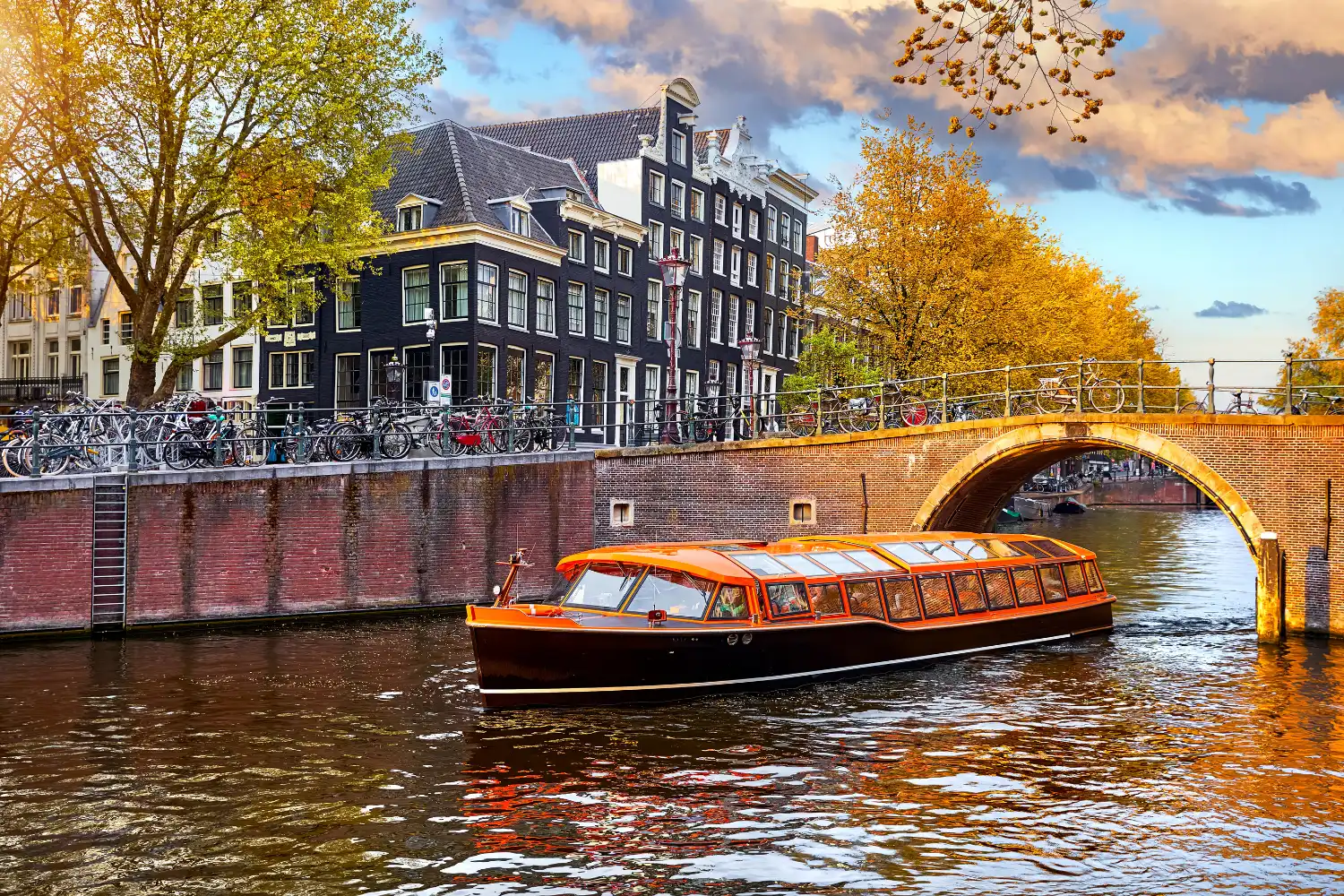
Three forces drive the premium: heritage protection, scarcity of land, and architectural typology. In the historic canal ring, every building is a protected monument, which limits renovation and supply. NVM sales in the Canal District (Grachtengordel) averaged €9,587 per square meter over the 12 months to September 2026, and the neighboring Jordaan was higher still at €10,012, according to NVM/MVA data published by Amsterdam at Home. Canal-adjacent buildings rarely come to market, so the little supply that does is fought over.
The second factor is the apartment stock itself. Most historic canal-side buildings are narrow, deep merchant houses converted into two to four apartments each. Floor plates are tight, staircases are notoriously steep, and ceilings in the older stock can be surprisingly low in upper floors. That combination of heritage and compromise creates a unique product, which is part of why the premium exists.
🔢 Quick Numbers
- Canal District (Grachtengordel) average sale price: €9,587 per m², with Jordaan at €10,012 (NVM, 12 months to September 2026)
- Amsterdam-Noord €6,945 and IJburg €6,547 per m², the lowest of the districts in this guide (NVM, 12 months to September 2026)
- Bos en Lommer €8,496 and Houthavens €9,227 per m²: cheaper than the canal ring, but well above Noord and IJburg (NVM, 12 months to September 2026)
- Typical one to two bedroom rents run from about €1,500 in Zuidoost to over €3,500 in Grachtengordel and Jordaan (Investropa, updated September 2026)
Where to Find Genuinely Cheap Canal-Side Apartments in Amsterdam
Cheap is relative in Amsterdam, but real value exists if you step outside the famous rings. The districts below offer actual waterfront adjacency without the historic monument premium.
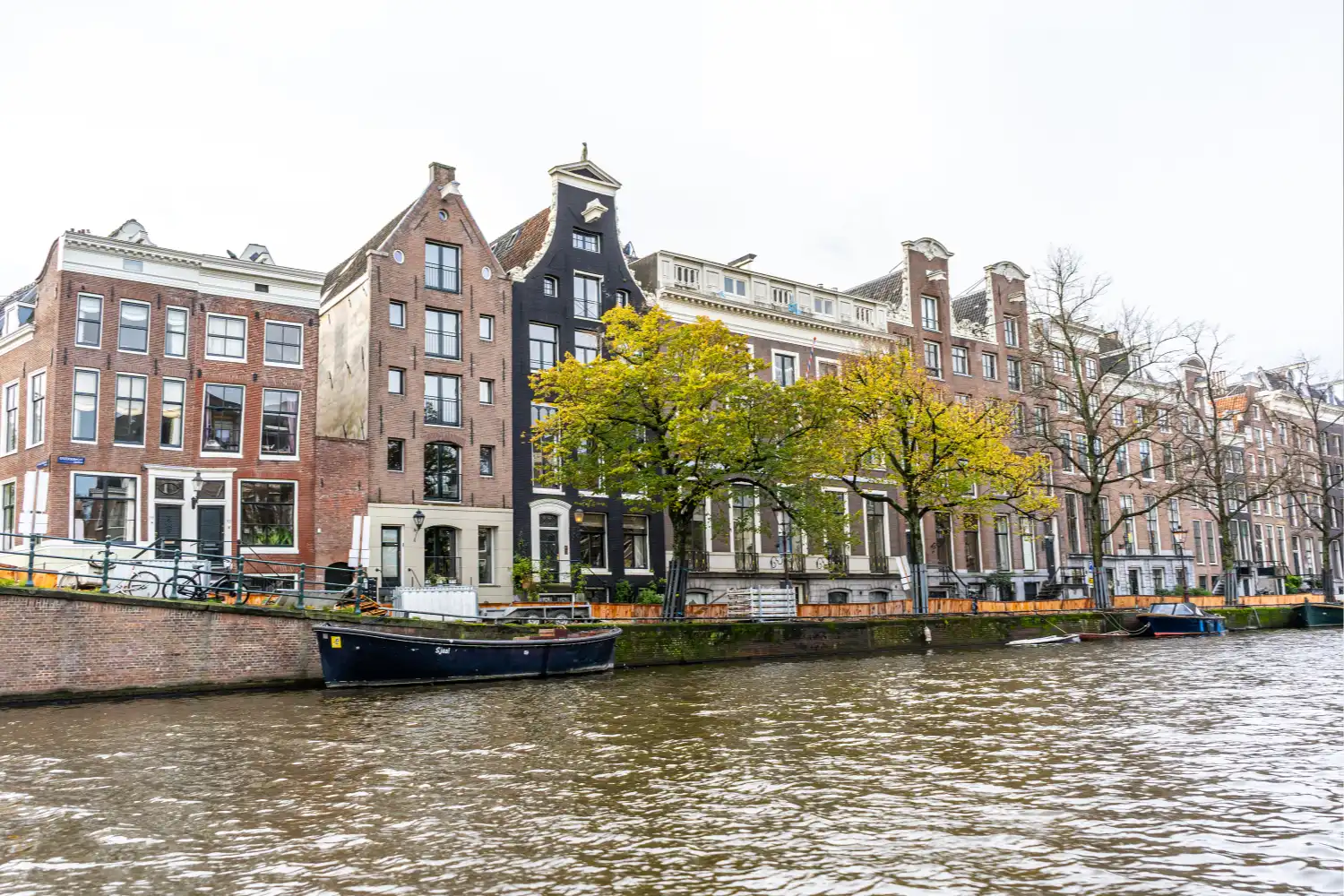
Amsterdam-Noord: The Affordable Waterfront
Amsterdam-Noord sits directly across the IJ waterway from Central Station and has transformed over the last decade from an industrial area into one of the city’s most interesting residential districts. The ferry is free, the journey is three to four minutes, and the waterfronts of the Noordhollandsch Kanaal and the smaller canals around Nieuwendammerdijk offer canal-side apartments for roughly 28 percent less per square meter than the canal ring: NVM sales in Noord averaged €6,945 per m² over the 12 months to September 2026, against €9,587 in the Canal District, although the handful of sales on Nieuwendammerdijk itself averaged €9,274. At the district average, a budget of €230,000 to €320,000 buys roughly 33 to 46 m². Rents in Investropa’s entry tier, which includes parts of Nieuwendam, run about €1,500 to €2,300 per month.
IJburg and Zeeburg: New-Build Water Living
IJburg is a set of reclaimed islands in the IJmeer, finished in phases from the 2000s onward. It is the clearest example of contemporary Dutch waterfront architecture, with courtyards opening onto private docks, floating homes, and bridge-linked blocks. NVM sales here averaged €6,547 per square meter over the 12 months to September 2026, the lowest of the districts in this guide, compared to €9,587 in the Canal District, and the apartments are newer, better-insulated, and larger on average. The trade-off is distance: you are 15 to 25 minutes by tram from the center.
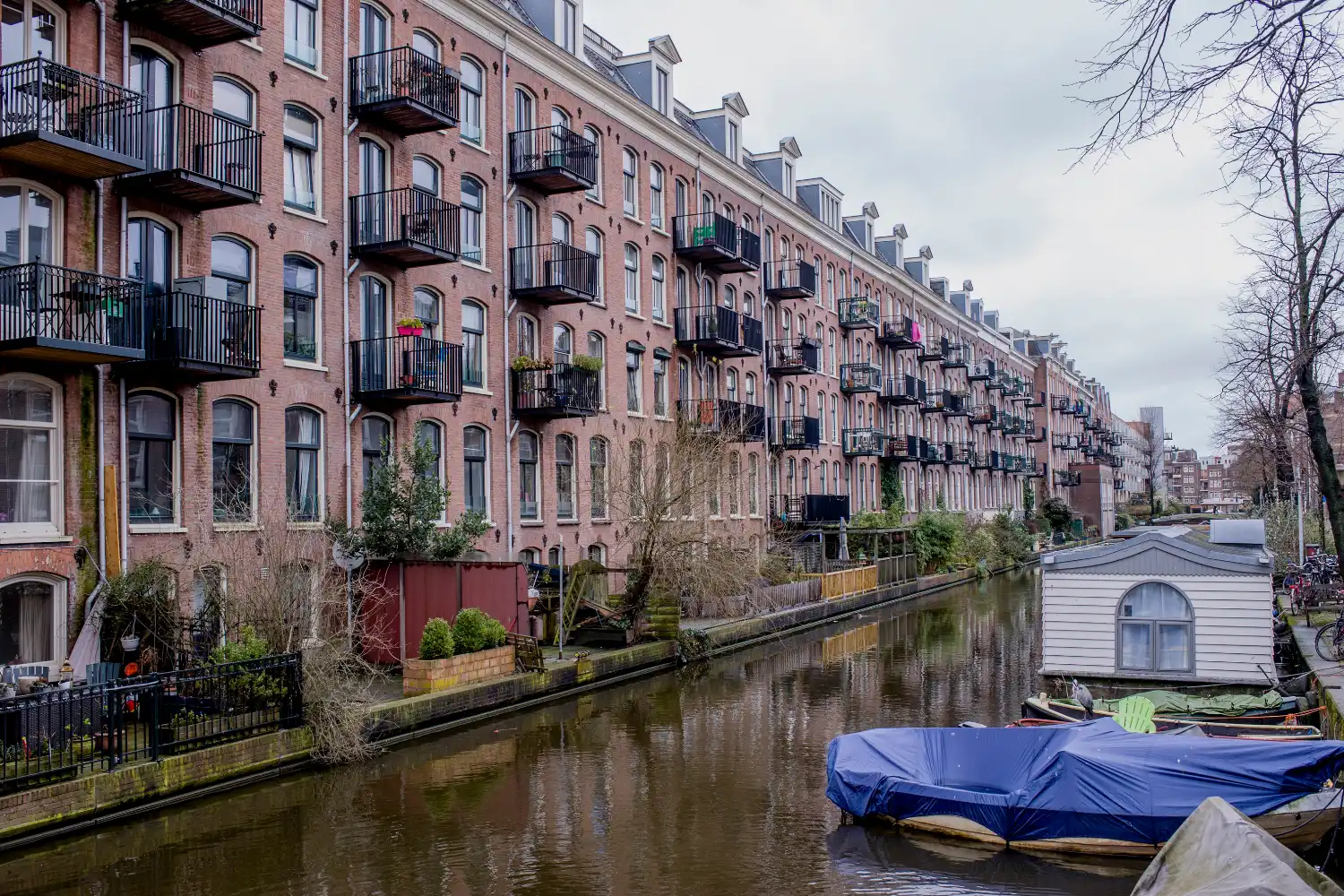
Bos en Lommer and De Baarsjes
West of the Jordaan, these districts sit along the Kostverlorenvaart and Erasmusgracht. The architecture is mostly interwar Amsterdam School brick blocks, often with small balconies facing the water. NVM sales in Bos en Lommer averaged €8,496 per m² over the 12 months to September 2026, about 11 percent below the Canal District but well above Noord and IJburg, and the tram connections to the center are strong. Canal-side units here rarely advertise themselves as such, so you have to filter listings manually.
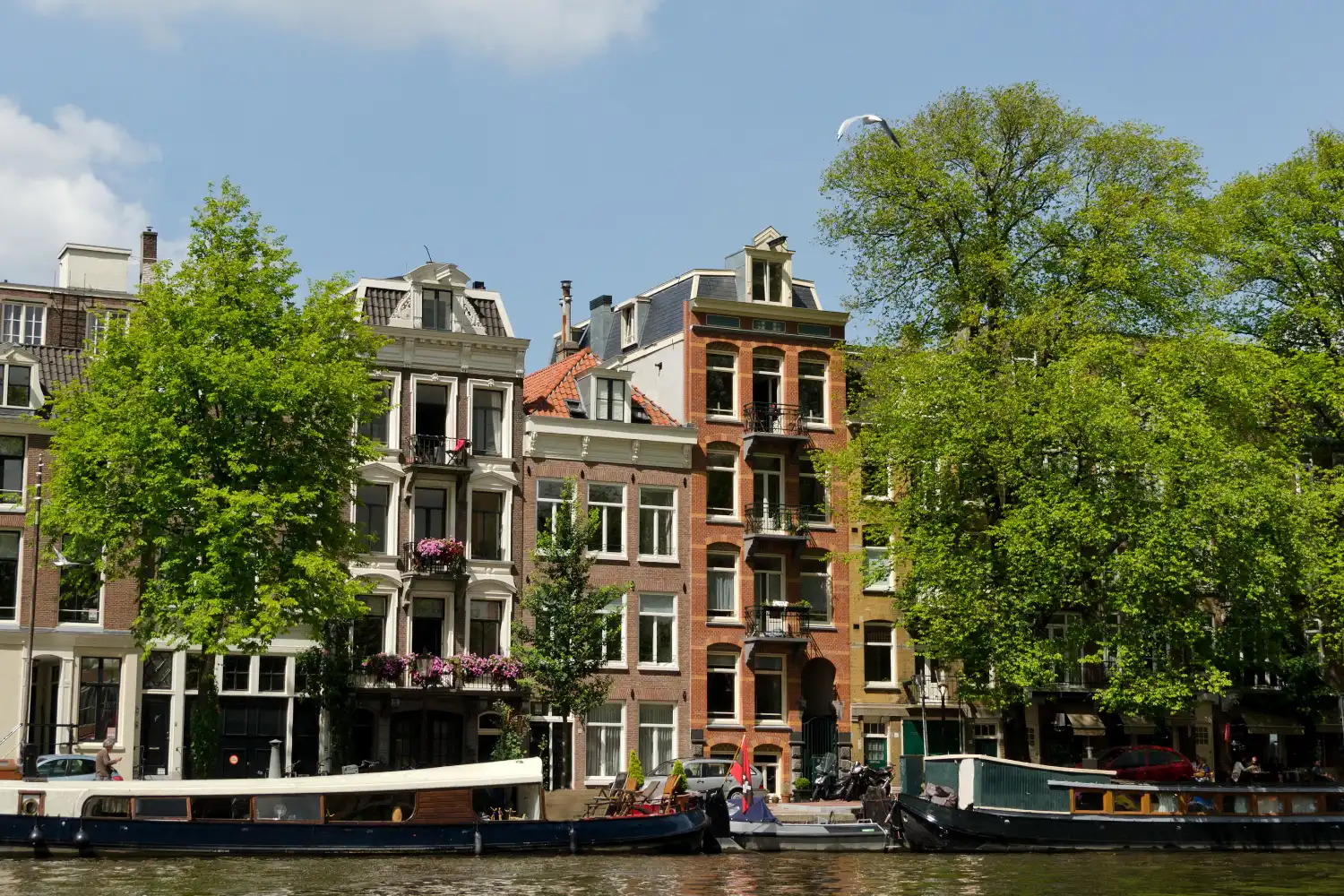
Houthavens and Sloterdijk Harbor Edges
Houthavens, the former timber harbor just west of Westerpark, is one of Amsterdam’s most recent large-scale residential projects. The buildings sit on reclaimed piers and peninsulas, with small marinas between them. Prices are higher than Noord but still below the historic center: NVM sales in Houthavens averaged €9,227 per m² over the 12 months to September 2026, against €6,945 in Noord and €9,587 in the Canal District, and the architecture is genuinely contemporary: CLT and concrete hybrids, stepped facades, and active ground-floor mixed use.
🏗️ Real-World Example
Sluishuis (IJburg, 2022): Designed by BIG and Barcode Architects, this 46,000 m² residential complex sits directly on the IJmeer with a boat passage cut through its mass. It houses 442 apartments and a public waterfront, and demonstrates how new-build canal-side architecture in Amsterdam is handling scale, water access, and density together rather than treating them as separate problems. Many units in Sluishuis price below equivalent central-canal properties despite being direct waterfront.
How Amsterdam Architecture Apartments Differ on the Water
Canal-side apartments in Amsterdam are built on top of wooden piles driven 10 to 15 meters into the soft soil, a technique dating to the 17th century and still used in modified form today. This affects everything about how the apartment feels. Historic buildings lean, settle unevenly, and creak. Newer buildings sit on concrete piles and feel completely rigid, which is one of the most tangible differences between a Grachtengordel unit and an IJburg one.
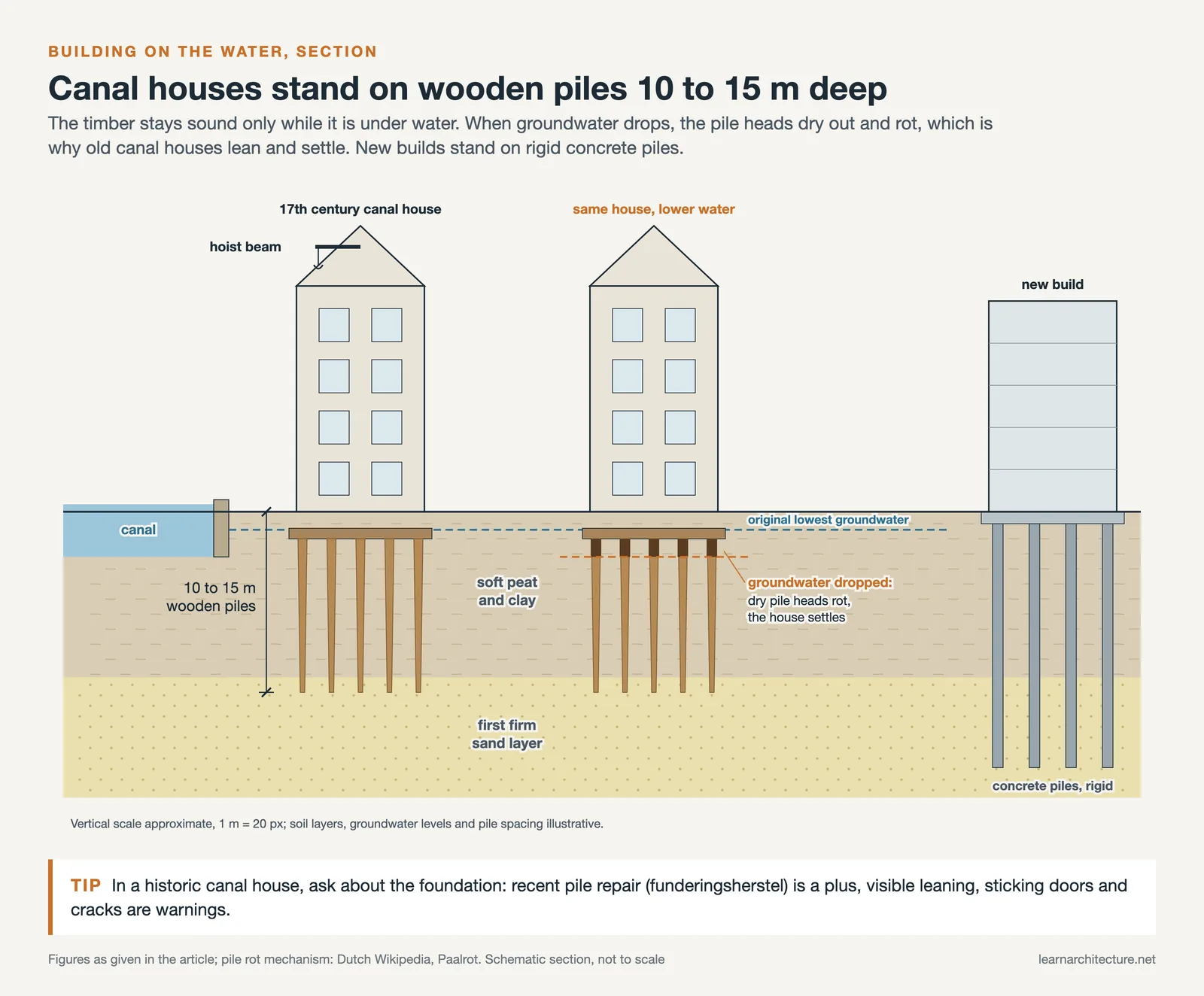
The other signature feature of Amsterdam apartment design is the hoist beam. In merchant houses along the canals, staircases were kept narrow to maximize living area, so furniture has always been pulled up through front windows using a hook beam projecting from the gable. If you rent or buy in a historic building, the hoist is not decorative. You will use it.
📌 Did You Know?
Amsterdam’s entire 17th-century canal ring is a UNESCO World Heritage Site inscribed in 2010, covering more than 90 islands linked by 1,500 bridges. The site is recognized as the largest and most homogeneous urban expansion of the 17th century and served as a reference for town planning worldwide until the 19th century.
Comparison: Cheap vs. Premium Canal-Side Districts
The table below gives a side-by-side view of what you actually get for your money across five canal-side Amsterdam districts, ordered from most to least expensive per m². Every price per m² is the NVM average sale price over the 12 months to September 2026, as published by Amsterdam at Home from NVM/MVA market data; Grachtengordel appears there as the Canal District. Rents are the neighborhood tiers given by Investropa (page updated September 21, 2026); they cover typical one to two bedroom apartments and are tiers, not district averages. On this basis IJburg, not Noord, has the lowest price per m², and Jordaan is slightly more expensive per m² than the canal ring itself.
| District | Price per m² (NVM, Sep 2026) | Rent / Month (Investropa tier) | Architecture | Best For |
|---|---|---|---|---|
| Jordaan | €10,012 | €2,600 to €3,800 (premium) | Small-canal tenement blocks | Central village feel |
| Grachtengordel (Canal Ring) | €9,587 | €2,600 to €3,800 (premium) | 17th-century merchant houses | Heritage buyers |
| Bos en Lommer | €8,496 | €1,800 to €2,800 (mid-range) | Interwar Amsterdam School brick blocks | Tram access west of the center |
| Amsterdam-Noord | €6,945 | €1,500 to €2,300 (entry) | Post-industrial and contemporary | Lowest rent tier |
| IJburg | €6,547 | €1,800 to €2,800 (mid-range) | New-build, reclaimed islands | Families, most space per euro |
What to Actually Check When Viewing Amsterdam Apartments for Rent
Cheap rarely means low-quality in Amsterdam, but canal-side buildings carry specific risks that standard apartment hunting checklists miss. The two biggest are foundation condition and damp. Many pre-1940 buildings still rest on original wooden pile foundations, and piles exposed to air through fluctuating groundwater levels rot. Ask whether the Vereniging van Eigenaren (VvE) has had a recent funderingsonderzoek (foundation inspection). If the answer is vague, assume the worst.
Damp is the second issue. Canal-side walls in older stock frequently show rising damp in the lower meters of interior walls. Look at the base of exterior walls, check for bubbling paint, and sniff near the skirting. In winter viewings, ask for the monthly heating bill. A number above €250 for a one-bedroom is a warning sign about insulation.
⚠️ Common Mistake to Avoid
Many renters assume that “canal view” in a listing means a primary view of a main canal. In Amsterdam this is often used loosely for any water-adjacent unit, including those facing small side canals behind a row of other buildings. Before paying any deposit, ask for the exact address and check it on a map. The difference between a Prinsengracht view and a view of an interior service canal is a three-figure monthly rent gap.
Canal-Side Apartments for Rent: Search Platforms and Tactics
Private-sector rentals in Amsterdam are dominated by a handful of platforms. Pararius and Funda cover the largest inventory, with Pararius leaning toward rentals and Funda toward sales. Filters for “waterfront” or “water view” are inconsistent, so search by specific street names along canals you care about rather than by feature tags.
Timing matters more than most people realize. Market data for 2026 shows Amsterdam rental listings typically stay on the market for 15 to 20 days, but well-priced units in popular areas find tenants within a week. That means you need to be ready to view within 48 hours of a listing going live, with documentation (employer letter, payslips, ID) already packaged. For international moves, viewings through Dutch-speaking agents can also significantly expand the pool of off-market canal-side apartments that never hit the public platforms.
Video: Understanding Amsterdam Canal House Architecture
This short explainer from Bright Trip walks through why Amsterdam’s canal houses look the way they do, why they lean, and how their narrow, deep typology was shaped by tax rules and limited land. Helpful context before you start viewing canal-side apartments in person.
Apartments in Amsterdam Netherlands: Rules That Affect Pricing
Dutch housing policy changes quickly, and rental pricing in Amsterdam in 2026 is heavily shaped by the Wet betaalbare huur (Affordable Rent Act), which extended regulated rent caps to a much wider range of properties. This pushed some units out of the free-sector rental market entirely, and some landlords have responded by selling rather than renting. For buyers, this has softened a narrow band of mid-market prices. For renters, it means more small and mid-size apartments are now rent-controlled, with eligibility based on a points system (puntensysteem) rather than just income.
From January 1, 2026, the rent limit condition for huurtoeslag (housing allowance) eligibility was also removed, meaning more renters may qualify for allowance even if rent is above the previous €900 threshold. This is worth checking before signing any canal-side lease, especially for students and lower-income tenants.
Cost figures, rent levels, and rental regulations vary by neighborhood, individual property, and over time. Always verify with current listings on Pararius, Funda, or a licensed real estate agent, and consult local Dutch tax and housing advice before signing any agreement.
How Much Does a Cheap Canal-Side Apartment in Amsterdam Actually Cost?
For rentals, Investropa’s neighborhood tiers (page updated September 21, 2026) put entry-level apartments in areas including parts of Nieuwendam in Noord at about €1,500 to €2,300 per month, standard one to two bedroom apartments in mid-range districts such as Bos en Lommer and IJburg at €1,800 to €2,800, and high-end apartments in Grachtengordel and Jordaan at €2,600 to €3,800. For purchase, NVM sales over the 12 months to September 2026 averaged €6,547 per m² in IJburg, €6,945 in Amsterdam-Noord, €8,496 in Bos en Lommer, €9,587 in the Canal District and €10,012 in Jordaan. At those averages, a €300,000 budget buys roughly 46 m² in IJburg, 43 m² in Noord, 35 m² in Bos en Lommer and 31 m² in the Canal District, which is why realistic “cheap” canal-side buying, for the purposes of this article, means Noord and IJburg.
✅ Key Takeaways
- Genuinely cheap canal-side apartments in Amsterdam exist, but almost entirely outside the UNESCO canal ring, in Amsterdam-Noord and IJburg, with Bos en Lommer a mid-priced alternative.
- The Grachtengordel premium is real: €9,587 per m² in the Canal District compared to €6,945 in Amsterdam-Noord and €6,547 in IJburg (NVM, 12 months to September 2026), a gap of roughly 28 to 32 percent.
- New-build canal-adjacent districts like IJburg and Houthavens offer better insulation and easier maintenance than historic stock, and IJburg also gives the most space per euro.
- Foundation condition (funderingsonderzoek) and damp are the two most important checks unique to canal-side Amsterdam viewings.
- The 2026 Wet betaalbare huur and updated huurtoeslag rules have reshaped the mid-market and widened allowance eligibility, both worth factoring in before signing.
Final Thoughts
Canal-side living in Amsterdam does not require a Grachtengordel budget. It requires a clear view of where the actual waterfront stock sits and how the architecture and pricing in those districts differ from the tourist image of the city. Noord, IJburg, and Houthavens are where the next decade of canal-adjacent residential design is being built, and they offer a more realistic path into water-facing Amsterdam apartment design than the historic center. For heritage and character, Jordaan’s smaller canals remain the best mid-tier choice. For pure affordability, IJburg and Amsterdam-Noord are the clearest options in 2026, with the lowest NVM prices per m² of the districts in this guide, and Noord’s ferry connection makes the distance argument weaker every year.
Related reading on learnarchitecture.net: the 2025 affordable housing trends report covers micro-apartments, adaptive reuse, and modular construction as the main forces reshaping urban housing, many of which apply directly to Amsterdam’s newer canal-side developments. For broader design thinking on small-space efficiency, see the small spaces design tips guide, and for how European cities are approaching socially-oriented housing next to waterfront sites, the Illa Glòries Social Housing case study offers a useful comparison. For further context on Amsterdam’s broader residential stock, see the apartment architecture category, which collects projects across Europe with similar density and water-adjacent constraints.












Leave a comment