


Table of Contents Show
Architecture movies offer architects and design students a unique way to study how space, light, and structure shape human experience on screen. The best films about architecture go beyond pretty backdrops, treating buildings and cities as active participants in storytelling. The 10 movies below reward repeated viewing with fresh ideas about form, materials, circulation, and the emotional power of designed environments.
Film and architecture share a deep connection rooted in how both disciplines frame space and guide the viewer through it. A director composes shots the way an architect composes plans: by controlling sightlines, managing light, and sequencing movement. For this reason, movies about architecture are not just entertainment for designers. They are case studies in spatial thinking presented through a lens that strips away technical drawings and lets you experience space as an occupant would.
The list below mixes narrative features, documentaries, and science fiction. Some films place an architect as the main character, while others simply treat the built environment with enough care and intelligence to make any designer sit up and pay attention. Each entry includes a brief note on why it matters from a design perspective.
The Fountainhead (1949): Architecture as Individual Vision

Based on Ayn Rand’s novel, The Fountainhead follows Howard Roark, a fictional architect who refuses to compromise his design principles despite enormous pressure from clients, critics, and colleagues. Gary Cooper plays Roark with a quiet stubbornness that mirrors the character’s buildings: stripped of ornament, honest in material expression, and indifferent to popular taste. The film stages a debate about artistic integrity versus commercial conformity that still resonates in every architecture studio where students argue over client demands and design awards.
The production design draws on modernist principles, with Roark’s buildings echoing the work of Frank Lloyd Wright and the International Style. While the film oversimplifies the relationship between architect and society, it forces viewers to consider what they would sacrifice, and what they would refuse to sacrifice, for a design they believed in.
🎓 Expert Insight
“Architecture is the will of an epoch translated into space.”
Ludwig Mies van der Rohe
This principle sits at the core of what The Fountainhead dramatizes. Roark’s designs, like Mies’s own work, insist that buildings should express the spirit of their time honestly rather than retreating into historical pastiche.
My Architect (2003): A Documentary on Legacy and Space
Nathaniel Kahn’s documentary about his father, Louis Kahn, is part biography, part architecture pilgrimage, and part family reckoning. The younger Kahn travels to his father’s buildings around the world, from the Salk Institute in La Jolla to the National Parliament House in Dhaka, Bangladesh, searching for an understanding of a man he barely knew. The film succeeds because it treats famous architects as real people with complicated lives, not just names on building plaques.
What makes My Architect essential for architecture lovers is how it photographs buildings. Kahn’s structures are filmed with patience, allowing natural light to move across concrete surfaces, revealing the material quality and spatial depth that photographs in textbooks rarely capture. If you have ever wondered why architects talk about “the quality of light” in a room, this movie will show you exactly what they mean.
Blade Runner (1982): Dystopian Urbanism as Design Warning

Ridley Scott’s science fiction classic imagines Los Angeles in 2019 as a rain-soaked, vertically stratified megacity where neon advertisements compete with industrial exhaust for the skyline. The production design by Syd Mead and Lawrence G. Paull drew on real architectural references: the Bradbury Building in downtown Los Angeles, Ennis House by Frank Lloyd Wright, and the dense urban fabric of Hong Kong’s Kowloon Walled City. The result is a movie about architecture in everything but name, a film where the city itself functions as a character dictating mood, movement, and social hierarchy.
For architects, Blade Runner remains a powerful thought experiment about what happens when urbanism prioritizes commerce and density without considering livability. The film’s influence on speculative architecture and innovative design ideas is enormous, visible in the work of firms like Morphosis and Coop Himmelb(l)au.
💡 Pro Tip
When watching Blade Runner or its 2017 sequel, pay close attention to how vertical layering creates social narrative. Ground-level streets are dark, crowded, and polluted, while upper levels have clean air and natural light. This is a cinematic version of section drawing analysis, and it works as a design exercise if you pause and sketch the spatial hierarchy you see on screen.
Inception (2010): Architecture as Spatial Logic
Christopher Nolan’s Inception places an architect at the center of its plot. Ellen Page plays Ariadne, a design student recruited to build dream worlds that must follow spatial rules convincing enough to fool the dreamer’s subconscious. The film treats architecture not as decoration but as a system of logic: stairs that loop back on themselves, cities that fold like origami, and spaces that obey internal rules even when those rules defy physics.
What sets this movie apart from other films about architecture is how seriously it takes the design process. Ariadne sketches, builds models, tests spatial sequences, and iterates, the same workflow taught in architecture concept development. The Penrose staircase scene alone has generated more conversations about spatial perception in design studios than most textbooks manage.
Koyaanisqatsi (1982): The Built Environment Without Words

Godfrey Reggio’s experimental film contains no dialogue, no characters, and no traditional narrative. Instead, it pairs slow-motion and time-lapse footage of landscapes, cities, and infrastructure with Philip Glass’s hypnotic score. The title is a Hopi word meaning “life out of balance,” and the film builds its argument entirely through images of the built environment contrasted with natural landscapes.
For movies for architecture lovers, Koyaanisqatsi works as a masterclass in visual composition. The film’s footage of highways, housing projects, and demolitions forces you to look at familiar infrastructure with fresh eyes. Architects who watch it often report noticing patterns in their own cities that they had previously ignored: the rhythm of repeated window openings, the scale contrast between pedestrians and skyscrapers, the speed at which urban systems operate versus natural ones.
📌 Did You Know?
Koyaanisqatsi includes footage of the demolition of the Pruitt-Igoe housing project in St. Louis, Missouri. Designed by Minoru Yamasaki in 1954, the project’s demolition in 1972 was described by architectural historian Charles Jencks as “the day modern architecture died.” The sequence has become one of the most referenced clips in architecture education.
Why Do Architecture Movies Matter for Design Thinking?
The best architecture movies do something that plan drawings, renders, and even physical models cannot: they let you experience space in motion, over time, and through the eyes of occupants. A floor plan tells you where walls are. A film shows you what it feels like to walk between them, how light changes through a window across the course of a day, and how a corridor’s proportions affect the mood of someone passing through it.
This is why architecture in movies matters beyond entertainment. Film forces architects to think about the temporal dimension of their work, something that static drawings easily miss. Buildings are not experienced as frozen objects; they are experienced as sequences of spaces that unfold over minutes and hours. Cinema is the closest medium to that lived experience.
The Grand Budapest Hotel (2014): Color, Symmetry, and Set Design
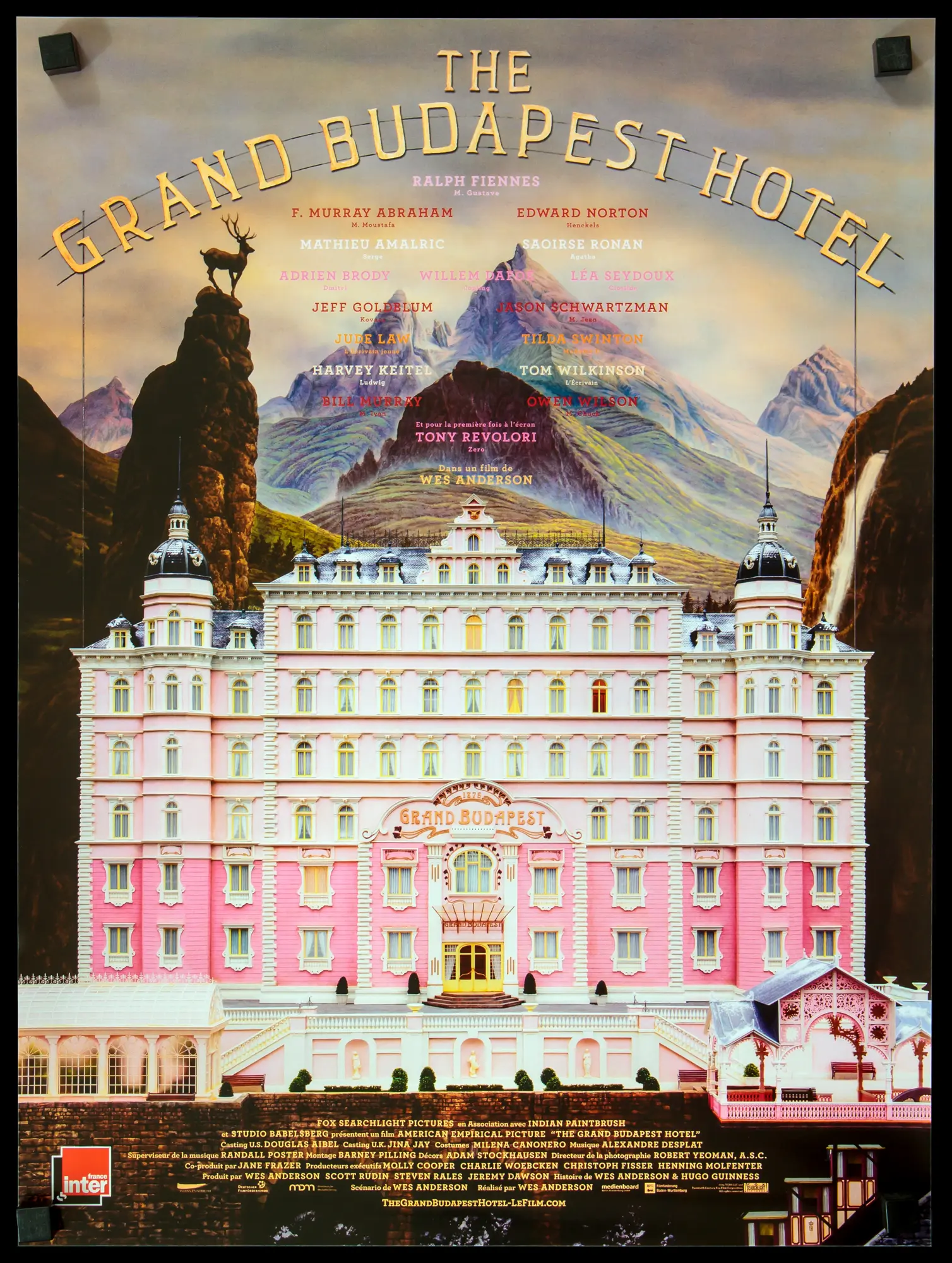
Wes Anderson’s films are famous for their visual precision, and The Grand Budapest Hotel pushes that quality to an extreme. Every frame is composed with the symmetry and color control of an architectural elevation drawing. The fictional hotel itself becomes a study in how interior proportions, material palettes, and lighting choices create atmosphere. The production design references Art Nouveau and Central European Secessionist architecture, creating spaces that feel historically grounded even when they are entirely invented.
Architecture students studying architectural styles in history will find the film’s careful recreation of period interiors both educational and inspiring. Anderson’s obsession with axial symmetry, pastel color palettes, and miniature models mirrors the discipline of architectural drawing itself.
Sketches of Frank Gehry (2006): Inside the Design Process
Directed by Sydney Pollack, this documentary provides an unusually honest look at how Frank Gehry works. The film follows Gehry through his studio, where crumpled paper models and rough sketches gradually become complex, computer-modeled buildings. Unlike many architecture documentaries that focus on finished products, Sketches of Frank Gehry is interested in the messy, uncertain middle of the design process, the part where ideas do not yet make sense and the architect does not yet know if they will work.
The documentary connects directly to how architects develop ideas from concept sketches into built form. Gehry’s practice of making hundreds of physical models before committing to a direction is a valuable lesson for any designer who relies too heavily on digital tools from the start.
Parasite (2019): Architecture as Social Commentary
Bong Joon-ho’s Palme d’Or and Academy Award-winning film uses architecture as its primary storytelling device. The wealthy Park family lives in a modernist house designed (in the film’s fiction) by a famous architect, with clean lines, glass walls, and a manicured garden. The impoverished Kim family lives in a semi-basement apartment where street-level windows frame only passing feet and stray dogs. The vertical distance between these two homes, measured in elevation change, drives the entire plot.
Few movies about architecture use spatial design as precisely as Parasite. The Park house was built as a full-scale set, and its plan was designed to allow specific camera movements that reinforce the power dynamics between characters. The basement, the stairs, the garden, and the sight lines through glass walls are all architectural decisions that the director uses to build tension. For architects, the film is a reminder that spatial design is never neutral: it always communicates something about who has power and who does not.
🏗️ Real-World Example
The Park House Set (Jeonju, 2018): Production designer Lee Ha-jun built the Park family’s home as a complete, functional set on a water stage in Jeonju, South Korea. The house covers approximately 1,500 square meters and took two months to construct. Every room, corridor, and outdoor space was designed to allow specific camera angles that reinforce the film’s themes of class division through spatial hierarchy.
Columbus (2017): Architecture as Emotional Landscape
Set in Columbus, Indiana, a small American city with an unusually rich collection of modernist buildings by architects including Eero Saarinen, I.M. Pei, and Deborah Berke, this film treats real architecture as its subject. The two main characters, Casey and Jin, walk through the city’s buildings while working through personal grief and ambition. The camera holds on each building long enough for the viewer to actually study it, something most films never do.
Director Kogonada, a former video essayist, shoots Columbus’s buildings the way a careful architectural photographer would: with attention to natural light, material texture, and the relationship between building and landscape. If you want to understand what architects mean when they talk about how a building “sits” in its context, Columbus will teach you more in 100 minutes than most lectures could.
💡 Pro Tip
After watching Columbus, look up the buildings featured in the film and compare the cinematic shots with standard architectural photographs. You will notice how the director uses human figures and natural light conditions to give the buildings an emotional quality that technical photography usually strips away. This exercise sharpens your eye for how occupants change the reading of a space.
Blade Runner 2049 (2017): World-Building Through Environmental Design
Denis Villeneuve’s sequel expands the original film’s urban vision into vast, depopulated landscapes. Where the 1982 film packed density into every frame, Blade Runner 2049 uses emptiness and scale to create unease. Abandoned cities, monolithic seawalls, and enormous interiors with diffused orange light turn production design into environmental storytelling at an architectural scale.
The film’s production designer, Dennis Gassner, cited brutalist architecture and the work of architects like Tadao Ando as influences on the film’s massive concrete interiors. For students and professionals studying how architecture shapes atmosphere, the film works as a visual reference library of spatial moods: oppressive, serene, monumental, intimate, and desolate, all achieved through scale, material, and light rather than dialogue.
Video: Movies Every Architect Should Watch
This video from the altArch channel presents a visual breakdown of 10 films that reward close attention from architects and design students, covering many of the titles discussed above.
Architects as Characters: Why Film Keeps Casting Them
Architects appear in film far more often than their share of the population would suggest, and almost never as a background detail. Screenwriters reach for the profession because it solves a problem: it makes a character’s inner life visible. An architect’s work is literally built, publicly, at scale, and can be walked through by other people. Ambition, compromise and failure all take physical form.
The archetype is remarkably consistent. The architect in film is usually male, usually uncompromising, and usually in conflict with a client, a committee or a city, from Howard Roark in The Fountainhead onward. It is a flattering caricature and a persistent one, and it bears little resemblance to a profession that spends most of its time coordinating consultants and answering planning objections. Where films get closer to the reality is in the documentaries, where the tension is between the drawing and what the building actually became.
The pattern matters for anyone watching these films as a designer rather than an audience. The fictional architect is a device for talking about authorship and control. The documented architect is a record of process. Both are useful; they are not the same thing, and confusing the first for the second is how the profession acquired its least accurate reputation.
If you want the record rather than the archetype, the companion guide to architect documentaries covers films built from real practice.
How to Watch Architecture Movies Like a Designer
Watching a movie as an architect is different from watching it as a general audience member. Here are a few approaches that turn passive viewing into active design research:
First, pause and sketch. When a scene features a striking interior or urban landscape, stop the film and make a quick thumbnail sketch of the spatial composition. Note where the light source is, how the camera is positioned relative to the space, and what the dominant material is. This builds the same observational skills used in traveling for architectural inspiration.
Second, analyze the section. Many films use vertical layering to tell stories about social hierarchy (as in Parasite) or temporal shifts (as in Inception). Try to reconstruct the building section from the scenes you watch. This forces you to think spatially rather than just visually.
Third, research the real locations. Films like Columbus, Blade Runner, and The Grand Budapest Hotel reference real buildings, architects, and design movements. Following those references after watching the film turns a two-hour movie into weeks of productive research.
⚠️ Common Mistake to Avoid
Many architecture students watch films passively, treating them as entertainment rather than design research. The biggest mistake is focusing only on famous buildings that appear in the background. Instead, pay attention to how ordinary spaces (corridors, stairwells, doorways, windows) are used to control pacing, mood, and character movement. These everyday spatial decisions often teach more about good design than any landmark building.
Frequently Asked Questions
What movies should architects watch?
Start with the ones that use architecture structurally rather than decoratively: The Fountainhead for the myth of the uncompromising architect, My Architect and Sketches of Frank Gehry for real practice, Columbus for buildings as emotional landscape, Parasite for architecture as social argument, and Koyaanisqatsi for the built environment with the narrative stripped out. Inception and Blade Runner 2049 are worth watching for spatial logic and world-building rather than for architecture as subject.
Are there films about real architects?
Yes, mostly documentaries. My Architect follows Nathaniel Kahn’s search for his father Louis Kahn through the buildings he left. Sketches of Frank Gehry documents Gehry’s process with Sydney Pollack. Koolhaas Houselife observes a Rem Koolhaas house through the eyes of its housekeeper, which tells you more about how buildings are actually used than most architectural film. These sit alongside the fictional treatments rather than replacing them.
Why do so many films feature architects as characters?
Because the job externalises a character’s inner life. An architect’s ambition takes physical, public, permanent form, so conflict over a building is conflict over the person. It is also a profession that reads as creative and authoritative at once, which is convenient for a protagonist. The result is a durable archetype, the uncompromising visionary against the philistine client, that flatters the profession and describes almost none of its actual working life.
Is The Fountainhead accurate about architecture?
Not as a description of practice, no. It dramatises a philosophical position about individual will using architecture as its vehicle, and its architect refuses the collaboration, compromise and client service that constitute most real architectural work. It remains worth watching precisely because it is the origin of the archetype: understanding why the profession is imagined the way it is helps explain the expectations clients arrive with.
What is the best film about architecture for students?
Columbus is the most useful starting point, because it treats buildings as things people stand in front of and feel something about, which is closer to how architecture is experienced than any drawing exercise conveys. After that, My Architect for the gap between reputation and reality, and Koolhaas Houselife for the unglamorous truth about maintaining a celebrated building.
Final Thoughts
Architecture movies give designers something no other medium can: the experience of moving through space over time, with sound, light, and human presence shaping the way buildings feel rather than just how they look. The 10 films on this list approach the built environment from wildly different directions, from Ayn Rand’s philosophical drama to Bong Joon-ho’s sharp social critique, from Ridley Scott’s neon-lit dystopia to Kogonada’s quiet celebration of midwestern modernism.
Each one rewards close viewing with design ideas that transfer directly into studio work. The next time you are stuck on a project and need a shift in perspective, close your modeling software, pick a film from this list, and watch it with a sketchbook open. The best architecture movies are not escapes from the design process. They are part of it.
✅ Key Takeaways
- Architecture movies train designers to think about space as a time-based experience, not a static object.
- Films like Parasite and Blade Runner use spatial hierarchy (vertical layering, section-based storytelling) to communicate social relationships without dialogue.
- Documentaries like My Architect and Sketches of Frank Gehry reveal the messy, iterative design process that polished renders and photographs hide.
- Columbus and The Grand Budapest Hotel demonstrate how real and fictional architectural settings create emotional atmosphere through light, color, and proportion.
- Watching films with a sketchbook, pausing to analyze spatial composition, material choices, and camera positioning, turns passive viewing into active design research.
For more design inspiration beyond film, see our guide to must-read architecture books for design enthusiasts, or explore how movies for architects spark creativity and design inspiration in greater depth.







Leave a comment