


Table of Contents Show
The largest cities in the world by population are concentrated overwhelmingly in Asia, with Jakarta, Dhaka, and Tokyo leading global rankings according to the UN World Urbanization Prospects 2025 report. As of 2025, 33 megacities exceed 10 million residents, and cities, as the UN’s Degree of Urbanization defines them, now house 45 percent of the world’s 8.2 billion people, reshaping architecture, infrastructure, and urban planning on every continent.
Ranking the largest cities in the world is not as straightforward as it sounds. The answer shifts depending on whether you measure by city proper boundaries, metropolitan area, or urban agglomeration. The United Nations World Urbanization Prospects 2025 report, released in November 2025, introduced a new satellite-based methodology called the Degree of Urbanization. This approach maps continuous built-up areas with at least 50,000 people and a density of 1,500 or more per square kilometer. Under this framework, Jakarta surpassed Tokyo for the first time as the most populous city on Earth.
Other widely used data sources, such as World Population Review, still rank Tokyo at the top when using the traditional urban agglomeration definition. Both perspectives offer valuable insights into where humanity is clustering and how urban growth is accelerating across the developing world.

Top 10 Largest Cities in the World by Population
The top 10 list varies based on which measurement framework you apply. Below is a comparison of the two most authoritative rankings available in 2025, giving you a clear picture of how methodology shapes the results.
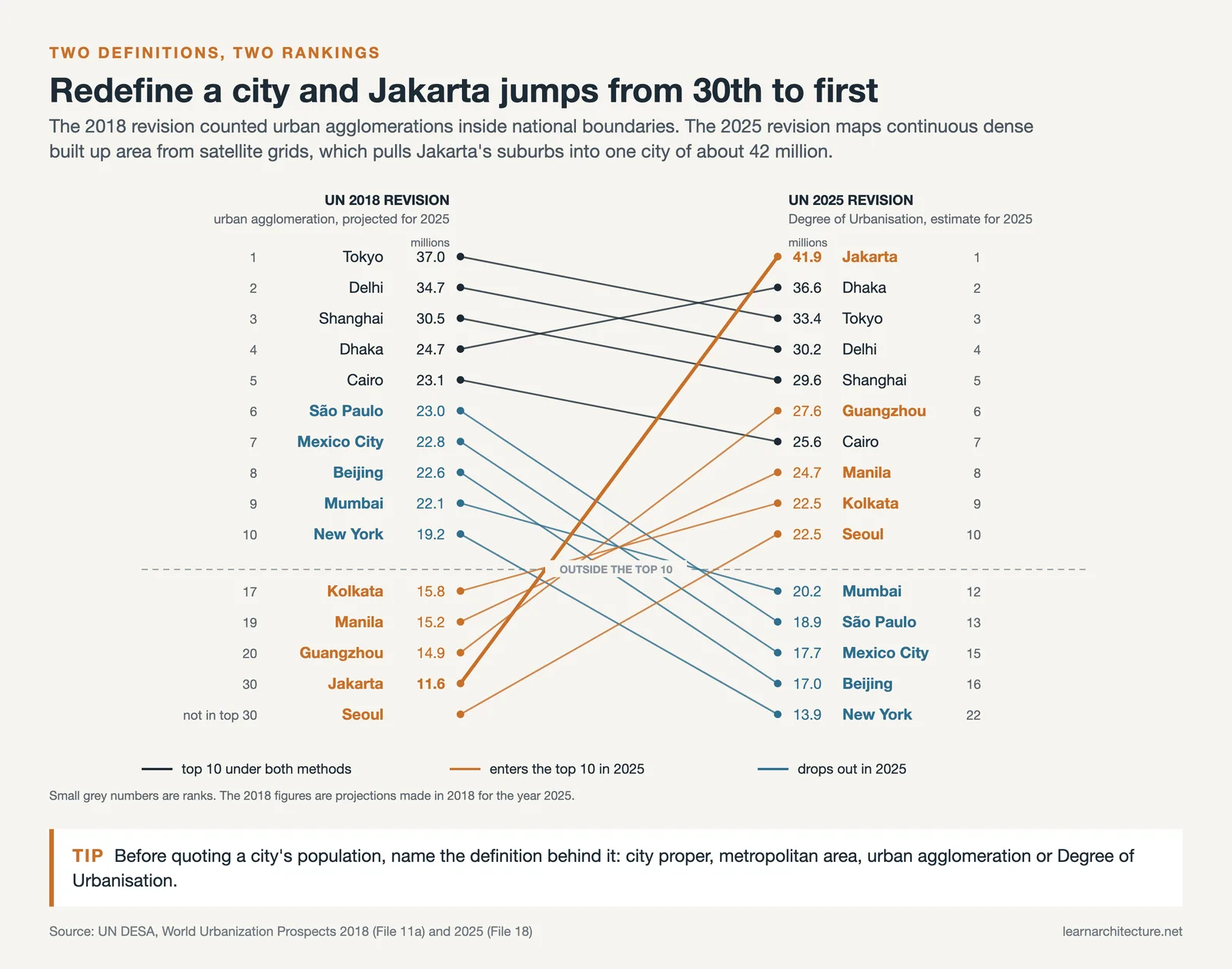
Population Rankings by Data Source (2025)
The following table shows how the world’s largest cities rank under two different measurement systems:
| Rank | UN WUP 2025 (Degree of Urbanization) | Population | World Population Review (Urban Agglomeration) | Population |
|---|---|---|---|---|
| 1 | Jakarta, Indonesia | 41.9 million | Tokyo, Japan | 37.0 million |
| 2 | Dhaka, Bangladesh | 36.6 million | Delhi, India | 34.7 million |
| 3 | Tokyo, Japan | 33.4 million | Shanghai, China | 30.5 million |
| 4 | Delhi, India | 30.2 million | Dhaka, Bangladesh | 24.7 million |
| 5 | Shanghai, China | 29.6 million | Cairo, Egypt | 23.1 million |
| 6 | Guangzhou, China | 27.6 million | Sao Paulo, Brazil | 23.0 million |
| 7 | Cairo, Egypt | 25.6 million | Mexico City, Mexico | 22.8 million |
| 8 | Manila, Philippines | 24.7 million | Beijing, China | 22.6 million |
| 9 | Kolkata, India | 22.5 million | Mumbai, India | 22.1 million |
| 10 | Seoul, South Korea | 22.5 million | New York, USA | 19.2 million |
Notice how the UN’s updated methodology dramatically changes the picture. Jakarta’s sprawling metropolitan footprint, which extends into Tangerang, Bekasi, and Bogor, registers nearly 42 million under satellite mapping. Cairo is the only non-Asian city among the top 10 in the UN ranking, highlighting how profoundly Asia dominates global urban population.
What Is the Largest City in the World?

The answer depends entirely on your measurement framework. According to the UN World Urbanization Prospects 2025 report, Jakarta, Indonesia holds the title with nearly 42 million residents. This was the first time Jakarta topped the global rankings, displacing Tokyo, which had held the position for decades. The shift resulted from the UN’s adoption of satellite-based urban footprint mapping rather than administrative boundaries.
Under the traditional urban agglomeration model used by World Population Review, Tokyo remains the largest city in the world at approximately 37 million people. Tokyo’s figure encompasses the greater metropolitan area stretching across multiple prefectures, including Yokohama, Kawasaki, and Saitama. Despite a slight population decline of about 0.2% annually due to Japan’s aging demographics, the sheer density of Tokyo’s built environment keeps it at or near the top of every ranking.
Jakarta’s rise reflects a broader pattern. Indonesia’s capital has expanded far beyond its historic boundaries, absorbing surrounding cities into one continuous urban mass. The Indonesian government has been planning to relocate the capital to Nusantara on Borneo, partly because of Jakarta’s extreme congestion, flooding risks, and land subsidence. Even so, the city’s economic gravity continues to pull millions inward from across the archipelago.
Why Are the Largest Cities in the World Growing So Fast?

Several forces drive the explosive growth of the world’s largest cities by population. Economic opportunity is the primary magnet. Cities concentrate jobs, education, healthcare, and infrastructure in ways that rural areas simply cannot match. According to the UN DESA press release on WUP 2025, two-thirds of global population growth through 2050 is projected to occur in cities.
Rural-to-urban migration remains the single largest contributor to megacity growth across South Asia and Sub-Saharan Africa. Young populations seeking employment and stability relocate to urban centers at rates that outpace infrastructure development. In cities like Dhaka and Lagos, informal settlements have expanded rapidly as housing construction lags behind demand.
Natural population increase also plays a role, particularly in regions with high fertility rates. African cities are growing at some of the fastest rates on the planet. Luanda, Angola’s capital, has expanded at roughly 11% annually since 2000, according to the UN World Urbanization Prospects 2025 data. Lagos, Kinshasa, and Dar es Salaam are all climbing the global rankings as Sub-Saharan Africa’s young population and accelerating urbanization reshape the continent’s urban geography.
“Urbanization is a defining force of our time. When managed inclusively and strategically, it can unlock transformative pathways for climate action, economic growth, and social equity.”
Li Junhua, UN Under-Secretary-General for Economic and Social Affairs (UN DESA, November 2025)
How Megacities Shape Architecture and Urban Design

The rapid expansion of the largest cities in the world creates enormous pressure on architects, urban planners, and civil engineers. When a city grows by hundreds of thousands of residents each year, questions of housing density, transportation, public space, and environmental resilience move from theoretical concerns to urgent daily challenges.
Tokyo offers one of the most studied examples of how architecture adapts to extreme density. The city’s micro-apartment typology, efficient rail network, and layered commercial-residential zones represent decades of careful urban design evolution. Architects working in Tokyo routinely design for lots as small as 20 square meters, pushing creative solutions for light, ventilation, and spatial efficiency.
In contrast, cities like Dhaka and Lagos face a different set of challenges. Rapid informal settlement growth outpaces formal planning, and architects working in these contexts increasingly focus on incremental housing strategies, flood-resistant construction, and community-driven design processes. The gap between infrastructure supply and population demand defines the architectural agenda in most of the world’s fastest-growing megacities.
Shanghai’s skyline transformation over the past three decades illustrates what concentrated investment can achieve. The Pudong district, largely farmland in the early 1990s, now contains some of the world’s tallest buildings and most advanced urban infrastructure. This kind of rapid vertical development is becoming a template for other Asian megacities seeking to accommodate millions within limited land area.
The Fastest-Growing Cities to Watch

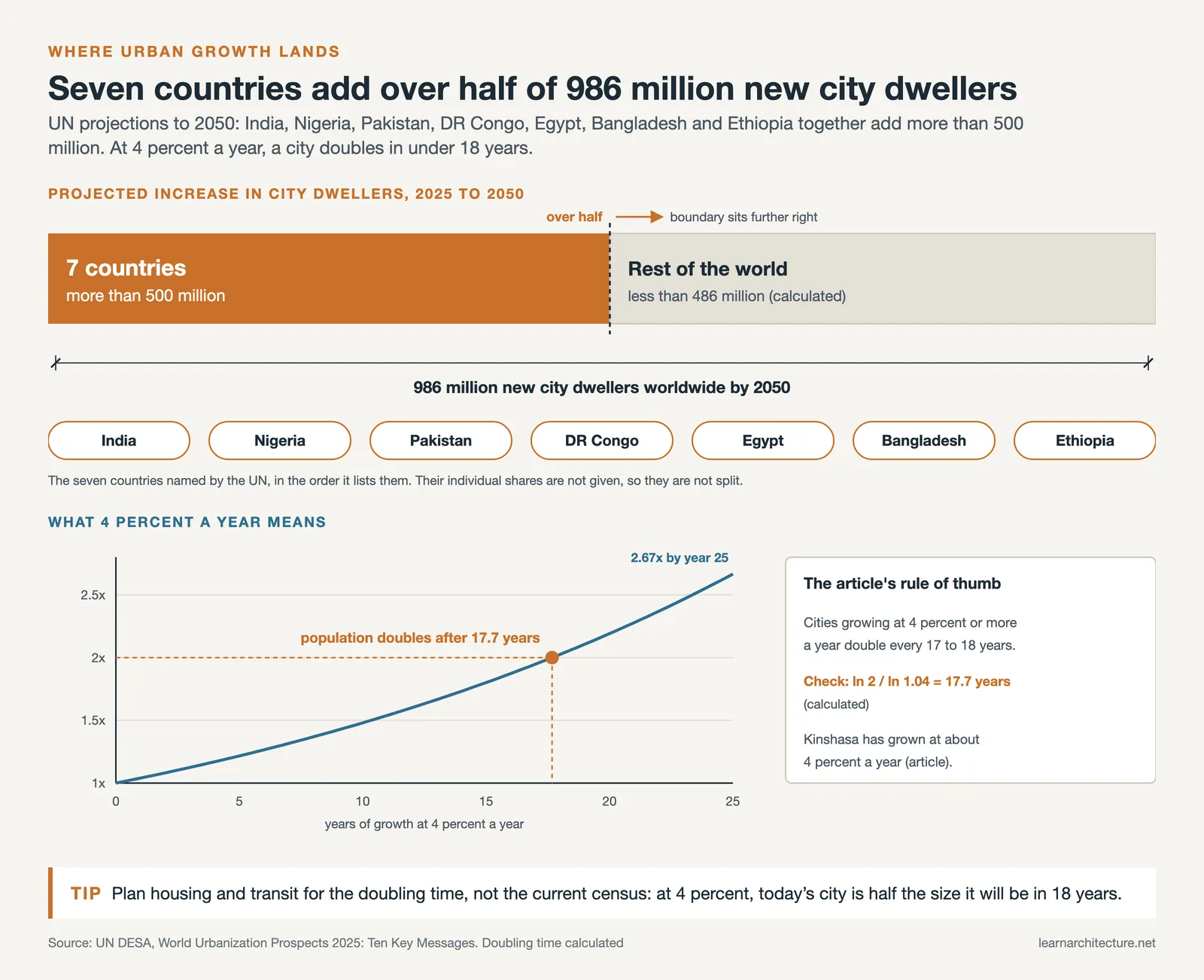
While the largest cities in the world top 10 list is dominated by Asian megacities, the fastest growth rates tell a different story. Africa is the continent to watch. According to the UN World Urbanization Prospects 2025, seven countries (India, Nigeria, Pakistan, Democratic Republic of Congo, Egypt, Bangladesh, and Ethiopia) are expected to add more than 500 million city residents between 2025 and 2050, accounting for over half of the projected 986 million new urban dwellers globally.
Kinshasa, the capital of the Democratic Republic of Congo, has grown at approximately 4% annually, making it one of Africa’s most significant emerging megacities. Lagos, Nigeria continues its trajectory toward becoming one of the world’s top five largest cities by mid-century. Dar es Salaam in Tanzania and Addis Ababa in Ethiopia are projected to surpass the 10 million threshold by 2050, according to UN forecasts.
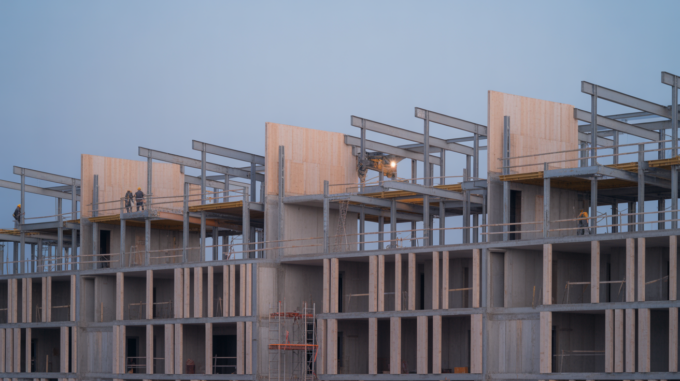
This shift has profound implications for sustainable architecture and urban planning. Cities growing at 4% or more annually essentially double their populations every 17 to 18 years. Building infrastructure, housing, transit systems, and public spaces fast enough to keep pace with that growth requires innovative approaches to construction, financing, and governance. Prefabricated housing, mass timber construction, and community-driven design are all gaining traction in rapidly urbanizing regions.
What Will the Largest Cities Look Like by 2050?
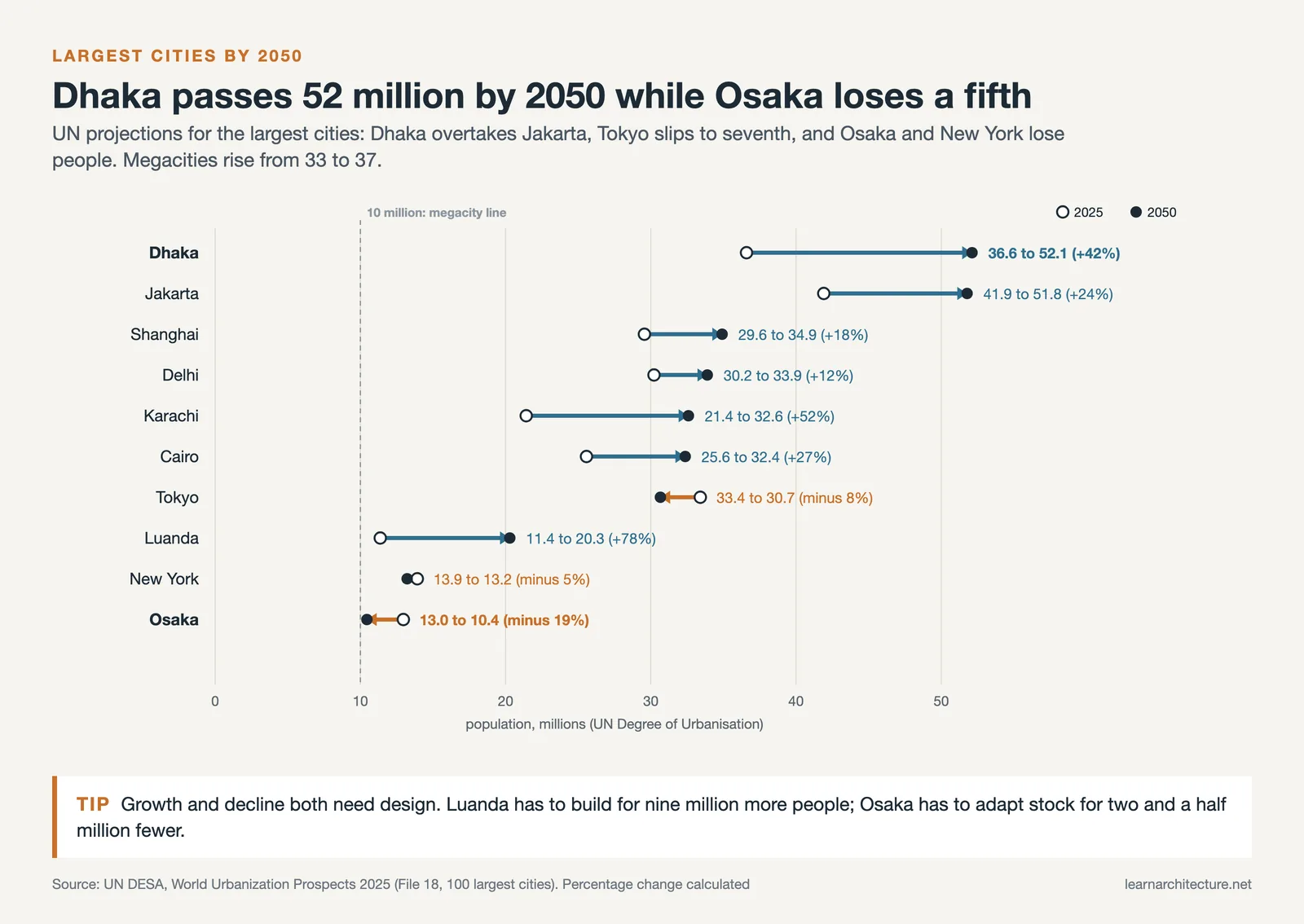
The UN projects that by 2050, Dhaka could become the largest city in the world, with over 52 million residents. Jakarta is expected to remain close behind. Tokyo, by contrast, is projected to decline in rank as Japan’s population continues shrinking. The number of megacities worldwide is expected to rise from 33 to 37, with new entrants including Addis Ababa, Dar es Salaam, Hajipur (India), and Kuala Lumpur.
The architectural profession will play a central role in shaping these future cities. Questions of climate adaptation are already urgent. Jakarta faces severe flooding and land subsidence. Delhi struggles with extreme air pollution. Cairo’s expansion into agricultural land threatens food security in the Nile Delta. Each of these challenges requires design solutions that go well beyond individual buildings to encompass entire urban systems.
According to the Wikipedia entry on megacities, the number of cities analyzed by the UN has expanded from around 1,700 in previous editions to over 12,000 in the 2025 report, reflecting a much broader understanding of global urbanization. Small and medium-sized cities, particularly in Africa and Asia, are growing even faster than megacities, creating distributed urbanization patterns that will define the built environment for decades to come.
Meanwhile, some of the world’s historically large cities are facing population decline. Osaka’s population is projected to shrink by roughly 20% by 2050. New York City may see a 5% decline. These cities face a different architectural challenge: adapting existing infrastructure for smaller, older populations while maintaining economic vitality and quality of life.
Population data is based on estimates and projections from the UN World Urbanization Prospects 2025 and World Population Review. Figures vary by measurement methodology and may be updated as new census data becomes available.












Leave a comment