


Table of Contents Show
The leaning tower of pisa is the freestanding bell tower of Pisa Cathedral, located in Tuscany, Italy. Construction began in 1173 and stretched across two centuries, during which the structure began tilting due to soft, unstable subsoil beneath its shallow foundations. What started as a structural miscalculation became the most recognized architectural oddity in the world, drawing over five million visitors annually to the Piazza dei Miracoli.
Where Is the Leaning Tower of Pisa?
The leaning tower of pisa italy stands within the Piazza dei Miracoli (Square of Miracles) in the city of Pisa, in the Tuscany region of west-central Italy. The square itself is a UNESCO World Heritage Site and contains three other significant structures: the Pisa Cathedral (Duomo), the Pisa Baptistery, and the Camposanto Monumentale (monumental cemetery). Together, they represent one of the finest surviving examples of Romanesque architecture in medieval Europe.
Pisa sits at the confluence of the Arno River and the Ligurian Sea, and this geography is central to the tower’s story. Over millions of years, the river deposited irregular layers of sand and clay across the landscape. The patch of ground chosen for the bell tower happened to contain softer clay to the south than to the north: an asymmetry that would take 800 years to correct.
💡 Pro Tip
When visiting the Piazza dei Miracoli, most tourists photograph the tower from the south side where the lean is most dramatic. For architectural study, approach from the east to see the full complex in sequence (baptistery, cathedral, and campanile) and observe how the Romanesque marble detailing carries consistently across all three structures despite their different construction periods.
When Was the Leaning Tower of Pisa Built?

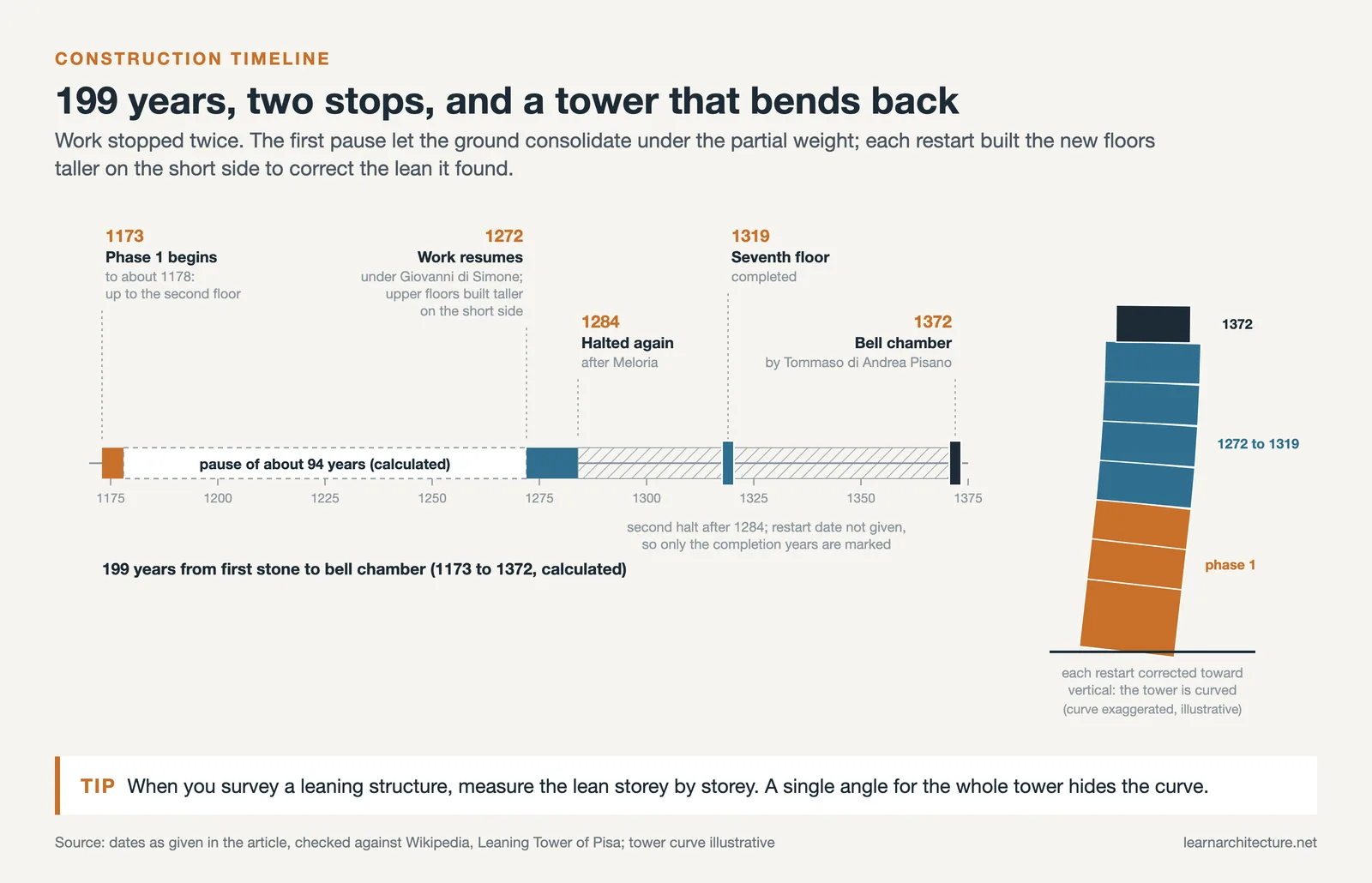
Construction on the leaning tower of pisa began in August 1173, intended as the campanile (bell tower) for the adjacent cathedral. The project proceeded in three distinct phases interrupted by wars and political upheaval.
The first phase, from 1173 to around 1178, brought the tower to the height of the second story before work stopped, most likely because Pisa was engaged in military conflict with neighboring city-states including Genoa and Florence. By the time construction resumed nearly a century later in 1272, the foundation had already settled unevenly, and the tower was visibly tilting to the south.
Rather than tear down and start over, the builders adapted. Under the oversight of Giovanni di Simone, the upper floors were constructed slightly taller on the shorter side to compensate for the angle. This adjustment failed to correct the lean, however, and the added weight only caused the southern foundation to sink further. The consequence of these repeated corrections is visible today: the leaning tower of pisa is not just tilted but subtly curved, with the lower sections reflecting earlier lean directions and the upper sections correcting back toward vertical.
A second halt came in 1284 after Pisa’s defeat in the Battle of Meloria. Work resumed again and the seventh floor was completed by 1319. The belfry chamber was finally added between 1360 and 1372, completed by Tommaso di Andrea Pisano. Total construction spanned approximately 199 years.
📌 Did You Know?
The long construction pauses were not purely a liability. Geotechnical engineers studying the tower later concluded that the 100-year interruption after the first phase actually allowed the underlying soil to consolidate and strengthen under the tower’s partial weight. Had construction continued without interruption, the additional load applied too quickly might have caused the structure to topple before it was ever finished.
Architectural Design: Romanesque Style and White Marble

The tower was designed as a circular campanile in the Italian Romanesque style, consistent with the cathedral complex it serves. At its base, 15 marble arches form a colonnade, with each of the six middle floors repeating the rhythm of 30 arches. The top belfry chamber contains 16 arches, smaller in scale and slightly Gothic in detail, reflecting Tommaso Pisano’s later work completing the structure.
The exterior is clad entirely in white and gray marble from the quarries near Pisa and Carrara. The surface treatment, including blind arcading, engaged columns, and carved capitals, closely mirrors the Duomo it accompanies. This visual continuity across the complex was intentional: the baptistery, cathedral, and campanile were designed as a unified architectural statement of Pisa’s wealth and civic power at the height of the city’s maritime dominance in the Mediterranean.
The circular footprint, while unusual for campaniles of the period, was a deliberate architectural choice. Most Italian bell towers of the 12th century were square or rectangular. The circular plan gave the Pisa campanile a distinctly classicized character and was probably influenced by early Christian round towers. For a closer look at how Romanesque and Gothic styles developed in parallel across Europe, see the guide to iconic architectural styles of Europe on this site.
📐 Technical Note
The tower stands 55.86 m (183 ft) on its low side and 56.67 m (186 ft) on its high side, with an outer diameter of approximately 15.5 m and wall thickness of 2.44 m at the base. Its total estimated weight is 14,500 tonnes. The original foundation depth was only about 3 m, significantly shallow for a structure of this mass, and it rests within the compressible upper layer of sandy and clayey silts that extends to around 10 m depth at that location.
Why Is the Leaning Tower of Pisa Leaning?
The question of why does the tower of pisa lean has a straightforward geotechnical answer: the soil beneath the southern foundation is softer and more compressible than the soil to the north. When the weight of the masonry was applied, the ground did not settle uniformly. The south side compressed more, causing the tower to tilt in that direction.
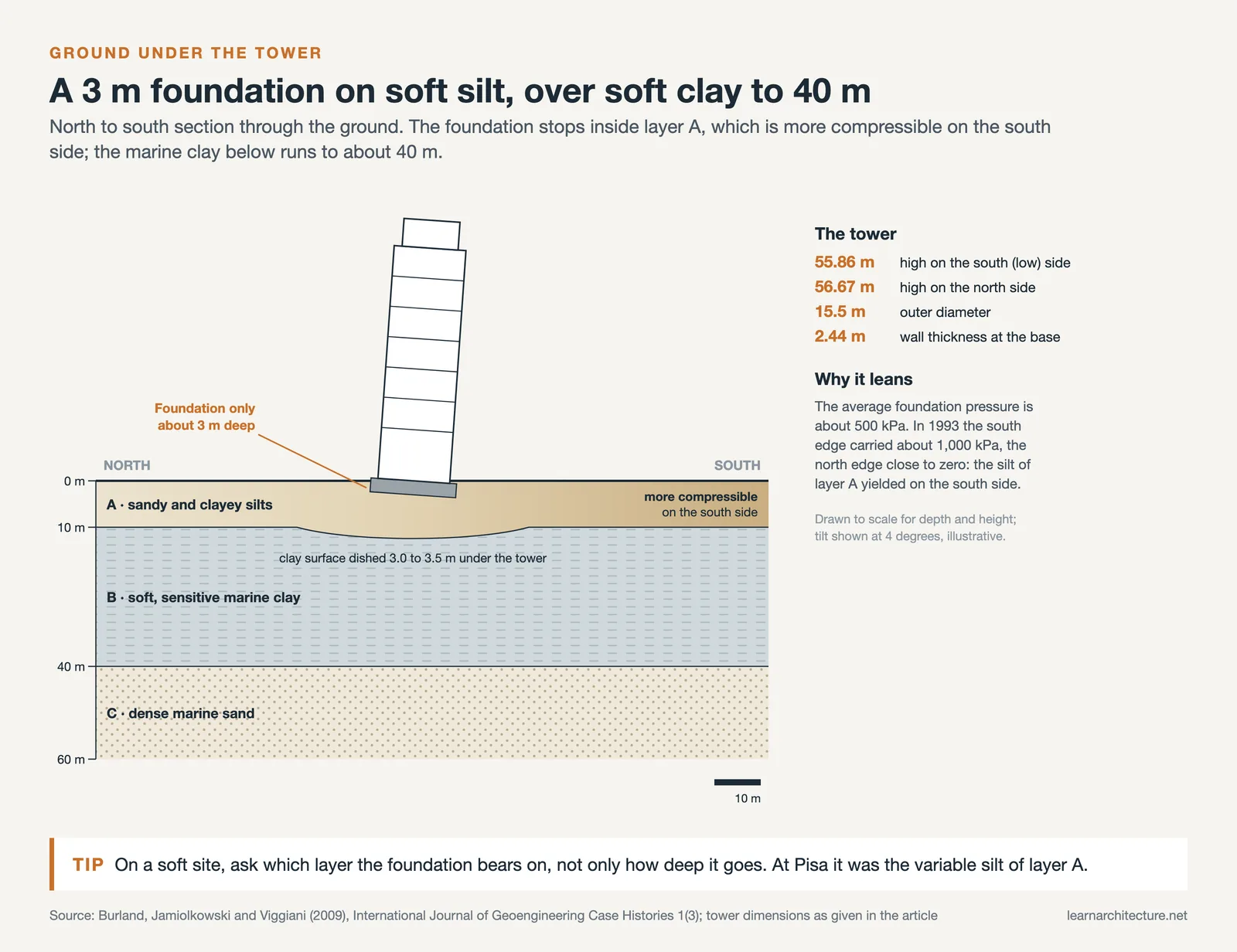
The subsurface geology at the site consists of multiple distinct layers. The upper horizon, from the surface to roughly 10 meters depth, is a mix of marine sediment that is highly sensitive to moisture changes. Below that sits soft, sensitive marine clay extending down to approximately 40 meters, and deeper still, a layer of dense sand. The original 3-meter-deep foundation placed the base of the tower squarely in the weakest zone (the upper compressible layer) and provided no connection to the stable sand below.
Medieval builders had no quantitative method for predicting soil bearing capacity. The decision to use shallow foundations reflected both the knowledge limits of 12th-century construction practice and, possibly, the assumption that the tower’s relatively modest height posed no structural risk. Comparable bell towers built across Italy at the time used similar foundation depths, though few were placed on soil as problematic as the ground at Pisa. You can read more about how foundation failures and material choices shaped landmark structures in the article on landmark buildings that defined architectural eras.
⚠️ Common Mistake to Avoid
Many sources describe the lean as resulting from a “design flaw” or “architect’s error.” This is imprecise. The original architects had no way to test subsoil bearing capacity with the tools available in 1173. The lean resulted from an inadequate understanding of geotechnical conditions: a limitation of the era, not negligence. Modern engineers would conduct extensive soil borings, load tests, and bearing capacity calculations before placing any foundation, a practice that became standard only in the 20th century.
How Tall Is the Leaning Tower of Pisa?

How tall is the leaning tower of pisa depends on which side you measure. On the lower (south) side, the height from ground to the top of the belfry is 55.86 meters (approximately 183 feet). On the higher (north) side, it measures 56.67 meters (approximately 186 feet). The difference reflects the asymmetric settling of the foundation over the centuries.
The tower has eight stories, including the ground-floor arcade and the belfry chamber at the top. Twin spiral staircases line the interior, with 294 steps leading from ground level to the bell chamber. One of the staircases incorporates two additional steps to account for the tilt. Seven bells are mounted in the belfry, each tuned to a different musical note. The largest, cast in 1655, weighs approximately 3.5 tonnes and had been silenced for decades during the 20th century out of concern that its vibration during ringing could worsen the lean.
Video: How Engineers Straightened the Leaning Tower of Pisa
Crash Course Engineering produced an excellent explainer on the geotechnical and structural challenges engineers faced when stabilizing the tower, including the soil extraction method that ultimately proved successful.
Will the Leaning Tower of Pisa Fall?
Based on current engineering assessments, will the leaning tower of pisa fall in the foreseeable future? No. Engineers who completed the stabilization project in 2001 concluded that the tower should remain safe for at least 200 years without further intervention. In May 2008, sensors confirmed that the tower had stopped moving for the first time in its recorded history.
The tower’s survival of at least four significant earthquakes since 1280, despite its precarious tilt, has been studied extensively. A 2018 engineering investigation concluded that the tower survived seismic events because of dynamic soil-structure interaction: the softness of the foundation soil and the height and stiffness of the tower combine to prevent the structure from resonating with earthquake ground motion. In an ironic twist, the same soft clay that caused the lean also absorbs seismic energy in a way that protects the masonry.
The longer-term concern is not the lean itself but the condition of the marble masonry in the lower stories, where centuries of differential stress have accumulated. Engineers expect continued monitoring will be necessary and that another intervention will likely be required within the next two centuries.
🎓 Expert Insight
“The lean isn’t just a fascinating oddity; it is integral to the historical character of the tower. Tilting is in the Campanile’s DNA.”
Grady Hillhouse, Practical Engineering
This observation captures an important principle in heritage conservation: the goal of stabilization was never to straighten the tower, but to preserve its iconic character for future generations while ensuring structural safety. The engineers deliberately maintained 3.97 degrees of lean, reducing it only enough to remove the risk of collapse.
The 20th-Century Stabilization: How Engineers Saved the Tower

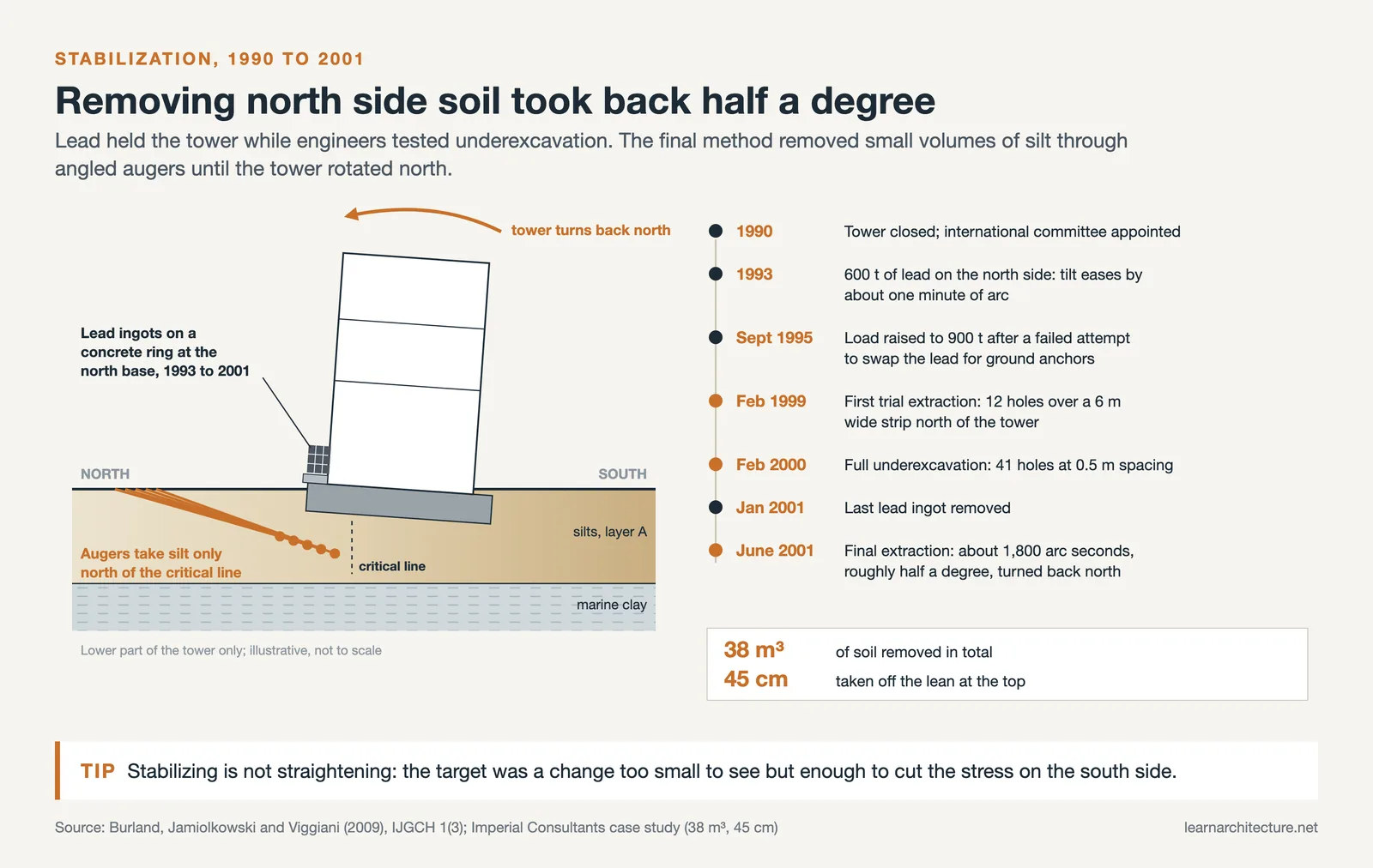
By 1990, the tilt had reached 5.5 degrees, and the foundation was very close to failure. One year earlier, the structurally similar Civic Tower of Pavia had collapsed without warning, and Italian authorities moved quickly. The leaning tower of pisa was closed to the public and an international committee of engineers, architects, and conservation experts was convened to develop a stabilization solution.
The challenge was extreme. Any intervention had to stabilize the tower structurally, reduce the lean enough to lower the risk of collapse, and preserve the tower’s historical character and its famous tilt. Propping, buttressing, or fully straightening the tower were all ruled out. The solution needed to be largely invisible.
Initial temporary measures involved placing approximately 600 tonnes of lead counterweights on the north side of the foundation to reduce the overhanging mass on the south. This slowed the movement but did not solve the underlying soil problem. Engineers then attempted to replace the lead with temporary ground anchors, but discovered during preparatory excavation that part of the tower’s base rested on the adjacent walkway (the Catino). Removing a section of the Catino caused the tower to suddenly tilt an additional 2.5 mm overnight, enough to prompt an emergency abandonment of the anchoring approach and the addition of 300 more tonnes of lead, raising the counterweight to 900 tonnes.
The permanent solution, developed by Prof. Michele Jamiolkowski of the Polytechnic University of Turin and a team of international geotechnical engineers, was soil underexcavation. Engineers bored a series of angled tubes beneath the north side of the foundation and carefully extracted small amounts of earth. As the north foundation settled slightly, the overall lean of the tower decreased. The process required extraordinary precision: too much soil removed too quickly would destabilize the structure. A total of approximately 38 cubic meters of soil was extracted. By 2001, the lean had been reduced by 45 cm to 3.97 degrees, reversing the tower to the inclination it had in the early 19th century.
🔢 Quick Numbers
- 5.5 degrees: maximum tilt reached before stabilization began in 1990 (Britannica, 2024)
- 3.97 degrees: current tilt after stabilization was completed in 2001 (Guinness World Records, 2010)
- 38 m³: volume of soil extracted during the underexcavation project (Burland, Jamiolkowski & Viggiani, 2009)
- 200+ years: estimated stable period before next intervention is required (Italian Government engineering committee, 2001)
The Tower Within Its Broader Architectural Context

The leaning tower of pisa buildings in the Piazza dei Miracoli are notable not just individually but as an ensemble. The Pisa Duomo, begun in 1063 under architect Buscheto, is considered one of the finest examples of Italian Romanesque architecture anywhere. Its striped marble facade and multi-tiered blind arcading set the visual vocabulary that the baptistery and campanile then followed. The baptistery, started in 1152 by Diotisalvi, was later modified with Gothic additions by Nicola and Giovanni Pisano in the 13th century, making it a rare hybrid of Romanesque planning and Gothic decorative language.
The campanile sits at the eastern end of the complex, displaced from the cathedral’s central axis in a way unusual for cathedral complexes of the period. This offset placement may have been deliberate to avoid conflicts with the adjacent cemetery, or it may reflect the pragmatics of the marshy ground conditions at the site. Either way, the spatial arrangement of the four structures across the wide grassy piazza creates one of the most studied compositions in European architectural history.
For context on how other medieval and Gothic structures across Europe tackled similar challenges of height, material, and foundation, see the overview of seven major architectural styles in history. The broader story of how medieval construction methods influenced landmark buildings worldwide is covered in the companion article on diverse architectural styles through history.
💡 Pro Tip
Architecture students studying the Piazza dei Miracoli should examine the belfry chamber at the top of the tower closely. Completed by Tommaso Pisano in 1372, it differs slightly from the lower floors in its proportions and pointed arches, an early Gothic detail introduced to harmonize the top of the tower with contemporary stylistic trends, while the rest of the structure remained firmly Romanesque. It is a useful case study in how medieval builders managed stylistic continuity across long construction timelines.
Galileo and the Tower: Legend vs. History

No discussion of the tower is complete without addressing the legend that Galileo Galilei dropped cannonballs from its summit to demonstrate that objects of different masses fall at the same rate. The story, which appears in accounts written by Galileo’s student Vincenzo Viviani, is almost certainly embellished or entirely invented. No contemporaneous records confirm that the experiment took place at Pisa, and Galileo’s own written accounts of his falling-body experiments describe inclined plane tests, not a dramatic public demonstration from a bell tower.
Galileo did live in Pisa and was a professor at the University of Pisa in the late 16th century, so a connection to the tower is plausible on a biographical level. But historians of science are broadly skeptical of the tower story as described. The more significant link between Galileo and Pisa is his documented research into the motion of pendulums, allegedly inspired by observing a chandelier swinging in the adjacent Pisa Cathedral. The tower served his reputation more as a dramatic backdrop than as an actual laboratory.
Final Thoughts: An Accidental Masterpiece
The Leaning Tower of Pisa is an unusual case in architectural history. It is celebrated not for achieving its design intent (a straight campanile serving a cathedral) but for failing at it in a way that became more interesting than the original goal. Its accidental tilt transformed a competent piece of Romanesque craftsmanship into a global landmark, and the centuries-long effort to understand and control that tilt produced some of the most innovative geotechnical engineering of the 20th century.
It also offers a practical lesson in heritage conservation: when an unintended quality becomes historically and culturally essential to a structure, the correct response is not to eliminate it but to manage it. Engineers did not straighten the tower. They preserved the lean while making it safe, a distinction that reflects a mature understanding of what old buildings are actually for. For broader reading on how architects navigate the tension between original intent and historical significance, see the profile of famous architects who reshaped how we think about buildings over time.
✅ Key Takeaways
- Construction of the leaning tower of pisa began in 1173 and was completed in 1372, with two long interruptions caused by war, pauses that inadvertently helped stabilize the structure.
- The tower leans because its shallow 3-meter foundations were placed in soft, compressible silts and clays that settled unevenly under the structure’s weight.
- At 55.86 to 56.67 meters tall, the tower contains 8 stories, 294 interior steps, and 7 bells; its exterior is clad in white Carrara marble in the Italian Romanesque style.
- By 1990 the tilt had reached 5.5 degrees and the tower was near collapse; engineers used soil underexcavation between 1993 and 2001 to reduce the lean to 3.97 degrees.
- The tower is now considered stable for at least 200 years, and, counterintuitively, the same soft soil that caused the lean also protects the structure during earthquakes.
External resources: For the official history and visitor information, see the Opera della Primaziale Pisana official site. The geotechnical details of the stabilization project are documented in Britannica’s Leaning Tower of Pisa entry. For the full engineering story, the Practical Engineering transcript is available at practical.engineering. The UNESCO heritage designation is covered at UNESCO World Heritage: Piazza del Duomo, Pisa. For academic context, see the geotechnical stabilization paper by Burland, Jamiolkowski, and Viggiani in ScienceDirect.
- how tall is the leaning tower of pisa
- leaning tower of pisa
- leaning tower of pisa buildings
- leaning tower of pisa italy
- the leaning tower of pisa
- when leaning tower of pisa built
- when was the leaning tower of pisa built
- where is the leaning tower of pisa
- why does the tower of pisa lean
- why is the leaning tower of pisa leaning
- why is the tower of pisa leaning
- will the leaning tower of pisa fall









Leave a comment