


Table of Contents Show
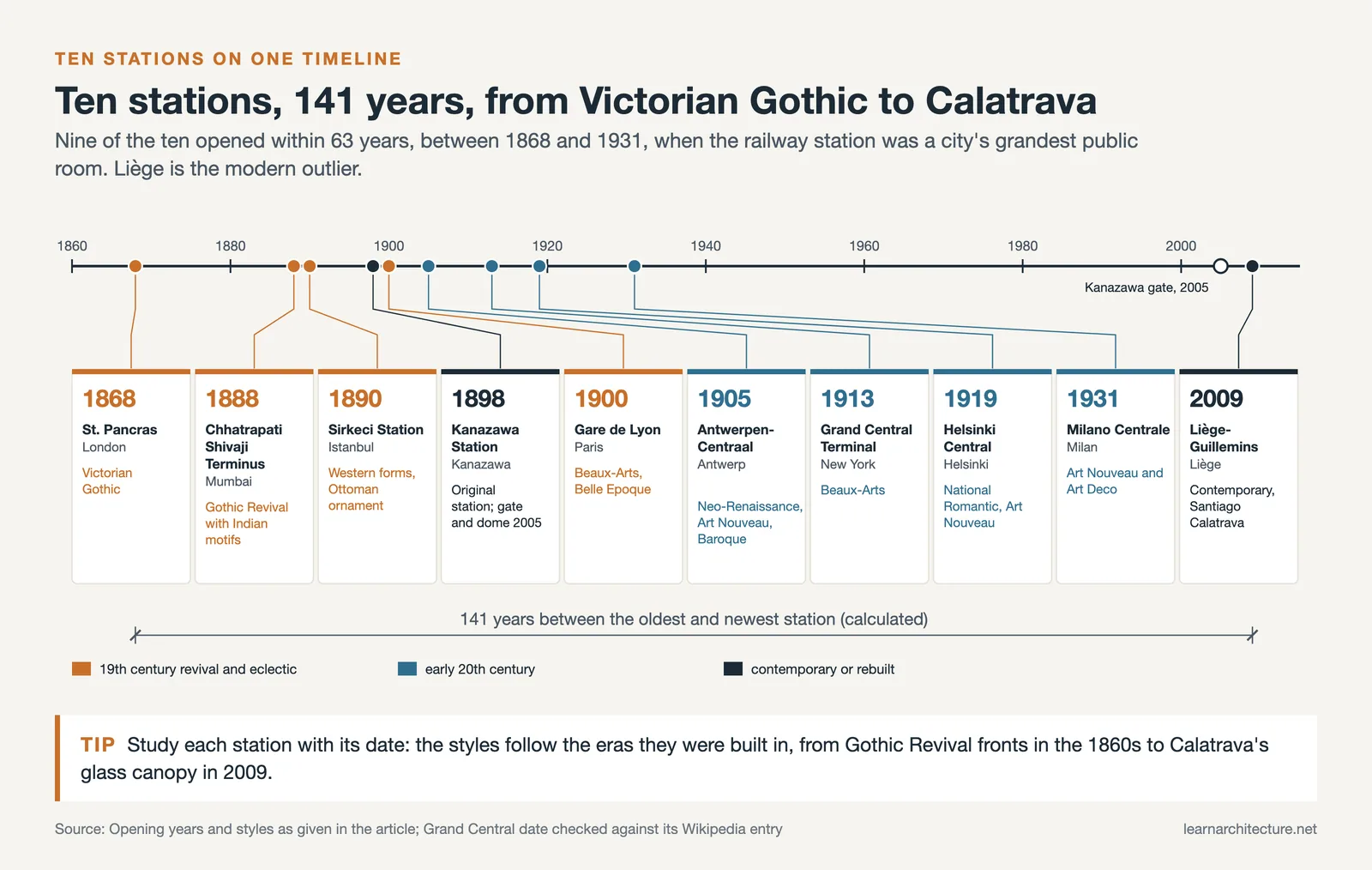
The most beautiful train stations in the world are far more than places to catch a train. Built during the golden age of rail travel, these structures were designed by leading architects to impress, inspire, and reflect the cultural ambitions of entire cities. From the Beaux-Arts grandeur of Grand Central Terminal to the breathtaking white arches of Liège-Guillemins, beautiful train stations in the world continue to draw millions of visitors who never board a single train.

Why Train Station Architecture Matters
When locomotive travel expanded in the 19th century, cities viewed their stations as civic monuments. Governments and railway companies hired top architects to create structures that projected power, wealth, and modernity. The result was a generation of buildings that blended structural engineering with artistic ambition, many of which still stand as some of the finest public architecture on the planet.
Today, the tradition continues. Contemporary architects like Santiago Calatrava are designing new stations that rival any historic counterpart in beauty and ingenuity. Whether Gothic Revival, Beaux-Arts, Art Nouveau, or cutting-edge parametric design, these buildings demonstrate how architecture and infrastructure can achieve something extraordinary together. If you’re exploring how architectural styles influence public spaces, the guide to iconic European architectural styles offers valuable context for understanding the movements that shaped many of the stations on this list.
💡 Pro Tip
When visiting any of these stations as an architecture student or enthusiast, arrive during off-peak hours if possible. Late morning on a weekday gives you calmer crowds and better natural light in the main concourses, especially in stations with large glazed roofs like Antwerpen-Centraal and Liège-Guillemins. Bring a wide-angle lens or use your phone’s ultra-wide setting to capture the full scale of the interiors.

What Is the Biggest Train Station in the World?
Grand Central Terminal in New York holds the Guinness World Record for the largest train station in the world by number of platforms, with 44 platforms spread across two levels. When people ask what is the biggest train station in the world or the largest train station in the world, Grand Central is consistently the answer. It is also one of the most beautiful, which is why it tops so many architectural lists globally.
The 10 Most Beautiful Train Stations in the World
1. Grand Central Terminal, New York, USA (1913)
Designed by architecture firms Reed & Stem and Warren & Wetmore, Grand Central Terminal is arguably the most beautiful train station in the world. Its Beaux-Arts main concourse features a famous celestial ceiling mural painted in gold and cerulean blue, depicting the zodiac constellations across 12,000 square feet of vaulted plaster. More than 20 million tourists visit each year in addition to the hundreds of thousands of daily commuters.
The station’s design was remarkably forward-thinking. Engineers buried the tracks below street level, freeing the city block above for development while allowing natural light to flood the main hall through 75-foot arched windows. Grand Central was threatened with demolition in the 1960s, but a preservation campaign ultimately saved it. Today it remains, many argue, the grandest transit hub in North America. The biggest train stations in the world rarely combine scale and elegance as successfully as this one does.
📌 Did You Know?
Grand Central Terminal’s celestial ceiling mural was painted backwards, with the constellations displayed as they would appear from outside the Earth looking inward rather than from the Earth looking up. According to the MTA’s official history, this was likely based on a medieval manuscript depicting the sky from God’s perspective. The “error” was discovered but left intentionally as part of the station’s character.

2. Antwerpen-Centraal, Antwerp, Belgium (1905)
Often called the “Railway Cathedral,” Antwerpen-Centraal is widely regarded as one of the most beautiful train stations in the world. Belgian architect Louis Delacenserie incorporated more than 20 types of marble and stone into a building that combines Neo-Renaissance, Art Nouveau, and Baroque elements under a massive glass dome. In 2014, Mashable named it the most beautiful railway station in the world based on a survey of architecture experts.
The station was damaged during World War II but remained structurally sound. A restoration in 1986 and a major expansion between 1998 and 2007 added underground platforms for high-speed trains while carefully preserving the historic concourse above. The result is a seamless layering of 19th-century grandeur and 21st-century engineering. You can arrive on a Thalys or Eurostar train at modern speed and step directly into a space that feels like a Flemish palace.
3. Liège-Guillemins, Liège, Belgium (2009)
Santiago Calatrava’s station in Liège is the most dramatic example of contemporary beautiful train station architecture anywhere in Europe. The open-air structure features soaring white concrete beams that form a massive arch over the tracks, with a glass canopy spanning 200 meters. There are no interior walls, giving the design a transparency and lightness that is extraordinary in a building of this scale.
Calatrava, known for his sculptural white structures such as the City of Arts and Sciences in Valencia, designed the station to serve as a gateway to the city. It handles Thalys high-speed trains connecting Liège to Paris, Brussels, and Amsterdam. The station has won numerous architectural awards and is consistently cited as one of the most photographed transit buildings built in the 21st century.
🏗️ Real-World Example
São Bento Station (Porto, Portugal, 1916): Though not on this core list of ten, São Bento illustrates a compelling approach to station design that goes beyond structure. Its entrance hall is covered with 20,000 hand-painted azulejo ceramic tiles by artist Jorge Colaço, depicting scenes from Portuguese history. The tile panels took 11 years to complete. São Bento demonstrates how interior art programs can elevate a functional transit space into a cultural institution.

4. St. Pancras International, London, UK (1868 / reopened 2007)
St. Pancras International is the finest example of Victorian Gothic architecture applied to a railway station. The original building opened in 1868 and features an elaborate red brick facade with pointed arches, turrets, and intricate stonework designed by Sir George Gilbert Scott. The station’s train shed, engineered by William Henry Barlow, had the largest single-span roof in the world when it was completed.
By the 1960s, the station faced demolition, but a successful campaign led by poet Sir John Betjeman saved it. A comprehensive restoration and expansion project, completed in 2007, removed 300,000 pounds of accumulated grime from the facade and restored 8,000 glass roof panes. Today the station serves as the London terminus for Eurostar trains to Paris and Brussels, and it houses the longest champagne bar in Europe at Searcy’s.
5. Chhatrapati Shivaji Maharaj Terminus, Mumbai, India (1888)
Designated a UNESCO World Heritage Site in 2004, Chhatrapati Shivaji Maharaj Terminus (formerly Victoria Terminus) is the most important example of Victorian Gothic Revival architecture in Asia. British architect F.W. Stevens worked alongside Indian craftsmen to blend Gothic structural forms with traditional Indian decorative motifs, including the stone dome, pointed arches, and elaborate carvings typical of Mughal and Hindu palaces.
The station serves approximately three million commuters daily, making it not only among the most beautiful train stations in the world but also one of the busiest. The UNESCO designation specifically recognized the building’s “outstanding example of late Victorian Gothic Revival architecture” and the way it fused two distinct architectural traditions into a coherent whole. Look for symbolic details at the entry gates: the figures atop the columns represent Britain through a lion and India through a tiger.
🎓 Expert Insight
“Train stations weren’t just transportation hubs; they became symbols of entire empires, as rulers transported their architectural and engineering know-how as far as India.”
This observation from TIME Magazine’s architectural analysis captures precisely why Chhatrapati Shivaji Terminus remains so architecturally significant. The station was a deliberate exercise in colonial soft power, yet the Indian craftsmen who built it shaped the result as much as the British architect who designed it.

6. Gare de Lyon, Paris, France (1900)
Paris has seven major stations, and Gare de Lyon is widely considered the most architecturally magnificent of them all. Designed by architect Marius Toudoire for the 1900 Exposition Universelle, the building features a 220-foot clock tower that draws immediate comparisons with London’s Elizabeth Tower (Big Ben). Inside, the station is home to Le Train Bleu, a Belle Époque restaurant that has been serving travelers since 1901, with a ceiling covered in gilded reliefs and murals depicting French cities and landscapes.
The station connects Paris to Lyon, Marseille, and destinations across southern France, Switzerland, and Italy via TGV. Its ornate exterior and lavish interiors belong to the Beaux-Arts tradition that made French public architecture in the Third Republic era so distinctive. Understanding how this tradition developed is worth exploring further through the landmark buildings that defined architectural eras article on learnarchitecture.net.
7. Sirkeci Station, Istanbul, Turkey (1890)
Sirkeci Station holds a unique place in architectural and cultural history as the eastern terminus of the legendary Orient Express. Built in 1890 by Prussian architect August Jasmund, the station blends 19th-century Western European design with Ottoman and Moorish decorative elements, using pointed arches, colored tile panels, and elaborate stone ornamentation. It represents one of the clearest examples of European Orientalism in architectural practice.
The station ceased regular passenger service in 2013 when the Marmaray tunnel opened, and it now operates as the Istanbul Railway Museum. Its position at the crossroads of Europe and Asia made it historically the meeting point of two worlds, a quality that Jasmund’s design physically expresses through its hybrid architectural vocabulary. Istanbul’s capacity to blend architectural influences from multiple traditions is something the city’s broader built environment shares. For more on that dynamic, the history of European architectural styles on learnarchitecture.net provides useful background.
💡 Pro Tip
If you are studying architectural hybridity for a project or essay, Sirkeci Station is one of the most accessible case studies available. The building’s blending of Western structural forms with Eastern ornamental traditions is well-documented, and the Istanbul Railway Museum makes the interior accessible without needing to purchase a train ticket. Pair a visit with Hagia Sophia nearby to see how Byzantine, Ottoman, and modern influences have layered across the city over 1,500 years.

8. Kanazawa Station, Kanazawa, Japan (2005 facade / original 1898)
Kanazawa Station is the most striking example of a contemporary transit building that fuses traditional Japanese cultural symbolism with modern architecture. The station’s Tsuzumi Gate, shaped like the hand drum used in Noh theater performances specific to Kanazawa, frames the entrance in laminated wood. Behind it, a sweeping glass dome called the Motenashi Dome (meaning “hospitality dome”) shelters arriving passengers from Japan’s heavy rainfall and snow.
When the design was unveiled in 2005, local residents were divided: the ultramodern glass structure seemed at odds with Kanazawa’s reputation as one of Japan’s best-preserved traditional cities, spared from WWII bombing. But the station’s popularity with visitors and photographers has built consensus around its success. The design works because it does not attempt to replicate traditional architecture but instead uses traditional symbols within a thoroughly contemporary structure. For a broader exploration of how Japanese architectural principles balance tradition and innovation, the Japanese architecture guide on learnarchitecture.net covers this in depth.
9. Helsinki Central Station, Helsinki, Finland (1919)
Designed by Eliel Saarinen and completed in 1919, Helsinki Central Station is a cornerstone of Finnish National Romantic architecture with strong Art Nouveau influences. The building’s granite facade and the famous statues holding spherical lamps at the main entrance have become inseparable from Helsinki’s visual identity. Saarinen’s design was selected through a competition in 1904, and the resulting building remains one of the most elegant rail termini in Northern Europe.
The station serves as the main hub for Finland’s rail network and handles suburban metro connections as well. Despite being over 100 years old, its functional layout and spatial generosity have allowed it to adapt to modern transit demands without losing its architectural dignity. Saarinen later emigrated to the United States, where his influence shaped American modernism significantly, including through his son Eero Saarinen’s work.

10. Milano Centrale, Milan, Italy (1931)
Milano Centrale is one of the largest and most imposing train stations ever built. Opened in 1931, it was designed by architect Ulisse Stacchini and represents a blend of Art Nouveau and Art Deco styles, with Fascist-era monumentality layered over both. The main facade is adorned with elaborate sculptures, and the barrel-vaulted steel and glass canopies over the tracks are engineering achievements comparable to the finest Victorian train sheds in Britain.
The station serves as the primary intercity hub for Milan and handles Frecciarossa high-speed trains connecting the city to Rome, Florence, Venice, and Turin. Its massive scale, the main ticket hall is nearly the size of a cathedral nave, is matched by the quality of its interior detailing. Understanding how Art Deco principles applied to large civic buildings, the Art Deco skyscraper analysis on learnarchitecture.net offers relevant architectural context.
What Makes a Train Station Architecturally Great?
The buildings on this list share several qualities beyond surface beauty. Each resolves a genuine functional challenge, moving enormous numbers of people efficiently, while simultaneously creating a spatial experience that feels meaningful. The best examples use natural light through glass roofs or clerestory windows, design generous circulation paths that reduce congestion, and apply materials that improve with age rather than deteriorating quickly.
They also tend to serve as anchors for urban development. Grand Central Terminal catalyzed Midtown Manhattan’s rise as a commercial district. St. Pancras International’s restoration in 2007 triggered the regeneration of King’s Cross into one of London’s most dynamic neighborhoods. The relationship between landmark architecture and urban vitality is one reason cities continue to invest heavily in station design even in an era of air travel dominance. For more on how architecture shapes cities over time, the skyscraper design trends article examines the parallel dynamic in tall building design.
⚠️ Common Mistake to Avoid
Many sources describe Grand Central Terminal as the biggest train station in the world based on floor area or passenger volume, but this is imprecise. Grand Central holds the record for the most platforms (44), which is the basis of the Guinness World Record. By overall floor area, stations like Beijing South Railway Station and Shanghai Hongqiao are considerably larger. When citing size records in architectural writing, always specify which metric you are using.

How Architecture and Function Work Together in Station Design
The best train station architecture never treats beauty as decoration added over a functional shell. In every case on this list, the structural system, the column spacing, the roof form, the material choices, is also the aesthetic system. Calatrava’s white concrete arches at Liège-Guillemins carry the roof and shade the platforms while defining the building’s visual identity. Barlow’s train shed at St. Pancras was the largest single-span structure in the world at the time because the engineering ambition and the architectural ambition were the same ambition.
This integration of form and function in public buildings connects directly to principles discussed in the role of shapes in architecture. Understanding how structural geometry becomes spatial experience is one of the central skills in architectural education, and train stations offer some of the most accessible and well-documented examples available anywhere.
✅ Key Takeaways
- Grand Central Terminal holds the Guinness World Record for the largest train station in the world by number of platforms (44) and is widely considered the most beautiful train station in the world by architectural consensus.
- The most beautiful train stations were built during the 19th and early 20th centuries when cities viewed rail infrastructure as civic monuments, hiring leading architects to express national and urban ambition.
- Contemporary station design, exemplified by Liège-Guillemins and Kanazawa, proves that modern architecture can match or exceed historic stations in visual impact when structural innovation and cultural symbolism are combined.
- Many of the world’s most architecturally significant train stations have served as catalysts for urban regeneration, including St. Pancras International in London and Grand Central Terminal in New York.
- Chhatrapati Shivaji Maharaj Terminus in Mumbai is the only train station on this list recognized as a UNESCO World Heritage Site, valued for its fusion of Victorian Gothic Revival architecture with traditional Indian craftsmanship.
For further reading on how public buildings reflect the culture and values of their era, the article on how architectural design influences human perception on learnarchitecture.net explores the psychology behind spaces like these.
External Resources
- beautiful train stations in the world
- biggest train station in the world
- biggest train stations in the world
- largest train station in the world
- most beautiful train station in the world
- most beautiful train stations in the world
- the largest train station in the world
- the most beautiful train station in the world
- what is the biggest train station in the world









Leave a comment