



Table of Contents Show
Inspiring women in architecture have broken barriers, won the profession’s highest awards, and designed buildings that redefined what structures can look like and do. From Zaha Hadid’s fluid curves to Jeanne Gang’s community-driven towers, these architects proved that talent, persistence, and vision matter far more than gender.
The history of architecture has long been told through the work of men, but the most famous women architects in history challenged that narrative at every turn. Some fought for decades before seeing a single design built. Others quietly shaped iconic projects while credit went elsewhere. The list below profiles ten women whose contributions to architecture are impossible to ignore, each selected for the originality of their work, the scale of their influence, and the obstacles they overcame to practice.

Why Recognizing Famous Women Architects Matters
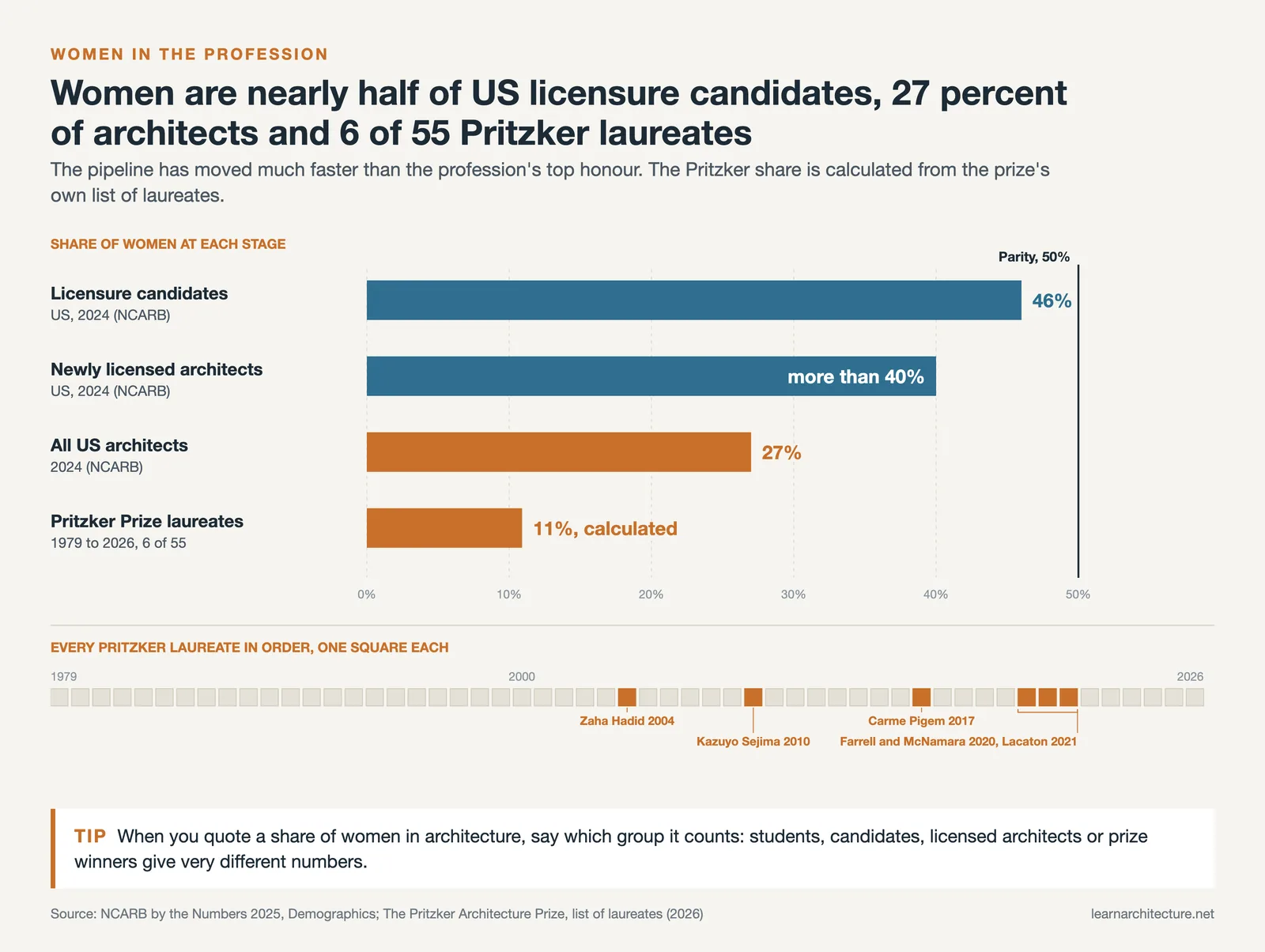
Women made up just 1% of registered architects in the United States in 1958. By 2005, that figure had risen to roughly 16% in senior positions, according to the American Institute of Architects. Today, women represent about half of all architecture students, yet they still hold a disproportionately small share of leadership roles at major firms. Visibility matters because representation shapes who enters the profession and who stays. The famous female architects who changed design did so not just through buildings but by proving that the profession belongs to everyone.
🔢 Quick Numbers
- Women made up 1% of registered architects in the US in 1958 and 27% as of 2024 (AIA, National Council of Architectural Registration Boards)
- Only 6 of the 55 Pritzker Prize laureates as of September 2026 have been women (The Hyatt Foundation)
- Women now represent over 50% of students enrolled in US architecture programs (National Architectural Accrediting Board, 2023)
1. Zaha Hadid: The First Woman to Win the Pritzker Prize
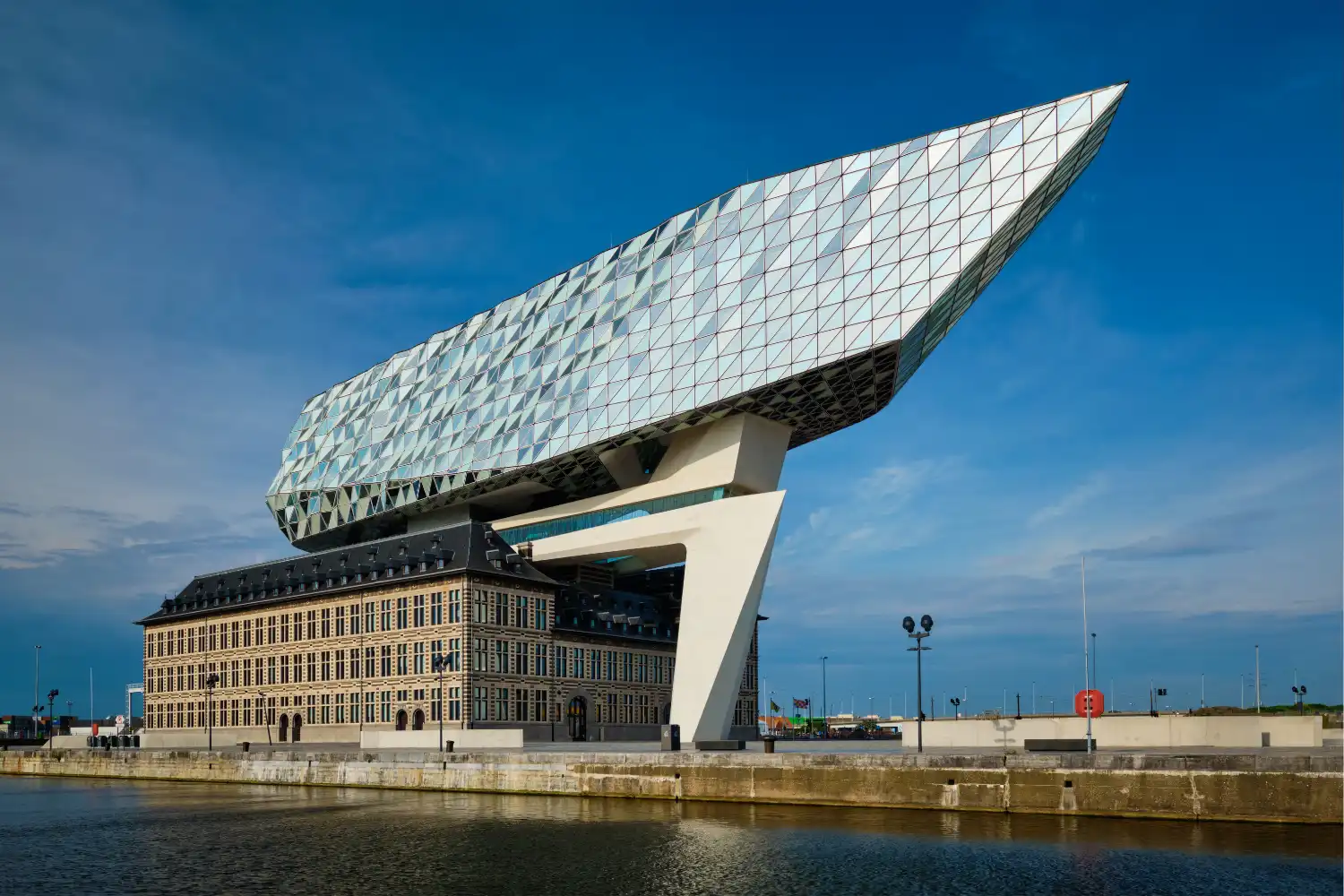
No list of famous women architects history would be complete without Zaha Hadid. Born in Baghdad in 1950 and trained at the Architectural Association in London, Hadid spent nearly two decades winning competitions for buildings that were never constructed. Critics called her a “paper architect.” That changed in 1993 with the Vitra Fire Station in Germany, and by the early 2000s, her practice was producing some of the most recognizable structures on the planet.
In 2004, Hadid became the first woman to receive the Pritzker Architecture Prize. Her buildings, including the Heydar Aliyev Center in Baku and the London Aquatics Centre, rejected the right angle in favor of sweeping curves and fluid surfaces. She was also the first woman to individually receive the RIBA Royal Gold Medal in 2016, the month before her death. For a detailed look at her design philosophy and landmark projects, see our guide on Zaha Hadid architecture.
🎓 Expert Insight
“Your success will not be determined by your gender or your ethnicity but only by the scope of your dreams.”
Zaha Hadid, from a BBC Arts postcard to her younger self
Hadid’s career backed up that statement. She built on every continent, won the Stirling Prize twice, and was named a Dame by Queen Elizabeth II, all in a profession that repeatedly told her that her designs were unbuildable.
2. Julia Morgan: Over 700 Buildings and a Quiet Revolution
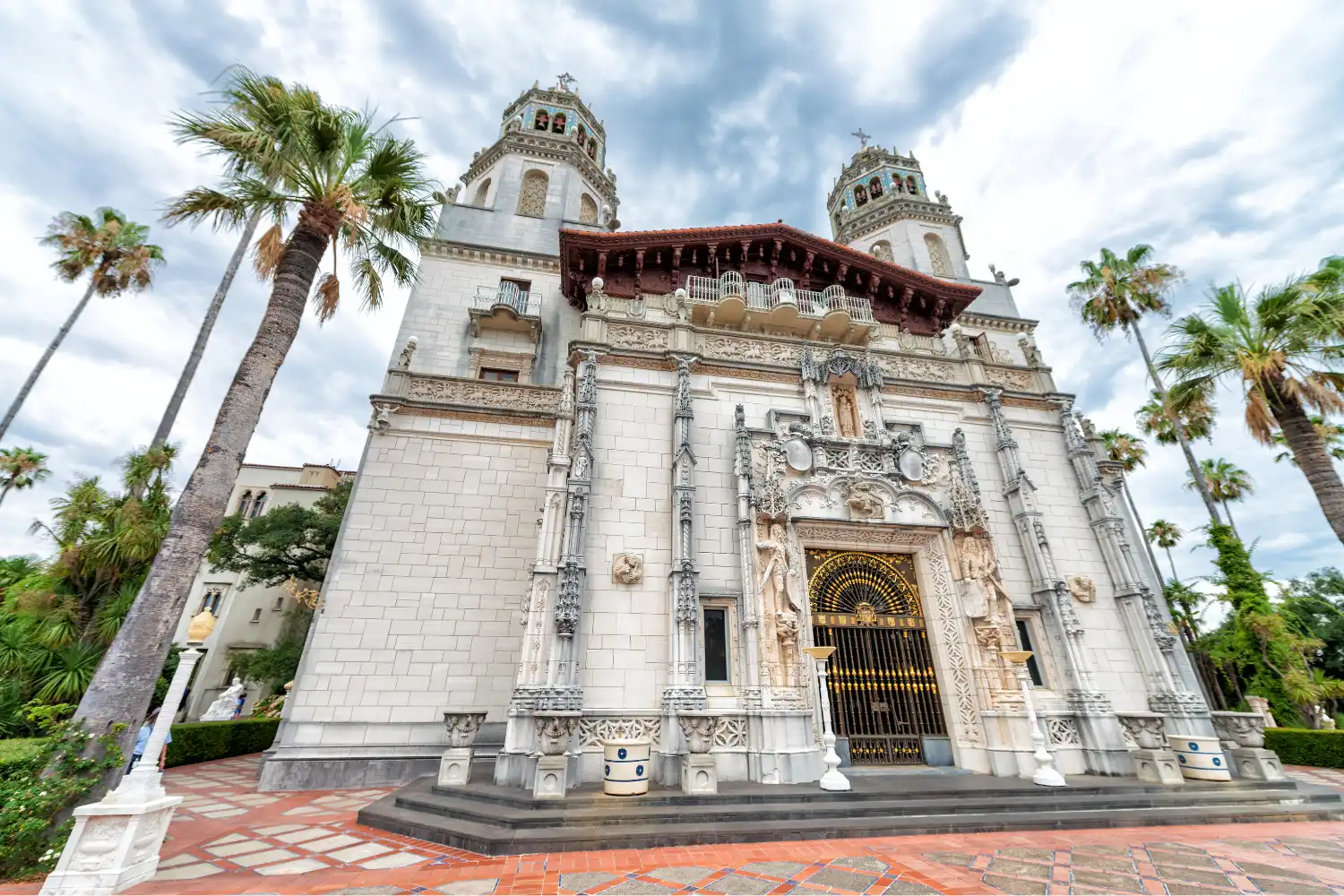
Julia Morgan was the first woman to earn a certificate in architecture from the École des Beaux-Arts in Paris, in 1902, and the first woman licensed as an architect in California. Over her career, she designed more than 700 structures, the most famous being Hearst Castle in San Simeon, a project that spanned 28 years. Morgan combined Beaux-Arts training with practical engineering knowledge, having also studied civil engineering at UC Berkeley. Her work ranged from residential homes to YWCAs, churches, and university buildings across California.
In 2014, Morgan became the first woman to receive the AIA Gold Medal, the highest honor given by the American Institute of Architects, awarded posthumously more than 50 years after her death.
3. Eileen Gray: Modernism’s Overlooked Pioneer
Irish-born Eileen Gray was one of the earliest architects to embrace modernist principles, yet her contributions were overshadowed for decades. Her most celebrated work, the E-1027 house in Roquebrune-Cap-Martin, France (1929), demonstrated a deep understanding of how people actually live in spaces. Gray designed the house as a complete environment, down to the furniture, and her approach to adaptable, user-centered design was ahead of its time.
Gray’s story also highlights the erasure women faced. Le Corbusier, uninvited, painted murals over the interior walls of E-1027, an act widely interpreted as an attempt to claim ownership over her work. Gray’s reputation has only been fully restored in recent decades, with a 2013 retrospective at the Centre Pompidou and the 2014 documentary “Gray Matters” helping to bring her legacy back into focus.
💡 Pro Tip
If you’re studying the history of modernism, look beyond the standard canon. Architects like Eileen Gray, Lilly Reich, and Charlotte Perriand made contributions to furniture, interiors, and spatial planning that are often credited to the men they worked alongside. Cross-referencing project timelines with exhibition records often reveals who actually originated the ideas.
4. Lina Bo Bardi: Redefining Architecture in Brazil
Italian-born Lina Bo Bardi moved to Brazil in 1946 and spent four decades producing work that mixed modernism with local materials, cultural references, and social purpose. Her São Paulo Museum of Art (MASP), completed in 1968, suspends its main gallery on two massive red concrete beams, freeing the ground level as a public plaza. The design was radical for its time and remains one of the most recognized museum buildings in the world.
Bo Bardi’s SESC Pompéia (1986), a leisure center built inside a converted factory in São Paulo, is equally significant. She preserved the industrial shell and inserted new concrete towers connected by skyways, creating a building that serves as sports facility, library, theater, and community gathering space. Bo Bardi saw architecture as inseparable from everyday life, and her buildings reflect that belief.

5. Kazuyo Sejima: Minimalism with Maximum Precision
Kazuyo Sejima, co-founder of the Japanese firm SANAA alongside Ryue Nishizawa, became one of the most influential architects in history to receive the Pritzker Prize when the duo won in 2010. Sejima’s work is defined by transparency, lightness, and radical simplicity. Her buildings, including the Rolex Learning Center in Lausanne and the 21st Century Museum of Contemporary Art in Kanazawa, dissolve the usual boundaries between interior and exterior, public and private.
Sejima’s approach treats architecture as a series of spatial relationships rather than fixed rooms. The 21st Century Museum, for instance, is a perfect circle with no front or back, encouraging visitors to enter from any direction. That openness reflects Sejima’s broader design philosophy: architecture should reduce hierarchy and invite people in.
6. Jeanne Gang: Community, Climate, and the Tallest Tower
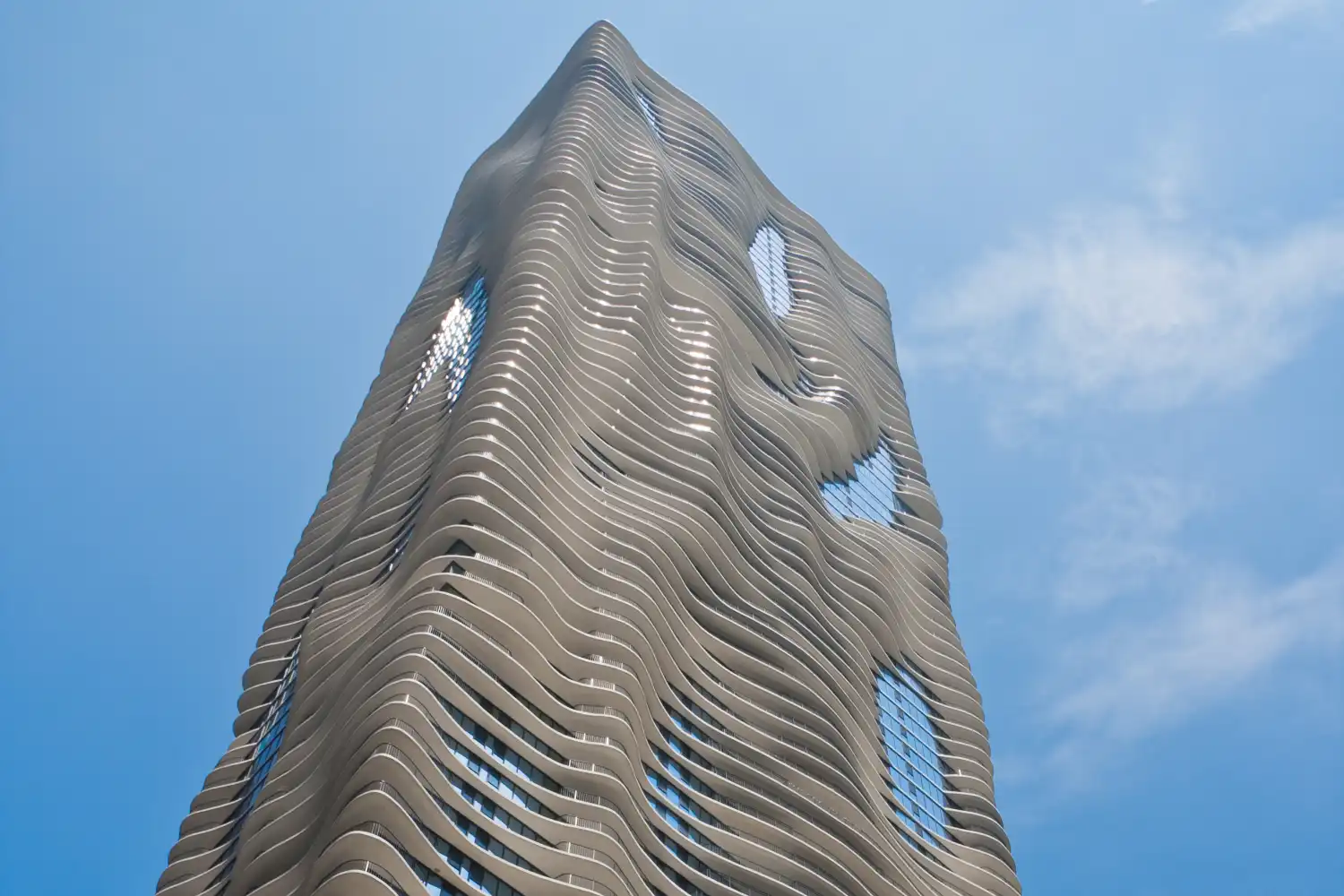
Jeanne Gang, founder of Studio Gang, was named to TIME magazine’s list of 100 most influential people in 2019, the only architect on the list that year. Her Aqua Tower in Chicago (2010) was, at the time, the tallest building in the world designed by a woman. Its sculptured floor slabs create rippling balconies that provide shade, reduce wind, and frame views of the city’s landmarks.
Gang’s practice goes well beyond tower design. Her Polis Station concept reimagines police stations as civic centers that combine law enforcement with community recreation. She has also closed the gender pay gap at her firm, putting into practice the equity she advocates for in the profession. Her St. Regis Chicago (Vista Tower), completed in 2020, surpassed Aqua as the world’s tallest woman-designed building at 101 stories. For more on her firm’s work, visit Studio Gang’s official site.
🏗️ Real-World Example
Aqua Tower (Chicago, 2010): The 82-story mixed-use building features undulating concrete balconies shaped by terrain-inspired topography. Each floor slab is unique, and the sculptural facades reduce wind loads while providing residents with varied sightlines. It was the tallest building designed by a woman-led firm when completed and became a landmark of community-focused high-rise design.
7. Denise Scott Brown: The Voice Behind Postmodernism
Denise Scott Brown is one of the most famous architect women in the history of postmodern theory, yet her name was left off the 1991 Pritzker Prize awarded to her partner Robert Venturi. Their 1972 book, “Learning from Las Vegas,” reshaped how architects think about popular culture, signage, and the vernacular landscape. Scott Brown co-designed major projects including the Sainsbury Wing of the National Gallery in London, but for years, credit went primarily to Venturi.
In 2013, an online petition signed by thousands of architects and students called on the Pritzker jury to retroactively recognize Scott Brown. The jury declined, but the campaign itself shifted public understanding of how credit works in architecture. Scott Brown’s 1975 essay, “Room at the Top? Sexism and the Star System in Architecture,” remains one of the sharpest critiques of gender bias in the profession.
8. Norma Merrick Sklarek: Breaking a Double Barrier
Norma Merrick Sklarek became the first African-American woman licensed as an architect in New York (1954) and later in California (1962). She worked at Gruen Associates and Welton Becket Associates before co-founding Siegel, Sklarek, Diamond, one of the largest woman-owned architecture firms in the United States. Her project portfolio includes Terminal One at Los Angeles International Airport and the US Embassy in Tokyo.
Sklarek’s career was defined by technical excellence and professional perseverance. She was elected a Fellow of the AIA in 1980, the first African-American woman to hold that distinction. Despite her achievements, she received far less public recognition than many male contemporaries, a pattern she addressed throughout her career by mentoring younger architects and advocating for diversity in the profession.
⚠️ Common Mistake to Avoid
Many historical accounts credit large-scale projects solely to the principal or the firm name, erasing the roles of individual designers. Norma Merrick Sklarek, Natalie de Blois (a senior designer at SOM behind projects attributed to Gordon Bunshaft), and Marion Mahony Griffin (whose renderings helped build Frank Lloyd Wright’s reputation) are prime examples. Always check project records beyond the headline credit when studying architectural history.

9. Yvonne Farrell and Shelley McNamara: Teaching Through Building
The Irish duo behind Grafton Architects won the Pritzker Prize in 2020, making them the fourth and fifth women to receive the award. Farrell and McNamara are known for buildings that treat natural light, material weight, and spatial generosity as primary design tools. Their Universita Luigi Bocconi in Milan (2008) features deep concrete overhangs that create sheltered outdoor spaces at ground level, while the Universidad de Ingeniería y Tecnología (UTEC) in Lima, Peru (2015), is a vertical campus carved into a cliff-like concrete structure.
What sets Farrell and McNamara apart is their dual commitment to practice and education. Both have taught at University College Dublin for decades, and their 2018 Venice Architecture Biennale, themed “Freespace,” argued that architecture’s most important quality is the generosity of space it offers to people who use it. Their work at Grafton Architects consistently reflects that principle.
10. The Women of Gando: Building Without the Credit
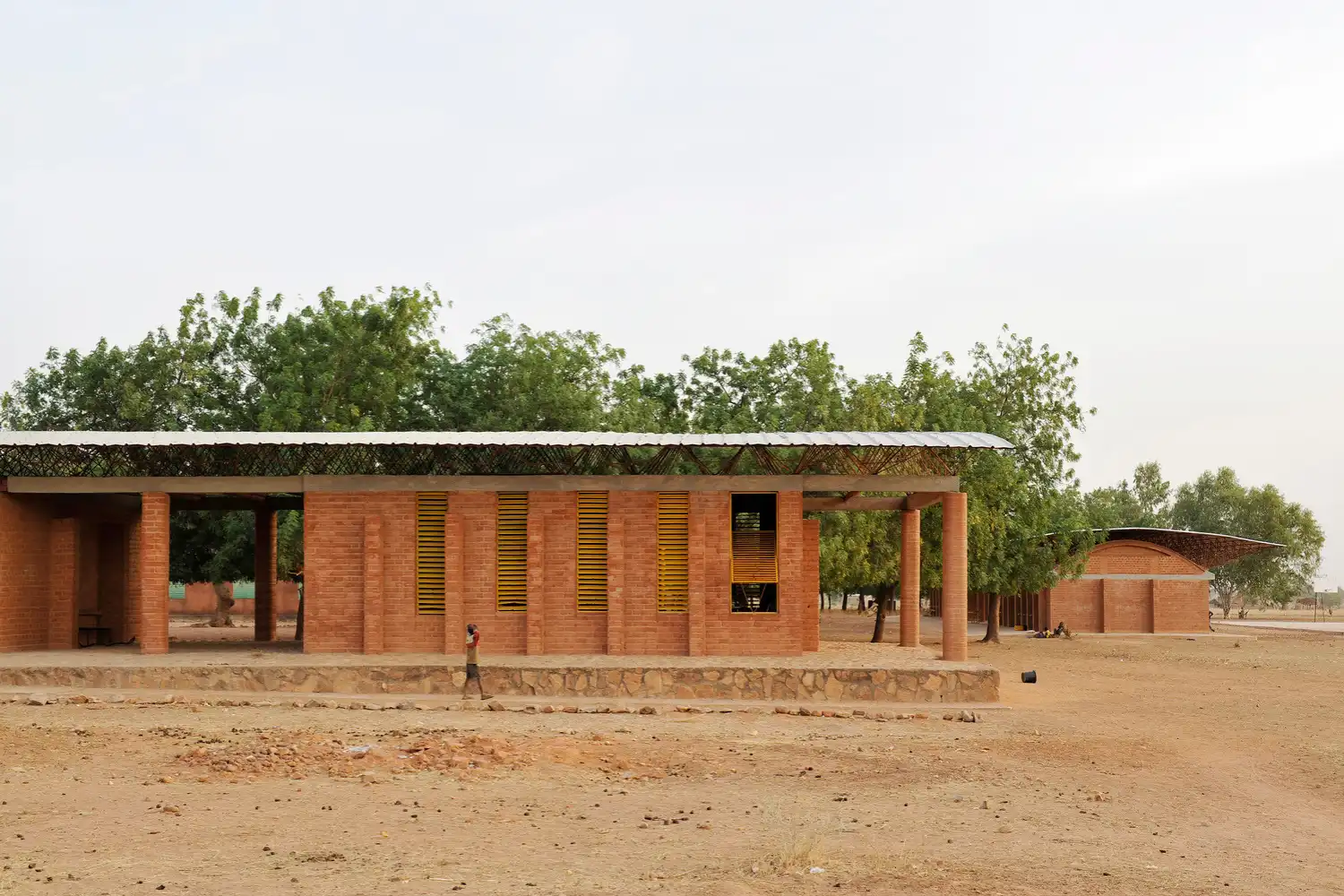
While Francis Kéré, the 2022 Pritzker laureate from Burkina Faso, is male, his story is inseparable from the women of his community. The Gando Primary School, his first built project (2001), was constructed with the direct participation of local women who shaped clay bricks and carried materials. Kéré’s approach to architecture places community participation, particularly women’s labor and knowledge, at the center of the building process.
This entry serves as a reminder that inspiring women in architecture are not limited to those holding formal titles. The women of Gando, and women builders across the Global South, contribute essential knowledge about local materials, climate adaptation, and construction techniques that professional architecture often overlooks. For more on how community-driven approaches shape modern design, visit the Kéré Foundation.
📌 Did You Know?
Marion Mahony Griffin passed the architectural licensure exam in Illinois in 1898, becoming one of the first licensed women architects in the world. She produced the detailed renderings that helped build Frank Lloyd Wright’s early reputation, yet her name was largely absent from architectural history until the 21st century.
The Barriers That Are Still There
Every name above cleared obstacles that their male contemporaries did not face, and most of those obstacles have not disappeared. They are worth stating plainly, because the celebratory list format tends to imply the problem was solved by the people on it.
The attrition between school and practice
Architecture schools have been close to evenly split by gender for decades. Registration figures are not, and the share of women falls further at principal and partner level. The loss happens after graduation rather than before it, which points at the profession rather than at the pipeline. Long hours, low early-career pay relative to the length of training, and a culture that treats availability as commitment all bear disproportionately on anyone with caring responsibilities.
Attribution
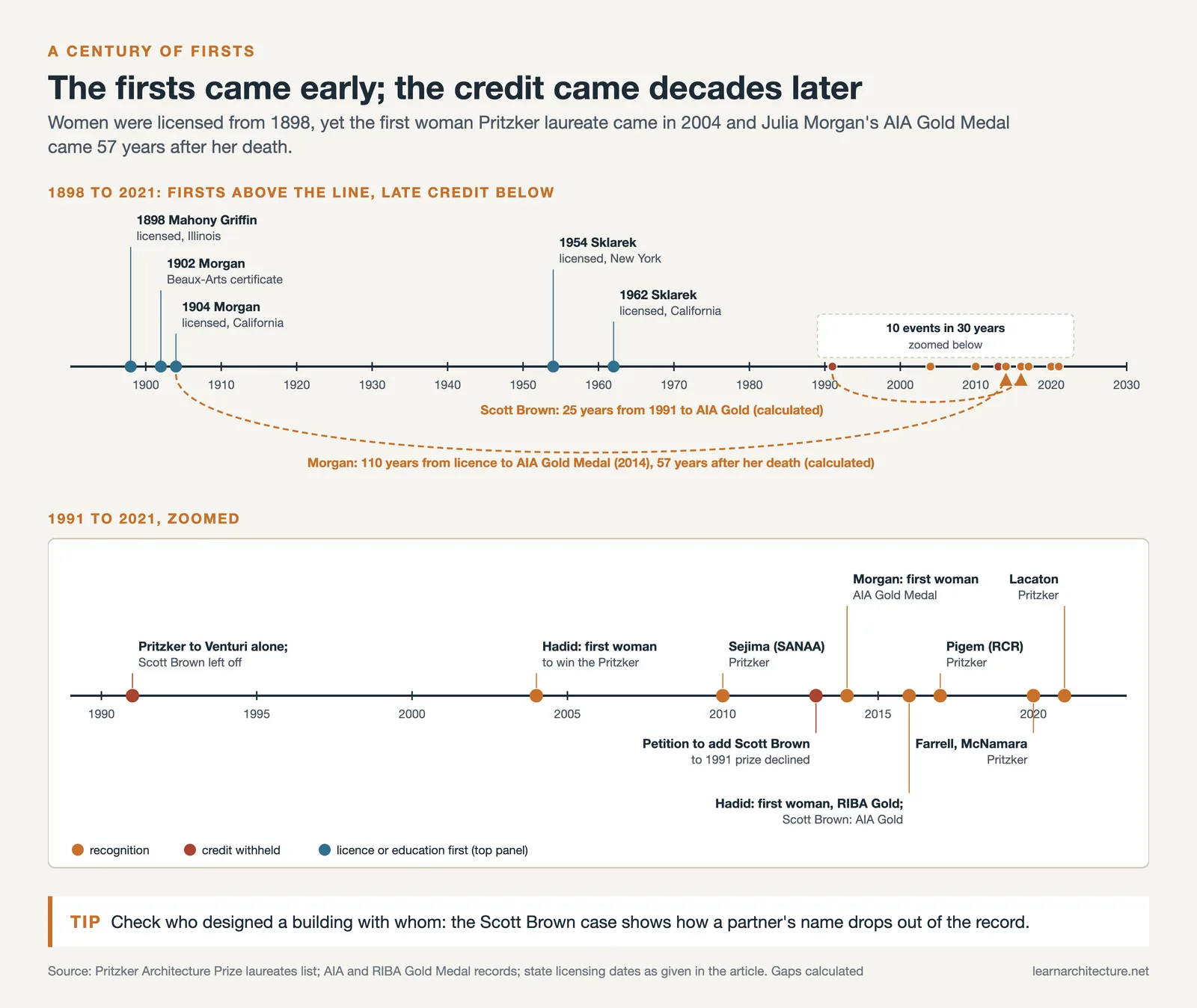
The Denise Scott Brown case is the clearest documented example. She was Robert Venturi’s partner in work and in practice, and the 1991 Pritzker went to him alone. A 2013 petition asking the Pritzker jury to retroactively recognise her was declined. Her situation was unusual only in being visible: the pattern of a woman’s contribution being absorbed into a male partner’s or principal’s reputation runs throughout the history above, from Marion Mahony Griffin’s renderings for Frank Lloyd Wright onward.
Recognition
Zaha Hadid won the Pritzker in 2004, the first woman to do so in the prize’s twenty-five-year history. Kazuyo Sejima followed in 2010 with SANAA, Carme Pigem in 2017 with RCR Arquitectes, Yvonne Farrell and Shelley McNamara in 2020, and Anne Lacaton in 2021. Five of the profession’s highest honours across more than four decades is a record that says as much about who gets considered as about who is working.
What is actually changing
The visible shifts are structural rather than symbolic: parental leave and flexible working written into practice policy, transparent pay banding, and the slow normalising of shared credit on partnership work. Amanda Levete’s practice, founded after two decades in partnership, is one of a number of examples where the second act is the one on the founder’s own name. The gap between the number of women entering architecture and the number leading it remains the measure worth watching.
What These Famous Women Architects Have in Common
Looking at this list of famous women architects, several patterns emerge. Nearly all faced institutional resistance, whether that meant being denied entry to professional clubs, watching credit go to male collaborators, or spending years teaching because commissions would not come. Yet each one produced work that outlasted the bias. Zaha Hadid’s buildings now define skylines from Beijing to London. Julia Morgan’s Hearst Castle draws more than 750,000 visitors a year. Eileen Gray’s E-1027 is recognized as one of the most important houses of the 20th century.
The most famous women architects in history did not simply add buildings to the world. They expanded what architecture could be: more inclusive, more responsive to communities, more willing to question convention. That legacy continues in the work of contemporary practitioners like Jeanne Gang, Farshid Moussavi, Dorte Mandrup, and Tosin Oshinowo, who are building on foundations laid by the women profiled here.
To learn more about the broader history of architectural practice and how it has evolved, our guides on famous architects who transformed modern architecture and contemporary architecture pioneers provide useful context. For a closer look at the awards that recognize excellence in the field, see our overview of the most famous architecture awards.
💡 Pro Tip
If you are building a reading list on women in architecture, start with “The Women Who Changed Architecture” by Jan Cigliano Hartman (Princeton Architectural Press, 2022). It profiles over 100 architects from the 19th century to today and is one of the most thorough surveys available on the subject.
Frequently Asked Questions
Who was the first woman to win the Pritzker Prize?
Zaha Hadid, in 2004, twenty-five years after the prize was established. Kazuyo Sejima followed in 2010 as one half of SANAA with Ryue Nishizawa, Carme Pigem in 2017 with RCR Arquitectes, Yvonne Farrell and Shelley McNamara of Grafton Architects jointly in 2020, and Anne Lacaton with Jean-Philippe Vassal in 2021. Denise Scott Brown was not included when her partner Robert Venturi won in 1991, and a 2013 petition asking the jury to recognise her retroactively was declined.
Who are the most famous women architects?
Zaha Hadid is the most widely known, followed by Julia Morgan, whose roughly seven hundred buildings include Hearst Castle, and Eileen Gray, whose furniture and the E-1027 house were long attributed elsewhere. Working today: Kazuyo Sejima, Jeanne Gang, Yvonne Farrell and Shelley McNamara, and Amanda Levete. Denise Scott Brown and Norma Merrick Sklarek belong on any serious list, the first for postmodern theory and the second for breaking two barriers at once as the first African-American woman licensed as an architect in New York and California.
Why are there so few women architects?
There are not few women in architecture; there are few at the top. Schools have been close to evenly split by gender for decades, but the share of women falls at registration and falls further at principal level. Since the drop happens after graduation, the explanation lies in the profession’s working conditions rather than in recruitment: long hours, low pay relative to the length of training, and a culture that reads constant availability as commitment.
Who was the first licensed woman architect?
It depends on the jurisdiction, which is part of the problem with the question. Julia Morgan was the first woman licensed as an architect in California, in 1904, and the first woman admitted to study architecture at the École des Beaux-Arts in Paris. Marion Mahony Griffin passed the licensure examination in Illinois in 1898. Norma Merrick Sklarek became the first African-American woman licensed in New York, in 1954, and later in California.
Final Thoughts
The ten women profiled here represent only a fraction of the architects who have shaped the built environment. From Lilly Reich’s collaborations with Mies van der Rohe to Anne Lacaton’s resource-efficient housing in France, the full story of women in architecture stretches far wider than any single list can capture. What this selection does show is that the most inspiring women in architecture succeeded not despite the barriers they faced, but through a commitment to design that was too strong and too original to be ignored.
Their work is not a footnote. It is the main text. And as ArchDaily’s ongoing Women in Architecture coverage and Architizer’s 100 Women to Watch demonstrate, the next generation of women architects is already writing the next chapter.
- architect woman famous
- famous architect woman
- famous architects women
- famous woman architect
- famous women architects
- famous women architects history
- list of famous women architects
- most famous woman architect
- most famous women architects
- most famous women architects history
- woman architect famous
- women architects famous









Leave a comment