


Table of Contents Show
The height of the Shard in London is 309.6 metres (1,016 feet), making it the tallest building in the United Kingdom and Western Europe. Designed by Italian architect Renzo Piano and completed in 2012, this 95-storey glass spire in Southwark houses offices, restaurants, a five-star hotel, private residences, and the UK’s highest public viewing gallery, all within a single tapered structure conceived as a “vertical city.”
How High Is the Shard Building in London?
The Shard reaches 309.6 metres (1,016 feet) to its tip, making it a supertall skyscraper by the Council on Tall Buildings and Urban Habitat definition. Of its 95 total storeys, 72 are habitable floors. The open-air observation deck sits at 244 metres (801 feet) above street level, which is the highest publicly accessible point in Western Europe at the time of opening.
For context, the Shard is roughly 2.8 times the height of St Paul’s Cathedral (111 metres), and its shadow falls across the River Thames rather than onto the surrounding streets, a deliberate outcome of its location beside London Bridge Station. The tip of the spire tapers to a near-invisible point, giving the tower its characteristic appearance of dissolving into the London sky.
🔢 Quick Numbers
- Total height: 309.6 m / 1,016 ft (The Shard official data, 2012)
- Habitable floors: 72, with an additional non-habitable spire to storey 95 (Wikipedia / CTBUH)
- Observation deck height: 244 m / 801 ft above street level (The View from The Shard, 2013)
- Exterior glass panels: 11,000, equivalent in area to eight football pitches (Sellar Property Group)
How Many Floors Does the Shard Have in London?

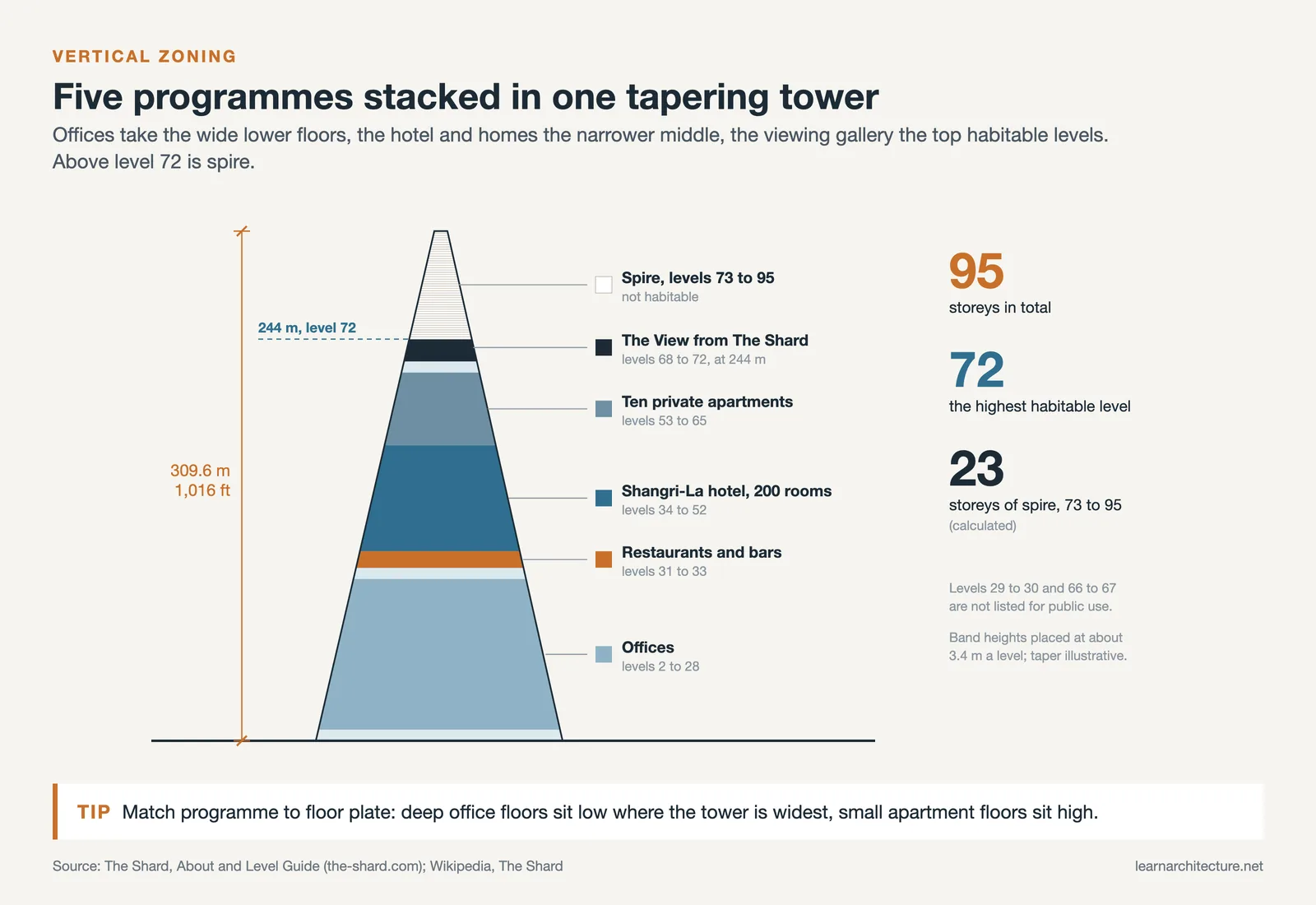
The Shard London has 95 storeys in total. However, the distinction between total floors and habitable floors matters here. The 72 habitable floors contain usable programme, while storeys 73 to 95 form the tapering glass-and-steel spire that gives the building its name. The highest floor open to the public is level 72, where the open-air observation platform is located.
The floor layout follows a clear vertical zoning logic:
- Levels 2 to 28: Office space (55,277 m²)
- Levels 31 to 33: Restaurants and bars, including Aqua Shard, Oblix, and Hutong
- Levels 34 to 52: Shangri-La The Shard hotel (200 rooms across 19 floors)
- Levels 53 to 65: Ten exclusive private residential apartments
- Levels 68 to 72: The View from The Shard observation gallery
💡 Pro Tip
When studying The Shard as a precedent for mixed-use towers, pay close attention to how the floor plate size decreases as the building rises. Offices need large open floors, hotels need medium-depth rooms, and apartments can be narrower with views on all sides. Piano used this natural taper of programme requirements to generate the building’s pyramidal form. The shape was not imposed, it emerged from the brief.
Renzo Piano’s Design Vision: What Does “Vertical City” Mean?
The concept of a vertical city was central to how Renzo Piano and developer Irvine Sellar approached the project. The idea was not simply to build tall, but to stack the diversity of an urban neighbourhood into a single structure. Offices, restaurants, a hotel, residences, and public observation space each occupy distinct zones, allowing the building to function around the clock rather than emptying out after business hours.
Piano’s design process for the London Shard skyscraper began in Berlin in 2000, when Sellar arranged a lunch meeting with the architect. According to Piano, his initial instinct was resistance. He has described tall buildings as “arrogant” and “fortress-like,” but the energy of the railway lines at London Bridge and the proximity of the Thames convinced him that this site was an exception. He sketched the building’s spire profile on the back of a restaurant menu that evening.
🎓 Expert Insight
“I foresee the tower as a vertical city, for thousands of people to work in and enjoy, and for millions to take to their heart.”
Renzo Piano, RPBW
This statement, made during the planning stages, captures what separates The Shard from conventional office towers. Mixed-use programming was not an afterthought: it was the original generator of the building’s form, influencing every floor plate dimension from the ground up.
Piano took design inspiration from two historical sources: the church spires of London and the masts of tall ships depicted in 18th-century paintings by Canaletto. Both references share the quality of being slender, tapering structures that mediate between the ground and the sky. The Shard’s eight sloping glass facades, each set at a slightly different angle, converge at the tip to produce a faceted spire that catches and fragments light throughout the day.
For a wider look at Piano’s body of work, our article on Renzo Piano architecture traces his design philosophy from the Centre Pompidou in Paris to The Shard and beyond.
Inside the Shard London: What’s There to See and Do?

Inside the Shard London, there are four distinct public and semi-public experiences, each at a different height. The ground-level lobby connects directly to London Bridge Station, and from there elevators travelling at approximately six metres per second carry visitors upward.
The restaurants on floors 31 to 33 are open to the public without booking the hotel or observation deck. Aqua Shard, Oblix, and Hutong each offer floor-to-ceiling glazed views across the city. Above the restaurants, the Shangri-La hotel occupies the central section of the building and includes the highest hotel infinity pool in Western Europe, located on floor 52.
📌 Did You Know?
The Shard’s 11,000 glass panels cover an area equivalent to eight football pitches. The glass is an extra-white formulation selected by Piano specifically to give the facade a sense of translucency and sensitivity to changing light conditions. On overcast London days, the tower appears almost silver-white; in direct sunlight, it becomes a shifting mirror of sky and cloud. The entire wiring length inside the building is 320 km, enough to stretch from London to Paris.
Hotel London the Shard: Shangri-La Overview

The Shangri-La The Shard is the only five-star hotel inside the building. It occupies floors 34 to 52, with 200 rooms and suites offering panoramic views of London in every direction. The hotel is the first Shangri-La property in the United Kingdom and includes the highest outdoor pool in Western Europe, a gym, and the restaurant Ting, which serves pan-Asian cuisine at floor 35.
Guests staying at the hotel access their rooms via a dedicated lobby on level 35, separate from the public circulation routes used by office workers and observation deck visitors. The residential apartments on floors 53 to 65, ten in total, sit directly above the hotel and are among the highest-altitude private residences in Europe.
The View from The Shard: London’s Highest Observation Deck
The observation gallery, known as The View from The Shard, spans floors 68 to 72 and offers 360-degree views stretching up to 64 kilometres (40 miles) on clear days. Floor 72 is partially open-air, making it the highest open-air viewpoint in the UK. The gallery opened to the public on 1 February 2013 and welcomed one million visitors within its first year of operation, according to Sellar Property Group.
Tickets for The View from The Shard are timed and purchased in advance. The experience includes three enclosed floors and one open-air level. On clear days, visitors can see landmarks including Wembley Stadium, the O2 Arena, Windsor Castle, and the North Downs.
📐 Technical Note
The Shard uses a hybrid structural system: a reinforced concrete core from the basement to level 40, post-tensioned concrete frame from levels 41 to 72, and a structural steel spire from level 72 to the tip at level 95. The building has a designed sway tolerance of 400 mm under extreme wind loading, achieved through the tapering pyramidal shape combined with post-tensioned floor slabs. The five-hundred-tonne steel spire was pre-assembled at Dalton Airfield in Yorkshire and transported to site in sections, per the engineering record published by Mace (principal contractor) in 2012.
How Tall Is the London Shard Compared to Other London Buildings?


At 309.6 metres, the London Shard skyscraper is significantly taller than any other completed building in the city. The next tallest, 22 Bishopsgate in the City of London, reaches 278 metres across 62 floors. The Leadenhall Building (also called the Cheesegrater) stands at 225 metres, and 30 St Mary Axe (the Gherkin) at 180 metres.
Internationally, The Shard ranks seventh among all buildings in Europe. The tallest buildings in Europe are concentrated in Moscow, with the Lakhta Center (462 m) holding the continental record. Within Western Europe, no building has surpassed The Shard’s height since its completion in 2012.
For a broader look at how supertall buildings compare globally, our article on the Shanghai Tower design explores the structural and programmatic logic behind the world’s third-tallest building.
⚠️ Common Mistake to Avoid
Many sources quote The Shard as having 72 floors, which is technically the number of habitable floors. The total storey count is 95. The discrepancy arises because storeys 73 to 95 form the non-habitable tapering spire structure. When referencing The Shard in academic or professional work, specify whether you mean total storeys (95) or habitable floors (72) to avoid confusion.
Construction Timeline and Engineering Challenges
Construction of The Shard began on 16 March 2009 and the building was topped out on 30 March 2012. Practical completion followed in November 2012, with the public inauguration on 5 July 2012. The entire construction period ran to just over three years, a remarkably tight schedule for a supertall building of this complexity.

The engineering team, with WSP as structural engineer, Arup as building services engineer and Mace as principal contractor, employed top-down construction for the foundations, a technique new to the UK at the time. In this method, foundation piling continues downward while the core and floors are built upward simultaneously, saving significant time on a constrained urban site directly above a major railway station.
Construction was also challenged by sub-zero winter temperatures, gale-force winds at height, and an incident where the Thames broke through the protective cofferdam around the excavation. The 500-tonne steel spire was test-assembled at an airfield in North Yorkshire before being dismantled and transported to London in sections to avoid the risks of full assembly at height.
💡 Pro Tip
When analysing The Shard as a case study in structural engineering, focus on the role of the post-tensioned concrete frame in the mid-section (levels 41 to 72). Post-tensioning allows shallower floor depths at those heights compared to conventional reinforced concrete, which is critical when every additional centimetre of floor thickness multiplies across dozens of levels and directly affects the maximum habitable floor count within a given overall height envelope.
Why The Shard Looks Different at Different Times of Day

Piano made deliberate material choices to ensure the tower would not have a fixed, static appearance on the London skyline. The extra-white glass panels used on the exterior have a lower iron content than standard float glass, giving them a colour-neutral, near-colourless transparency. This means the facade reads differently depending on cloud cover, sun angle, and season.
The double-skin facade includes automatic solar blinds between the exterior and interior glazing layers. Opening vents in the gaps between the eight faceted glass panels, which Piano called “fractures,” supply natural ventilation to the winter gardens on the office floors. This passive ventilation strategy reduces mechanical cooling loads in those zones.
The tower won first place at the 2014 Emporis Skyscraper Awards, with judges describing it as “a skyscraper that is recognized immediately and which is already considered London’s new emblem.” It also won the ENR (Engineering News-Record) Global Best Projects Award in 2013 in the mixed-use category and took the overall Project of the Year title in the same competition.
To explore how tall buildings like The Shard influence broader skyscraper design trends, including sustainability integration and vertical urban programming, that article examines the current direction of high-rise architecture worldwide.
✅ Key Takeaways
- The height of the Shard in London is 309.6 metres (1,016 feet), making it Western Europe’s tallest building and the UK’s tallest structure completed to date.
- The Shard has 95 total storeys, of which 72 are habitable floors; the remaining levels form the tapering glass-and-steel spire.
- The building operates as a genuine vertical city, with offices, restaurants, the Shangri-La hotel, private apartments, and a public observation gallery all stacked within a single mixed-use structure.
- Renzo Piano’s design was shaped by the floor plate requirements of each programme: large plates for offices at the base, narrower zones for apartments near the top, producing the building’s natural taper.
- The open-air observation deck at level 72 sits 244 metres above street level and offers views extending up to 64 kilometres on a clear day.
- Top-down construction and a hybrid concrete-steel structural system allowed Mace and Arup to complete the building in just over three years, setting a pace benchmark for UK supertall construction.
For official visitor information, tickets for The View from The Shard, and hotel bookings at the Shangri-La, visit the-shard.com. The full architectural record of the project, including drawings and construction photographs, is available through the Fondazione Renzo Piano. Renzo Piano’s own office documentation is published on the RPBW website. For architectural criticism and project photography, ArchDaily’s Shard project page and Dezeen’s interview with Renzo Piano are both authoritative sources.
- height of the shard in london
- height of the shard london
- hotel london the shard
- how high is the shard building in london
- how high is the shard in london
- how many floors in the shard london
- how many floors is the shard in london
- how tall is the london shard
- inside the shard london
- london skyscraper the shard
- london the shard









Leave a comment