


Table of Contents Show
Shanghai Tower is a 632-meter (2,073-foot), 128-story supertall skyscraper in Lujiazui, Pudong, designed by the American firm Gensler. Its 120-degree twisting double-skin glass facade is both an aesthetic statement and a structural strategy, reducing wind loads by 24% while housing nine sky garden atriums that create a vertical city within a single building. Completed in 2015, it holds LEED Platinum certification and remains the tallest building in China.
Shanghai Tower Architecture: The Twisting Form and What It Solves
The most immediately recognizable element of the shanghai tower design is its spiraling outer facade, which completes a 120-degree rotation as the building rises from ground to crown. But this was not an aesthetic decision made in isolation. Gensler’s design team, led by architect Jun Xia, arrived at the twisting form through rigorous wind tunnel testing conducted at a Canadian facility in collaboration with structural engineers Thornton Tomasetti.
Shanghai sits in a region susceptible to typhoon-force winds. The challenge was to build a 632-meter structure in a city known for typhoon wind speeds, silt-based soil, and an ever-shifting water table. Three design strategies addressed these conditions simultaneously: the building’s asymmetrical form, its tapering vertical profile, and its rounded corners. Together, these choices reduced structural wind loads by 24% compared to a conventional rectangular tower of the same height.
That reduction had real financial consequences. According to Gensler and Thornton Tomasetti, the optimized shape allowed the Shanghai Tower to use 25% less structural steel than a comparable design would have required, saving an estimated US$58 million in material costs during construction.
📐 Technical Note
The outer facade of the Shanghai Tower consists of over 20,000 curtain wall panels suspended from above on cantilevered trusses, not supported from below. The triangular outer curtain wall is engineered to a peak negative wind pressure of 6.5 kPa at its most exposed points, with a standardized 4.5 kPa baseline across the majority of the surface (Gensler Facade Design Report, 2011). This hanging system, unique at supertall scale, allowed the facade to twist continuously without transferring structural loads back to the floor plates.
The inner facade follows a cylindrical form, while the outer facade is triangular and rotates around it. The gap between them, ranging from 12 to 15 stories tall, creates nine enclosed atrium spaces that are central to both the building’s sustainability strategy and its social program. Parametric design software, including Grasshopper and BIM, was used at a level of complexity that was unprecedented among Chinese contractors at the time, according to Gensler’s Co-Managing Director of Shanghai, Xiaomei Lee.
What Is the Shanghai Tower Height and Why Does It Matter?

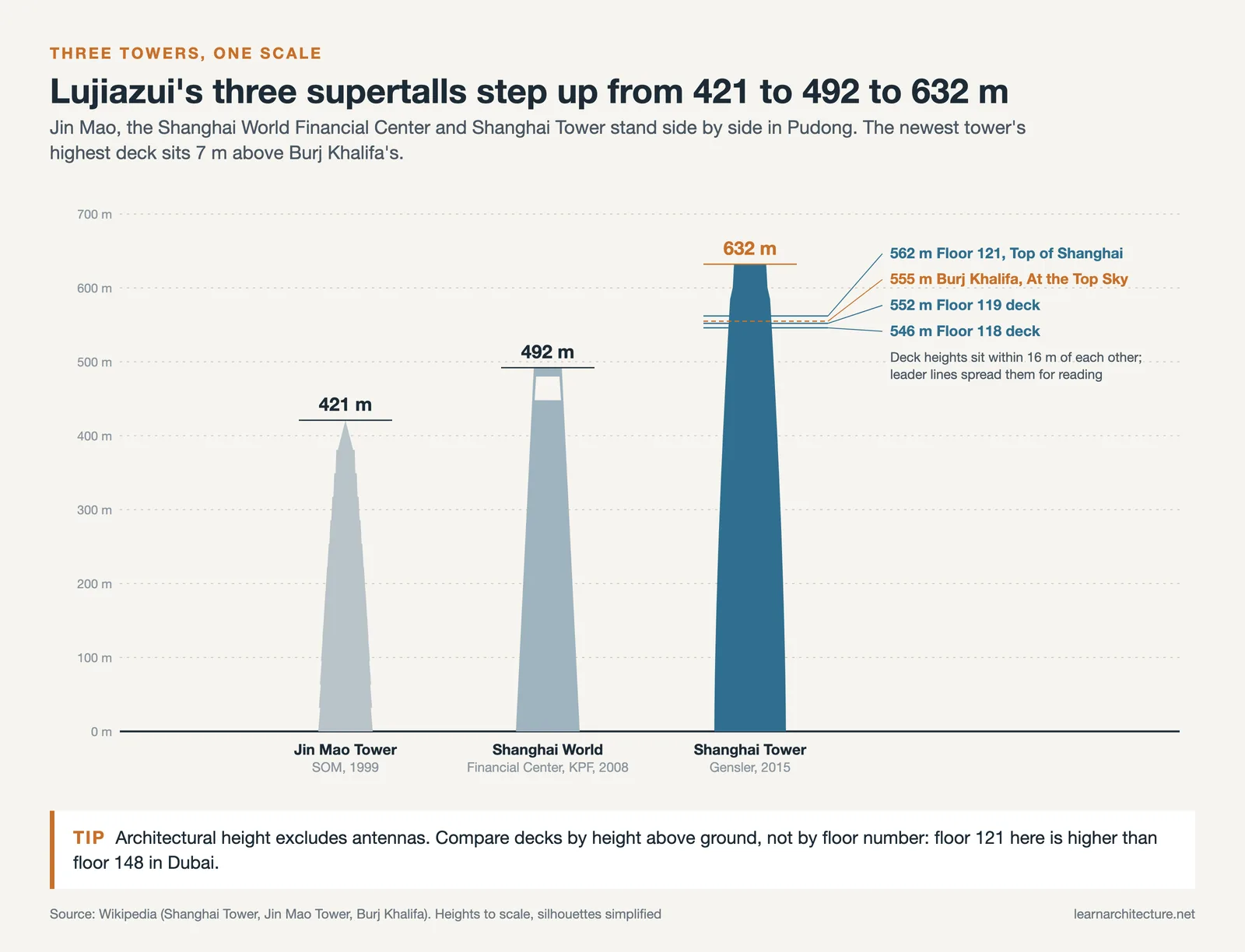
Shanghai tower height stands at 632 meters (2,073 feet), making it the tallest building in China and the world’s third tallest by architectural height as of 2025, according to the Council on Tall Buildings and Urban Habitat (CTBUH). It was the second tallest globally from its opening in 2015 until 2021, when it was surpassed by Merdeka 118 in Malaysia.
In its own context, the tower completes what is sometimes called the world’s first “triple-adjacent supertall” cluster in Lujiazui. The other two are SOM’s Jin Mao Tower (421 meters, 1999) and KPF’s Shanghai World Financial Center (492 meters, 2008). Jun Xia framed the trio as a narrative sequence: Jin Mao’s pagoda-like form represents Shanghai’s architectural past, the SWFC’s sharp geometric profile represents the present, and Shanghai Tower’s spiraling organic form points toward the future.
🔢 Quick Numbers
- 632 meters / 2,073 feet tall, tallest building in China (CTBUH, 2025)
- 25% less structural steel used versus a conventional tower of equivalent height, saving US$58 million in materials (Gensler / Thornton Tomasetti)
- 21% reduction in total energy consumption versus baseline; 40% reduction in water use (Shanghai Tower Construction & Development Co.)
- 270 vertical-axis wind turbines installed near the crown, capable of generating up to 350,000 kWh of supplementary electricity per year (Wikipedia / CTBUH)
The building’s observation deck on floors 118 and 119 (at 546 and 552 meters) has been open to the public since April 2017. By 2020, an additional deck on the 121st floor at 562 meters became accessible, making it the world’s highest observation deck at the time, surpassing the Burj Khalifa’s deck at 555 meters. The J Hotel Shanghai Tower, which opened in 2021 on the 120th floor, became the world’s highest luxury hotel by elevation above ground level.
Gensler Shanghai Tower: The Design Team and the Process

The Gensler Shanghai Tower project began with a 21-month international design competition in which 10 firms submitted 19 concepts. Gensler’s scheme was selected in April 2008, and groundbreaking took place in November of that year. Construction topped out in August 2013 and the building opened to the public in February 2015.
Lead architect Jun Xia, Gensler’s Regional Director for Shanghai, drew on the city’s Shikumen housing tradition as a conceptual starting point. Shikumen architecture is defined by a deliberate blurring of indoor and outdoor space, thresholds where public and private realms merge. In the tower, this translates to the 12- to 15-story-tall sky gardens between the two facade layers. These atriums function as semi-public gathering spaces (cafes, gardens, restaurants, and retail) accessible to the wider public, not just tenants.
🎓 Expert Insight
“Shanghai Tower shows the greatest commitment to communal space in a tall building since Commerzbank Tower completed in 1997. It contains the world’s first truly ‘inhabitable’ double-skin facade on a skyscraper, which is not only remarkable for its intended greenery, but its incorporation into the tower’s overall ventilation strategy.”
Antony Wood, Executive Director, Council on Tall Buildings and Urban Habitat (CTBUH)
This recognition came when CTBUH named Shanghai Tower the Best Tall Building Worldwide. The inhabitable double-skin facade was a first at supertall scale, combining passive environmental control with genuine social programming, a combination rarely achieved in commercial high-rise development.
The project team extended well beyond the architectural office. Structural engineering was handled by Thornton Tomasetti; MEP systems by Cosentini Associates; wind tunnel testing by Rowan Williams Davies & Irwin (RWDI) in Canada; and vertical transportation by Edgett Williams Consulting Group. The architect of record was the Architectural Design & Research Institute of Tongji University, which navigated China’s building codes alongside the Gensler team. The collaboration required introducing BIM and Grasshopper-based parametric workflows to contractors who had not previously worked with those tools at this scale.
To learn more about how parametric tools are changing the way tall buildings are designed, see our guide on parametric architecture and how firms use software to generate optimized building forms.
Shanghai Tower Sustainable Design: Layers, Systems, and Certifications

The shanghai tower sustainable design approach operates on several simultaneous levels. The most visible is the double-skin glass facade. The outer layer is not opaque or reflective like most supertall facades; it is fully transparent, which eliminates the need for either layer to be tinted or mirrored. The gap between the two skins functions as a thermal buffer: in winter it traps warm air, reducing heating demand; in summer it dissipates interior heat before it reaches the occupied floors. This single feature significantly reduced the building’s HVAC load, which otherwise accounts for over 50% of a supertall’s total energy consumption.
The tower holds both LEED Platinum certification from the US Green Building Council and China’s Green Building Three Star rating, the highest level in each system. According to Tetra Tech, the MEP engineering firm involved in the project, the sustainable systems reduced energy consumption by 21% and lifecycle energy costs by 45% compared to a conventional baseline design.
💡 Pro Tip
When studying Shanghai Tower’s double-skin system for design reference, note that the outer facade is structurally independent: it hangs from above rather than sitting on floor plates. This means it cannot transfer lateral loads back to the primary structure, which is an important consideration if you are adapting a double-skin approach for a smaller project. The thermal buffer works best when the interstitial zone is ventilated but not fully conditioned, so detailing the connection between zones matters as much as the overall concept.
How Does the Shanghai Tower Wind Resistance System Work?

The shanghai tower wind resistance strategy combines passive form with active structural engineering. The tapering, twisting outer profile reduces the surface area exposed to wind as the tower rises, while the rounded profile eliminates the sharp corners that create high-pressure zones on rectangular towers. Wind tunnel simulations, based on measured data from Hong Qiao International Airport and typhoon modeling from Applied Research Associates in Raleigh, confirmed that the final form reduced wind loads by 24% versus a rectangular baseline.
Inside the building, a 1,000-metric-ton tuned mass damper (TMD) sits atop the central concrete core within the building’s crown. The TMD acts as a counterweight, oscillating opposite to the building’s sway during strong wind events to reduce upper-floor movement. This type of mass damper is common in supertall buildings, but Shanghai Tower’s scale and integration with the crown’s other systems (including cooling towers, window-washing tracks, and the 270 wind turbines) made the engineering of that zone particularly complex.
The structural system itself is a core wall-outrigger-mega-frame, with a 90-foot by 90-foot concrete core connected to perimeter mega-columns via outrigger trusses at each of the nine zone boundaries. Thornton Tomasetti’s Dennis Poon described the outrigger trusses informally as “ski poles”, elements that provide lateral stability in both wind and seismic events without interrupting the usable floor plans within each zone.
Shanghai Tower Green Building Features: Active Systems
Beyond the facade, the tower incorporates 43 documented green and energy-saving technologies. The 270 vertical-axis wind turbines near the crown can generate up to 350,000 kWh of supplementary electricity per year, covering approximately 10% of the building’s electrical needs (Wikipedia, citing CTBUH data). A 2,130 kW natural gas-fired cogeneration system supplies electricity and heat to the lower zones. A geothermal ground-source heat pump handles heating and cooling for specific areas. Smart control systems monitor electricity consumption continuously and reportedly generate around US$556,000 in annual energy savings (LinkedIn/Shanghai Tower sustainability case study).
Water efficiency is equally detailed. The tower captures rainwater for internal reuse and processes grey water on-site. According to the Shanghai Tower Construction & Development Co., these systems reduce total water consumption by 40%, saving approximately 235,000 cubic meters annually. The building also includes 6,700 water control valves integrated into the HVAC systems to fine-tune pressure and flow across its 128 floors.
📌 Did You Know?
Shanghai Tower was the tallest and largest LEED-CS Platinum certified building in the world from 2015 to 2024, nearly a decade. That record held through the construction of dozens of newer supertalls globally, most of which achieved lower green certification tiers. Its annual carbon footprint reduction is estimated at approximately 37,000 metric tonnes, which is roughly equivalent to taking 8,000 cars off the road each year (Hello Energy ESG Solutions, citing Shanghai Tower data).
Vertical Urbanism: How Shanghai Tower Functions as a City

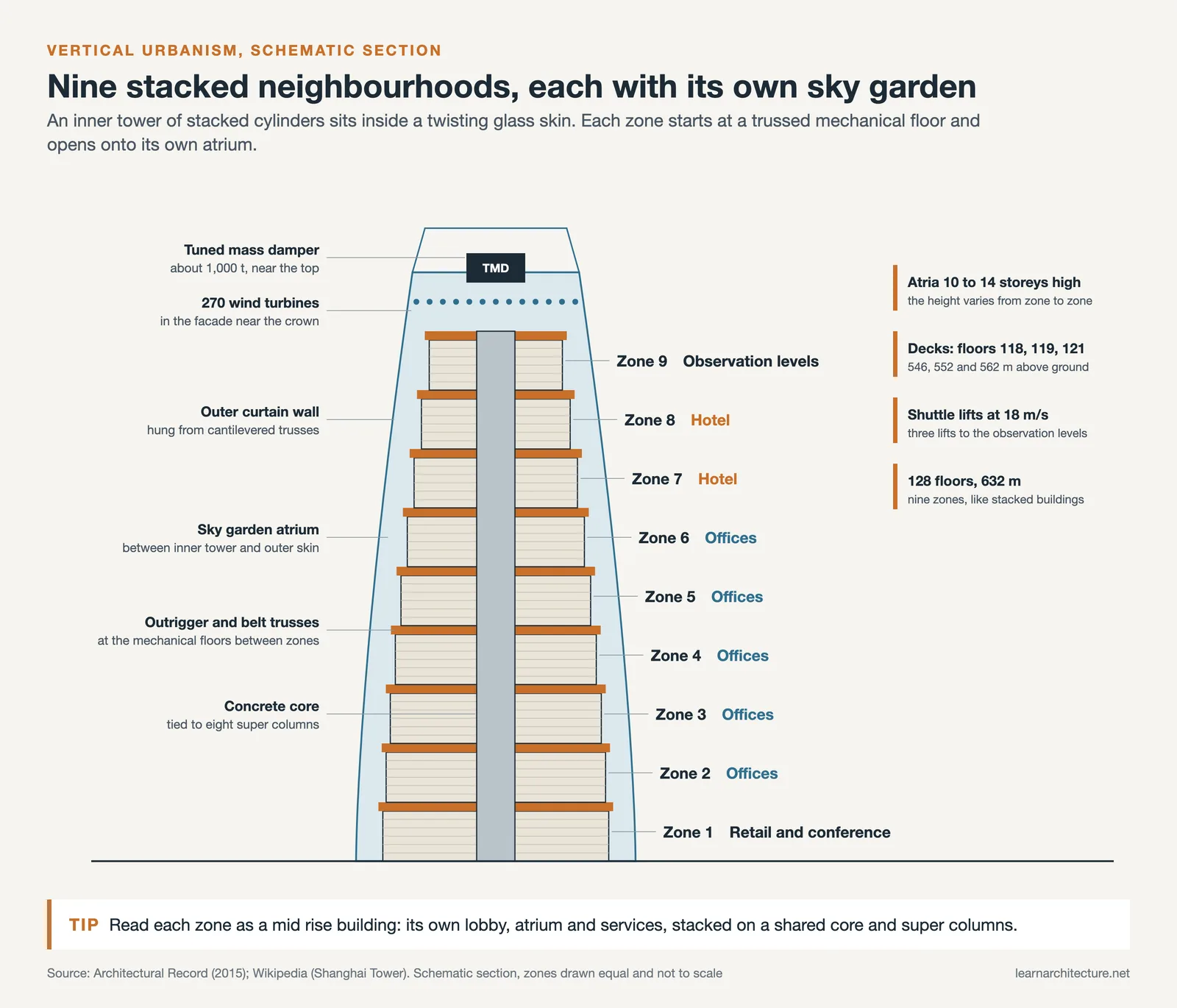
One of the most distinctive aspects of shanghai tower architecture is its organizational logic. The building is not a single unified interior; it is nine stacked vertical neighborhoods, each spanning 12 to 15 stories and containing its own atrium, sky garden, retail, dining, and community facilities. Each zone functions essentially as a mid-rise building within the larger supertall structure, with its own MEP systems sized to serve that zone independently.
Zone 1, at the base, contains retail and conference space. Zones 2 through 6 house Class A office space. Zone 7 is a luxury hotel. Zone 8 contains additional boutique hotel rooms and retail. Zone 9, at the top, holds public observation decks and the building’s crown. This stacking creates a genuinely mixed-use vertical community that accommodates up to 16,000 people daily.
For architects and students interested in how mixed-use programming shapes tall building design, our article on mixed-use building design explores the planning principles behind stacking programs vertically. You may also find our overview of supertall skyscraper design useful for understanding the engineering frameworks that make projects like this possible.
🏗️ Real-World Example
Commerzbank Tower (Frankfurt, 1997): Designed by Norman Foster, the Commerzbank was the first tall building to incorporate sky gardens as genuine social and environmental amenities, with garden atriums on every ninth floor acting as natural ventilation inlets. At 259 meters it is far shorter than Shanghai Tower, but its inhabitable facade concept was the direct predecessor that CTBUH cited when evaluating Shanghai Tower’s atrium program. Both buildings demonstrate that public space sacrificed from leasable area can be justified by measurable environmental and occupant well-being benefits.
The elevator system reflects the zone-based organization. Four sky lobbies, each a double-deck shuttle hub, serve the office floors. A fifth sky lobby at floors 101-102 serves the hotel. Three ultra-high-speed observation deck elevators travel at 18 meters per second (65 km/h), making them among the fastest in any commercial building at the time of opening. The vertical transportation design was led by Edgett Williams Consulting Group, who worked closely with Gensler to ensure the core remained efficient without consuming excessive floor plate area.
Foundation Engineering: Building in Shanghai’s Silt

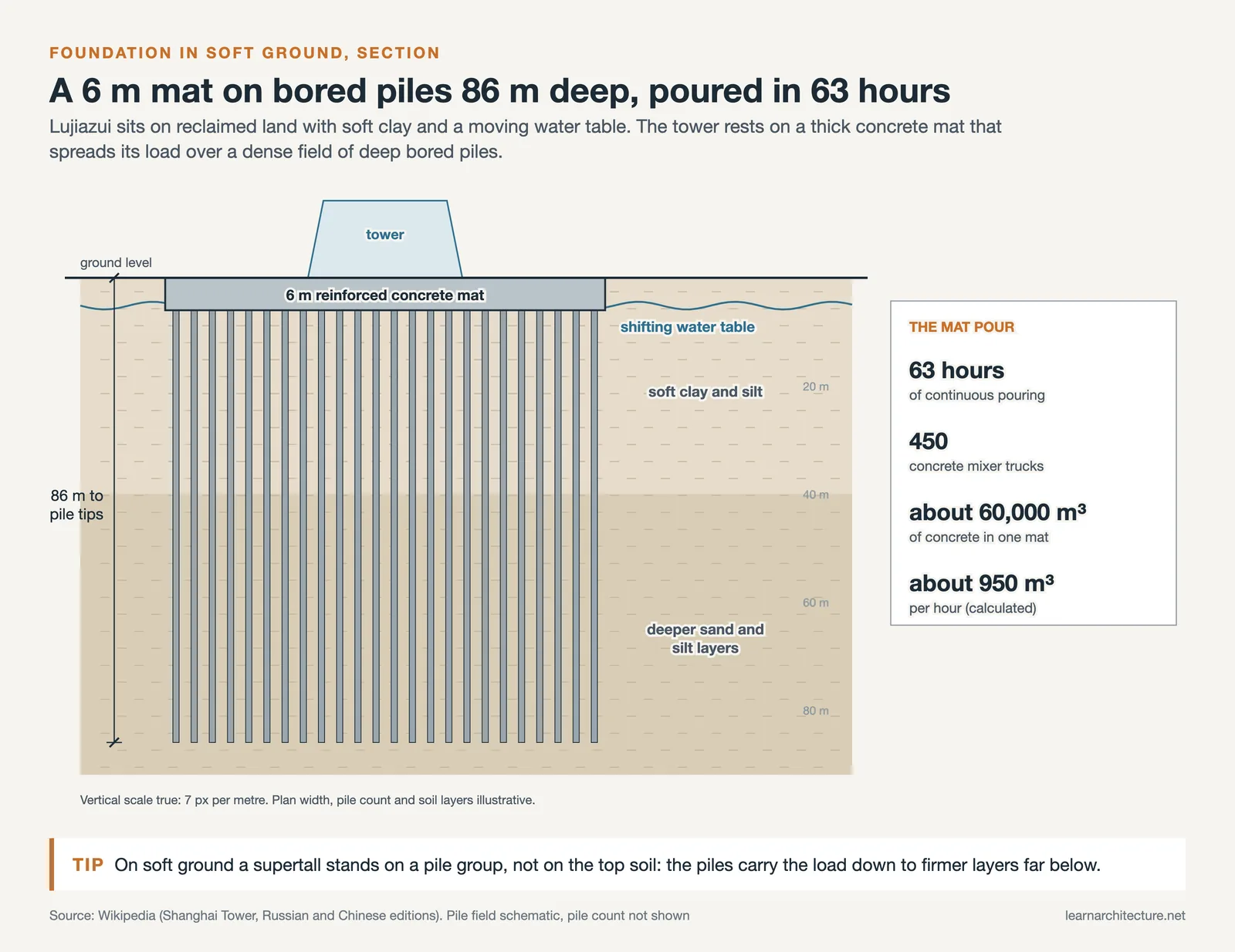
The Lujiazui district is built on reclaimed land with notoriously poor bearing capacity. Gensler’s Xiaomei Lee described the challenge as not only how to build the world’s tallest double-skin building, but how to stabilize it in clay-based soil with a shifting water table beneath a typhoon-prone coastline. The engineering response was substantial: more than 950 concrete and steel bore piles, each reaching about 86 meters into the ground, support a 6-meter-thick reinforced concrete mat foundation covering the building’s footprint.
Pouring the mat foundation alone required 63 continuous hours of concrete placement, using 450 concrete mixer trucks and eight pump stations distributed across the city. The total pour volume was approximately 60,000 cubic meters of concrete. The building was originally zoned for a structure no taller than 200 meters. The site’s rezoning to accommodate a 632-meter tower required entirely new thinking about how to anchor a structure of that weight and height in soil conditions that had defeated conventional approaches on smaller buildings nearby.
💡 Pro Tip
When researching supertall foundations in soft-soil urban contexts, Shanghai Tower’s pile-and-mat system is one of the most well-documented case studies available. The 85-meter pile depth and continuous concrete pour are often cited in structural engineering curricula. If you are writing about or specifying foundations in similar conditions, the CTBUH’s published technical papers on Shanghai Tower provide peer-reviewed data on load distribution and settlement monitoring that is difficult to find for most comparable projects.
Awards, Legacy, and the CTBUH 10-Year Award
Since completion, Shanghai Tower has accumulated a significant body of recognition. It won CTBUH’s Best Tall Building Worldwide award and, in 2025, received the CTBUH 10-Year Award at the organization’s International Conference, a recognition given to buildings that have demonstrated sustained performance and lasting influence on tall building design over the decade following their completion.
The tower’s influence on architectural thinking about supertalls has been substantial. It demonstrated that a building of extreme height could also be the most sustainably certified of its kind, contradicting the assumption that height and environmental performance are inherently in tension. It proved that public amenity space (sky gardens, observation decks, accessible atriums) could be integrated into commercial supertall development without undermining financial viability. And it showed that parametric design tools, then largely limited to academic and avant-garde practice, could be deployed at the scale of one of the world’s largest construction projects.
For further reading, the ArchDaily project page for Shanghai Tower includes project data and photography from Gensler. The Council on Tall Buildings and Urban Habitat (CTBUH) publishes detailed technical papers on the building’s structural and environmental performance. The Skyscraper Museum’s program page documents a public presentation by the design and engineering team covering structural logic and sustainable systems in their own words.
✅ Key Takeaways
- The 120-degree twisting facade is a structural solution first and an aesthetic choice second: it reduced wind loads by 24% and saved US$58 million in steel costs.
- The double-skin glass envelope creates nine inhabitable sky garden atriums that function as both passive thermal buffers and genuine public social spaces.
- Shanghai Tower held LEED Platinum certification as the world’s largest certified green building from 2015 to 2024, reducing annual energy consumption by 21% and water use by 40%.
- The nine-zone vertical organization treats the building as a stack of distinct neighborhoods, each with its own MEP systems, sky lobbies, and public amenities, a model for vertical urbanism at scale.
- Foundation engineering in Shanghai’s soft silt required more than 950 bore piles reaching 86 meters deep and a 63-hour continuous concrete pour, often cited as one of the most challenging foundation projects in modern supertall construction.
Note: Technical specifications cited in this article are drawn from published data by Gensler, Thornton Tomasetti, CTBUH, and the Shanghai Tower Construction & Development Co. For project-specific engineering decisions or academic research, primary sources from these organizations should be consulted directly.







Leave a comment