


Table of Contents Show
Architecture students need a specific set of drafting, modeling, and digital tools to keep up with studio work from the very first week. The right supplies make the difference between struggling through projects and actually enjoying the design process. This list covers 12 items that belong in every first-year student’s toolkit.
Walking into your first architecture studio with the wrong equipment is a fast way to fall behind. Unlike other degree programs, architecture demands hands-on production from day one. You will sketch, draft, build physical models, and run design software, sometimes all in the same week. Everything you create feeds into your growing architecture portfolio, so starting with the right tools matters from the very beginning. The supplies below are organized by category so you can build your kit without overspending or missing something critical.

Drafting and Drawing Tools Every Architecture Student Needs
Freehand sketching is still one of the fastest ways to test a design idea, and your professors will expect you to sketch constantly. A good set of drawing tools does not need to be expensive, but it does need to be reliable.
1. Mechanical Pencils (0.3mm, 0.5mm, 0.7mm)
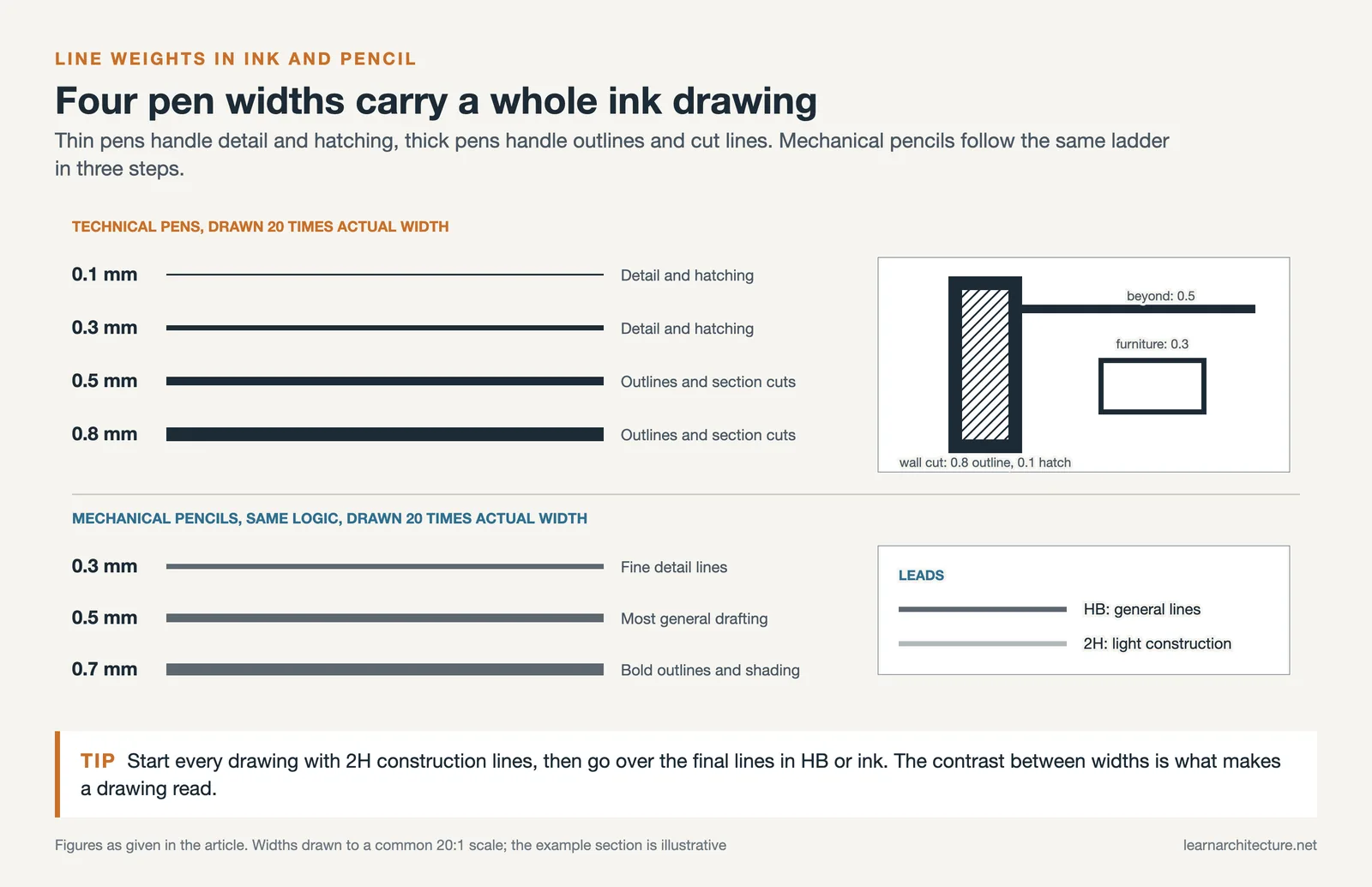
You will use mechanical pencils more than any other tool in your first year. A 0.5mm pencil handles most general drafting, while a 0.3mm gives you fine detail lines and a 0.7mm works for bold outlines and shading. Brands like Staedtler, Rotring, and Pentel are popular among architecture students for good reason: they hold up under heavy daily use. Pick up an HB lead refill pack and a 2H pack for lighter construction lines.

2. Sketchbook (A4 or A3)
Keep a dedicated sketchbook for studio work. An A4 size fits in most bags and gives you enough space to work through quick concept studies. Some students prefer A3 for more room during site analysis diagrams and early massing sketches. Choose a book with smooth, medium-weight paper (around 100gsm) that handles pencil and ink without bleeding. Avoid spiral-bound if you plan to scan or photograph pages, since the spiral creates uneven edges. Your sketchbook becomes part of your architecture student portfolio over time, so treat it as a design record, not a scratch pad.
💡 Pro Tip
Date every page in your sketchbook and add a short note about the project or exercise. When portfolio review comes around at the end of the year, you will have a clear timeline of your design thinking instead of a pile of unlabeled drawings.
3. Scale Ruler (Triangular Architect’s Scale)
A triangular architect’s scale ruler is non-negotiable. You will need it to read and produce drawings at standard scales like 1:50, 1:100, and 1:200 (or 1/4″ = 1′-0″ and 1/8″ = 1′-0″ if your program uses imperial units). The triangular shape gives you six scales on a single tool. Aluminum or high-quality plastic versions last longer than the cheap ones that wear down after a few months of sliding across paper. For a broader look at tools you will encounter throughout school, see this list of free architectural digital tools worth trying early on.

Model-Making Supplies for Studio Projects
Physical model-making is a core skill in first-year architecture programs. You will build concept models, site models, and sometimes detailed section models. Having the right materials on hand saves you from late-night runs to the craft store before a deadline.
4. Cutting Mat and X-Acto Knife
A self-healing cutting mat (A3 size minimum) protects your work surface and keeps your blade cuts clean. Pair it with an X-Acto #1 knife and a pack of #11 blades. Replace blades frequently. A dull blade tears cardboard instead of cutting it, and torn edges ruin the look of an otherwise strong concept model. Always cut away from your body, and never leave an uncapped blade on the desk.

5. Model-Making Materials Kit
Stock up on a basic materials kit: foam board (3mm and 5mm), chipboard, basswood sheets and strips, tracing paper, and white glue (PVA). Foam board is the go-to for quick massing models. Basswood gives you cleaner edges and a more finished look when you need it. Tracing paper is useful for layering sketch iterations over a base plan. Keep a small bottle of superglue (cyanoacrylate) for precision joints, but use it sparingly since it bonds skin instantly.
⚠️ Common Mistake to Avoid
Many first-year students buy pre-cut foam board pieces in small quantities from craft stores, paying two to three times the price per sheet. Buy full sheets (typically 20″ x 30″ or A1) from an art supply wholesaler or online in bulk. You will go through a lot more material than you expect during model-heavy weeks.
What Digital Tools Do First-Year Architecture Students Need?
Digital tools are now just as essential as physical ones. Most programs introduce CAD or BIM software in the first year, and you will need hardware that can handle 3D modeling without crashing mid-project.

6. Laptop with Dedicated Graphics
Your laptop is the single biggest investment on this list. Look for a machine with at least 16GB of RAM, a dedicated GPU (NVIDIA or AMD, not integrated graphics), and a fast SSD with 512GB or more of storage. You will run programs like AutoCAD, SketchUp, Revit, or Rhino, and these applications demand real processing power once models get complex. A 15-inch or 16-inch screen makes drawing and modeling more comfortable than squinting at a 13-inch panel. Check your school’s software requirements before buying, since some programs specify Windows-only software that won’t run natively on macOS.
7. External Mouse
Trackpads are fine for browsing, but they are painful for CAD work. A basic wired or wireless mouse with a scroll wheel is enough to start. The scroll wheel lets you zoom in and out of drawings quickly, and a middle-click function (pressing the scroll wheel) is used constantly for panning and orbiting in most 3D software. You do not need a high-end gaming mouse, just something comfortable for long hours of use.
🎓 Studio Tip
Treat the computer as a tool, not a substitute for thinking: sketch first, model second.
This advice is especially relevant for first-year students who sometimes rush to the computer before understanding the design problem. Your best ideas will often start on paper before they move to the screen.

Essential Supplies for Presentations and Documentation
Architecture school is not just about designing; you need to communicate your ideas clearly. Presentation boards, printed drawings, and well-organized documentation are all graded components of most studio courses.
8. T-Square or Parallel Rule
Even in a digital-heavy curriculum, many first-year studios still require hand-drafted assignments. A T-square (for use with a drafting board) or a portable parallel rule gives you straight horizontal lines to work from. If your school provides drafting desks in studio, a T-square is usually the better choice. If you work mostly at home or in shared spaces, a portable parallel rule clipped to a drawing board offers the same function in a smaller setup. Good studio habits around hand drafting pay off quickly, and these architecture school survival tips cover other first-year strategies worth adopting early.
9. Set of Technical Pens (Fine Liners)
Technical pens in sizes like 0.1mm, 0.3mm, 0.5mm, and 0.8mm let you produce clean ink drawings with consistent line weights. Brands like Staedtler Pigment Liner and Sakura Micron are standard choices. Use thinner pens for detail and hatching, and thicker ones for outlines and section cuts. These pens are also useful for annotating your concept sketches when preparing presentation boards.

10. USB Flash Drive or Portable SSD
Cloud storage is great until the campus Wi-Fi drops right before a submission deadline. Keep a USB flash drive (at least 64GB) or a portable SSD in your bag at all times. Save your working files locally and back them up to the drive at the end of every studio session. File corruption and accidental deletion are real problems, and losing a week of work the night before a review is a mistake you only want to make once.
Additional Must-Have Supplies for Architecture Students
11. Triangle Set (30/60 and 45-Degree)
A pair of clear acrylic triangles (one 30/60-degree and one 45-degree) works alongside your T-square to draw angled lines, construct perspectives, and produce section drawings by hand. Transparent triangles let you see the drawing underneath, which helps with alignment. Get a set that is at least 25cm (10 inches) on the longest side so they are practical for A3 and larger sheet sizes.

12. Portfolio Case or Tube
You will produce large-format drawings and presentation boards throughout the year, and you need a way to transport them without bending or creasing. An adjustable-length document tube works for rolled drawings. For flat boards and mounted prints, a portfolio carrying case (A2 or A1 size) keeps everything protected. Investing in a decent case early saves you from showing up to a review with a crumpled board and a bad first impression. For guidance on which projects to organize and display, see this breakdown of projects to include in an architecture student portfolio.
💡 Pro Tip
Before buying everything at once, check whether your school provides any supplies or has a materials shop with discounted rates for enrolled students. Many architecture programs offer starter kits or bulk purchasing deals through the department, which can save you 20-30% compared to retail prices.
Quick Reference: Architecture Student Supplies List
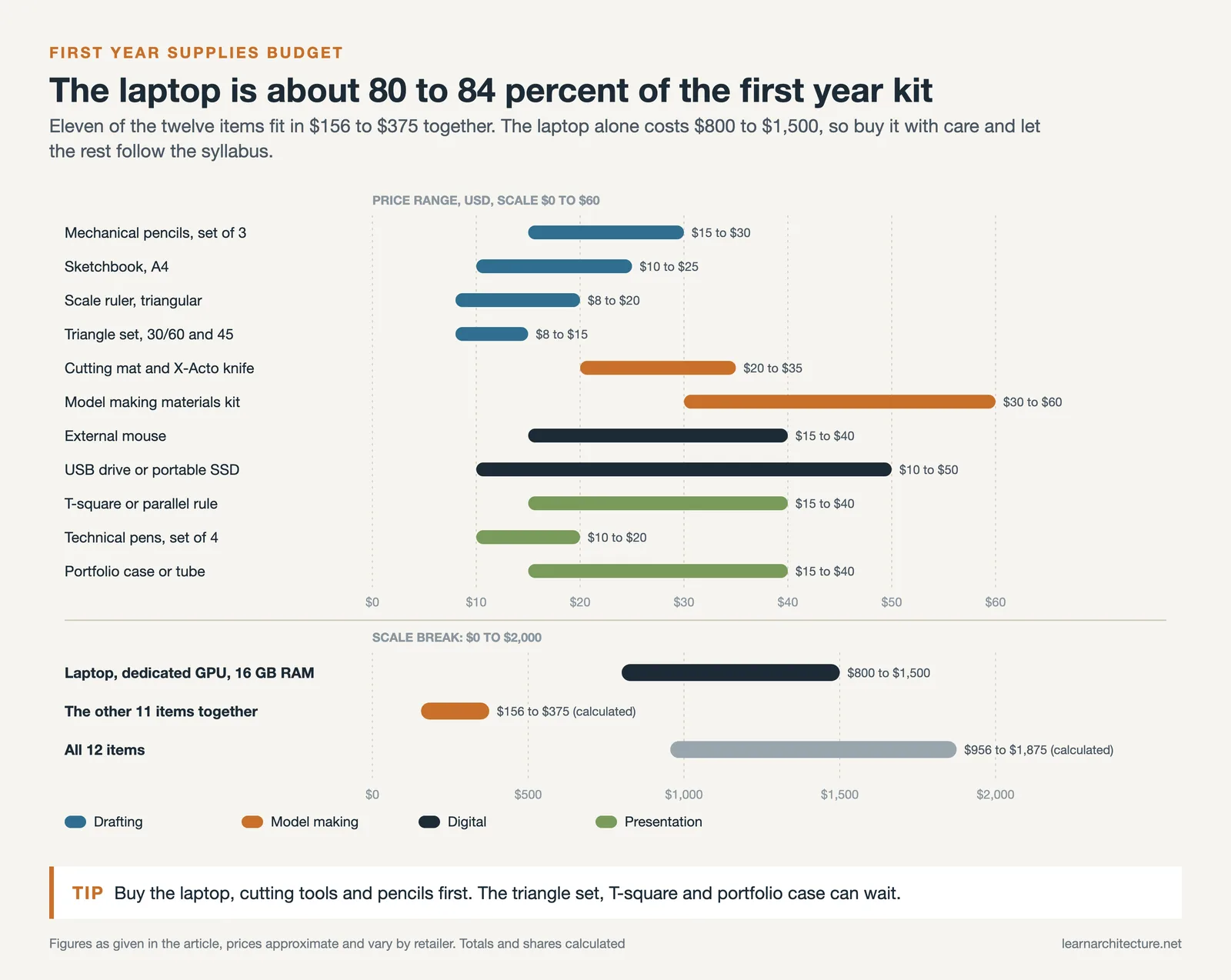
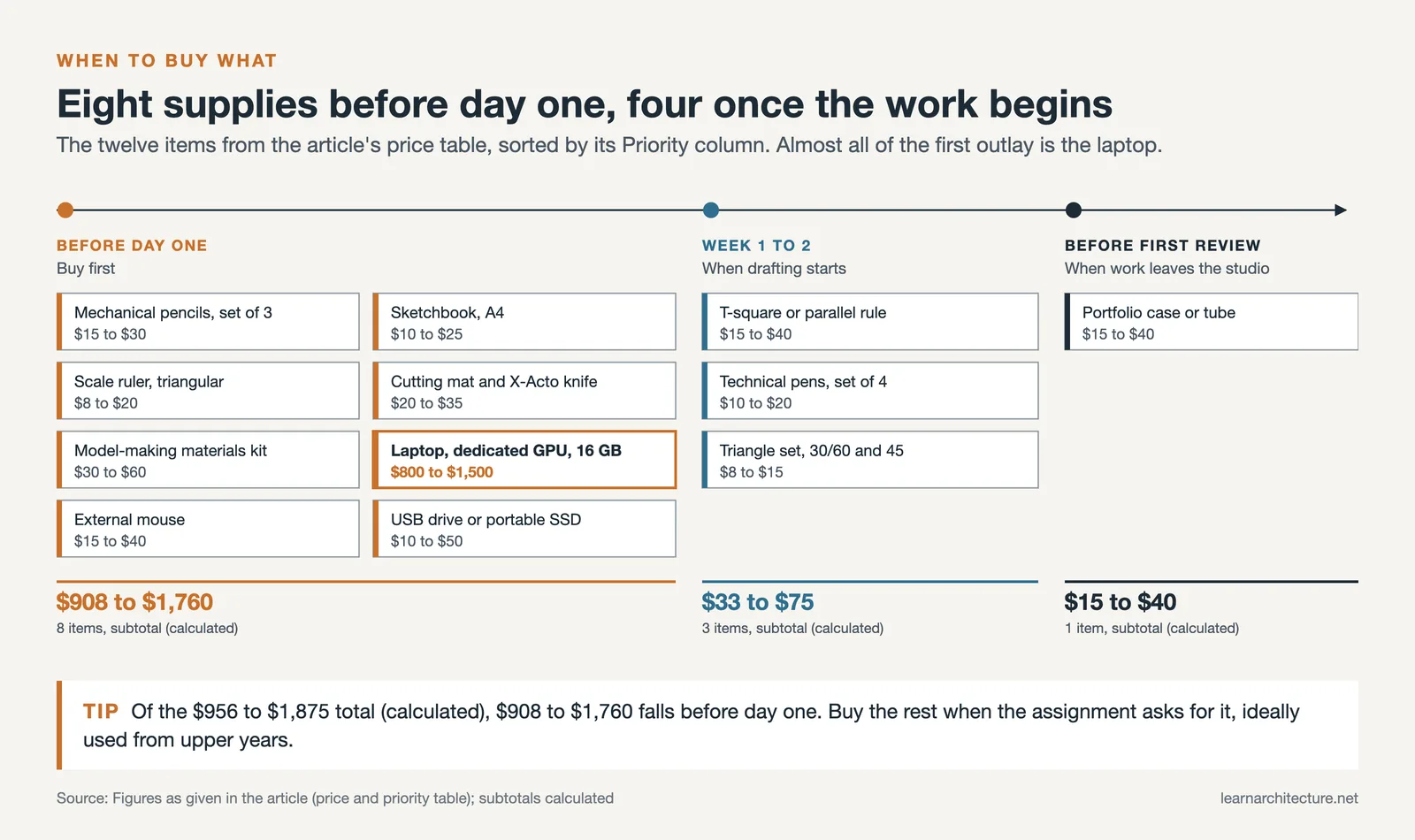
The following table summarizes all 12 items with estimated price ranges and priority levels to help you budget.
| Item | Category | Est. Price (USD) | Priority |
|---|---|---|---|
| Mechanical Pencils (set of 3) | Drafting | $15-30 | Buy first |
| Sketchbook (A4) | Drafting | $10-25 | Buy first |
| Scale Ruler (triangular) | Drafting | $8-20 | Buy first |
| Cutting Mat + X-Acto Knife | Model-making | $20-35 | Buy first |
| Model-Making Materials Kit | Model-making | $30-60 | Buy first |
| Laptop (dedicated GPU, 16GB RAM) | Digital | $800-1,500 | Buy first |
| External Mouse | Digital | $15-40 | Buy first |
| T-Square or Parallel Rule | Presentation | $15-40 | Week 1-2 |
| Technical Pens (set of 4) | Presentation | $10-20 | Week 1-2 |
| USB Drive / Portable SSD | Digital | $10-50 | Buy first |
| Triangle Set (30/60 + 45) | Drafting | $8-15 | Week 1-2 |
| Portfolio Case or Tube | Presentation | $15-40 | Before first review |
Prices are approximate and vary by brand, retailer, and region. Check your school’s recommended suppliers for student discounts.
Video: Must-Have Supplies for Architecture School
This video walks through the essential tools and materials that architecture students actually use day to day, with practical advice on what to buy and what to skip.
How to Budget for Architecture School Supplies
The total cost for all 12 items ranges from roughly $950 to $1,900, with the laptop accounting for the largest share. If you are on a tight budget, prioritize the laptop, cutting tools, and mechanical pencils first. These three categories cover the most ground in your first few weeks. Items like the portfolio case and triangle set can wait until you actually need them for a specific assignment.
Consider buying used tools from upper-year students who are upgrading or graduating. Scale rulers, T-squares, and cutting mats last for years if treated well, and you can often pick them up at half price through department bulletin boards or student group chats. Your school’s architecture society may also run supply swaps at the start of each semester.
Free and discounted software is another area where students save significantly. Most major architecture apps for students offer educational licenses at no cost. Autodesk provides free access to AutoCAD and Revit through its education portal, and Trimble offers SketchUp for Students at a reduced rate. Adobe Creative Cloud is available at steep student discounts through most universities. Take advantage of these programs early so you are familiar with the interfaces before assignments ramp up.
📌 Did You Know?
Students who enter school organized and properly equipped tend to manage studio workloads better, reducing burnout during the critical first two semesters.
Final Thoughts
The essential supplies for architecture students have not changed dramatically over the years: you still need sharp pencils, clean blades, a solid computer, and a way to carry your work. What has changed is how early you need to be comfortable with both analog and digital workflows. Your first year will push you to switch between hand sketching and CAD modeling within the same project, so having the right tools ready from day one removes one source of stress from an already demanding schedule.
If you are looking for more guidance on preparing for architecture school, start building good habits before the first studio crit and give yourself time to learn both your physical tools and your software before deadlines pile up.
- architecture apps for students
- Architecture Student
- architecture student supplies list
- architecture students
- essential supplies for architecture students
- essential tools for architecture students
- first-year architecture students
- must have supplies for architecture students
- what do first year architecture students need












Leave a comment