


Table of Contents Show
Preparing a jury presentation means more than finishing your drawings on time. A strong architecture jury requires you to communicate a clear design concept, organize your boards so critics can read them at a glance, and speak about your work with enough confidence to invite real dialogue. These nine practical tips cover everything from pre-jury prep to handling feedback on the day.

What Is an Architecture Jury Presentation?
An architecture jury, also called a crit, review, or pin-up, is the formal presentation of your design work to a panel of critics, tutors, and often external guests. You pin your drawings and models on the wall, stand beside them, and give a verbal presentation, typically lasting between seven and twenty minutes, followed by a discussion period of similar length.
The format has roots going back to the Ecole Nationale et Speciale des Beaux-Arts in Paris, which is widely credited as the first architecture school to establish a formal jury review system. Today it is standard practice in architecture programs worldwide, and the skills you build during these sessions, public speaking, visual storytelling, receiving criticism, translate directly into professional practice. The ArchDaily guide to surviving your first jury notes that even experienced students find the format demanding, which is why preparation matters far more than natural confidence.
📌 Did You Know?
The word “jury” in the academic architecture context is borrowed directly from legal terminology, reflecting the adversarial structure of early Beaux-Arts reviews where students defended their projects before a panel of senior academicians. Some schools today are actively redesigning the format to make it more collaborative and less confrontational, replacing “critique” language with “review” or “dialogue” to shift the culture.

How to Prepare for an Architecture Jury Presentation
The quality of your presentation on jury day is largely determined by what you do in the week before it. Students who arrive prepared not only perform better under pressure, they also get more useful feedback because the critics can focus on design ideas rather than deciphering incomplete drawings.
1. Build Everything Around One Strong Concept
Every drawing on the wall, every model piece, every word you say should connect back to a single driving idea. Before you start laying out your boards, write your concept down in two or three sentences. If you cannot summarize it clearly in writing, you will not be able to explain it verbally when a critic puts you on the spot.
Juries are not won by the student with the most sheets on the wall. Critics are looking for design intelligence, and a cohesive project with five well-developed boards will consistently outperform a chaotic spread of fifteen. Decide what your concept is, then ruthlessly cut anything that does not support it. According to Bob Borson of Life of an Architect, the work pinned up should make the concept obvious without you having to narrate every drawing.
💡 Pro Tip
Write your concept statement on a sticky note and tape it to the corner of your monitor while you lay out your boards. Every diagram, section, or render you add should pass the test: does this make the concept clearer or not? If not, drop it. Students who do this exercise consistently produce tighter, more legible presentations.
2. Know Your Assignment Brief Inside Out
Before the jury, go back to the original assignment brief and extract every stated objective. Your presentation must address these points directly. Critics on an academic jury panel often refer back to the brief when framing feedback, and if you have visibly ignored a key requirement, you will lose credibility regardless of how strong the rest of the work is.
Check whether your jury includes external critics who have never seen your project or tutors who know it well, the approach to your verbal pitch differs between these two scenarios. External critics need more context upfront; familiar tutors are more interested in how your thinking developed. The First in Architecture crit preparation guide recommends finding out this information in advance and adjusting your opening accordingly.

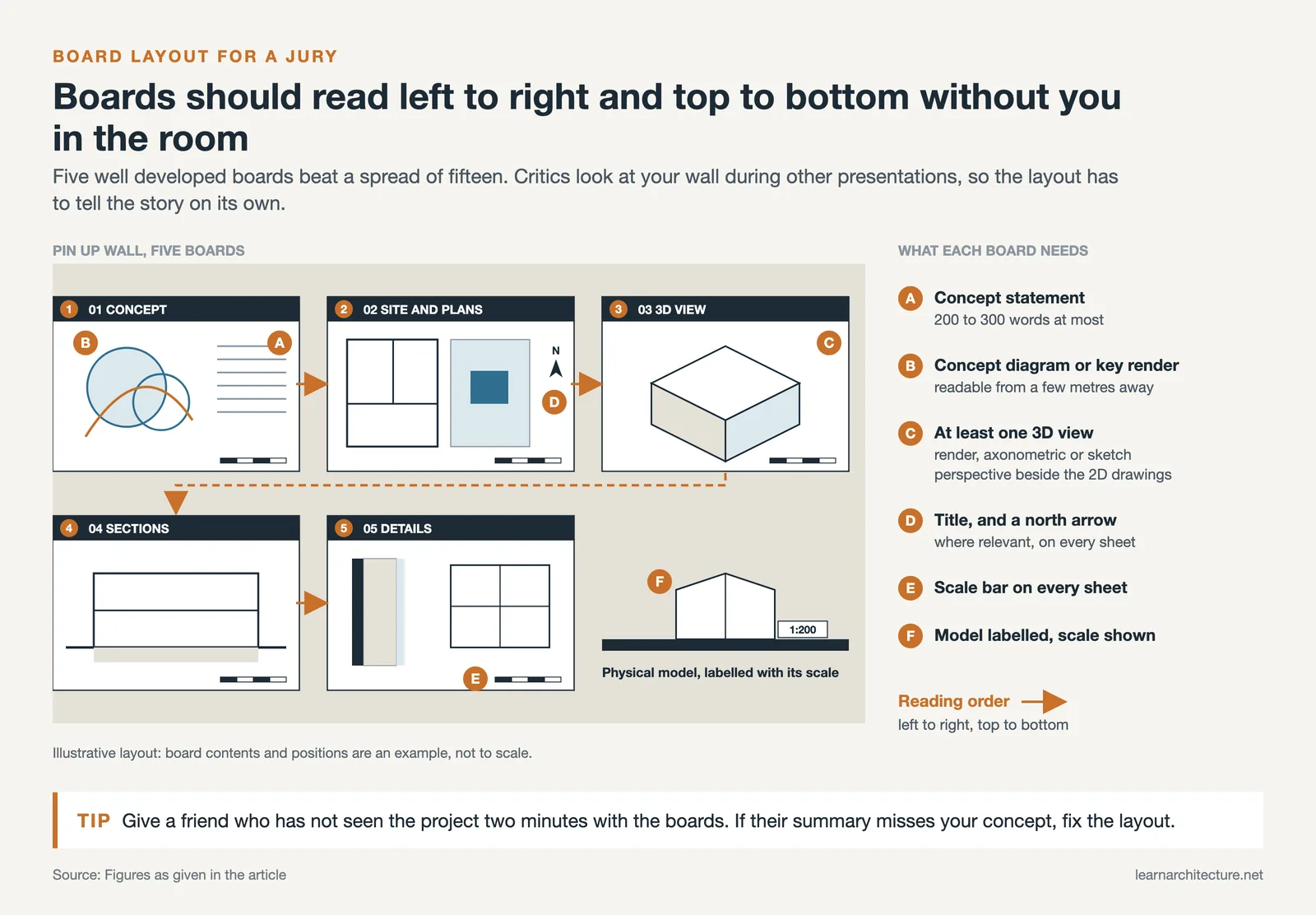
3. Organize Your Boards for a Viewer Who Cannot Hear You
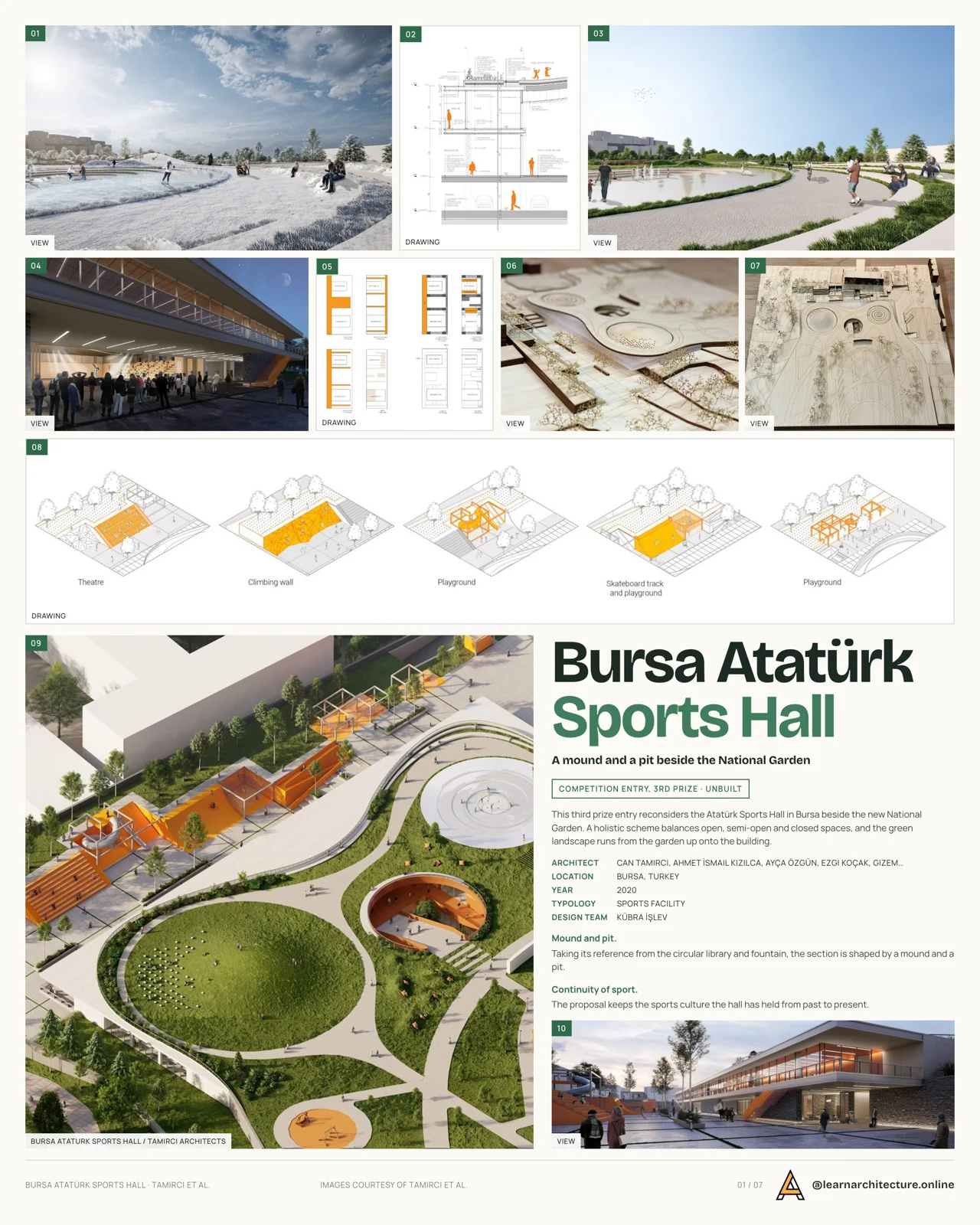
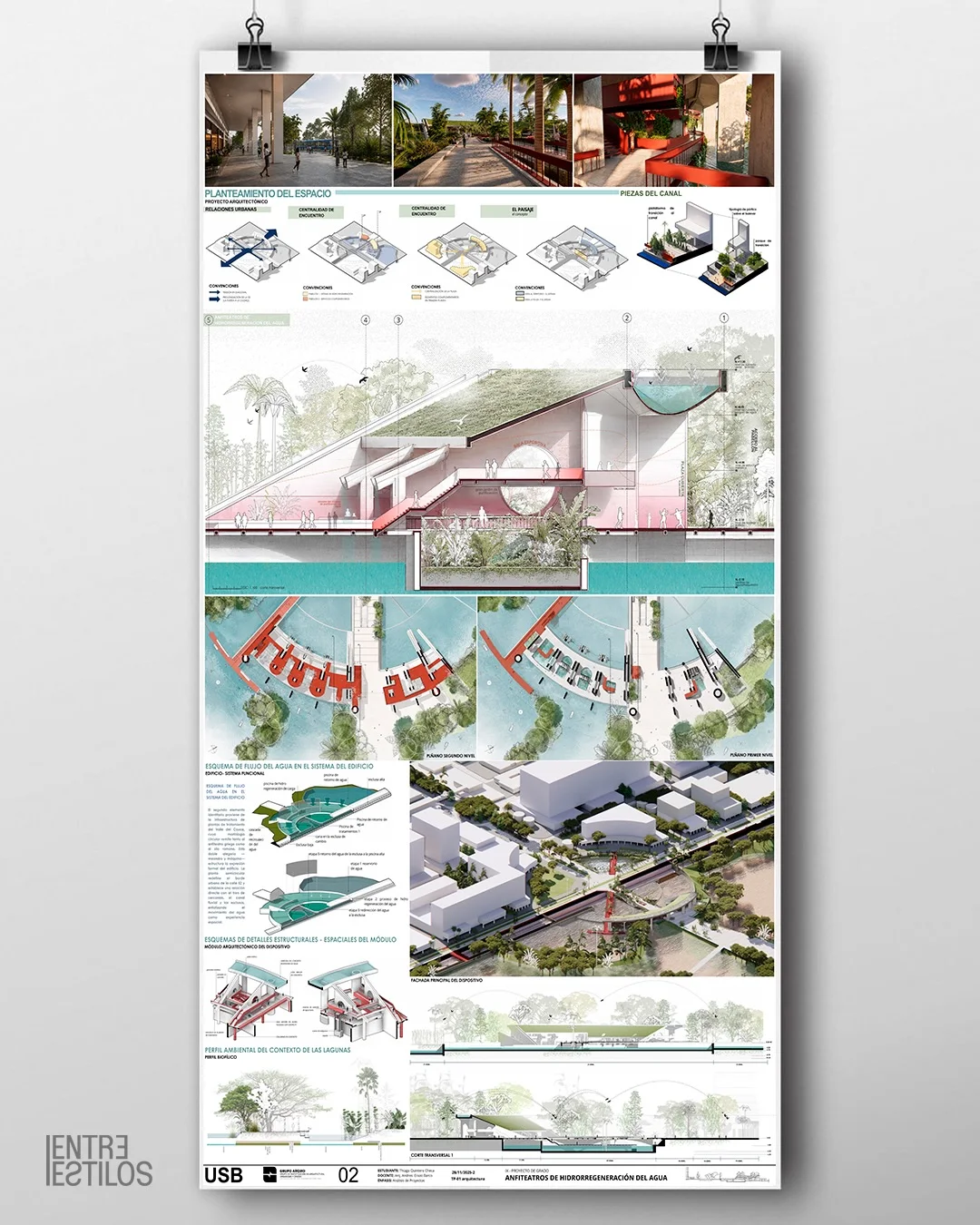
One of the most common errors in architecture crit presentations is boards that only make sense when the student is speaking. Your layout should tell the design story on its own, because jury members will look at your work during other presentations, and competition jurors may never hear you present at all.
Arrange drawings in a clear reading order, left to right and top to bottom. Place your concept diagram or key render where it is visible from a few meters away. Keep text to a minimum; a brief concept summary of no more than 200 to 300 words is sufficient. Use diagrams, flow charts, axonometrics, and section perspectives to communicate ideas that paragraphs cannot. For detailed guidance on structuring your visual layout, the architecture presentation board guide on learnarchitecture.net covers grid systems, hierarchy, and color strategy in depth.
4. Prioritize Visual Material Over Text
Critics are visual thinkers. A wall filled with dense paragraphs will lose the room within seconds. Your boards should be image-heavy, with diagrams and drawings doing most of the explanatory work. Two-dimensional plans and sections should be accompanied by at least one three-dimensional view, whether a render, axonometric, or sketch perspective, that shows how the space actually feels. Color choices on your boards also send signals to jurors before you say a word, and the guide to color in architectural presentations explains how to use palette strategically to establish hierarchy and direct attention.
Physical models, even rough process models, are particularly effective. They allow critics to understand spatial relationships faster than any drawing can, and they give the discussion something concrete to point at. Label your models clearly and make sure the scale is indicated.
⚠️ Common Mistake to Avoid
Many students open their jury presentation by walking the critics through the project floor by floor: “This is the entrance, here is the corridor, this is where the stair is.” Jury members can read plans. What they cannot read from your drawings is why you made the spatial decisions you did. Start with the concept and the experience you are creating, not the circulation sequence. Save functional descriptions for direct questions.
Architecture Jury Presentation Tips for the Day Itself
Preparing a jury presentation well means you can stop scrambling the night before and spend that time rehearsing instead. The tips below are about performance: how you speak, how you respond, and how you carry yourself when the critique begins.

5. Rehearse Out Loud, Not Just in Your Head
Thinking through your presentation and actually saying it aloud are two completely different experiences. Rehearse standing up, pointing at your boards, and talking through the narrative at the pace you plan to use on the day. Time yourself. Most academic juries give students between seven and twenty minutes, but check the time your studio allots for your slot and practice finishing within that window rather than being cut off mid-sentence. Communication and public speaking are core skills in architecture, not just in the studio. The architecture education guide on learnarchitecture.net covers how developing these habits early pays off across your entire academic and professional career.
Write out the key points you want to cover and keep that note card with you as a backup. You do not need to read from it, but having it visible reduces the cognitive load of trying to remember everything while managing nerves.
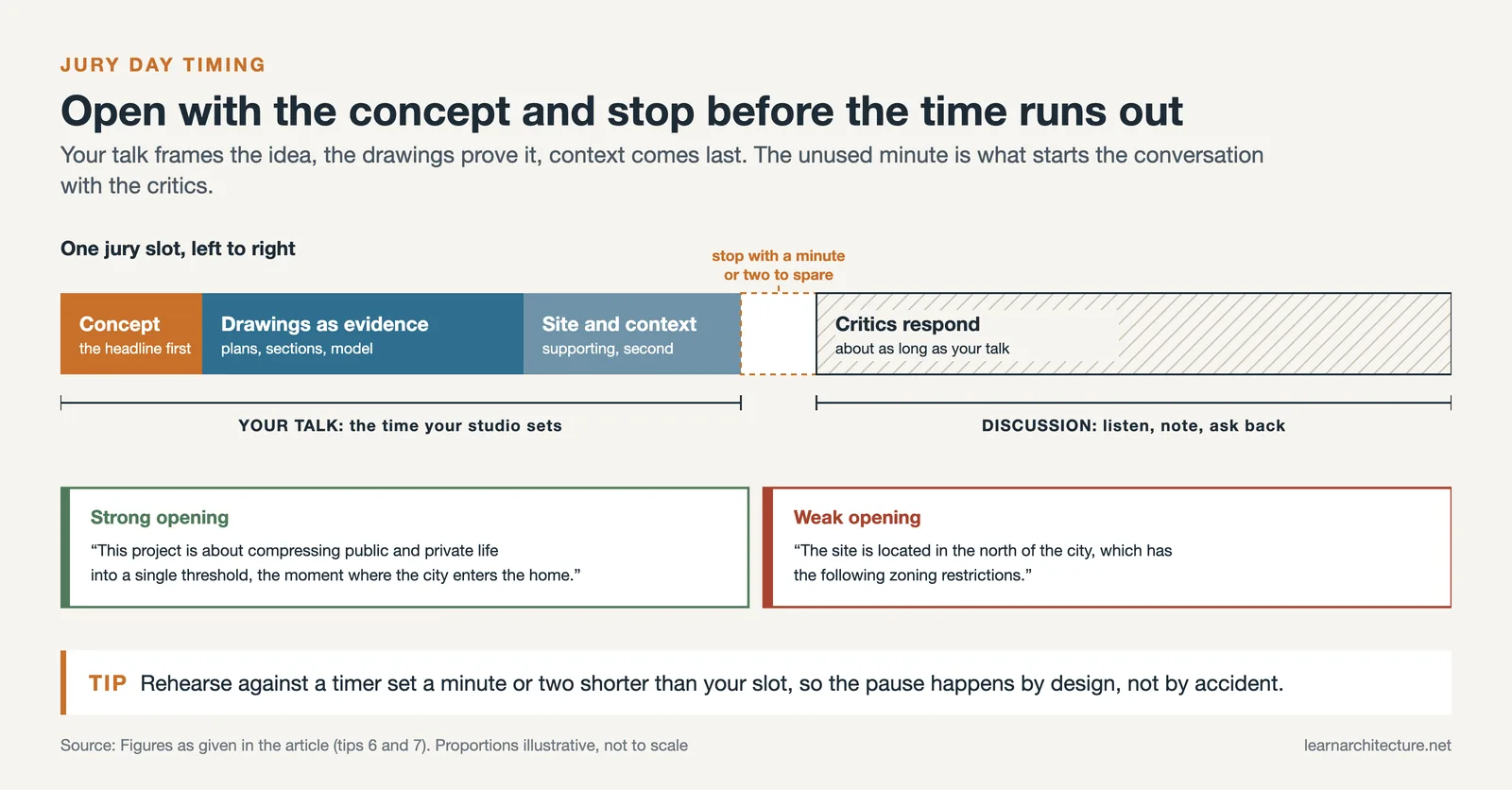
6. Start with the Concept, Not the Site
Open your verbal presentation with the core idea. Give the critics a frame before you fill in the details. A strong opening sounds like: “This project is about compressing public and private life into a single threshold, the moment where the city enters the home.” A weak opening sounds like: “The site is located in the north of the city, which has the following zoning restrictions.”
Site context, program, and technical constraints matter, but they are supporting information, not the headline. Once the critics understand what you are trying to achieve, the drawings give them the evidence. Context comes second.
🎓 Expert Insight
“The awards or the commissions don’t normally go to the architects who talk too long, speak in jargon, or bore the jury with an explanation of the stair and or toilet details.”
Peter Raisbeck, architect and academic
Raisbeck, who has sat on numerous design and award juries, consistently finds that successful presenters anchor their pitch in conceptual and theoretical language rather than procedural description. Critics want to understand your thinking, not your construction sequence.

7. Let the Critics Talk
Students who speak for their entire allotted time, leaving no room for discussion, almost always receive weaker feedback than those who present efficiently and invite dialogue. Finish your verbal pitch with a minute or two to spare, then stop. A short pause signals confidence and gives the critics space to respond.
When feedback comes, listen actively. Take notes if possible. Do not interrupt or immediately defend a decision unless you are asked directly for a reason. The critics are giving you material to work with after the jury ends. Students who argue against every comment miss the actual learning the session offers. As architect and educator Nidhip Mehta advises in his guide for design students, being an active presenter means documenting feedback in the room so you can act on it later.
8. How to Handle Tough or Conflicting Feedback
Ten critics will have ten different responses to the same project. Some feedback will contradict other feedback. Some of it will feel personal. The most useful mental shift is to separate objective criticism, a design decision that genuinely does not work, from subjective criticism, a preference the critic holds that another critic would dismiss.
When a critic makes a point you disagree with, the most effective response is a clarifying question rather than a defence: “Are you suggesting the threshold should be more ambiguous, or more clearly defined?” This keeps the conversation productive and shows you are engaging rather than deflecting. Students writing a thesis project face the same challenge across a much longer cycle; the architecture thesis guide on learnarchitecture.net covers how to build a constructive relationship with critique from the very beginning of a project.
9. Attend the Full Jury Day, Not Just Your Slot
One of the most overlooked architecture student jury tips is simply this: stay for the entire session. Watching how other students present, what gets praised, what gets questioned, and how different critics think, teaches you more in one day than months of studio tutorials. The critics reveal their values and concerns through other people’s presentations as much as through yours.
Supporting classmates also matters. Having familiar faces in the room during your presentation reduces nerves, and being present for others builds the kind of studio culture where criticism feels less like a performance and more like a design conversation.
💡 Pro Tip
The night before your jury, do one final walk-through of your boards with a friend who has not seen the project. Ask them to tell you, in their own words, what the project is about after looking at the boards for two minutes. If their summary does not match your concept, you have a clarity problem that one more night of work can fix. Fresh eyes catch things you are too close to see.

Before the Jury: A Quick Checklist
In the final 48 hours before your architecture jury presentation, run through these checks to make sure nothing derails the actual presentation:
- Every sheet has a title, north arrow where relevant, and a scale bar
- Physical models are labeled, clean, and have clearly indicated scale
- Your concept can be stated in two sentences without jargon
- You have rehearsed your verbal pitch out loud and timed it
- You know whether external critics are attending and have adjusted your intro accordingly
- You have a printed or handwritten note card with your key talking points
- You know the room setup, pin-up space, and equipment available
- You have at least a few hours of sleep planned before the day
Run through this list 48 hours before the day, not the night before. Finding a gap then still gives you time to fix it.
✅ Key Takeaways
- Every element of your presentation should connect back to one clear concept. If you cannot state it in two sentences, keep working before the jury.
- Your boards should communicate the project to someone who cannot hear you. Minimize text, prioritize diagrams, and establish a clear visual reading order.
- Open your verbal pitch with the concept and the experience you are creating, not the site conditions or functional description.
- Finish speaking before your time is up, invite the critics to respond, and take notes on every significant comment.
- Separate objective criticism from subjective preference, ask clarifying questions rather than defending decisions, and treat feedback as design material.
- Stay for the entire jury day. Watching other presentations is one of the highest-value learning experiences in architecture school.
Frequently Asked Questions About Architecture Jury Presentations
How long should an architecture jury presentation be?
Most academic juries give students between seven and twenty minutes for their verbal presentation, followed by an equal or slightly longer discussion period. The exact allocation varies by school and project stage. In general, it is better to present concisely and leave time for dialogue than to fill every minute with narration. Professional award and competition juries often work to even tighter time constraints, sometimes as short as five minutes.
What do architecture jury critics actually look for?
Critics are primarily looking for design intelligence: a clear concept, spatial decisions that support that concept, and evidence that the student understands why they made the choices they did. They are also assessing whether the visual material communicates without additional verbal explanation. Technical completeness, such as labeled drawings with north arrows and scale, matters because it signals professionalism, but it never substitutes for conceptual clarity.
How should you respond to negative feedback in an architecture jury?
The most effective response to critical feedback is listening without defensiveness, asking a clarifying question if the comment is unclear, and taking notes. Arguing against criticism rarely changes a critic’s view and often creates a poor impression. Treat every comment as a question your project has not yet answered. If the feedback is subjective or seems wrong to you, it is fine to acknowledge it without accepting it outright: “That’s an interesting way to read it, I’ll think about how to address that ambiguity.”
How do you prepare architecture presentation boards for a jury?
Start by identifying your core concept and building the board layout around it. Place the most important image or diagram where it reads from a distance. Arrange sheets in a clear left-to-right, top-to-bottom reading order. Keep text minimal; a short concept statement plus drawing labels is usually sufficient. Include at least one three-dimensional view alongside technical drawings. Check that every sheet has a title, scale, and north arrow where relevant. The architecture presentation board guide on learnarchitecture.net goes deeper on grid layouts, visual hierarchy, and color strategy for boards.
- architecture crit presentation tips
- architecture jury presentation guide
- architecture jury presentation tips
- architecture jury tips
- architecture student jury tips
- architecture thesis jury presentation
- how to ace architecture jury
- how to present in architecture jury
- how to survive architecture jury
- tips for architecture design jury








Leave a comment