


Table of Contents Show
Airport design has evolved from functional transit sheds into some of the most ambitious architectural projects on earth. The eight airports on this list demonstrate that a terminal can be a forest, a landmark, a public garden, or a structural engineering tour de force, sometimes all at once. Each one raises the bar for what it means to design an airport that serves millions of people while remaining genuinely extraordinary.
What Makes Airport Design Exceptional?
Great airport terminal design solves three problems at once: it must move enormous volumes of passengers efficiently, survive the structural demands of a large-span public building, and create an environment that people actually want to be in. Most airports achieve one or two of these goals. The airports below manage all three, and several go much further.
The best airport designs share a few traits. They use natural light generously, reducing the psychological fatigue of long layovers. They integrate wayfinding into the architecture so that movement feels intuitive rather than stressful. And they create a sense of place: something that tells passengers they are somewhere specific, not interchangeable with every other hub in the world.
💡 Pro Tip
When studying airports for design inspiration, pay particular attention to how daylight is introduced at the landside-to-airside transition. This is the moment passengers move from public urban space into the controlled terminal environment, and the best airports use a shift in light quality here to signal the change. A roof that floods the check-in hall with natural light immediately reduces anxiety and orients the traveller without a single sign.
1. Jewel Changi Airport, Singapore (2019)

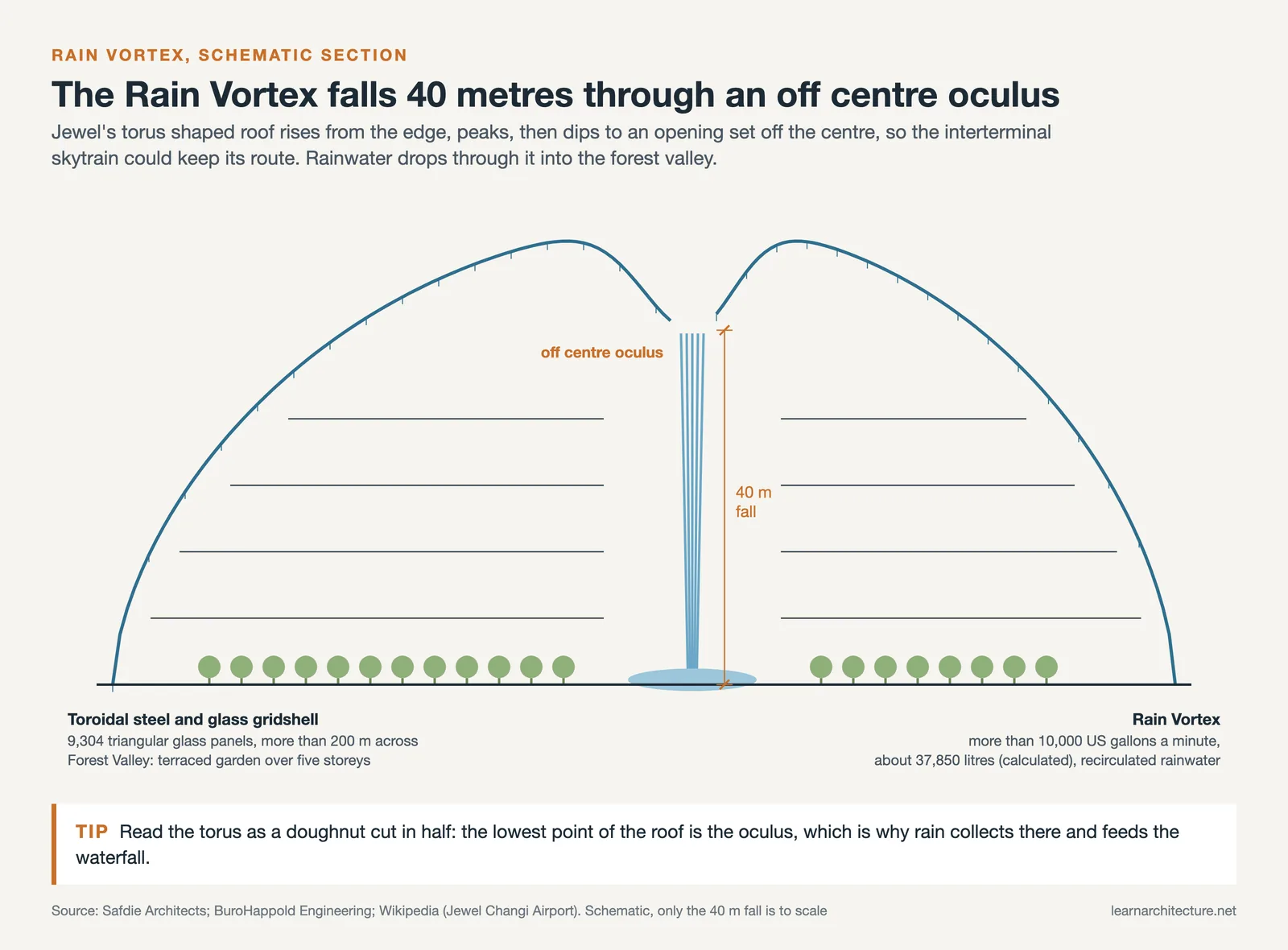
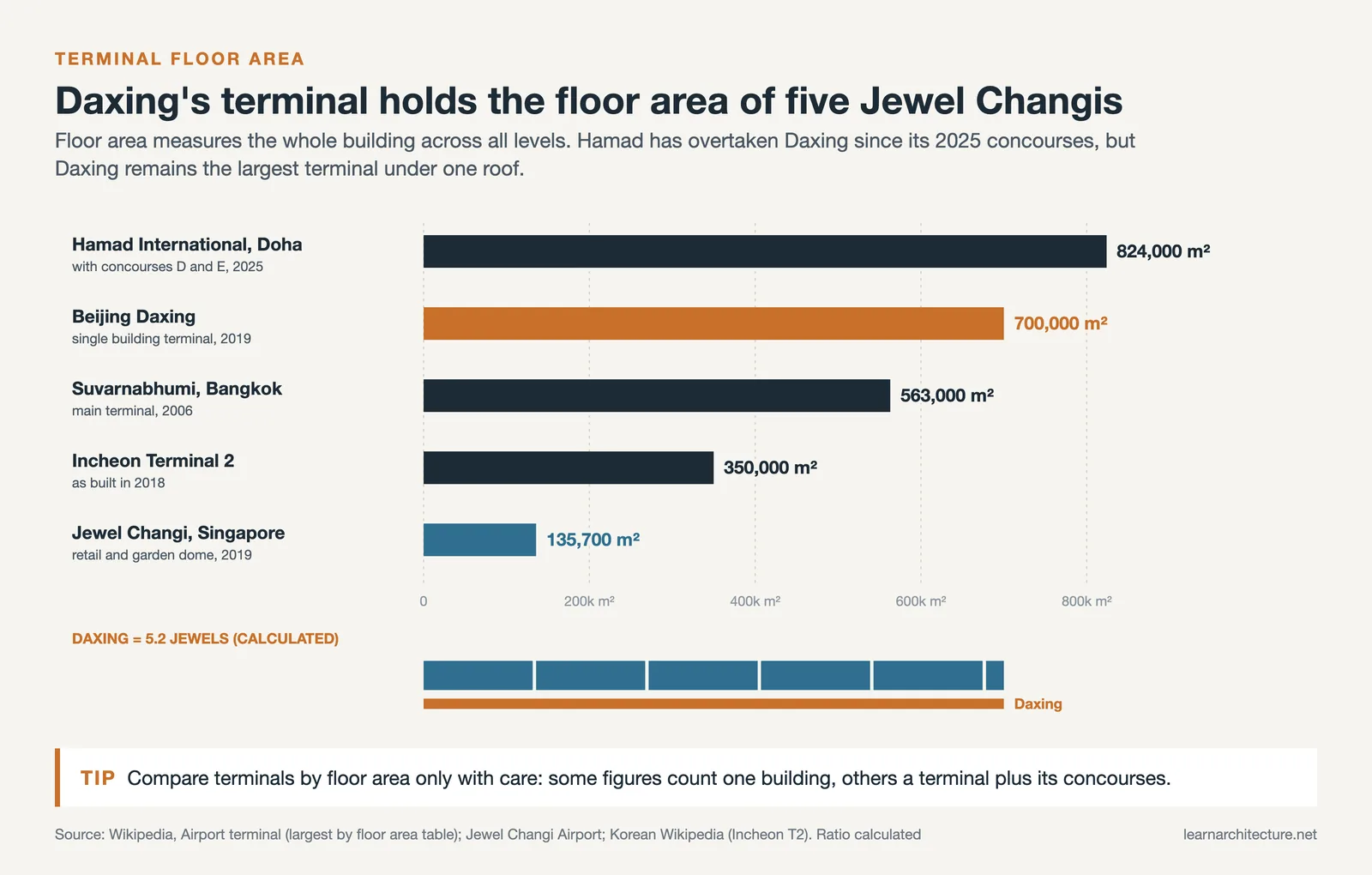
Designed by Moshe Safdie, Jewel Changi Airport is the most discussed airport interior design project of the past decade, and for good reason. The building is not a terminal in the traditional sense. It is a 135,700 square metre toroidal glass and steel dome that connects Changi’s three original terminals, housing a full indoor forest, 300 shops and restaurants, a luxury hotel, and the world’s tallest indoor waterfall.
The Rain Vortex drops 40 metres from an off-centre oculus in the roof at up to 37,000 litres per minute, with recirculated rainwater powering the display during storms. The off-centre position was a deliberate engineering choice: placing the oculus in the geometric centre would have intersected the existing interterminal skytrain track. Moshe Safdie described the resulting tension in the geometry as something that ultimately made the building “more beautiful.”
Structurally, the dome works in two phases. The outer shell behaves like a conventional dome, supported by a perimeter ring at Level 5 and 14 tree-like columns set inward from that ring. The inner section, which funnels toward the oculus, is held in place by a tension cone rather than compression. This zone is entirely unsupported from below, with loads transferred to a compression ring formed by the 14 columns. BuroHappold Engineering managed the facade, using parametric modelling to rationalise over 9,000 individual glass panels into a buildable geometry.
The Forest Valley at the centre contains 3,000 trees and 60,000 shrubs from subtropical climates across the world. Cooling is provided by chilled water pipes embedded in the floor and concealed vents under benches, keeping the space comfortable for visitors while sustaining the plant life. The building received Green Mark Gold certification from Singapore’s Building and Construction Authority.
Jewel attracted more than 50 million visitors in its first six months after opening in 2019. By 2024, annual footfall exceeded 80 million, a remarkable figure for a building attached to an airport.
📌 Did You Know?
The entire Jewel Changi Airport project cost S$1.7 billion (approximately US$1.3 billion) and was completed without any government funds or taxpayer money, despite being developed by entities ultimately connected to Temasek Holdings, Singapore’s state investment company. The project was funded entirely through the joint venture between Changi Airport Group and CapitaLand.
2. Beijing Daxing International Airport, China (2019)
Designed by Zaha Hadid Architects and ADP Ingénierie, Beijing Daxing is one of the largest airport terminal buildings ever constructed. The main terminal covers approximately 700,000 square metres, making it the world’s single-building largest airport terminal at the time of its opening. The project cost around $12 billion in total.
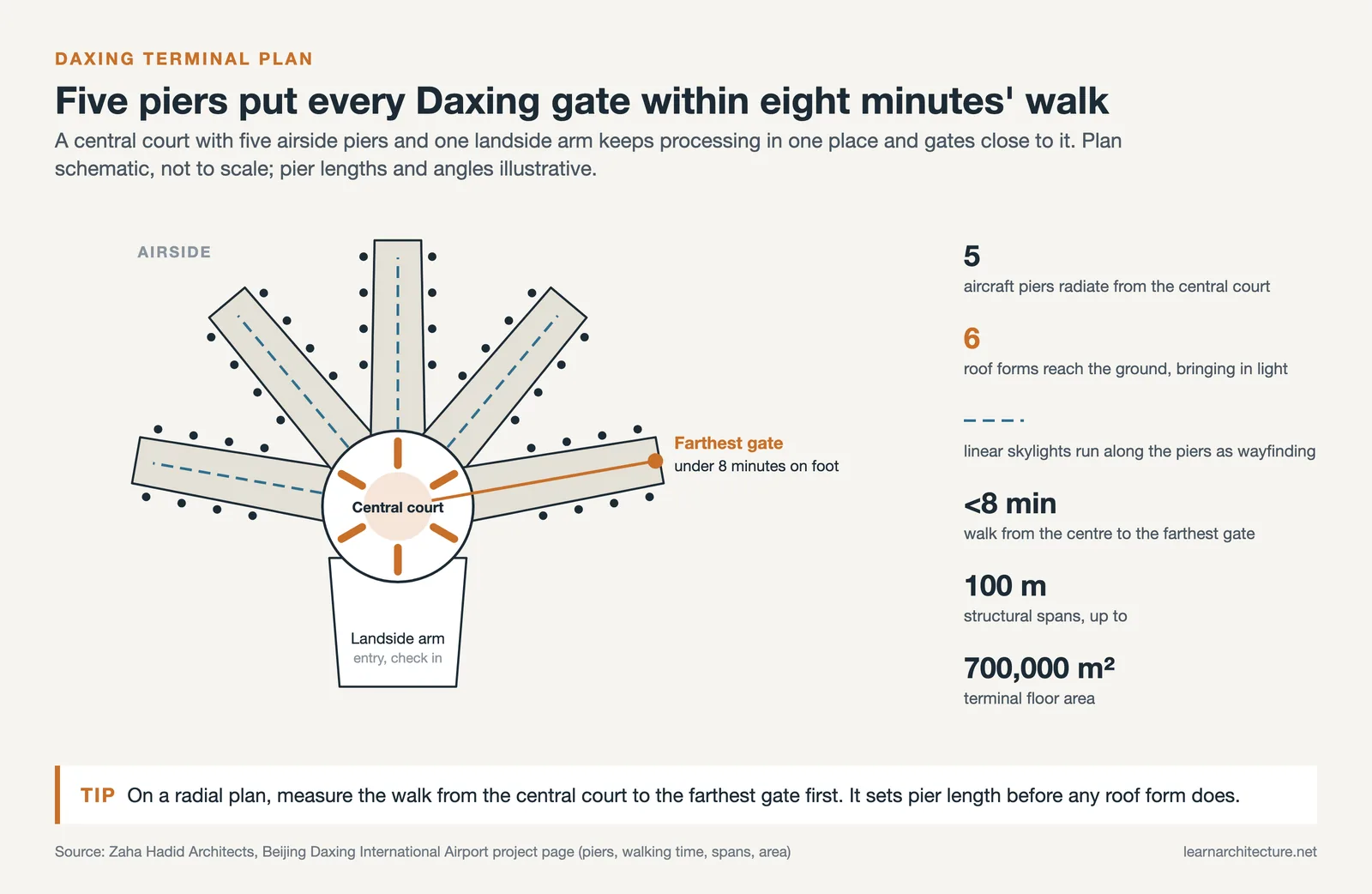
The building’s plan is often described as a starfish or snowflake shape, with five aircraft piers and one landside arm radiating from a central hall. This geometry was not purely aesthetic: it keeps the farthest boarding gate within a walk of less than eight minutes from the central court. The design resolves a fundamental tension in airport terminal design: the conflict between centralising passenger processing (which minimises staff and infrastructure costs) and distributing gates widely (which maximises the number of gates that can be built).
Six flowing forms in the vaulted roof reach down to the ground to support the structure and bring natural light into the central court, while a network of linear skylights guides passengers to their gates. The roof structure, a continuous free-form surface, uses structural spans of up to 100 metres. The structural geometry was developed computationally, with each section of the roof responding to different load conditions while maintaining a seamless visual surface from below.
Zaha Hadid Architects’ approach to airport interior design at Daxing prioritised flow and legibility. Circulation paths follow the natural curves of the building rather than imposing a grid, and the absence of hard right-angle turns in the main passenger zones reduces congestion at high capacity. The building opened on September 25, 2019, one week before the 70th anniversary of the People’s Republic of China.
🎓 Expert Insight
“The design of Daxing offers a seamless experience, bringing together the efficiency of a world-class airport with a unique user journey through fluid, continuous spaces.”
Patrik Schumacher, Principal, Zaha Hadid Architects
Schumacher’s observation points to a core principle of parametric airport design: that the building’s geometry should itself guide passengers rather than relying solely on signage. Daxing is a working example of that philosophy applied at extraordinary scale. For a deeper look at how parametric methods shape large public buildings, the introduction to parametric architecture on learnarchitecture.net provides useful background.
3. Heydar Aliyev International Airport, Baku, Azerbaijan (2014)

The international terminal at Heydar Aliyev Airport in Baku was designed by Autoban, a Turkish architecture and design practice, with structural engineering by Buro Happold. The terminal opened in 2014 and has since become one of the most photographed airport interiors in the world, primarily because of its distinctive ribbed white ceiling structure.
The interior design uses a continuous organic lattice of interlocking ribs that flows from the ceiling down to the walls and in some sections to the floor, eliminating any clear distinction between the three surfaces. The geometry draws on natural forms, particularly the internal structures of shells and bone. The result is a terminal that feels alive in a way that most airport architecture does not.
Practically, the ribbed canopy diffuses artificial and natural light evenly across the check-in hall, check-in counters, and departure lounges. It also provides excellent acoustic dampening in what would otherwise be a very loud, hard-surfaced environment. The design won multiple international awards and has been widely cited as evidence that airports in smaller cities can produce world-class architecture without the budgets of Chinese or Gulf state megaprojects.
4. Incheon International Airport, Seoul, South Korea (2001, expanded 2018)
Incheon has been voted the world’s best airport multiple times by Skytrax and consistently ranks among the top five in global passenger satisfaction surveys. The main terminal was designed by Fentress Architects, with the second terminal and the connecting Transit Center designed by a consortium that included the Airport Studio. The second terminal, opened in January 2018, added about 350,000 square metres to the complex.
The design philosophy at Incheon prioritises Korean cultural identity. The roofline references the gentle curves of traditional Korean architecture, while the interior uses warm timber finishes and extensive planting that would be unusual in a Western airport context. Cultural spaces, including a traditional Korean cultural center, a spa, an ice skating rink, and a casino, are integrated into the transit zone, making the airport a legitimate stopover destination rather than just a connection point.
From an airport interior design standpoint, Incheon Terminal 2 is notable for its transparency. The building’s facades are almost entirely glazed, giving runway views from nearly every part of the terminal and providing the natural light quality that is increasingly recognised as critical to passenger comfort on long-haul routes.
🔢 Quick Numbers
- Incheon Terminal 2 opened with about 350,000 m² and cost approximately $4.2 billion (Incheon International Airport Corporation, 2018)
- Jewel Changi’s glass dome spans 200 metres at its longest point and weighs 4,000 tonnes (BuroHappold Engineering, 2019)
- Beijing Daxing’s central terminal covers 700,000 m², reducing maximum gate-to-security walking time to under 8 minutes (Zaha Hadid Architects, 2019)
- Singapore Changi Airport has held the Skytrax World’s Best Airport title 12 times, more than any other airport (Skytrax World Airport Awards, 2023)
5. Denver International Airport, United States (1995)
Jeppesen Terminal at Denver International Airport remains one of the most recognisable airport buildings in the world, three decades after it opened. Designed by Fentress Architects, the terminal’s roof is a tensile fabric structure of 34 fibreglass-coated PTFE peaks, each one supported by a system of high-tension steel cables. The form references the snow-capped peaks of the Rocky Mountains visible on the horizon and the traditional tepee structures of the Native American nations whose territory surrounds the airport.
The structural system is unusual in airport design. The roof is not a rigid shell but a tensioned membrane, which means it can flex slightly in the wind without transmitting those forces to the walls. This flexibility was essential because the roof spans such a large area (approximately 33,000 square metres) that a rigid structure would have required far heavier steel sections and thicker column supports, obstructing sightlines within the terminal.
Denver’s airport terminal design also influenced how American airports thought about art and public space. The terminal hosts one of the largest public art collections in any American airport, with 23 permanent works commissioned specifically for the building. This integration of art into airport terminal design rather than treating it as an afterthought became a model referenced by subsequent American airport projects.
💡 Pro Tip
When designing an airport, or any large transport building, with a tensile fabric or membrane roof, the structural system requires early integration with the architectural concept, not just at the engineering detail stage. The fabric geometry, pre-tension values, and cable geometry all influence the interior spatial experience directly. Designing the form first and then handing it to engineers typically results in a compromise. The most successful tensile roof buildings, like Denver’s Jeppesen Terminal, treated structure and architecture as a single problem from the outset.
6. Hamad International Airport, Doha, Qatar (2014)

Hamad International Airport, designed by HOK with interiors by the airport operator Qatar Airways, is built to a scale that reflects Qatar’s ambitions as a global aviation hub. The terminal covers about 824,000 square metres since concourses D and E opened in 2025. The airport handled over 45 million passengers in 2023 according to the Hamad International Airport annual report, and it has twice been named the world’s best airport by Skytrax.
The interior design at Hamad is exceptional in the airport world for its integration of art and retail at genuine quality levels. The terminal hosts Damien Hirst’s 23-tonne bronze sculpture “Miraculous Journey,” a sequence of 14 bronze figures showing foetal development, installed across the airport’s main walkway. Jean-Michel Othoniel’s neon glass chandelier installation hangs in the main terminal atrium. These are not corporate artworks placed to fill space; they are significant commissions from internationally recognised artists.
From an airport interior design perspective, Hamad is notable for the quality of its material finishes across all passenger zones, not just premium lounges. Floors throughout the public areas use large-format natural stone, and the departure lounge uses a warm palette of timber, bronze, and woven textiles that avoids the cold, grey aesthetic common in most major hub airports.
Understanding how architecture firms like HOK approach large-scale public buildings, including terminals, stadiums, and civic spaces, is well covered in the overview of impressive architectural firms around the world on learnarchitecture.net.
7. Suvarnabhumi Airport, Bangkok, Thailand (2006)

Designed by Helmut Jahn of JAHN Architecture, Suvarnabhumi Airport is one of the clearest examples of high-tech architecture applied to an airport at very large scale. The terminal building spans 563,000 square metres and features a roof structure of eight steel arches, each spanning 230 metres across the terminal. The arches are supported on just 12 mega-columns, creating a vast column-free interior space beneath a glass and steel canopy.
The roof system allows natural light to filter across the entire terminal floor through a combination of clear and fritted glass, reducing artificial lighting loads while managing heat gain in Bangkok’s tropical climate. This approach to airport design in hot climates, using a large glazed canopy with solar control glass rather than an opaque roof with artificial lighting, became influential in subsequent Asian airport projects.
Helmut Jahn described the project as “a large public space, a city within a city.” The terminal’s scale supports that reading. The central departure hall rises to 42 metres, making it one of the tallest airport interiors in the world, and the visual continuity from check-in through security to the departure concourses is almost uninterrupted, which reduces disorientation in what is a genuinely enormous building.
⚠️ Common Mistake to Avoid
A common error when evaluating airport architecture is judging a terminal’s design purely by its appearance rather than by how it performs for passengers. A visually spectacular terminal that disorients travellers, creates long walking distances, or fails to manage crowd flow at peak times is, functionally, a poorly designed airport. The best airport terminal designs on this list succeed on both measures: they are architecturally significant and they work exceptionally well. When studying or designing airports, always assess wayfinding legibility, walking distance, and dwell zone quality alongside the structural and aesthetic ambitions of the building.
8. Oslo Gardermoen Airport, Norway (1998)

Oslo Gardermoen, designed by Aviaplan (a consortium led by Niels Torp), is less famous than the other airports on this list, but it belongs here because it demonstrated that sustainable airport design and architectural quality are not mutually exclusive, two decades before sustainability became a universal priority in architecture.
The terminal uses a natural ventilation strategy supplemented by mechanical systems, which was unusual for a major hub airport in the late 1990s. Torp used the building’s orientation, roof geometry, and strategic glazing to manage solar gain and cross-ventilation. The result is an airport that consumes significantly less energy per passenger than most comparable terminals of its era.
The interior uses Norwegian timber extensively, both structurally and as a finish material, creating a warmth that is absent from most airport interiors. The roof structure uses glulam arches that express the natural material honestly, in a way that connects to both Norwegian vernacular building tradition and to the broader Scandinavian design ethos of honesty in materials. The airport has been expanded several times since opening, but the original terminal’s character has been preserved through careful additions that respect the original timber palette and roof grammar.
The airport’s approach to using local materials and cultural identity as a design driver connects to a broader discussion about how architectural styles carry regional and cultural meaning, something explored in detail in the article on diverse styles in architecture.
What These Airport Designs Have in Common
Across these eight projects, a few consistent principles emerge for excellent airport terminal design. First, structure and architecture are treated as one problem, not two sequential steps. In every case on this list, the structural system, whether a tensile membrane, a parametric gridshell, or a timber arch, is also the primary architectural expression of the building. Second, natural light is treated as a primary material. Every airport here uses daylight strategically to define space, reduce fatigue, and create memorable moments for passengers. Third, cultural context matters. The strongest airport designs on this list (Jewel Changi, Incheon, Oslo Gardermoen) draw explicitly on the culture and landscape of their location rather than producing a generic international terminal.
For architects and students interested in how shape and structural form interact in large-span public buildings, the article on shapes in architecture provides a useful framework for thinking about how geometric choices carry both structural and cultural meaning.
🏗️ Real-World Example
Bangalore Kempegowda International Airport Terminal 2 (India, 2023): Designed by SOM (Skidmore, Owings & Merrill), Terminal 2 at BLR was awarded the Prix Versailles “World’s Most Beautiful Airport” prize, announced at UNESCO, in 2023. The terminal integrates 10,000 plants and trees within the passenger journey, with garden courts visible from the departure concourses and a 2.5-kilometre “Terminal in a Garden” concept that makes the building feel more like a public park than a transit facility. The project demonstrates that large-scale biophilic airport interior design is achievable even in new builds in rapidly growing secondary cities, not only in established aviation hubs.
The Future of Airport Design
The airports on this list reflect where airport design has arrived after decades of development. The direction of travel is clear. Future terminals will integrate more biophilic elements, as Jewel Changi and Bangalore T2 have shown is both possible and popular. They will use parametric design methods more extensively, both to optimise structural efficiency and to create passenger environments that respond to their specific geography and climate. And they will increasingly be judged not just on passenger throughput but on energy consumption, carbon footprint, and contribution to the cities they serve.
The architects who shaped the projects on this list (Moshe Safdie, Zaha Hadid Architects, Helmut Jahn, Fentress Architects) each pushed the definition of what designing an airport means. Learning about the careers and methods of famous architects who transformed modern architecture provides essential context for understanding why airport design has evolved so dramatically in the past 30 years.
✅ Key Takeaways
- The best airport designs solve structural, functional, and experiential problems simultaneously, not as separate disciplines.
- Natural light is treated as a primary material in every airport on this list, not just a secondary bonus.
- Cultural identity strengthens airport architecture: the most memorable terminals draw on the landscape and heritage of their location rather than producing generic international spaces.
- Parametric and computational design tools have made it possible to achieve building geometries, like Daxing’s free-form roof and Jewel’s toroidal shell, that would have been impossible to engineer in earlier decades.
- Passenger experience metrics, including walking distance, wayfinding clarity, and dwell zone quality, are as important as visual impact when evaluating airport terminal design.
The airports on this list are worth studying not just as aviation infrastructure but as architecture. Each one asked a fresh question about what designing an airport could mean, and answered it in a way that changed the field.
For further reading on how architectural firms approach large-scale structural and typological innovation, the article on parametric architecture and the exploration of iconic buildings across architectural styles both offer relevant context.













Leave a comment