


Table of Contents Show
Brutalist buildings are a defining category of 20th-century architecture, characterized by exposed concrete, bold geometric massing, and an uncompromising honesty about structure and materials. Emerging from postwar reconstruction efforts in the 1950s, the brutalist style spread from the UK and France to North America, South Asia, and beyond, producing some of the most debated and photographed structures in architectural history.

What Is a Brutalist Building?
A brutalist building is one that openly exposes its construction materials, particularly raw concrete (known in French as béton brut), rather than concealing them behind decorative finishes. The term “brutalism” does not refer to anything crude or aggressive in intent. It derives from the Swedish word nybrutalism, first applied to the Villa Göth in Uppsala in 1950, and was later formalized by British architectural critic Reyner Banham in a 1955 essay. Banham argued that a genuinely brutalist structure must satisfy three criteria: legible interior plan, clear expression of structure, and materials valued for their inherent qualities.
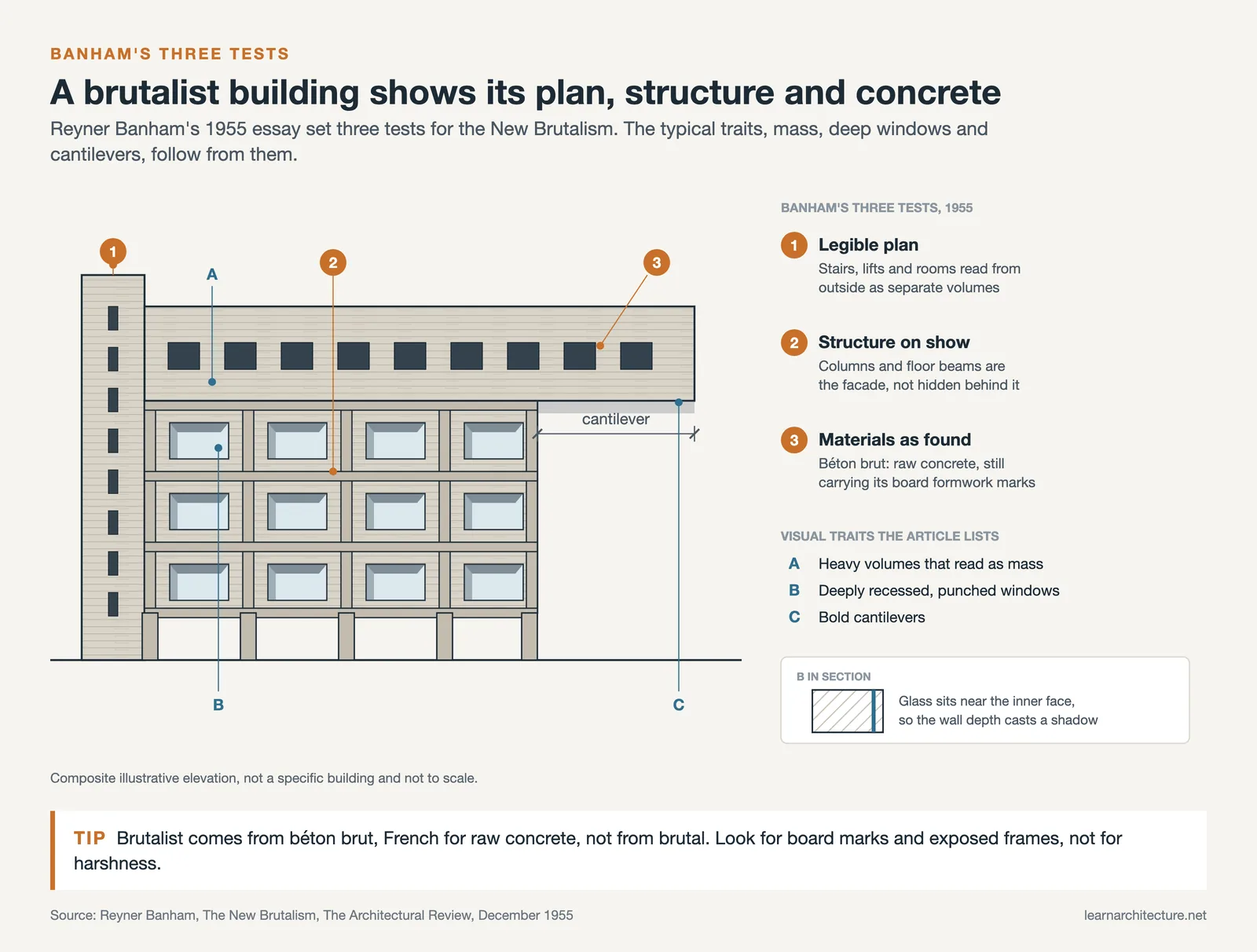
Brutalist-style buildings typically share several visual traits: heavy, load-bearing volumes that read as mass rather than surface; deeply recessed or punched windows; bold cantilevers; and a strong, instantly recognizable silhouette. Many were designed with an explicit social agenda, housing universities, civic halls, libraries, and public housing at a time when governments across the world were investing heavily in the built environment.
⚠️ Common Mistake to Avoid
Many people assume “brutalist” means brutal, harsh, or intentionally ugly. The word actually traces back to béton brut, French for raw concrete. The architects working in this tradition saw exposed materials as honest and democratic, not oppressive. Understanding this origin changes how you read the buildings entirely.

Why Brutalist Architecture Still Matters
Interest in brutalist architecture buildings has surged in recent years, driven partly by social media photography, preservation campaigns, and most recently by the 2024 Oscar-winning film The Brutalist. Buildings that faced demolition campaigns in the 1990s and 2000s are now being listed, restored, and reconsidered. Architectural critics and historians have come to recognize that the best brutalist buildings are not failures of taste but genuine achievements of civic ambition.
For students and practitioners studying architectural styles across history, brutalism occupies a fascinating position: it grew directly from modernism, reacted against the nostalgia of postwar classicism, and laid the groundwork for later explorations of material honesty that continue into contemporary practice.
📌 Did You Know?
The term “new brutalism” was coined by Swedish architect Hans Asplund in 1950 to describe Villa Göth in Uppsala, a house designed by Bengt Edman and Lennart Holm. The phrase spread to Britain within months and was picked up by a generation of young architects, eventually reaching a global audience through Reyner Banham’s 1966 book The New Brutalism: Ethic or Aesthetic?
The 10 Most Iconic Brutalist Buildings in the World
The following selection spans continents, typologies, and decades. Each building was chosen because it represents a distinct dimension of what brutalism could achieve: at its most social, its most monumental, its most sculptural, and its most spatially inventive.

1. Unité d’Habitation, Marseille, France (Le Corbusier, 1952)
Often cited as the building that gave brutalism both its vocabulary and its social mission, the Unité d’Habitation in Marseille is Le Corbusier’s most complete vision of collective urban living. The building houses 337 apartments across 18 floors, along with shops, a hotel, a rooftop running track, and a nursery school, all within a single reinforced concrete structure elevated on massive pilotis. Corbusier wanted steel framing but material shortages after World War II made concrete the only viable option, and the result became the definitive statement of béton brut as an architectural language. The board-marked concrete surfaces, colored balcony panels, and rooftop sculpture garden give the building an almost Mediterranean warmth that photographs rarely capture fully. Four further Unités d’Habitation were built, three in France and one in Berlin, but the Marseille original remains the most visited.
💡 Pro Tip
When studying Le Corbusier’s approach to concrete, pay close attention to how board-markings were used intentionally on the Unité d’Habitation rather than smoothed over. The visible grain of the formwork was a deliberate design decision, not a budget shortcut. This distinction between intentional texture and unfinished work is central to understanding what separates thoughtful brutalism from generic concrete construction.

2. Barbican Estate, London, United Kingdom (Chamberlin, Powell and Bon, 1976)
The Barbican is the largest residential development in the City of London and one of the most ambitious examples of brutalist urbanism anywhere in the world. Designed by the firm Chamberlin, Powell and Bon, it was built on a site heavily bombed during World War II and reflects a utopian vision of urban life as a self-contained world. The complex includes over 2,000 flats, a concert hall, two theatres, three cinemas, an art gallery, two schools, a conservatory, and a network of elevated walkways connecting the whole. Rather than presenting a conventional facade, the Barbican unfolds as a three-dimensional city of concrete terraces, lakes, and performance spaces that must be explored on foot to be understood. Initially criticized as impenetrable and alienating, it is now Grade II* listed and widely regarded as one of the finest pieces of residential architecture in the UK. Apartments sell for well over a million pounds.
3. National Theatre, London, United Kingdom (Denys Lasdun, 1976)
Perched on the South Bank of the Thames, the National Theatre is one of the most debated brutalist buildings in Britain, earning an infamous comparison to a nuclear power station from Prince Charles in 1988. Denys Lasdun conceived the building not as a single object but as a layered landscape, a series of concrete terraces and public platforms that extend the embankment into the building and turn the theatre into urban topography. The approach was deliberate: Lasdun wanted the building to belong to everyone, not just ticket-holders, creating foyers and terraces that remain open to the public regardless of performances. Today it is listed at Grade II* and attracts over a million visitors annually. Its bold horizontal layering and deeply shadowed recesses make it one of the most recognizable brutalist-style buildings in any European city.

4. National Assembly Building, Dhaka, Bangladesh (Louis Kahn, 1962-1982)
Louis Kahn’s National Assembly complex in Dhaka is frequently described as one of the greatest buildings of the twentieth century, and its claim to that title rests on an extraordinary synthesis of monumentality, geometry, and light. Kahn worked on the project from 1962, when Bangladesh was still East Pakistan, and construction continued until 1982, eight years after his death. The building consists of a central parliamentary chamber surrounded by eight subsidiary volumes, all composed in reinforced concrete with inlaid marble strips that reference local building traditions. The most astonishing aspect of the design is the way Kahn cut perfect geometric openings, circles, triangles, and cylinders into the massive walls, allowing natural light to enter the interior in constantly shifting patterns. The building sits surrounded by an artificial lake that doubles as a cooling system and frames the structure with a sense of quiet monumentality.
🏗️ Real-World Example
Salk Institute for Biological Studies (La Jolla, California, 1965): Also designed by Louis Kahn, the Salk Institute is a masterclass in how brutalist concrete can achieve transcendence through proportion and spatial sequence. Two mirror-image laboratory buildings frame a central courtyard of travertine marble, split by a thin channel of water that aligns precisely with the Pacific horizon at the equinoxes. The project was commissioned by Jonas Salk, who asked Kahn for a building “worthy of a visit by Picasso.” Many architects consider it the finest built work in the United States.
5. Trellick Tower, London, United Kingdom (Ernő Goldfinger, 1972)
At 31 stories, Trellick Tower is the most famous social housing project in the UK and one of the most recognizable brutalist buildings in Europe. Designed by the Hungarian-British architect Ernő Goldfinger and completed in 1972, it was commissioned by the Greater London Council to address the city’s severe postwar housing shortage. The tower’s distinctive silhouette, with its separate service tower connected to the main shaft by bridges at every third floor, became both a landmark and a symbol of troubled public housing policy. By the 1980s, Trellick had gained a reputation for crime and poor maintenance. By the 1990s, a resident-led management committee had reversed that decline entirely, and the building was Grade II* listed in 1998. Today its flats are sought after and command premium prices, a reversal that tracks closely with the broader rehabilitation of brutalism as a cultural phenomenon. The building also inspired a novel, a song, and countless architectural pilgrimages.

6. Habitat 67, Montreal, Canada (Moshe Safdie, 1967)
Habitat 67 began as a master’s thesis project by Israeli-Canadian architect Moshe Safdie at McGill University’s School of Architecture. Built for the 1967 World Exposition in Montreal, it was intended to demonstrate that high-density urban housing could provide the same qualities of space, privacy, and outdoor access as a suburban house. The complex consists of 354 prefabricated concrete modules arranged in 12 interlocking configurations to create 158 unique apartments, each with a private garden formed by the roof of the unit below. No two units are identical. The structure proved far more expensive to build than projected and the vision of mass-produced prefabricated housing never scaled as Safdie hoped, but as an architectural statement Habitat 67 remains unmatched in its demonstration of what modernist architectural ambition could look like at full scale.
7. Geisel Library, San Diego, USA (William Pereira, 1970)
Rising from the University of California San Diego campus like a concrete spacecraft, the Geisel Library is one of the most visually dramatic examples of brutalist architecture in North America. Designed by William Pereira and opened in 1970, the library’s eight floors cantilever dramatically outward from a central concrete core, each floor wider than the one below, creating the impression of a structure in the process of unfolding. Pereira described the concrete piers as hands holding books, and the stacked floors as the books themselves. The building was renamed in 1995 in honor of Audrey and Theodor Seuss Geisel, whose estate donated $20 million to the university’s library system. Architects and critics often note that the Geisel stands at the threshold between brutalism and the futurism that would follow it, demonstrating that concrete did not have to be heavy and inert but could express dynamic structural energy.

8. Robarts Library, Toronto, Canada (Mathers and Haldenby, 1973)
The John P. Robarts Research Library at the University of Toronto is one of the largest academic libraries in North America and one of the most architecturally imposing brutalist buildings on the continent. Nicknamed the “Turkey” or “Fort Book” by students, its massive triangulated towers, deeply recessed windows, and projecting concrete fans give it a defensive, fortress-like character that provokes strong reactions. The library holds over 4.5 million volumes and remains fully operational. Its scale and uncompromising formal logic represent the most extreme end of institutional brutalism, where the building’s mass becomes a civic statement in itself. Robarts has appeared in film productions requiring futuristic or dystopian settings, a pattern common among the most famous brutalist buildings.
💡 Pro Tip
When evaluating brutalist buildings for architectural study, visit them in the afternoon when low-angle sunlight rakes across the concrete surface and reveals the texture in full. The shadows cast by board markings, aggregate, and surface relief are integral to the design intent and simply cannot be seen in flat midday light or in photographs taken under overcast conditions. This is one of the most important things architecture instructors emphasize about concrete buildings that students often miss.
9. Boston City Hall, Boston, USA (Kallmann, McKinnell and Knowles, 1968)
Boston City Hall is arguably the most controversial brutalist building in the United States. Designed by the firm Kallmann, McKinnell and Knowles and completed in 1968, it won the Progressive Architecture Award before construction was finished and was celebrated as a breakthrough in civic architecture. Its inverted ziggurat form places the most public functions, council chambers, mayor’s office, and civic spaces, at the top of the building where they are visually expressed on the exterior, while administrative floors are more restrained below. The building’s raw concrete exterior, cavernous brick-paved plaza, and refusal to offer a conventional facade have made it a lightning rod for debate about what public buildings should look like. Multiple mayors have threatened to tear it down; preservation groups have blocked every attempt. In December 2024, the Boston Landmarks Commission voted to designate it an official Boston Landmark, and the designation took effect in 2025.

10. Nakagin Capsule Tower, Tokyo, Japan (Kisho Kurokawa, 1972)
The Nakagin Capsule Tower holds a singular place in architectural history as the most complete built expression of Japanese Metabolism, a movement that proposed architecture as a living organism capable of growth and renewal. Designed by Kisho Kurokawa and completed in 1972, the tower consists of 140 prefabricated capsules bolted to two concrete service cores. Each capsule measured just 2.5 by 4 meters but was fully self-contained, with a bed, bathroom, and integrated appliances, designed for the commuter worker who needed a Tokyo pied-à-terre during the week. Kurokawa intended the capsules to be replaced every 25 years as technology advanced, but they were never swapped out. The building was demolished in 2022 after years of deterioration and heated preservation debates, though several intact capsules were removed before demolition and are now displayed in museums around the world, including MoMA in New York. Its influence on contemporary capsule hotels, micro-housing, and modular construction research remains significant.
🎓 Expert Insight
Le Corbusier treated béton brut, raw concrete, as a finish in its own right.
That attitude captures the philosophical core of what brutalism was actually about. For Corbusier and the architects who followed him, leaving concrete unfinished was not a budget decision but an ethical one: a refusal to disguise the reality of construction behind decorative veneers. That honesty, applied to social housing, civic buildings, and universities, gave brutalism its moral weight alongside its visual character.
What Makes a Brutalist Building Iconic?
The most famous brutalist buildings share more than raw concrete. Each one resolves a genuine design problem, whether that is the organization of 337 apartments into a coherent community (Unité d’Habitation), the creation of a parliament that feels appropriately civic and permanent (Dhaka), or the demonstration that prefabricated modules can produce genuinely livable homes (Habitat 67). The architecture earns its material language by putting that material to real structural and spatial work.

Studying these buildings alongside broader architectural history, particularly how they differ from the Bauhaus rationalism and postwar classicism that preceded them, gives a much clearer picture of why the differences between Bauhaus and brutalism still matter in design education today. Understanding the brutalist movement also deepens appreciation for landmark buildings that defined architectural eras across the twentieth century.

The Legacy and Revival of Brutalist Architecture
Brutalism’s popular reputation suffered badly in the 1980s and 1990s, when poorly maintained social housing blocks became associated with urban decline and many buildings faced demolition. The last decade has reversed that trajectory sharply. Preservation organizations have fought to list buildings once considered unsaveable. Photography communities have rediscovered the graphic power of concrete geometry. Young architects study brutalism’s structural honesty as a counterpoint to the surface-driven aesthetics of contemporary parametric design.
The movement now recognized as neobrutalism applies the same principles of exposed materials and structural legibility to new buildings, sometimes in concrete and sometimes in brick, timber, or recycled steel. What has not changed is the central ambition: to make architecture that does not hide what it is. For anyone studying the full arc of eco-brutalism and its evolution toward sustainable design, the buildings on this list provide the historical foundation that makes that evolution legible.
✅ Key Takeaways
- Brutalism takes its name from béton brut (raw concrete), not from any concept of aggression. Its core principle is material honesty: showing exactly what a building is made of and how it stands.
- The movement emerged from postwar reconstruction needs in the 1950s, when steel was scarce and concrete offered a fast, affordable, and structurally expressive alternative.
- The most iconic brutalist buildings, from the Unité d’Habitation to the National Assembly in Dhaka, were designed with explicit social missions: housing, civic governance, and public education.
- Many brutalist buildings that faced demolition campaigns in the 1990s are now listed landmarks. Trellick Tower (UK), Boston City Hall (US), and the Barbican (UK) all reversed their reputations within a generation.
- Neobrutalism is an active contemporary movement that extends brutalist principles into new materials and environmental considerations, making the study of original brutalist-style buildings directly relevant to current practice.
For further reading on how brutalism fits into the broader history of 20th-century design, the Royal Institute of British Architects maintains a dedicated resource at architecture.com. Wikipedia’s brutalist architecture article provides a comprehensive reference on the movement’s history and key figures. ArchEyes has produced an in-depth guide to brutalist buildings and their defining principles, and Reyner Banham’s foundational 1966 text remains the essential critical source for understanding the movement’s intellectual origins.










Leave a comment