


Table of Contents Show
101 Taipei (officially Taipei 101) stands 508 meters above the Xinyi District of Taiwan’s capital, making it the tallest building in Taiwan and one of the most structurally sophisticated supertalls ever constructed. Designed by C.Y. Lee & Partners and completed in 2004, the tower held the title of world’s tallest building for six years and remains a benchmark in high-rise engineering and culturally grounded design.
What Is Taipei 101 and Where Is It Located?

The building taipei 101 sits in the Xinyi District, Taipei’s central business quarter, at the heart of a city that experiences both powerful typhoons and significant seismic activity. Construction ran from 1999 to 2004 under a joint venture led by KTRT and Samsung C&T of South Korea, with structural engineering handled by Evergreen Consulting Engineering and peer-reviewed by Thornton Tomasetti of New York.
The tower comprises 101 floors above ground and five basement levels. Below the tower sits a six-story retail podium housing the Taipei 101 Mall, which spans over 77,000 square meters. Above the mall, the office floors rise to the observation decks on floors 88 through 91, with a second outdoor deck on floor 101. The building cost approximately $700 million USD to complete.
🔢 Quick Numbers
- 508 meters (1,667 ft) total height including spire: world’s tallest from 2004 to 2010 (Council on Tall Buildings and Urban Habitat)
- 660 metric tons: weight of the main tuned mass damper, the world’s largest visible TMD (Wikipedia / CTBUH)
- 380 foundation piles, each 1.5 meters in diameter, driven up to 80 meters into the ground (Taipei 101 official specifications)
- 18% annual energy savings after LEED Platinum retrofit in 2011, equivalent to approximately NT$36 million per year (LEED certification records, 2011)
How Tall Is Taipei 101? Height Explained
How tall is taipei 101 exactly depends on what you measure. The architectural height to the tip of the spire is 508.2 meters (1,667 feet). The roof height, excluding the spire, is 449.2 meters (1,474 feet). The highest occupied floor sits at 439.2 meters. By CTBUH standards, the official architectural height is 508 meters, which made it the first skyscraper to break the half-kilometer mark when it opened.
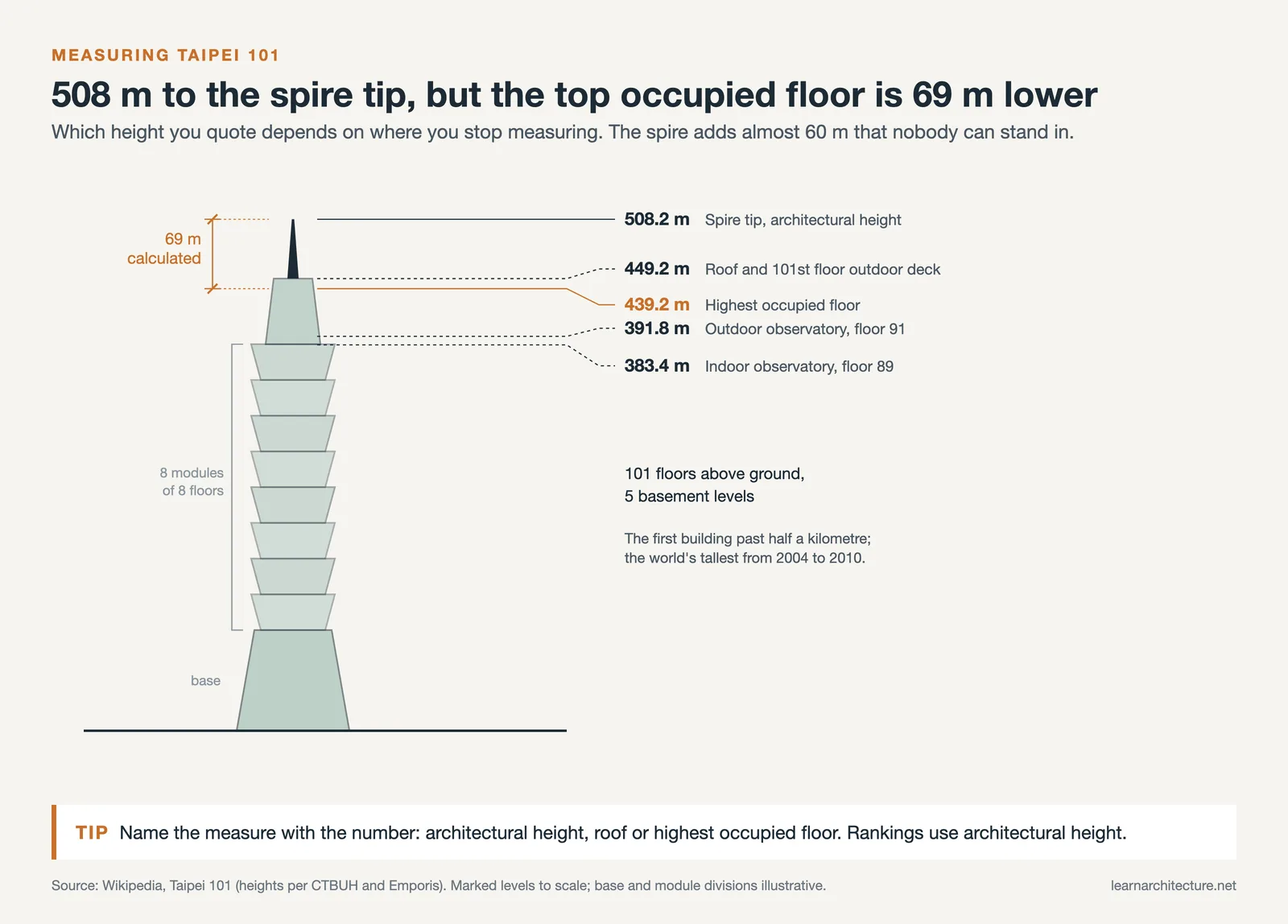
The Skyline 460 name sometimes referenced in tourism materials belongs to the outdoor deck on the 101st floor, opened to the public in 2019 at 460 meters above sea level, not to the full tower height. The outdoor observation deck on the 91st floor sits at 391.8 meters. Visitors accessing the indoor observatory on floor 89 stand at 383.4 meters above street level, with 360-degree views of Taipei and the surrounding mountains.
📌 Did You Know?
During construction in 2002, a magnitude 6.8 earthquake struck near Taipei. Two cranes fell from the partially built structure, killing five workers. After inspection, the structural frame showed no significant damage, and construction resumed. This event demonstrated the building’s earthquake-resistant design years before it was even complete.
The Design Philosophy: Bamboo, Pagoda and the Number Eight

The taipei 101 building draws directly from traditional East Asian architecture and symbolism. Architect C.Y. Lee conceived the form as a stalk of bamboo: segmented, flexible, and tapering upward. Eight eight-story modules are stacked on a 25-story truncated pyramidal base. Each module flares outward at the top before stepping inward, creating the pagoda-like stepping profile visible from across the city. The eight modules end at floor 89; the remaining floors, 90 to 101, form the narrower crown that holds the outdoor observatory on floor 91, mechanical levels and the top deck on floor 101.
The number eight recurs throughout the design deliberately. In Chinese culture, eight is a homonym for prosperity and abundance, making it particularly appropriate for a tower housing the Taiwan Stock Exchange. The eight modules, each containing eight floors, carry this symbolic weight through the entire structure. At the transition points between each module, C.Y. Lee integrated ruyi brackets (traditional decorative elements associated with protection and good fortune), which also serve a wind-deflecting function by acting as secondary canopies over the floors below.
The blue-green glass curtain wall references the colour of indigenous bamboo. Each panel is double-paned and specially glazed to block up to 50% of external solar radiation while maintaining visual transparency, reducing internal heat gain without requiring reflective or tinted glass.
🎓 Expert Insight
The decision to make the damper visible to the public changed how many visitors relate to building engineering.
Thornton Tomasetti of New York peer-reviewed the structural engineering for Taipei 101. Rather than hiding it in a locked mechanical floor, the design team treated the damper as an educational and cultural centerpiece, a decision that has made it one of the building’s most visited features.
The Structural System: How the Building Stands
Building taipei 101 to this height in a seismically active typhoon zone required a structural system unlike anything previously built. The primary lateral load-resisting system uses a braced reinforced concrete and steel composite core, connected to the perimeter by outrigger trusses at every eighth floor. This configuration mirrors the joints of a bamboo stalk, where segments are tied at regular intervals to distribute stress evenly along the full height.
The perimeter frame includes eight super-columns in total, set around the four faces of the building. Each column measures 2.4 by 3.1 meters in cross-section, fabricated from welded steel box sections 50 to 80 mm thick and filled with high-strength concrete up to the 62nd floor; above that level they continue as steel only, to keep their own weight down. The 16 box columns in the central core are also concrete-filled up to floor 62. Together, these elements form a mega-frame capable of resisting the overturning forces generated by both wind and seismic loads at this scale.
Belt trusses, deep horizontal trusses wrapping the perimeter at key floor levels, gather and redistribute forces from the perimeter columns to the core. Below floor 27, these trusses are two stories deep. Above that, they are one story deep at every eighth floor. This system allows the floor plates themselves to remain column-free and flexible in plan, supporting the open office layouts the building requires.
📐 Technical Note
The super-column plates, up to 80 mm thick, use a steel specified as SM570M: the Taiwanese CNS SM570 grade modified by the engineers for ductility and weldability in thick plates. Its specification sets yield strength between 4,200 and 5,200 kgf/cm² (roughly 410 to 510 MPa) and tensile strength between 5,800 and 7,300 kgf/cm² (roughly 570 to 715 MPa). The concrete pumped into the columns up to the 62nd floor was designed for 10,000 psi (about 69 MPa), and at its 90-day design age it tested at about 12,000 psi. Source: Shieh, Chang and Jong, Structural Design of Composite Super-Columns for the Taipei 101 Tower (Evergreen Consulting Engineering).
How Does Taipei 101 Resist Wind and Earthquakes?

Taipei sits at the intersection of two serious environmental threats: it lies in a high-frequency typhoon corridor experiencing winds of up to 156 km/h with a 100-year return period, and it sits just 200 meters from a major fault line. The structural challenge was unusual because the two threats pull in opposite directions. Earthquake resistance calls for flexibility: a building that can move with ground motion without fracturing. Typhoon resistance demands stiffness: minimizing the sway that makes occupants uncomfortable at high speeds. Taipei 101 had to satisfy both simultaneously.
The saw-tooth or “double notch” corners of the building address the wind problem at a facade level. Wind tunnel testing at RWDI’s facility in Ontario showed that sharp square corners produce large vortex shedding forces: alternating crosswind pressures that can cause oscillations. The chamfered and notched corners reduced these crosswind forces by up to 40%, allowing the structural engineers to reduce the required stiffness of the frame and save substantial steel tonnage.
For seismic safety, the structural system uses perimeter moment frames and special core connections in addition to the outrigger system. The building is designed to withstand a ground acceleration of 0.5g and the strongest earthquakes expected within a 2,500-year cycle, according to Evergreen Consulting Engineering’s specifications. The combination of a stiff mega-frame with ductile connections allows the tower to dissipate seismic energy through controlled deformation rather than brittle failure.
💡 Pro Tip
When studying tall building structural systems, use Taipei 101 as a reference case for the outrigger-and-belt-truss concept. The eight-floor interval spacing of the outriggers was determined through wind tunnel and structural analysis to optimize the balance between lateral stiffness and floor plan flexibility. This spacing principle can be scaled and adapted to shorter towers where similar trade-offs apply.
Inside Taipei 101: The Tuned Mass Damper
The most famous feature inside taipei 101 is the tuned mass damper suspended between floors 87 and 92. This steel sphere weighs 660 metric tons (728 short tons), measures 5.5 meters in diameter, and is composed of 41 circular steel plates of varying diameters, each 125 mm thick, welded together to form the sphere. Eight steel cables support it from the 92nd floor. Eight viscous dampers, functioning like hydraulic shock absorbers, connect the sphere to the surrounding structure and control its motion as it swings.
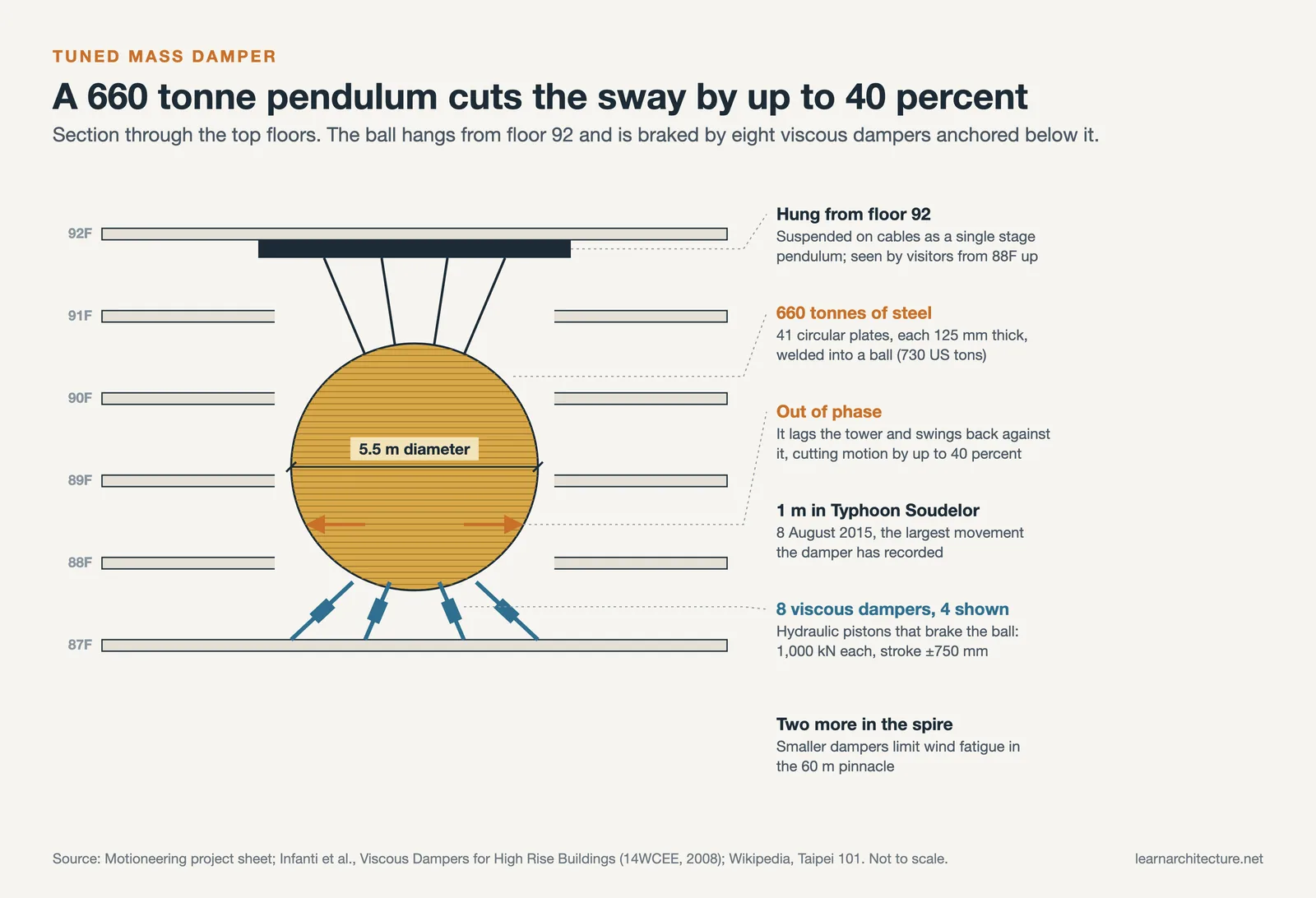
The damper works on the principle of counterweight oscillation. When wind or seismic forces push the tower in one direction, the damper’s mass lags slightly behind the building’s movement, then swings back in the opposite direction. This out-of-phase oscillation reduces the peak sway of the tower by up to 40%. The system was designed by Motioneering and cost approximately $4 million USD to build and install.
What distinguishes Taipei 101’s damper from those in comparable supertalls is its visibility. In most tall buildings, tuned mass dampers are hidden in locked mechanical floors. Here, it is fully exposed to public view from the 89th-floor observatory, backlit in gold and surrounded by informational displays. During Typhoon Soudelor in August 2015, visitors recorded the damper swinging approximately 1 meter, the largest movement ever recorded in the system.
Two smaller tuned mass dampers, each weighing 6 metric tons, are also installed at the tip of the spire to protect the steel-spined pinnacle from wind-induced fatigue over time. You can read more about how outrigger systems and lateral load strategies are applied across other supertalls in our guide to Shanghai Tower’s structural and sustainable design.
⚠️ Common Mistake to Avoid
Many sources cite the Taipei 101 damper weight as either 728 tons or 660 tons, and both figures are technically correct. The 660-metric-ton figure (660,000 kg) is the mass of the sphere itself. The 728-short-ton figure is the same mass converted to US customary short tons. They refer to the same damper. Use metric tons when citing engineering specifications, and clarify the unit when quoting sources that use short tons.
The Foundation: Engineering Below Ground
Building the taipei 101 tower required solving a difficult ground condition before a single floor could rise. The site sits on 40 to 60 meters of clay and stiff colluvial soil with low load-bearing capacity, beneath which lies soft sandstone. The groundwater table is approximately 2 meters below grade, creating significant uplift pressure on any underground structure.
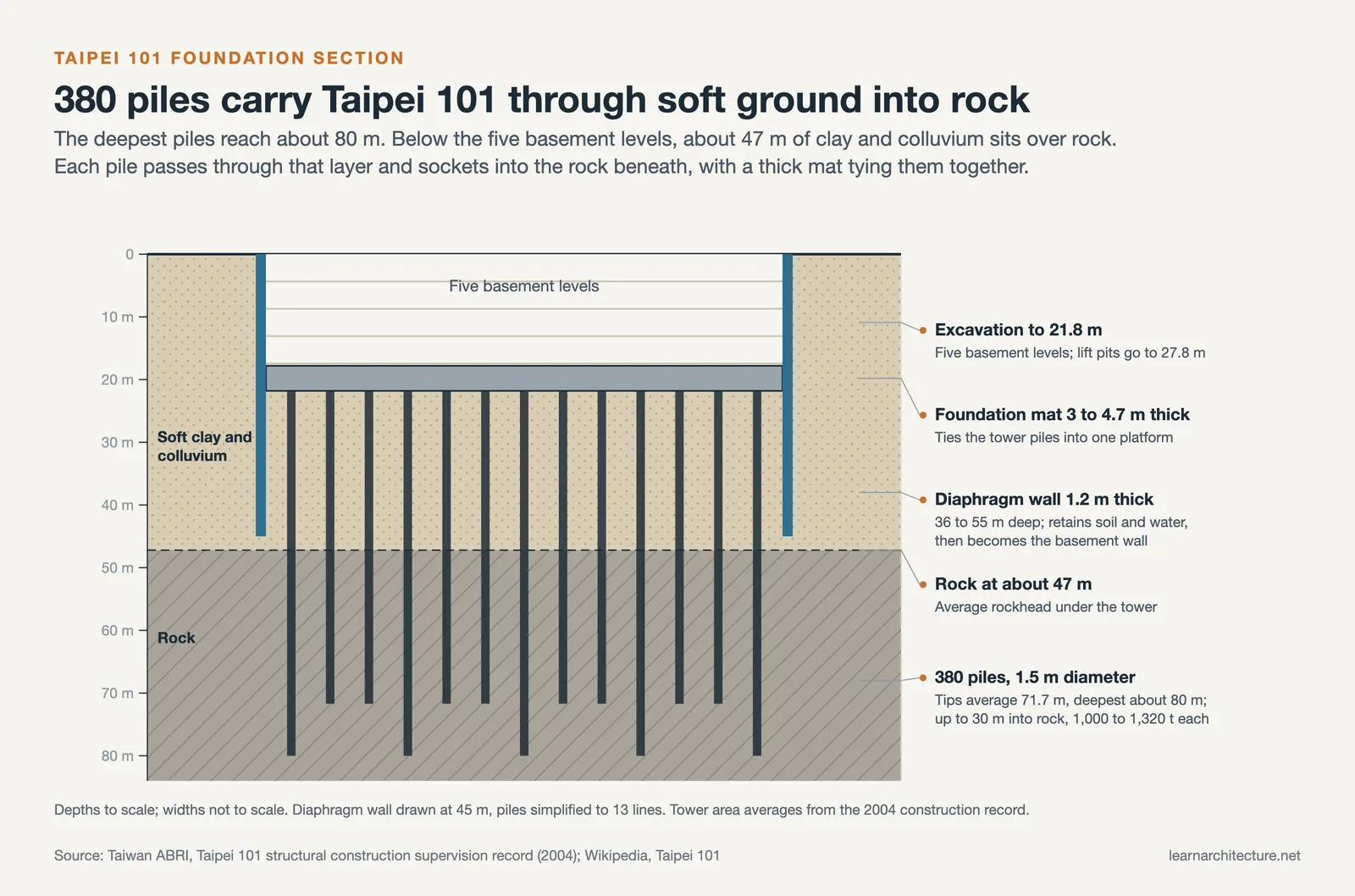
The solution required a 21-meter deep basement and 380 concrete piles each 1.5 meters in diameter, driven up to 80 meters into the ground. The deepest piles reach 30 meters into bedrock, effectively pinning the building to solid tectonic material. Each pile has a load-bearing capacity of 1,000 to 1,320 metric tons. Slurry walls (deep perimeter walls 1.2 meters thick extending 36 to 55 meters below grade) were constructed around both the tower and the podium footprint to contain groundwater during excavation and provide permanent lateral support to the basement structure.
The main foundation mat ties all 380 tower piles into a single rigid platform. This monolithic approach ensures that seismic forces are distributed evenly to the pile group rather than concentrated in individual elements during earthquake ground motion.
Sustainability: Inside Taipei 101’s LEED Certification
Taipei 101 was not originally designed as a green building in the contemporary certification sense, but it incorporated energy-conscious systems from the outset. The double-paned facade reduces solar heat gain by 50%, significantly lowering the cooling load in a subtropical climate. The building’s own recycled water system, collecting and treating roof and facade runoff, meets 20 to 30% of internal water demand.
In 2011, a major operational retrofit achieved LEED Platinum certification under the “Existing Buildings: Operations and Maintenance” category, making it at the time the tallest and largest LEED Platinum-certified building in the world. The retrofit cost NT$60 million (approximately $2 million USD) and included upgraded HVAC controls, energy-efficient lighting systems with custom luminaires, low-flow water fixtures, and smart building management systems. The result was an 18% reduction in annual energy consumption, saving roughly 14.4 million kilowatt-hours per year. LEED Platinum recertification was achieved again in 2016 and 2021.
For a broader look at how green certification standards have evolved and what they require at this scale, the US Green Building Council’s LEED program provides detailed technical criteria for each certification level. Our overview of sustainable architecture’s future direction covers how these strategies are applied across contemporary projects.
💡 Pro Tip
When analyzing Taipei 101’s LEED achievement for academic or professional reference, note that it was certified under LEED for Existing Buildings (LEED-EB), not LEED for New Construction (LEED-NC). These are distinct rating systems with different credit weightings. LEED-EB focuses on operational performance over time rather than design-stage decisions, which is why a building completed in 2004 without a green certification brief could still achieve Platinum through a focused operational upgrade in 2011.
What Can You See Inside Taipei 101?

Visitors to inside taipei 101 can access several distinct zones. The lower floors from basement to floor five house the Taipei 101 Mall, one of Taiwan’s largest luxury shopping centers covering more than 77,000 square meters. Floors six through 84 contain Class A office space housing dozens of corporations and the Taiwan Stock Exchange.
The observation experience begins on floor 89 with the Indoor Observatory at 383.4 meters elevation, offering 360-degree views of Taipei, the surrounding mountain ridges including Elephant Mountain (Xiangshan), and on clear days extending to the coast. The tuned mass damper is visible from here through glass panels, with recorded voice tours in eight languages explaining its function. Two flights of stairs lead to the Outdoor Observatory on floor 91 at 391.8 meters, open weather permitting. A second outdoor deck at the very top of the tower on floor 101 provides unobstructed views but is separate from the main observatory ticket.
High-speed elevators manufactured by Toshiba connect the fifth floor to the 89th floor in 37 seconds, reaching 60.6 km/h. When the building opened, these were the fastest elevators in the world. They include pressurization systems that adjust cabin atmosphere during ascent and descent to prevent ear discomfort, and active vibration control to smooth the ride at high speed.
🏗️ Real-World Example
Shanghai Tower (Shanghai, 2015): Completed eleven years after Taipei 101, the 632-meter Shanghai Tower used many of the same structural principles (outrigger trusses, a composite mega-frame, and a tuned mass damper) but took the sustainability agenda further, achieving LEED Platinum at completion rather than through retrofit. Its twisting double-skin glass facade reduced wind loads by 24%, saving an estimated $58 million in structural steel costs compared to a conventional square tower of the same height.
Taipei 101’s Place in Architectural History

The 101 taipei tower was the world’s first skyscraper to exceed 500 meters, breaking a symbolic barrier when it opened on 31 December 2004. It held the title of world’s tallest building until the Burj Khalifa surpassed it in March 2010. As of 2023, it ranks as the eleventh-tallest building in the world according to CTBUH.
Beyond its height records, Taipei 101 influenced subsequent supertall design in several practical ways. The decision to use saw-tooth corners to reduce vortex shedding, confirmed by RWDI wind tunnel testing, has since been adopted or adapted in other tall buildings in typhoon-prone regions. The choice to make the tuned mass damper publicly visible, rather than hide it in a mechanical floor, shifted how engineers and developers think about communicating structural systems to non-specialist audiences. The building has appeared in the CTBUH’s list of the 50 most influential skyscrapers in the world (2019) and was prominently featured in Netflix’s 2026 broadcast of climber Alex Honnold’s free solo ascent of its exterior.
In January 2026, Honnold completed the climb in one hour and 31 minutes (the tallest authorized urban free solo climb in history), bringing renewed international attention to the building and to Taiwan.
For context on where Taipei 101 fits among the world’s tallest structures, see our article on the tallest buildings in the world and their engineering approaches. For students and professionals interested in the structural logic behind forms like Taipei 101’s tapering modules, our piece on form finding in architecture covers how structural forces can generate architectural geometry. The top skyscraper design trends article looks at how Taipei 101’s innovations have filtered through to contemporary tower design.
C.Y. Lee & Partners, the Taipei-based firm that designed the tower, maintains project information on their website at cylee.com. Thornton Tomasetti’s detailed project page at thorntontomasetti.com covers the structural engineering in technical detail. The CTBUH’s technical paper on Taipei 101’s structural design, available through the Council on Tall Buildings and Urban Habitat, remains one of the most thorough published accounts of how the building was engineered. The official building management website at taipei-101.com.tw covers visitor access, observatory hours, and current building information.
✅ Key Takeaways
- Taipei 101 stands 508 meters tall and was the world’s first skyscraper to exceed the half-kilometer mark, holding the world’s tallest title from 2004 to 2010.
- Its bamboo-inspired eight-module design is not just aesthetic: the form, the notched corners, and the outrigger-at-every-eighth-floor structural logic all derive from solving real engineering problems of wind and seismic resistance.
- The 660-metric-ton tuned mass damper is the world’s largest visible TMD, reducing building sway by up to 40% and serving as both an engineering system and a public attraction.
- LEED Platinum certification was achieved in 2011 through a $2 million operational retrofit that cut annual energy use by 18%, and has been maintained through 2016 and 2021 recertifications.
- The saw-tooth facade corners, confirmed by wind tunnel testing at RWDI, reduced crosswind vortex forces by up to 40%, a finding that has since influenced other supertall designs in typhoon zones.








Leave a comment