



Table of Contents Show
Mental health in architecture school is one of the most pressing yet least discussed challenges facing design students today. Research published in the Building Healthy Academic Communities Journal in 2024 found that 33% of architecture students screen positive for moderate to severe depression and 46% for anxiety, rates well above national college averages. This guide unpacks why this happens and what students can actually do about it.
Architecture school has a reputation, and most of it is earned. The all-nighters, the brutal critiques, the studio that becomes a second home (or first home): these are not exaggerations. They are the documented norm. What is changing is that students, faculty, and accrediting bodies are finally beginning to call this culture what it is: a structural problem that compromises the well-being of the people who go on to design our cities, hospitals, and homes.
This article looks at the real numbers behind mental health in architecture school, the specific pressures that drive them, and a set of practical, evidence-based strategies you can apply this semester. Some are personal habits. Others involve pushing back, gently but firmly, on a culture that often treats burnout as a badge of honor.
What does mental health in architecture school actually look like?
Mental health in architecture school refers to the emotional, psychological, and behavioral well-being of students enrolled in architectural education programs. It encompasses how students manage stress, sleep, social relationships, and academic pressure across the demanding studio-based curriculum that defines most schools of architecture.
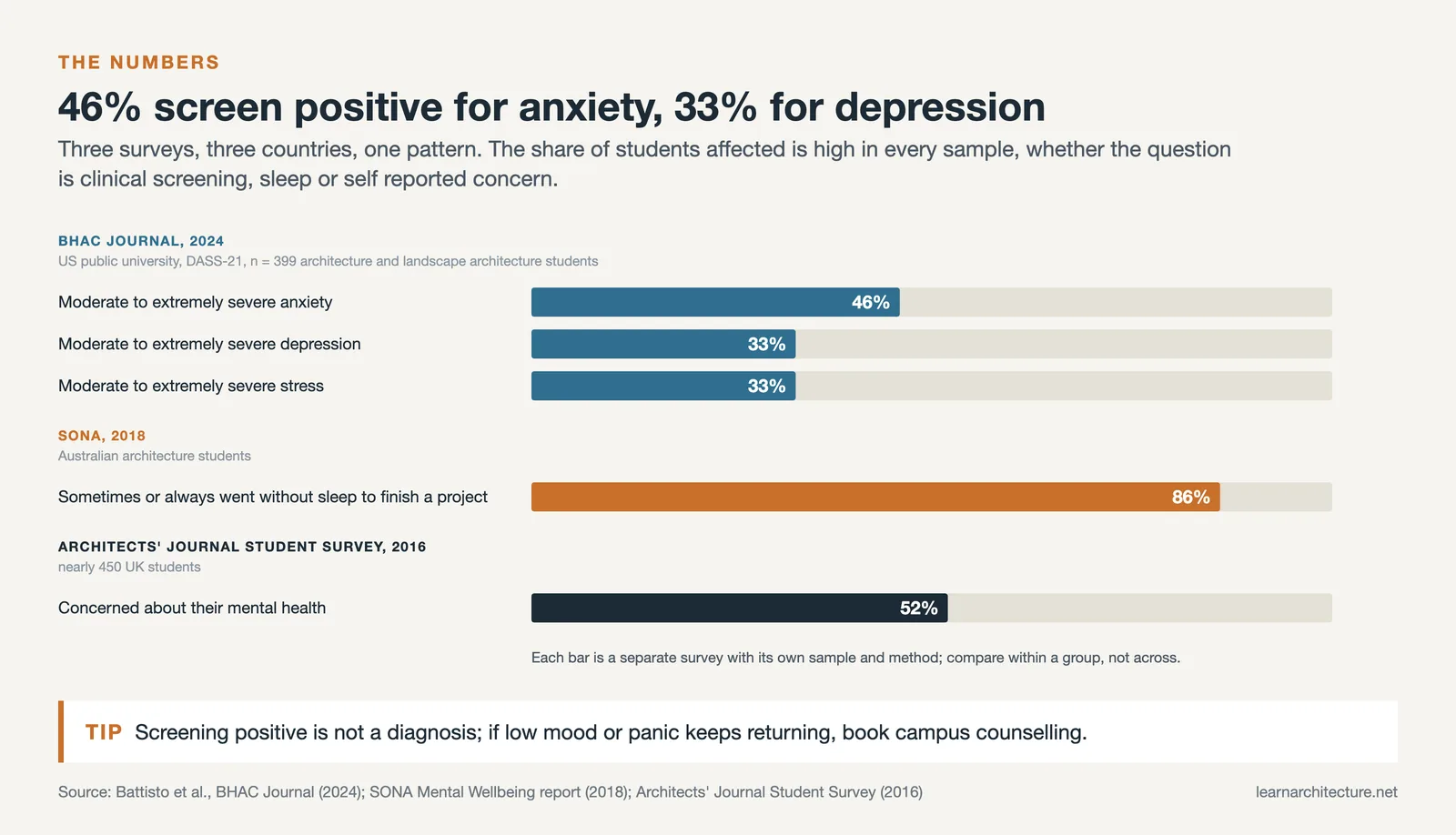
The picture is not vague or anecdotal. A 2024 peer-reviewed study tracked depression, anxiety, and stress symptoms among architecture and landscape architecture students at a four-year public university. Their findings echoed earlier surveys from the United Kingdom, Australia, Turkey, and Hong Kong. Across very different educational systems, mental health in architecture students follows the same pattern: significantly worse than their peers in other disciplines.
🔢 Quick Numbers
- 33% of architecture students screen positive for moderate to severe depression and 46% for anxiety (Building Healthy Academic Communities Journal, 2024)
- 86% of architecture students reported sometimes or always going without sleep to complete a project (SONA survey, 2018)
- Architecture students were 43% more likely to experience panic than the typical student in Melissa Kirkpatrick’s 2018 MArch dissertation survey (Architects Benevolent Society)
These numbers reflect a structural reality, not individual weakness. Anxiety in architecture students often shows up as physical symptoms first, racing heart before pin-up reviews, stomach pain during charrettes, or the inability to fall asleep even when finally given the chance. Depression often presents as a slow erosion of interest in the work itself, the very thing that drew students to architecture in the first place.
Why is mental health in architecture so much worse than other majors?

The reason mental health in architecture is consistently worse than in most other majors comes down to a unique combination of factors that compound each other. Studio-based learning, subjective evaluation, and the absence of clear stopping points create conditions that other disciplines simply do not impose on their students.
The studio culture problem
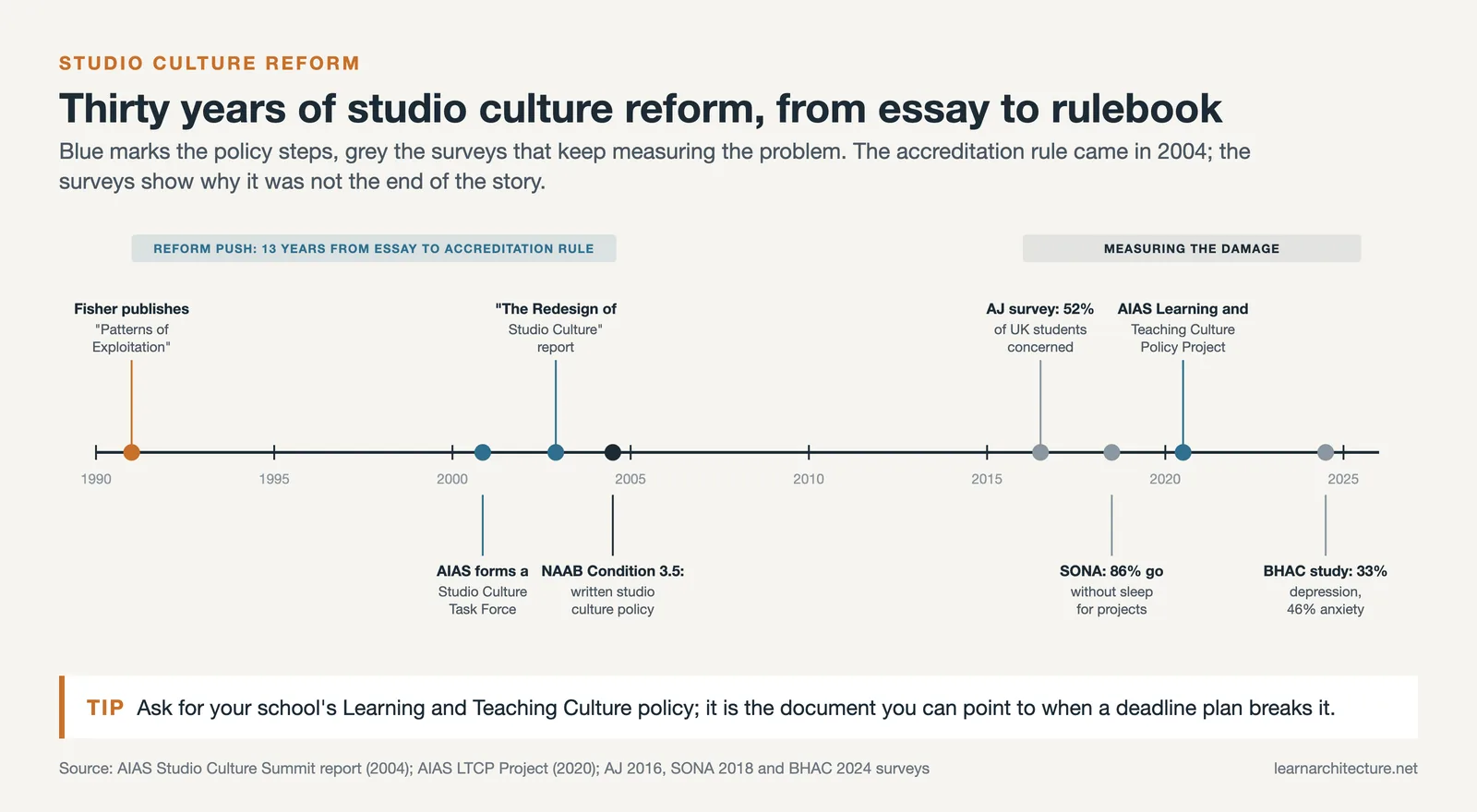
The design studio is the heart of architectural education and also the source of most of its pressure. The American Institute of Architecture Students (AIAS) formed its first Studio Culture Task Force in 2000, partly in response to incidents that exposed serious health and safety issues at architectural schools. Their 2002 report, “The Redesign of Studio Culture,” argued that change was needed to produce healthier, more optimistic graduates. More than two decades later, much of what they identified remains intact.
A 2025 systematic review of burnout in architecture students, published in TPM: Testing, Psychometrics, Methodology in Applied Psychology, found that studio culture norms tend to glorify sleeplessness, treat suffering as proof of dedication, and quietly reward students who sacrifice their personal lives for studio output. Faculty rarely codify these expectations, which makes them harder to challenge directly.
Subjective evaluation and the critique cycle
Unlike a math exam, a design project has no answer key. Your work is evaluated by jurors whose tastes, philosophies, and moods you cannot predict. This subjectivity is genuinely valuable for design education, but it also produces a particular form of psychological strain. Students often internalize critiques of their work as critiques of themselves, especially when feedback is delivered in front of peers during pin-ups or final reviews.
🎓 Expert Insight
“Burnout is the absence of growth. It robs us of our ability to thrive.”
Dr. Akua Boateng, mental health professional, in an AIA panel on tackling mental health in architectural practice
This framing is useful for students because it reframes burnout as more than fatigue. When you cannot learn from feedback, generate new ideas, or feel curiosity about your project, that is a signal worth taking seriously, not pushing through.
The “no stopping point” problem
A studio project can always be improved. There is no equivalent to handing in a finished problem set. This is why so many architecture students develop a habit of working until exhaustion rather than until completion. Without a defined stopping point, work expands to fill all available time, which is one of the strongest predictors of academic burnout in design fields.
How does sleep deprivation in architecture school affect performance?
Sleep deprivation does not improve design output, despite what studio culture often implies. The 2025 TPM systematic review found that chronic sleep loss in architecture students impairs attention, participation, and creativity. Students who pull repeated all-nighters frequently neglect nutrition as well, which compounds fatigue and worsens mental health over the course of a semester.
The toxic culture of architectural education was first formally documented in 1991, when Thomas Fisher published “Patterns of Exploitation” in response to the death of an architecture student who fell asleep at the wheel driving home from a design review. The AIAS referenced this article in its 2002 Studio Culture report, acknowledging that little had changed in the decade since. Sleep deprivation is not a quirky design-school inconvenience. It has been linked to genuine physical danger.
⚠️ Common Mistake to Avoid
Many students assume that an all-nighter before a review will produce better work than going to bed at midnight. The opposite is generally true. Cognitive performance after 17 hours awake is comparable to a blood alcohol level of 0.05%, and it gets worse from there. The model you finish at 6 a.m. usually contains decisions you would not have made awake, and those decisions show up under jury scrutiny.
Practical strategies to protect your mental health in architecture school

Knowing the problem is half the battle. The other half is having a concrete set of habits and boundaries that you can actually use in the middle of a stressful week. The strategies below are drawn from peer-reviewed research, AIAS recommendations, and practices that experienced studio instructors quietly endorse.
1. Treat sleep as a project deliverable
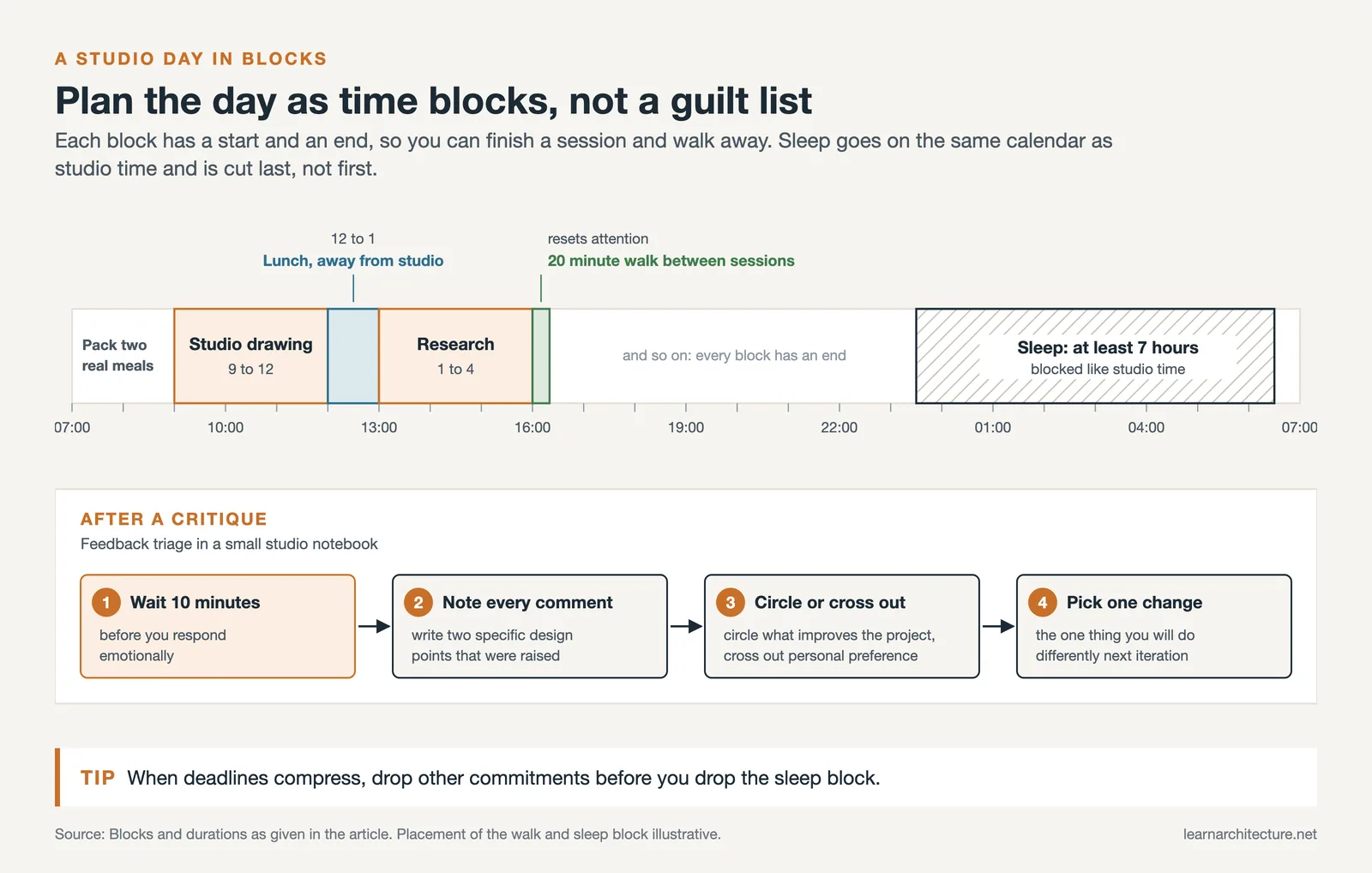
If you would not skip submitting a model, do not skip sleep. Block out at least seven hours per night in your calendar the same way you block out studio time. When deadlines compress, reduce other commitments before you reduce sleep. Cognitive functions like memory, spatial reasoning, and judgment, all critical to architectural design, deteriorate sharply with each lost hour.
2. Build a real schedule, not a guilt schedule
Many students plan their week as a long list of things they should do, which produces guilt without action. Instead, plan your week as time blocks: 9 to 12 is studio drawing, 12 to 1 is lunch (away from studio), 1 to 4 is research, and so on. Time blocking makes it easier to actually finish a session and walk away. For more on time management approaches that work for design students, the guide on architecture education tips covering task prioritization and feedback cycles covers practical methods like Trello and Asana boards adapted to studio workflow.
3. Separate the work from your worth
A jury critique is feedback on a drawing, not a verdict on you. This sounds obvious in writing and feels impossible during the actual review. Practice it deliberately: after every critique, write down two specific design points that were raised and one thing you will do differently next iteration. This concrete framing pulls feedback away from identity and back toward craft.
💡 Pro Tip
Keep a small notebook in studio for what experienced reviewers call “feedback triage.” After a critique, give yourself ten minutes before responding emotionally. Note the comments, then circle the ones that genuinely improve your project and cross out the ones that reflect the reviewer’s personal preference. Both are useful information, but only one should drive your next iteration.
4. Eat like someone who plans to keep designing tomorrow
Studio culture often treats meals as optional, with students subsisting on coffee, vending machine snacks, and whatever someone brings in at 2 a.m. This is one of the easiest things to fix. Pack two real meals before your studio day starts. The friction of having to leave studio to find food is exactly what leads people to skip eating altogether.
5. Use physical movement as a mental reset
You do not need a gym membership or a running routine. A 20-minute walk around campus between studio sessions resets attention and lowers stress hormones measurably. Walking also tends to surface design ideas you could not have arrived at while staring at a screen. Many architects build this into their professional practice and credit it for breakthroughs.
6. Find at least one peer you can be honest with
Studio culture rewards the appearance of effortless brilliance, which means most students hide their struggles. Find one classmate, ideally outside your immediate studio cohort, with whom you can be honest about what you are actually feeling. Peer support reduces burnout and the isolation that often accompanies it.
7. Use professional mental health resources without apology
Most universities offer free counseling services, and architecture students are exactly the demographic these services are designed to support. There is no threshold of suffering you must meet before seeking help. If you are considering whether you should talk to someone, that consideration itself is enough of a reason to make the appointment.
8. Push back on unreasonable expectations, in writing
If a faculty member assigns a workload that genuinely cannot be completed in the allocated time, raise it through proper channels. AIAS chapter representatives, learning and teaching culture committees, and program directors exist for this purpose. The AIAS Learning & Teaching Culture Policy Project (2020) provides language and frameworks you can reference. Pushing back is legitimate, and accreditation bodies like NAAB now expect schools to have policies addressing exactly these concerns.
9. Build a life outside studio
This sounds soft, but it is genuinely the most reliable predictor of long-term sustainability in the discipline. Students who maintain hobbies, friendships, and routines unrelated to architecture report lower burnout and, interestingly, often produce more inventive design work. Inspiration tends to come from outside the studio bubble, not from within it.
What if you are already burned out?
If you recognize yourself in this article and feel like you are already deep in burnout territory, the first move is not a productivity plan. It is rest, honesty with someone qualified to help, and a realistic conversation with your advisor about workload. Burnout is not solved by harder work. It is resolved by structural change in how you spend your time and energy.
What can architecture schools do to support student mental health?

Individual strategies matter, but they cannot fully solve a structural problem. Schools that take mental health in architecture students seriously have implemented a few specific changes with documented positive effects on well-being.
NAAB, the National Architectural Accrediting Board, added Studio Culture Policy as a condition for accreditation in 2004, and the AIAS has continued to push for stronger Learning & Teaching Culture policies since then. The American Institute of Architects (AIA) hosted a panel on tackling mental health in architectural practice in 2022, signaling that the conversation is moving from student advocacy into professional discourse. Mental health professionals like Dr. Akua Boateng have spoken at AIA-organized events and emphasize that solutions must combine firm-wide and individual actions.
🏗️ Real-World Example
University of Memphis Department of Architecture (Learning & Teaching Culture Policy): The department adopted an LTCP modeled on the AIAS document, with annual review by a committee of equally-empowered student leaders, faculty, and administrators. The policy is published openly and discussed at orientation, giving students an explicit channel to raise concerns about workload and well-being. This model has been replicated at programs across the United States.
Schools have also begun to recognize that the social dimension of studio, when healthy, is genuinely one of its strengths. The close relationships formed during long studio hours can be a source of peer support if the culture allows it. Programs that structure studio time to include collaborative breaks and collective problem-solving report better student cohesion without sacrificing output quality.
How does mental health in architecture school connect to long-term career health?
Habits formed in architecture school tend to persist into professional practice. AIAS has emphasized this point repeatedly: students who normalize sleep deprivation, blurred boundaries, and personal sacrifice in school often carry these patterns into their first jobs and beyond. The mental health crisis in the broader architectural profession, documented in Dezeen’s 2019 reporting on overworked architecture students who have considered suicide, is in many ways the studio culture problem aging into a workplace problem.
This is also why the connection between architecture and well-being is more than abstract. The discipline understands that the spaces we design shape how people feel and function; see the related work on architectural designs to improve mental health through natural light, biophilic elements, and flexible layouts and the broader piece on how architecture affects our well-being across mental and physical health. If we accept that the built environment is a determinant of health, the next logical step is to apply the same care to the conditions in which architecture itself is taught and practiced.
📌 Did You Know?
A student survey conducted by the Architects’ Journal in 2016 found that 52% of architecture students in the UK were concerned about their mental well-being. Eight years later, the 2024 Building Healthy Academic Communities Journal study found nearly identical patterns in the United States. The consistency across decades and continents suggests a structural problem in architectural education itself, not a temporary or regional one.
Key signs you should take seriously, not push through
Some signals are worth paying attention to even when you are convinced you can power through. Behavioral changes such as sudden withdrawal from social interactions, sharp shifts in academic performance, persistent loss of interest in work you once loved, panic attacks before reviews, or persistent sleep difficulties are all flagged in the research as early indicators of more serious mental health concerns.
The 2024 Building Healthy Academic Communities study noted that depression in architecture students often develops slowly, masked by the discipline’s normalization of exhaustion. Students often describe the moment they realized something was wrong as one where they noticed they had stopped caring about a project they would once have stayed up to perfect.
✅ Key Takeaways
- Mental health in architecture school is structurally worse than in most other majors, with 33% of students screening positive for depression and 46% for anxiety in 2024 research.
- The all-nighter culture normalized in studio education is linked to cognitive impairment and burnout, not better design outcomes.
- Practical strategies like protected sleep, time blocking, peer support, and separating work from self-worth have the most documented impact on student well-being.
- Architecture schools and accrediting bodies like NAAB now expect Learning & Teaching Culture policies, giving students legitimate channels to raise concerns.
- Habits built in school tend to persist into professional practice, so protecting your mental health now is also protecting your long-term career.
- Early warning signs (withdrawal, loss of interest, persistent sleep issues, panic attacks before reviews) deserve professional attention, not pushing through.
Final thoughts on protecting your mental health in architecture school

Architecture is a long discipline. The career arc spans decades, and the work demands sustained creativity, judgment, and care. Treating your mental health as expendable in school is a poor investment in the architect you are trying to become. The research is consistent and the institutional acknowledgment is finally catching up. You are not weak for struggling, and you are not alone.
The students who thrive in architecture school over the long term are rarely the ones who pulled the most all-nighters or sat in studio the longest. They are the ones who found a sustainable rhythm, built honest peer relationships, set boundaries with their work, and learned to separate their craft from their identity. Those are skills you can start building this week, and they will serve you long after graduation.
This article discusses mental health in the context of architectural education. It is not a substitute for professional mental health care. If you are experiencing significant distress, please contact your university counseling service or a qualified mental health professional. If you are in crisis, contact local emergency services or a crisis helpline.
Frequently Asked Questions
How common are mental health issues among architecture students?
Mental health issues are significantly more common among architecture students than the general college population. Peer-reviewed research published in 2024 found that 33% of architecture students screen positive for moderate to severe depression and 46% for anxiety, compared to lower averages across other disciplines. Surveys from the United Kingdom, Australia, Turkey, and Hong Kong have reported comparable patterns.
Is studio culture really to blame for mental health problems in architecture school?
Studio culture is widely recognized as a major contributor, though not the only one. The 2025 TPM systematic review found that studio norms which glorify sleeplessness, equate suffering with dedication, and blur boundaries between academic and personal life all increase burnout risk. AIAS has been formally addressing these patterns since 2000, and NAAB now requires schools to have Learning & Teaching Culture policies as a condition of accreditation.
How many hours of sleep should architecture students aim for?
Most sleep researchers recommend seven to nine hours per night for college-age adults, and architecture students should aim for the same. The 2025 systematic review on burnout in architecture students found that chronic sleep deprivation impairs attention, creativity, and decision-making, exactly the abilities studio work demands. Treating sleep as a non-negotiable rather than a flexible variable produces measurably better academic and design outcomes over a semester.
Should I see a therapist if I am struggling in architecture school?
If you are wondering whether to talk to someone, that question itself is generally enough reason to make an appointment. Most universities offer free counseling services to enrolled students. There is no minimum threshold of suffering required to seek support, and architecture students are exactly the population these services are designed to help. Talking to a professional early tends to prevent more serious episodes later.
Will architecture schools ever change their culture?
Change is happening, though slowly. Since the AIAS published its first studio culture report in 2002, NAAB has added Learning & Teaching Culture as an accreditation requirement, and many programs have implemented their own policies modeled on AIAS recommendations. The pace of change has been gradual, but the institutional acknowledgment of mental health issues in architecture education is now broader than it has ever been, and student advocacy continues to push it forward.








Leave a comment