


Table of Contents Show
The tallest skyscrapers in the Middle East include some of the most extraordinary structures ever built, led by the Burj Khalifa in Dubai at 828 meters, still the tallest building in the world as of 2026. From UAE and Saudi Arabia to Kuwait, the region has concentrated more supertall towers per square kilometer than almost anywhere else on earth, turning desert cities into vertical landmarks that define 21st-century architecture.
Why the Middle East Became a Global Skyscraper Capital
The rise of supertall construction in the Middle East is not accidental. Oil wealth, rapid urbanization, and deliberate economic diversification strategies (most notably Saudi Arabia’s Vision 2030 and Dubai’s successive master plans) created conditions where building tall became both financially viable and politically symbolic. Cities like Dubai had little existing urban fabric to protect, which gave developers and architects unusual freedom to build at unprecedented scales.
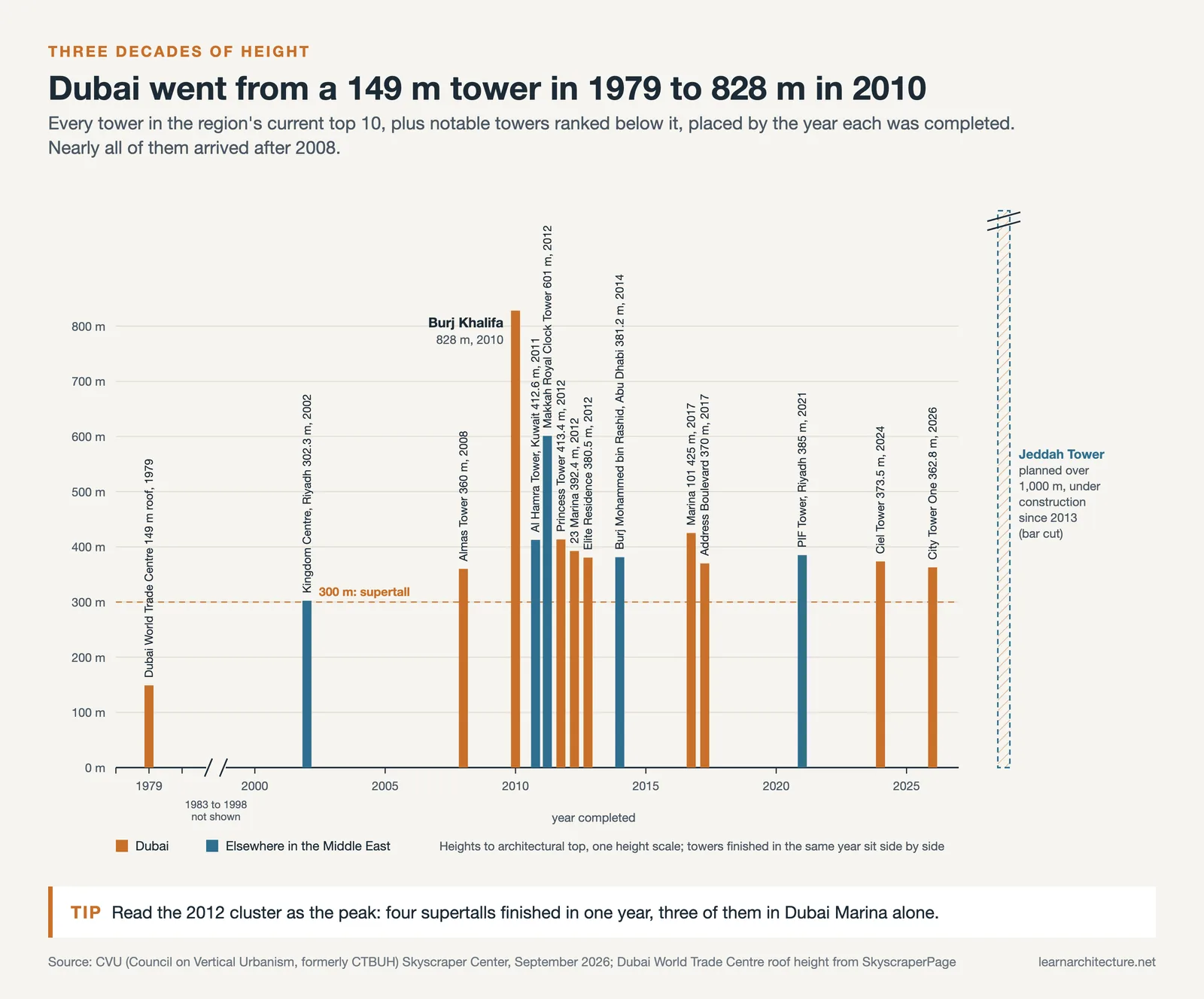
According to the Council on Tall Buildings and Urban Habitat (CTBUH), the UAE alone holds 16 of the 100 highest completed buildings in the world as of 2025, a concentration unmatched by any country relative to its size. Dubai has 18 completed supertalls rising above 300 meters, more than any other single city globally. The region’s skyscraper story, which started in 1979 with the 149-meter Dubai World Trade Centre, has moved faster than any comparable building boom in modern history.
🔢 Quick Numbers
- Dubai has 18 completed supertall buildings above 300 m, more than any other city (CTBUH, 2025)
- The UAE ranks third globally in total skyscraper count, with 251 towers above 150 m (CTBUH, 2024)
- 6 of the 10 tallest completed buildings in the Middle East are located in Dubai, and 7 are in the UAE (CVU Skyscraper Center, as of September 2026)
What Counts as the Tallest Skyscraper in the Middle East?

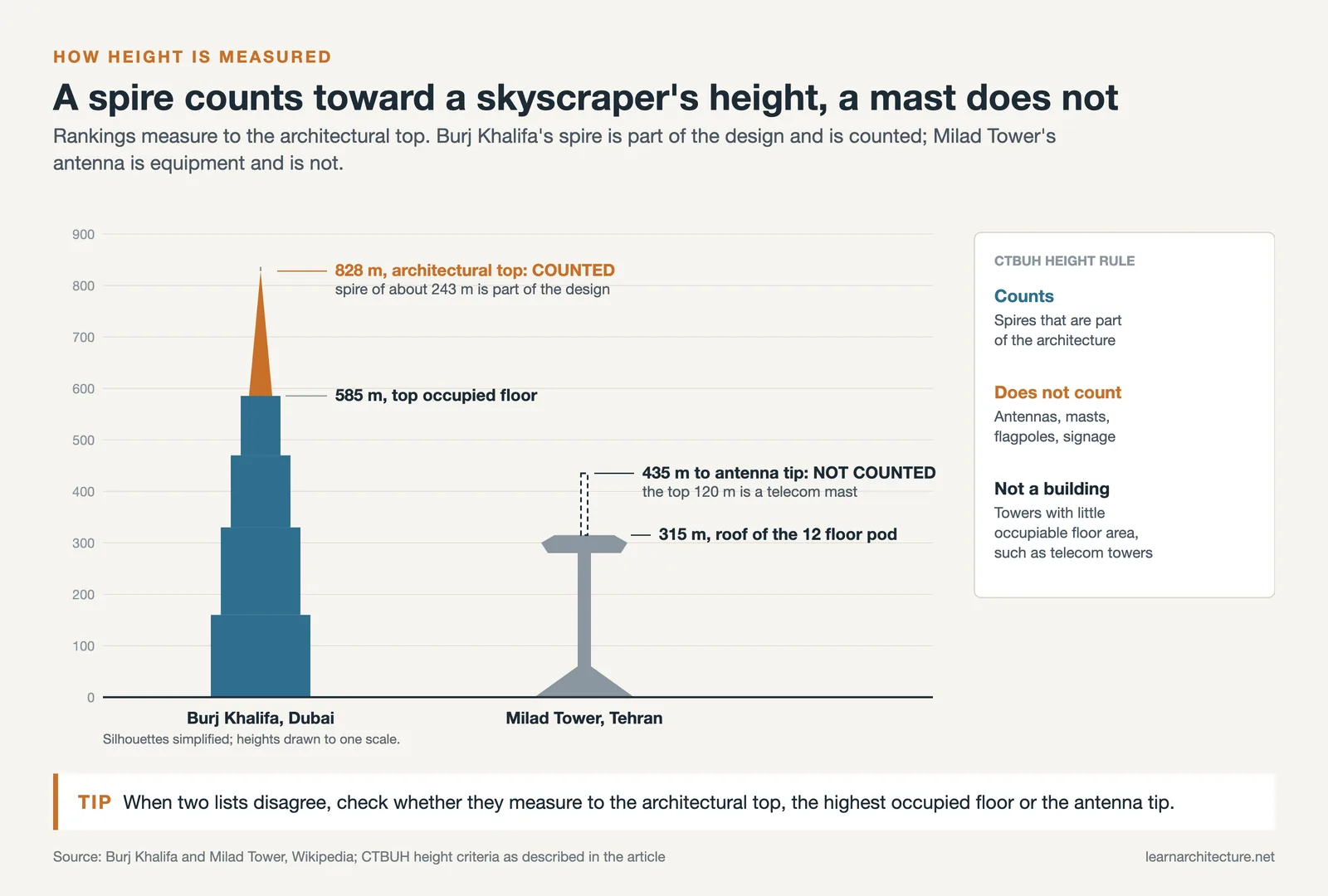
Height rankings follow the CTBUH standard, which measures to the structural top of a building, including spires that are architecturally integral, but excludes antenna masts, flagpoles, and non-occupied roof additions. This distinction matters for the Middle East: the Burj Khalifa’s 828-meter measurement, for instance, includes its architectural spire, while broadcast towers in the region with taller antenna masts are excluded from skyscraper rankings.
The list below covers completed buildings only. Under-construction projects like the Jeddah Tower in Saudi Arabia (planned at over 1,000 meters) are excluded, as their final heights and completion timelines remain subject to change.
⚠️ Common Mistake to Avoid
Many sources conflate “tallest building” with “tallest structure.” Iran’s Milad Tower, at 435 meters, is often cited in regional rankings, but 120 of those meters come from its telecommunications mast rather than occupied floors. Under CTBUH criteria, it ranks lower than its total height suggests. Always check whether a source is measuring to the occupied top or the antenna tip when comparing skyscraper heights across different lists.
The 10 Tallest Skyscrapers in the Middle East
The following table ranks the top 10 completed buildings by height, with city, floor count and completion year, following the Skyscraper Center’s Middle East ranking by the Council on Vertical Urbanism (CVU, formerly CTBUH) as of September 2026. Egypt’s 394-meter Iconic Tower (2024) is not included because CVU lists it under Africa, where it ranks as the continent’s tallest building.
Top 10 Tallest Completed Skyscrapers in the Middle East
All heights are measured to architectural top per CTBUH standard.
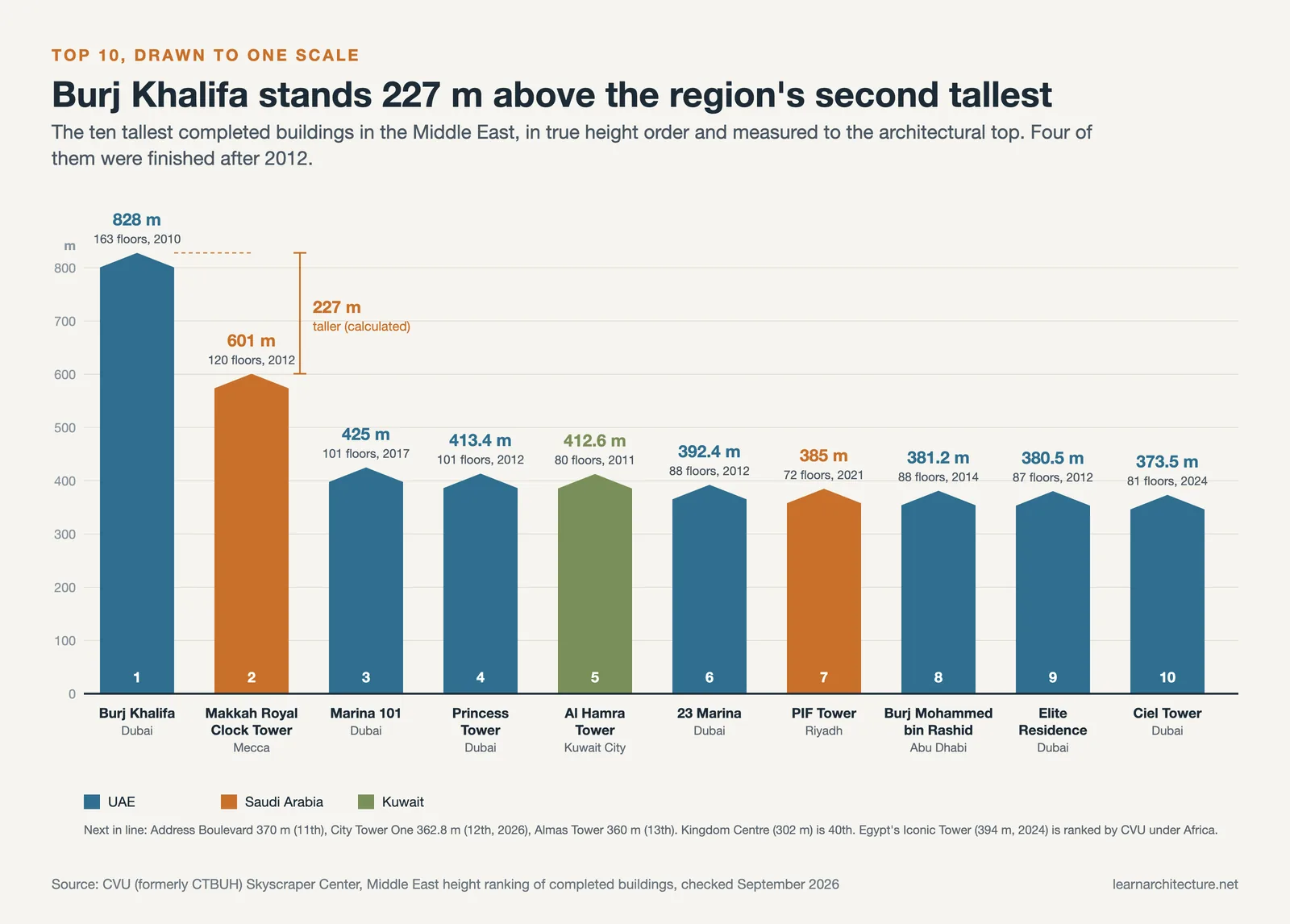
| # | Building | City | Height | Floors | Completed |
|---|---|---|---|---|---|
| 1 | Burj Khalifa | Dubai, UAE | 828 m | 163 | 2010 |
| 2 | Makkah Royal Clock Tower | Mecca, Saudi Arabia | 601 m | 120 | 2012 |
| 3 | Marina 101 | Dubai, UAE | 425 m | 101 | 2017 |
| 4 | Princess Tower | Dubai, UAE | 413.4 m | 101 | 2012 |
| 5 | Al Hamra Tower | Kuwait City, Kuwait | 412.6 m | 80 | 2011 |
| 6 | 23 Marina | Dubai, UAE | 392.4 m | 88 | 2012 |
| 7 | PIF Tower | Riyadh, Saudi Arabia | 385 m | 72 | 2021 |
| 8 | Burj Mohammed bin Rashid | Abu Dhabi, UAE | 381.2 m | 88 | 2014 |
| 9 | Elite Residence | Dubai, UAE | 380.5 m | 87 | 2012 |
| 10 | Ciel Tower | Dubai, UAE | 373.5 m | 81 | 2024 |
1. Burj Khalifa: The World’s Tallest Skyscraper (828 m, Dubai)

No discussion of the tallest skyscraper in the world begins anywhere other than Dubai’s Burj Khalifa. Completed in January 2010 after roughly six years of construction, the tower rises 828 meters across 163 floors, holding world records for highest occupied floor, highest outdoor observation deck, and tallest elevator installation. Its design firm, Skidmore, Owings and Merrill (SOM), led by architect Adrian Smith, drew from the structural logic of the Hymenocallis desert flower to create the tower’s three-lobed, Y-shaped footprint, a form that dramatically reduces wind load while giving each residential floor natural light on three sides.
The Burj Khalifa is genuinely mixed-use. Below the 108th floor you find the Armani Hotel, corporate offices, and 900 apartments. Above that, the structure tapers into mechanical floors, the observation decks at levels 124 and 148, and finally the spire of roughly 243 meters. Construction cost approximately $1.5 billion, and at peak activity more than 12,000 workers were on site daily.
💡 Pro Tip
When studying the Burj Khalifa structurally, pay close attention to its buttressed core system rather than its cladding. The tower’s three wings each act as a structural buttress for the central core, which transfers wind loads down to a reinforced concrete mat foundation over 50 meters deep. This buttressed core approach, rather than a conventional diagrid or tube, was critical to reaching 828 meters with the materials and timeline available in the mid-2000s.
📌 Did You Know?
The Burj Khalifa’s air conditioning system collects approximately 15 million liters of condensate water per year from the humid Dubai air, equivalent to roughly 20 Olympic swimming pools. This water is entirely recycled to irrigate the surrounding landscaping, including the Dubai Fountain. The engineering team designed this system specifically to address water scarcity in the desert climate, making condensate recovery one of the tower’s most practical sustainability features.
2. Makkah Royal Clock Tower: The Tallest Skyscraper in Saudi Arabia (601 m, Mecca)
The Makkah Royal Clock Tower, formally part of the Abraj Al-Bait complex, is the tallest skyscraper in Saudi Arabia and the second-tallest building in the Middle East at 601 meters. Completed in 2012 at a cost of approximately $15 billion (making it the most expensive building ever constructed), the tower overlooks the Grand Mosque in Mecca and was designed to serve the millions of pilgrims who visit annually for Hajj and Umrah.
The clock faces mounted near the tower’s summit are the largest in the world, each measuring 43 meters in diameter and visible from up to 25 kilometers away. The complex below the clock tower contains seven additional hotel towers, more than 1.5 million square meters of floor space, and accommodation for over 100,000 guests. Architecturally, the project blends Islamic geometric patterning with the program requirements of a mega-hotel complex, a combination that has generated both admiration for its scale and criticism for its proximity to historical sites in central Mecca.
3. Marina 101: Dubai’s Second Tallest Residential Tower (425 m, Dubai)

Marina 101 stands at 425 meters across 101 floors in the Dubai Marina district, completing in 2017 after several construction delays. At the time of completion, it ranked as the world’s fourth-tallest residential building and the tallest skyscraper in Dubai after the Burj Khalifa. The tower’s program is entirely residential, with over 750 apartments, making it one of the most concentrated luxury housing towers in the region.
Its needle-like profile, tapered aggressively toward the top, gives Marina 101 a distinctive silhouette in a skyline already crowded with supertalls. The building sits at the northern end of the Dubai Marina canal, orienting most floors toward open water views across the Arabian Gulf and the Palm Jumeirah. For an architectural analysis of how residential towers compare to mixed-use supertalls in terms of structural strategy, see the skyscraper design trends overview on this site.
4. Princess Tower: Dubai’s Residential Icon (413 m, Dubai)
Princess Tower, completed in 2012, held the title of the world’s tallest purely residential building from completion until 2015, when it was surpassed by New York’s 432 Park Avenue. Standing at 413 meters across 101 floors above ground in the Dubai Marina cluster, it offers over 700 apartments, amenities including gyms, pools and concierge services, and views stretching across the Marina water and the Arabian Gulf.
The tower was designed by the Eng. Adnan Saffarini Office and cost approximately $210 million to construct. Its crown-shaped roof profile distinguishes it from neighboring towers in the Marina skyline. Princess Tower illustrates the scale at which Dubai pursued residential supertall construction during the mid-2000s boom: in a three-block stretch of Dubai Marina, multiple towers above 300 meters were completed within a few years of each other, a concentration of residential height found nowhere else on earth.
5. Al Hamra Tower: Kuwait City’s Landmark (413 m, Kuwait)

Al Hamra Tower in Kuwait City is the only entry from Kuwait in the top 10, and it is the most architecturally distinctive tower on this list. At 413 meters across 80 floors, the building was designed by Skidmore, Owings and Merrill (the same firm behind the Burj Khalifa) in collaboration with CallisonRTKL. Its defining feature is a sculpted facade that appears to unravel from a full rectangular footprint at the base to an open void near the top, where a curved limestone-clad surface peels away from the core.
This form is not merely aesthetic. The curving facade reduces direct solar exposure on the south-facing elevation, cutting cooling loads in Kuwait’s extreme climate. The tower houses commercial offices and a large retail mall below, completed in 2011 at a cost of $500 million. In 2012 it was a finalist for the CTBUH Best Tall Building Middle East and Africa award, recognised specifically for its response to climate through form.
🎓 Key Insight
SOM handled both the architecture and the structural engineering of Al Hamra Tower, and the sculpted form is read as part of the structure rather than as decorative cladding. This places Al Hamra in a small category of supertalls where architectural form and structural logic are genuinely unified.
6. 23 Marina: The “Tower of Pools” (392 m, Dubai)
23 Marina, also completed in 2012, sits just south of Princess Tower in Dubai Marina and reaches 392 meters across 88 floors. Its informal nickname, “Tower of Pools,” comes from its 57 swimming and plunge pools distributed across the residential floors, including private plunge pools for each of the 23 four-bedroom duplex units at the upper levels. Each of those duplex apartments has its own dedicated high-speed elevator.
From its upper floors, 23 Marina looks directly over Media City’s lake and amphitheatre, with the Palm Jumeirah and Gulf beyond. For students of high-rise design, this tower is worth studying alongside its neighbors: understanding why multiple 400-meter-class towers were built simultaneously in this single neighborhood illuminates how speculative real estate cycles interact with supertall construction economics.
7. PIF Tower: Riyadh’s Tallest Building (385 m, Riyadh)
The Public Investment Fund Tower, known as the Capital Market Authority Tower before it became the headquarters of Saudi Arabia’s sovereign wealth fund, is the tallest building in Riyadh and the second tallest in Saudi Arabia after the Makkah Royal Clock Tower. It rises 385 meters across 72 floors above ground at the center of the King Abdullah Financial District. Construction began in 2010 and the tower reached its full height in 2014, but final completion came only in 2021. The design is by HOK working with the Riyadh firm Omrania.
The tower’s prismatic form grew out of a constraint: the site is oddly shaped, and the architects answered it with a faceted skin of diamond-shaped panels that catch the sun at many angles, rising from a hexagonal base set on a podium with dining facilities and a two-story auditorium. The facade is also the climate strategy. An outer layer of fins, gantries and perforated panels shades triple-pane unitized glazing to reduce solar gain and cooling loads, and a photovoltaic array sits on the roof. The building targets LEED Gold certification and uses the TWIN elevator system, which runs two cabs in a single shaft. In 2021 the Council on Tall Buildings and Urban Habitat gave it an Award of Excellence in the facade category of its annual awards.
8. Burj Mohammed bin Rashid: Abu Dhabi’s Tallest Tower (381 m, Abu Dhabi)
Burj Mohammed bin Rashid is the tallest building in Abu Dhabi and the only tower on this list from the UAE capital. Designed by Foster + Partners and completed in 2014, it rises 381 meters across 88 floors and is primarily residential. It stands on the site of Abu Dhabi’s old Central Market, a traditional crossroads of the city, as the tallest element of the World Trade Center Abu Dhabi, a mixed-use development of about 700,000 square meters that also includes the Trust Tower offices, a mall and a souk. The 2008 financial crisis delayed the project by several years and led to a planned hotel tower being dropped.
Foster + Partners shaped the tower for its desert setting. The glass envelope undulates in waves around the core, creating a mirage-like effect and floor plans that vary far more than in a conventionally stacked tower. A smooth, reflective facade keeps maintenance low in a dusty climate, internal shading layers control glare and heat gain, and a ventilated three-skin facade works together with solar collectors to reduce energy use. Local materials were used wherever possible to cut the cost and environmental impact of transport. In 2015 the tower won the regional category of the CTBUH Best Tall Building awards.
9. Elite Residence: Sustainability in the Skyline (380.5 m, Dubai)

Elite Residence, rising 380.5 meters across 87 floors and completing in 2012, stands as one of the early adopters of green building technology among Dubai’s residential supertalls. The tower incorporates energy-efficient building systems and achieved recognition for its reduced energy consumption relative to comparable buildings. Its nearly 700 apartments have direct views over the Palm Jumeirah, and the building’s slim profile makes it visually lighter than its immediate neighbors despite its height.
For architecture students comparing how tallest skyscrapers in the UAE approach sustainability, Elite Residence represents a generation of towers that began integrating passive and active efficiency measures before environmental performance became standard in Dubai’s building code.
💡 Pro Tip
When analyzing supertall residential towers in Dubai’s Marina cluster, compare floor plate efficiency across buildings of similar height. Towers like Elite Residence and 23 Marina use significantly different floor plate geometries (one optimizing views, the other optimizing structural core placement), which directly affects the achievable apartment layouts at each floor level. These trade-offs become visible when you overlay the published floor plans side by side.
10. Ciel Tower: The World’s Tallest Hotel (373.5 m, Dubai)
Ciel Tower, which operates as Ciel Dubai Marina, is the newest building in the top 10 and the tallest hotel in the world. CVU measures it at 373.5 meters to its architectural top with 81 floors above ground and records it as completed in 2024, while the developer and press coverage at its opening quote 377 meters and 82 floors. Designed by NORR, with Yahya Jan as architect, for the developer The First Group, the tower welcomed its first guests in November 2025 with 1,004 rooms and suites, taking the tallest hotel title from Dubai’s 356-meter Gevora Hotel.
The slender tower tapers at both its upper and lower sections and is finished in a silver facade with recesses at the crown. Its signature amenity is the Tattu Sky Pool on level 76, about 310 meters above the city, which opened as the world’s highest infinity pool. The hotel is run by The First Group Hospitality under IHG’s Vignette Collection brand. In 2025 CTBUH named Ciel Tower the regional winner of its Best Tall Building awards, making it the fifth Dubai Marina tower in the top 10 after Marina 101, Princess Tower, 23 Marina and Elite Residence.
Notable Towers Beyond the Top 10
The three towers below featured in earlier versions of this ranking. They remain landmark buildings, but taller towers completed elsewhere in the region now place them outside the top 10. In the CVU Middle East ranking as of September 2026, Address Boulevard is 11th, Almas Tower is 13th and Kingdom Centre is 40th. The only new tower near the top in 2025 and 2026 is Dubai’s City Tower One (362.8 m, 94 floors, completed 2026), which entered at 12th.
Address Boulevard: Luxury Mixed-Use at 370 m (Dubai)
Address Boulevard opened in 2017 and stands 370 meters tall across 73 floors, directly connected to both the Dubai Mall and the Burj Khalifa via air-conditioned walkways. This connectivity is architecturally significant: the tower functions not as a standalone landmark but as part of the integrated Downtown Dubai precinct, which was master-planned by Emaar Properties to create a pedestrian-accessible urban district at the base of the world’s tallest building.
The tower houses hotel rooms, serviced apartments, and food and beverage outlets on its lower floors, with residential units above. Its relatively low floor count for its height (73 floors to 370 meters) means generous floor-to-ceiling heights throughout, which distinguishes it from the more efficiently stacked residential towers in the Marina cluster. Address Boulevard is often studied alongside its sister tower, Address Downtown, at 302 meters, as a case study in how a single developer’s brand can create architectural coherence across a large urban precinct.
Almas Tower: Diamond in the Jumeirah Lakes (360 m, Dubai)
Almas Tower sits at the heart of the Jumeirah Lakes Towers district and rises 360 meters across 68 floors, completing in 2008. Its name means “diamond” in Arabic, and the tower serves as headquarters for the Dubai Multi Commodities Centre (DMCC), one of the largest free trade zones in the world. Below the commercial offices, Almas Tower contains high-security vaults and safe deposit facilities for the commodities trading sector, a specialized use that sets it apart from the predominantly residential and hospitality supertalls on this list.
Almas Tower was briefly the tallest building in Dubai after its completion in 2008, until the rising Burj Khalifa overtook it. Princess Tower, 23 Marina and Elite Residence then passed it in 2012, followed by Marina 101 in 2017. This rapid succession of records illustrates the pace of Dubai’s skyscraper boom during the late 2000s and early 2010s.
Kingdom Centre: Riyadh’s Landmark (302 m, Saudi Arabia)

Kingdom Centre in Riyadh represents the Saudi Arabian capital’s most recognizable skyscraper. Completed in 2002 and designed by Ellerbe Becket with a distinctive sky bridge and open oval aperture at its crown, the tower stands 302.3 meters, with 41 floors above ground in the CVU count. The sky bridge, about 290 meters above the ground, is accessible to visitors and has become one of Riyadh’s most popular observation points.
Kingdom Centre contains offices, a luxury Four Seasons Hotel, a women’s-only floor, retail space, and the sky bridge: a genuinely mixed-use program that was unusual for Saudi Arabia at the time of completion. Its crystalline curtain wall facade and the geometric void at the top give it an identity distinct from Dubai’s residential supertalls, reflecting Riyadh’s position as a financial and governmental center rather than a tourism-oriented city. The tower’s design aligns with Saudi Arabia’s ongoing ambition to establish Riyadh as a global financial hub, a goal that has accelerated under Vision 2030.
🏗️ Real-World Example
Kingdom Centre Sky Bridge (Riyadh, 2002): The suspended sky bridge linking Kingdom Centre’s two upper shafts about 290 meters up spans 65 meters and hangs from the tower’s structural core rather than resting on supports, a technique borrowed from suspension bridge engineering. It was the first publicly accessible sky bridge at this height in the Middle East and remained the region’s highest public viewpoint for several years after completion.
What Connects These Towers Architecturally?
Looking across this list, several patterns emerge. First, climate is a dominant design driver: Al Hamra Tower’s sculpted void, the Burj Khalifa’s tapered Y-plan, and Elite Residence’s passive systems all address the same problem: excessive solar exposure in a region with extreme summer temperatures and high humidity near the coast. Second, six of the ten tallest towers are in Dubai and a seventh stands in Abu Dhabi, reflecting how a single city’s planning policy and developer ecosystem can concentrate construction at a scale no other regional market has matched.
Third, structural innovation is more varied than it might appear from the outside. The Burj Khalifa uses a buttressed core, Al Hamra Tower uses a sculpted diagrid-adjacent system, and Kingdom Centre, just outside the top 10, uses a pair of tapered shafts connected by a suspended bridge. Each represents a different engineering response to the shared challenge of building tall in an extreme climate. Students studying architectural shapes and structural systems will find the Middle East’s supertall collection among the most varied anywhere.
For reference on how these towers relate to global records and the architects behind them, the overview of famous architects who transformed modern architecture covers SOM, Adrian Smith, and the broader design philosophy behind supertall construction. For landmark buildings more broadly, the landmark buildings guide places the Burj Khalifa and its contemporaries in their full historical context.
What’s Next: The Jeddah Tower and the Future of Middle East Skyscrapers
The next major shift in the region’s height rankings will come from Saudi Arabia, not Dubai. The Jeddah Tower, designed by Adrian Smith and Gordon Gill Architecture (the same lead architect behind the Burj Khalifa), is planned to exceed 1,000 meters and has been under construction since 2013, albeit with significant delays. As of early 2026, the tower’s construction had resumed after a period of inactivity, and its completion would give Saudi Arabia both the tallest building and the tallest skyscraper in the Middle East by a margin that no existing structure approaches.
Beyond Jeddah, Saudi Arabia’s Vision 2030 agenda includes several other supertall proposals within the NEOM megaproject, including towers projected above 500 meters. Dubai continues to build as well; several residential towers above 400 meters are in active construction as of 2026, and the Dubai Creek Tower remains a proposed structure that would exceed 1,300 meters if completed. The Middle East’s position as the world’s most active market for extreme-height construction shows no signs of slowing.
✅ Key Takeaways
- The Burj Khalifa at 828 m remains the world’s tallest skyscraper and the tallest building in the Middle East, completed in 2010 and designed by SOM’s Adrian Smith.
- 6 of the 10 tallest buildings in the Middle East are located in Dubai, and 7 in the UAE as a whole (CVU, as of September 2026), driven by a deliberate master-planning strategy and a concentration of developer investment that no other regional city has matched.
- The Makkah Royal Clock Tower is the tallest skyscraper in Saudi Arabia at 601 m, and the most expensive building ever constructed at approximately $15 billion.
- Al Hamra Tower in Kuwait City is the list’s most architecturally inventive entry, with a sculpted facade that reduces solar heat gain through form rather than cladding technology.
- Climate drives structural and formal decisions more visibly in Middle Eastern supertalls than in almost any other region, making this collection a valuable study for students of high-performance building design.
- Saudi Arabia’s Jeddah Tower, when completed, will become the new tallest skyscraper in the Middle East and the world at over 1,000 meters.
For further reading on how these towers fit into the broader evolution of tall building design, the guide to the world’s leading architectural firms covers SOM, Foster + Partners, and other offices with major projects in the region. The Council on Tall Buildings and Urban Habitat maintains the most complete and rigorously verified database of supertall structures globally, and the CTBUH Skyscraper Center provides interactive height comparisons and real-time construction updates. For primary data on Dubai’s skyline specifically, the Wikipedia list of tallest buildings in Dubai aggregates CTBUH-verified heights. Academic research on supertall structural systems is covered extensively in the Journal of Building Engineering.











Leave a comment