


Table of Contents Show
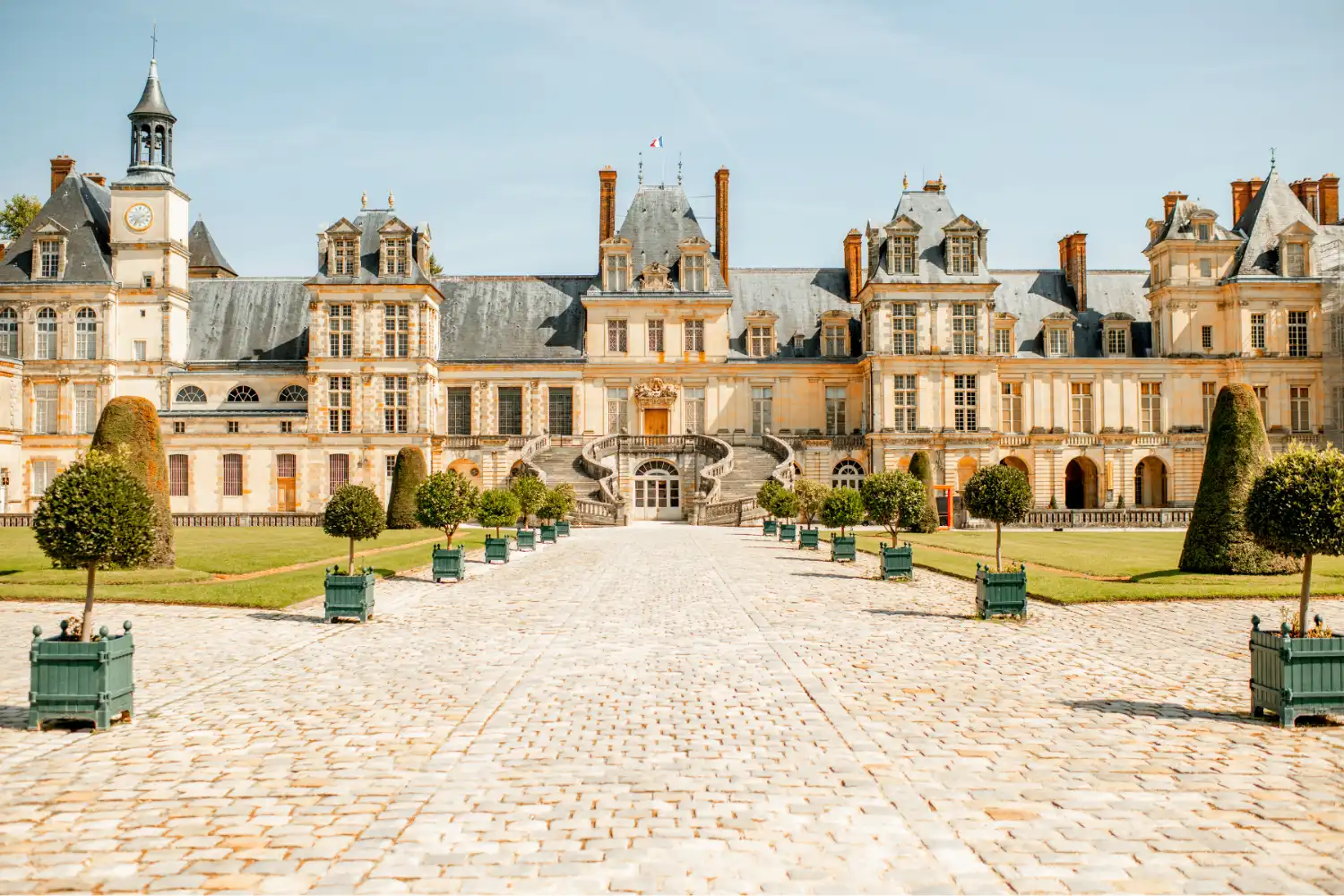
Budget castles for sale in France are more accessible than most people realize. With roughly 45,000 châteaux across the country, many sell for under €500,000, and some go for as little as €100,000 to €300,000 in rural departments. The key is knowing where to look, what to inspect, and which hidden costs can turn a bargain into a financial trap.
France has more castles per square kilometer than almost any country in Europe. The Fondation du Patrimoine estimates that thousands of these properties sit vacant or underused after centuries of aristocratic building, revolution, and inheritance disputes. For architecture enthusiasts and adventurous buyers willing to invest time and energy, the French château market offers a rare chance to own a piece of history without a seven-figure budget.
Why Are Castles in France for Sale So Cheap?
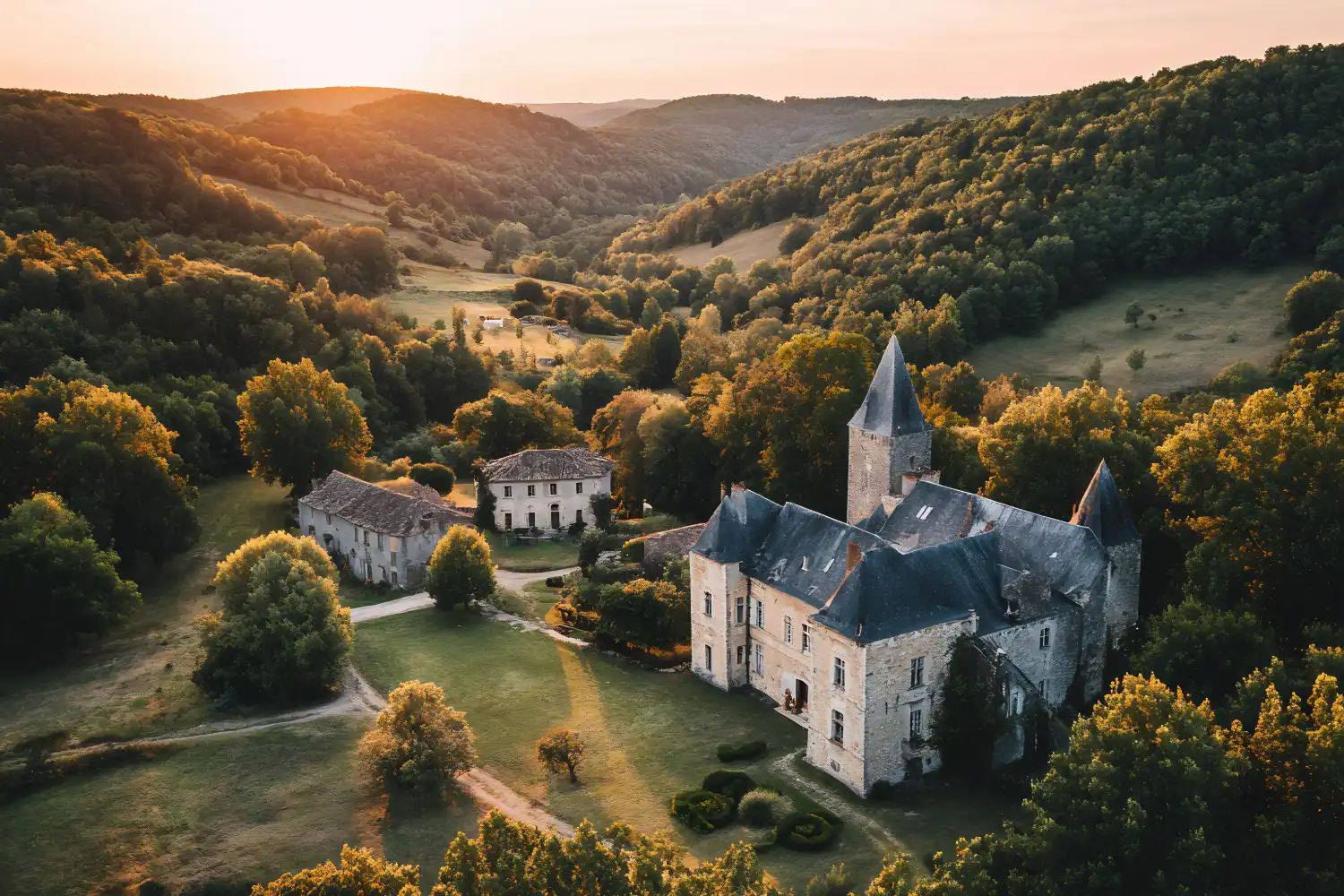
The question most people ask first is the simplest one: why can you buy a castle in France for the price of a modest suburban house? The answer involves a mix of supply, inheritance law, and geography.
France’s inheritance laws require estates to be divided among heirs. After several generations, a single château might belong to dozens of family members who can’t agree on maintenance or use. Selling becomes the only realistic option, and urgency drives prices down. Rural depopulation adds pressure. Departments like Creuse, Haute-Vienne, and Gers have shrinking populations, which means lower demand and softer property values. A castle in the middle of the Massif Central simply doesn’t attract the same buyer pool as a villa on the Côte d’Azur.
Renovation costs also keep prices low. Many châteaux need new roofs, updated electrical systems, and serious structural work. The choice of building materials for restoration must often match the original construction, which adds to expense. Buyers factor in these costs, and sellers adjust their asking prices accordingly. The result is a market where a 15th-century fortified manor with five bedrooms and two hectares of land can list for under €400,000.
💡 Pro Tip
Before visiting any cheap castle for sale in France, request the most recent Diagnostic de Performance Énergétique (DPE) and a structural survey. A château with a sound roof and dry walls at €350,000 is almost always a better deal than one listed at €150,000 with a collapsed wing and active dry rot (mérule).
Best Regions to Find Cheap Castles for Sale in France
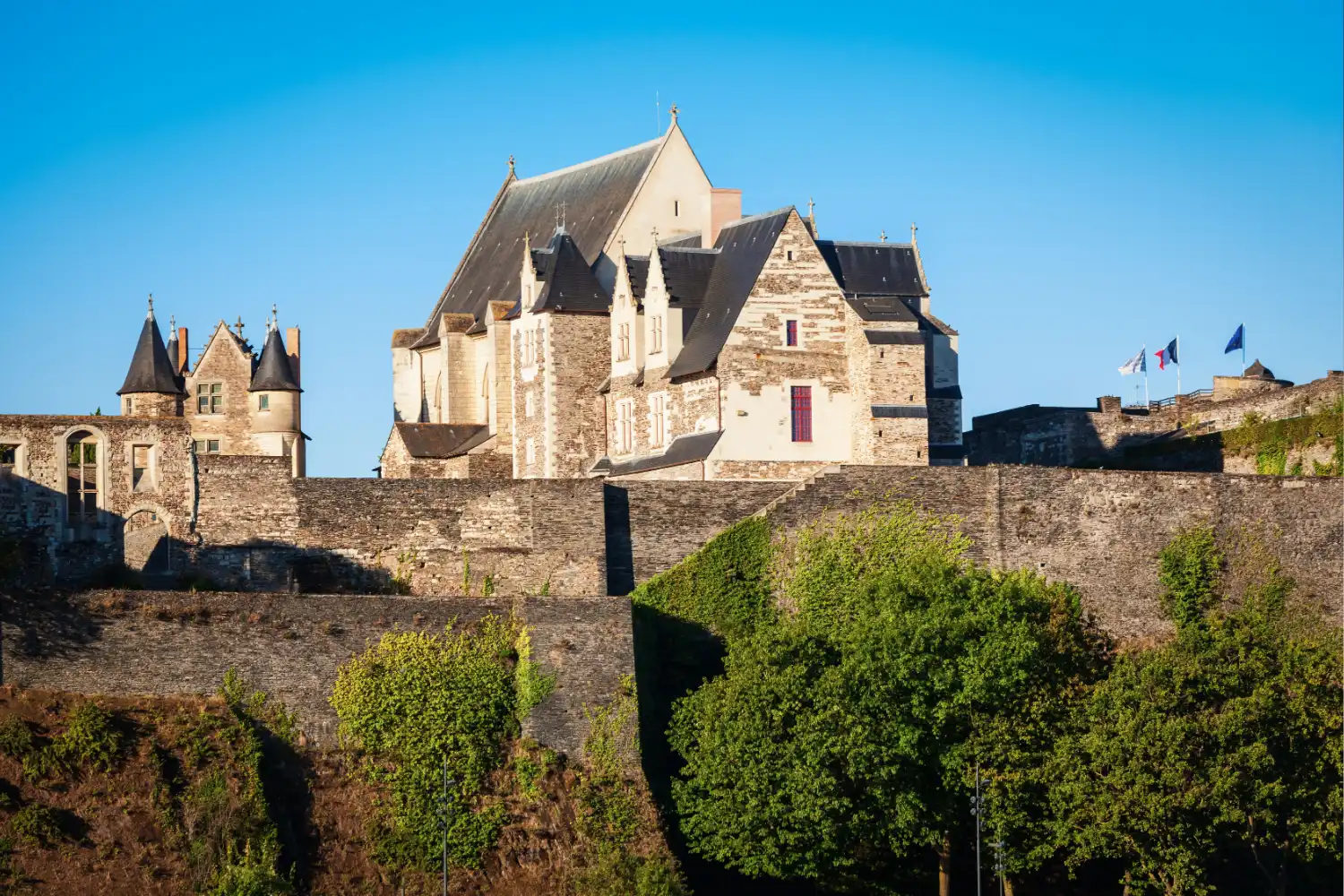
Location determines price more than any other factor. French castles for sale in popular tourist regions like Provence, the Loire Valley, and Île-de-France carry premium tags. The real bargains sit in historically rich but less fashionable departments further from major cities.
Creuse and Haute-Vienne (Nouvelle-Aquitaine)
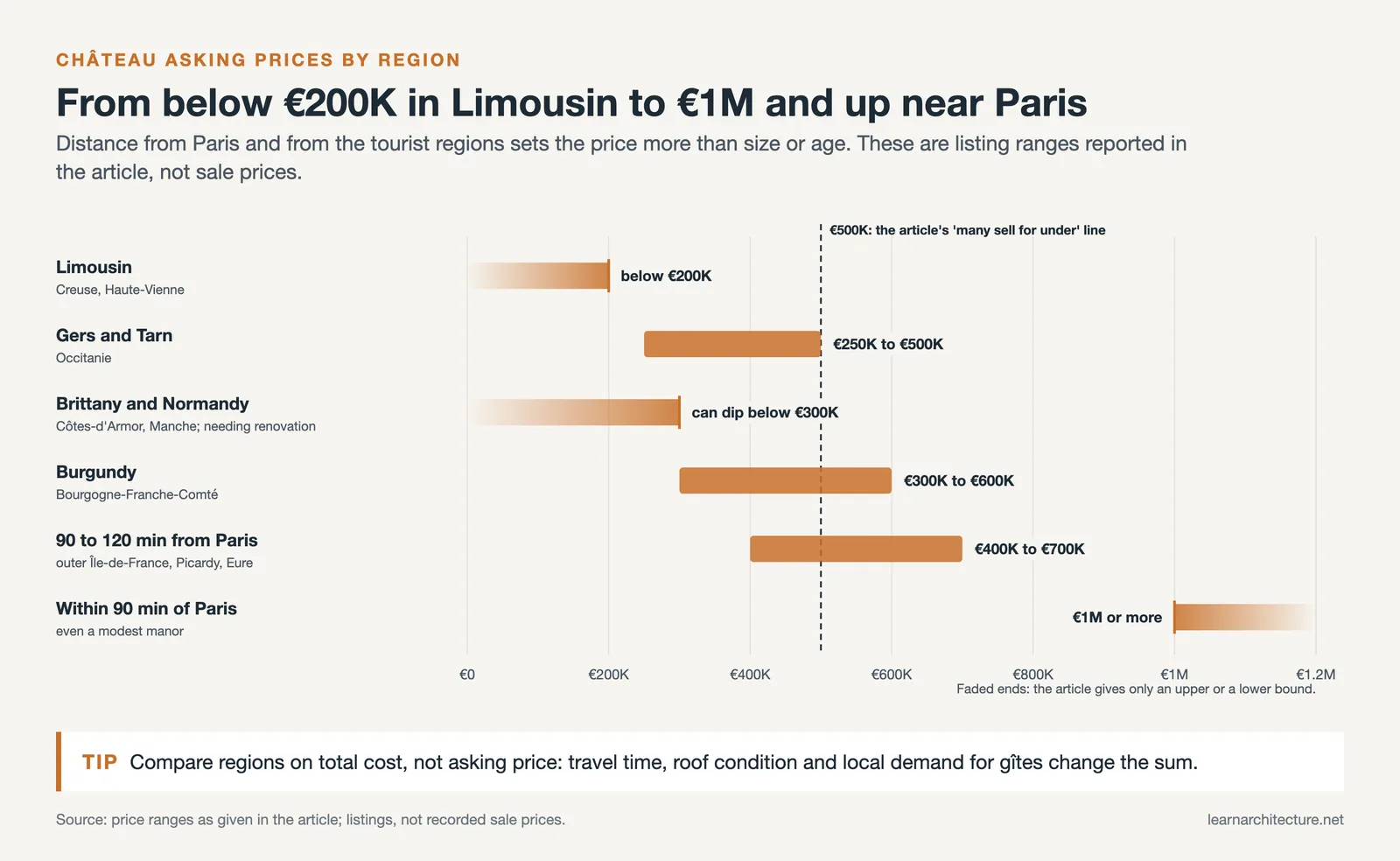
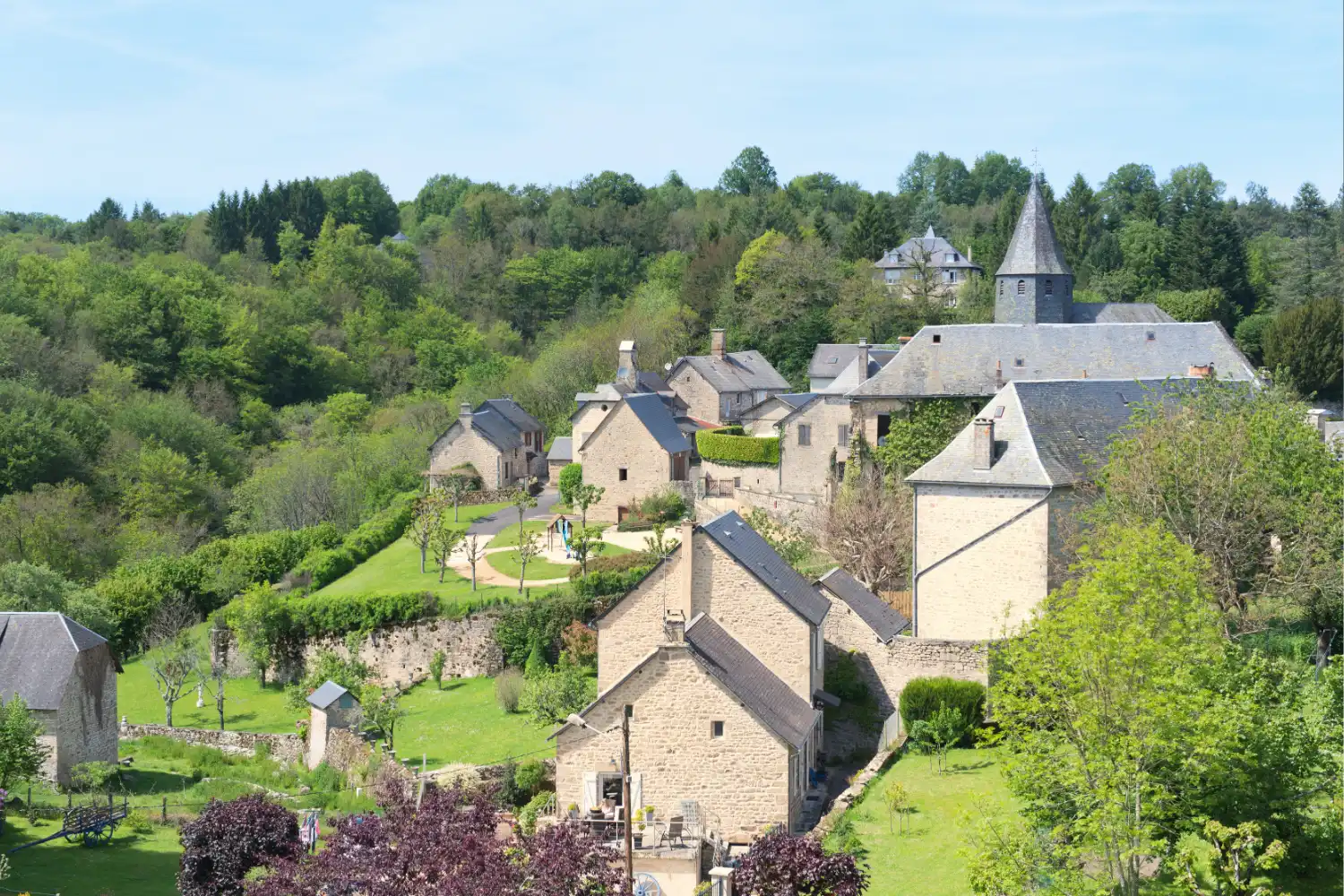
The Limousin area consistently produces the lowest château prices in France. Properties here regularly appear below €200,000 on platforms like French-Property.com, which allows filtering by property type and maximum price. The landscape is hilly, green, and quiet. Expect granite construction, slate roofs, and large plots of farmland included in the sale. Ryanair flies into nearby Limoges, which helps with access.
Gers and Tarn (Occitanie)
Southwest France offers a warmer climate and a strong local food culture. Castles in the Gers department tend to range from €250,000 to €500,000 depending on condition. Specialist agencies like Cabinet Le Nail list heritage properties across these regions. Many date from the 13th to 17th centuries and feature the region’s characteristic warm stone walls and round towers.
Brittany and Normandy
Northern France has a dense supply of manors and small châteaux. Prices in departments like Côtes-d’Armor and Manche can dip below €300,000 for properties needing partial renovation. These regions also benefit from strong tourism, which creates income potential through gîte and chambre d’hôtes conversions.
Burgundy (Bourgogne-Franche-Comté)
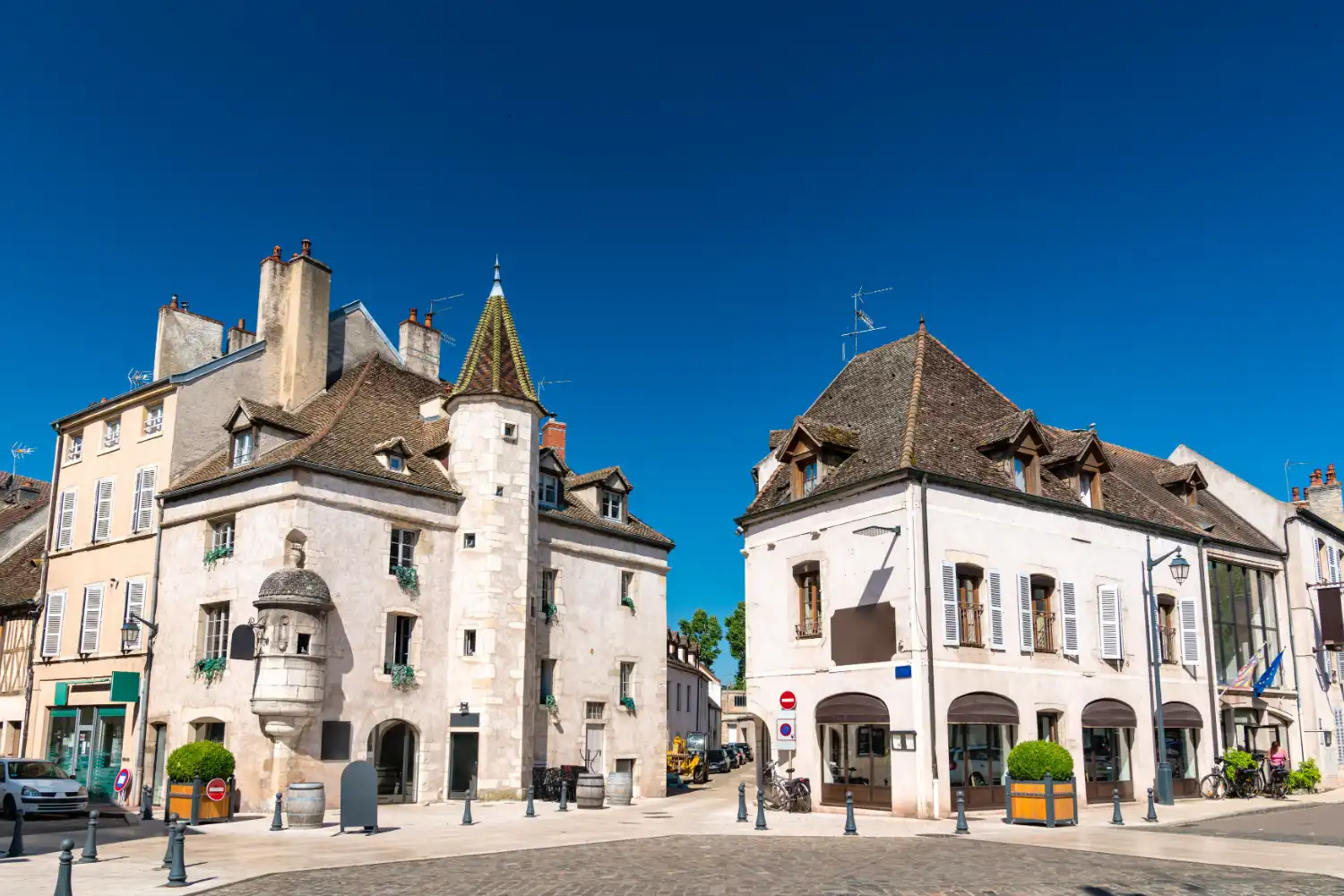
Burgundy sits between Paris and Lyon with TGV connections to both. Small castles and fortified houses appear here in the €300,000 to €600,000 range. The wine-producing landscape adds tourism value, and the region’s limestone construction ages well with proper maintenance.
📌 Did You Know?
France has approximately 45,000 châteaux, more than the total number of communes in the country. Many of these properties sit vacant or underused, with owners unable to fund ongoing maintenance. Complex inheritance rules and rural depopulation continue to push new listings onto the market every year.
How Much Does a Castle in France for Sale Really Cost?
The listing price is only part of the equation. Castles in France for sale carry a set of costs that standard residential purchases don’t. Understanding these upfront prevents unpleasant surprises after signing.
Purchase Costs Beyond the Price Tag
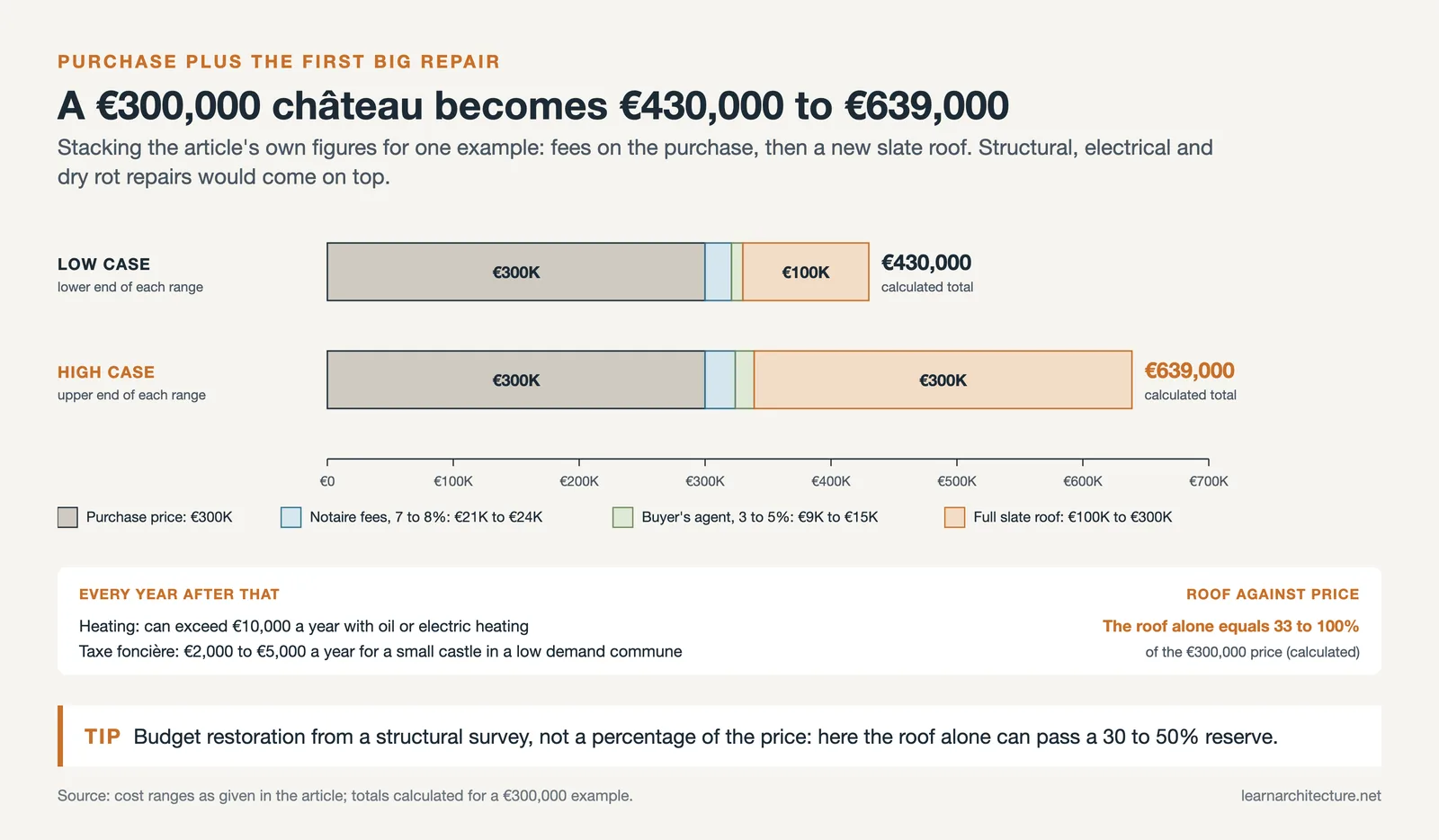
French property transactions include notaire fees (roughly 7-8% of the purchase price for older properties), which cover legal processing, registration, and taxes. On a €300,000 château, expect to pay around €21,000 to €24,000 in notaire fees alone. If you use a buyer’s agent, their commission typically runs 3-5% on top of the sale price.
Renovation and Maintenance
Roof replacement is often the single largest expense. A full slate roof on a medium-sized château can cost €100,000 to €300,000 depending on surface area and material. Heating a stone building with thick walls and high ceilings is expensive regardless of system. Many owners install wood pellet boilers or heat pumps to manage annual energy bills, which can otherwise exceed €10,000 per year for oil or electric heating.
Annual property taxes (taxe foncière) for rural châteaux vary widely. A small castle in a low-demand commune might pay €2,000 to €5,000 per year, while a larger listed property near a town could owe considerably more.
⚠️ Common Mistake to Avoid
Many first-time château buyers focus on the purchase price and ignore roof condition. A château that has been unheated and unoccupied for years often develops mérule (dry rot), a wood-destroying fungus that is extremely expensive to treat. Always commission an independent mérule inspection before making an offer, especially in humid regions like Brittany and Normandy.
Where to Search for French Castles for Sale
The best listings appear on specialized property platforms rather than general real estate sites. French-Property.com, Properstar, and Cabinet Le Nail each cover different regions and price ranges. Properstar aggregates listings from multiple French agencies and lets you sort by price from low to high, making it useful for spotting the cheapest castles in France.
For direct searches, the French government’s official notaire listing site (immobilier.notaires.fr) publishes properties being sold through notaires, sometimes at lower prices than those listed through estate agents. Local immobilier offices in small towns occasionally have unlisted châteaux that never make it onto international platforms.
Tax Benefits and Grants for Castle Restoration
France actively supports the preservation of its architectural heritage. If your château holds any form of historic classification, you may qualify for financial assistance that significantly reduces restoration costs.
Properties classified as Monuments Historiques (either “classé” or “inscrit”) qualify for tax deductions on restoration work. Owners can deduct up to 100% of maintenance and restoration costs from taxable income if the property is open to the public. Even without full public access, 50% deductibility applies to listed elements. The Fondation du Patrimoine also grants a label to non-listed buildings visible from public roads, enabling tax deductions of up to 50% of exterior work costs.
Regional and departmental grants through the DRAC (Direction Régionale des Affaires Culturelles) can cover up to 40% of approved restoration projects. These grants come with obligations: approved architects (Architecte des Bâtiments de France) must oversee the work, and specific materials and techniques are often required. All restoration must align with the property’s historical character and period-appropriate construction methods.
🎓 Expert Insight
“The Monuments Historiques tax regime remains one of the most generous property tax incentives in Europe. But buyers must understand that classification also means restrictions on what you can change.”
Licensed heritage property consultant with 20+ years of experience in French real estate
This reflects a key tension in buying a listed château: tax savings come paired with limited freedom over renovations. Every modification must be approved, and non-compliant work can result in fines or forced reversal.
Castles for Sale in Paris France: Is It Possible?
Strictly speaking, there are no medieval castles for sale within Paris city limits. However, the Île-de-France region surrounding Paris does contain châteaux, though prices are significantly higher than in rural departments. Expect to pay €1 million or more for even a modest manor within 90 minutes of the capital.
Budget-minded buyers looking near Paris should focus on the outer departments of Île-de-France or neighboring regions like Picardy and the Eure. A château 90 to 120 minutes from central Paris by car or train can still appear in the €400,000 to €700,000 range, especially if it requires renovation work. TGV connections make locations like Tours, Reims, and even Bordeaux accessible for weekend use.
Video: Affordable Castles for Sale in France
This video walks through five châteaux available for under €500,000 across different French regions, showing the range of conditions and settings you can expect at this price point.
How to Buy a Castle in France as a Foreign Buyer
France places no restrictions on foreign nationals buying property, including castles. Citizens of any country can purchase, own, and renovate a French château with the same rights as French nationals. The process follows a structured legal path that typically takes three to four months from accepted offer to completion.

After agreeing on a price, both parties sign a compromis de vente (preliminary contract). The buyer pays a deposit of around 10% at this stage. A ten-day cooling-off period follows, during which the buyer can withdraw without penalty. The notaire then conducts title searches, checks for planning restrictions, and prepares the acte de vente (final deed), which both parties sign to complete the transfer.
Foreign buyers should open a French bank account early in the process. Mortgage options exist through French banks, though lending criteria for châteaux differ from standard residential properties. Most banks require a higher down payment (30-40%) and may impose conditions related to the property’s condition and habitability. Cash purchases simplify the process considerably and are common in the château market. Architects and design professionals transitioning into real estate often find this market particularly appealing because of the overlap between renovation planning and property investment.
💡 Pro Tip
Include a clause suspensive (conditional clause) in your compromis de vente that makes the sale contingent on satisfactory structural and mérule inspections. This gives you a legal exit if serious problems appear during the due diligence period, and it is standard practice in French property law.
Generating Income from Your French Château
Many budget château buyers offset ownership costs by converting part of their property into income-generating accommodation. France’s gîte and chambre d’hôtes system is well-established, and rural tourism continues to grow. A château with three or four guest rooms can generate €20,000 to €60,000 per year in seasonal rental income, depending on location and marketing.
Event hosting is another revenue stream. Château weddings remain popular across France, with couples paying €5,000 to €15,000 for venue hire alone. Properties with large grounds, restored reception rooms, and photogenic facades command the highest rates. Some owners combine accommodation and events, offering weekend wedding packages that include guest rooms.
Listing your property on platforms like Airbnb, Booking.com, and Gîtes de France brings international visibility. However, French regulations require registration with the local mairie, and some communes impose limits on short-term rental days per year.
🏗️ Real-World Example
Château de Gudanes (Verdun, Ariège, purchased 2013): This 18th-century listed château was bought in a near-ruinous state and has been gradually restored by its Australian-American owners. The project funded ongoing renovations partly through creative workshops, photography retreats, and social media storytelling, attracting a global following and demonstrating that even a large-scale restoration can be financially sustainable with the right approach.
Final Thoughts
Buying a budget castle in France is genuinely possible, but it requires patience, thorough research, and realistic expectations about renovation timelines and costs. The cheapest castles in France often sit in remote rural areas with limited services, so lifestyle fit matters as much as price. Start by identifying your preferred region, set a total budget with a renovation reserve based on a structural survey rather than a fixed percentage, since a new slate roof alone can cost a third to the whole of a €300,000 purchase price, and work with a bilingual notaire experienced in heritage property transactions.
The French château market rewards informed buyers. With the right property in the right location, you can own a piece of architectural heritage for less than a typical apartment in London or New York.
Cost figures mentioned in this article are approximate and vary by region, property condition, and market conditions. Always consult a qualified notaire and independent surveyor before committing to a purchase.









Leave a comment