


Table of Contents Show
Perched on a wooded, sloping site near the summit of Le Maelström Mountain in Lac-Beauport, Peace Residence is conceived as both refuge and threshold: a home that marks the beginning and end of multiple hiking trails while offering a deeply immersive relationship with the surrounding landscape. Designed by Quinzhee Architecture, the project embraces the rawness of its environment, translating topography, climate, and movement into an architectural language that feels at once sculptural and instinctively rooted in place.

Rather than positioning the house as a singular object within nature, the design allows the building to become an extension of the terrain itself. Architecture here does not dominate the landscape; it negotiates with it, offering shelter, viewpoints, transitions, and moments of pause for outdoor enthusiasts seeking a retreat that amplifies their connection to the site.

Two Interwoven Volumes Anchored in the Terrain
The project is structured around the dialogue between two distinct yet interdependent architectural volumes, each expressing a different relationship to the landscape. The first is a compact metal volume clad in Eastern Townships tiles. Rising across three levels, it contains the primary interior functions of the residence while adapting its profile to the steep natural slope. Its form is not purely geometric but subtly adjusted, resulting in a parallelogram shape that responds to the topography rather than resisting it.
This upper volume culminates in a rooftop terrace with a spa, enclosed by generous parapets that provide both privacy and protection from strong mountain winds. From this elevated platform, the inhabitants are offered long views across the forest canopy and toward the distant river, reinforcing the experience of withdrawal and contemplation that defines the project.
In contrast, the second volume takes on a far more tactile and expressive role. Emerging directly from the ground, a monumental wooden bleacher constructed from open-jointed cedar slats extends toward the southeast like a vast observatory. This oversized stair does more than connect levels; it becomes a landscape in itself, a inhabitable structure where architecture and terrain merge into one continuous surface.

Architecture as Movement and Experience
The bleacher structure operates simultaneously as circulation, shading device, social space, and viewpoint. Its stepped geometry offers countless opportunities for sitting, gathering, exercising, reading, or simply watching the changing light over the mountains. The house thus becomes not only a place to inhabit but a terrain to explore, encouraging movement through and around the architecture as part of daily life.
Functionally, the wooden volume connects all levels of the residence. It provides external access between floors while also regulating sunlight, casting layered shadows across the interior spaces below. This porous timber envelope mediates between exposure and protection, allowing the house to feel open without becoming vulnerable.
The decision to use cedar slats with open joints reinforces this balance. The structure filters views rather than framing them rigidly, offering a dynamic experience that changes throughout the day as light, weather, and seasons evolve.

Interior Spaces Rooted in Atmosphere
The spatial organization of the interior reflects the same sensitivity to intimacy and transition. Entry occurs beneath the wooden volume, where visitors pass under the bleachers before reaching the threshold of the house. This gesture immediately situates the body within the architectural narrative: shelter, weight, and structure are felt physically before the interior is even reached.
On the ground floor, the bedrooms are positioned to benefit from quiet and enclosure, with the bathroom acting as a buffer between sleeping spaces. The ceiling is clad in the same open-jointed cedar used externally, extending the material language indoors and blurring the boundary between interior and exterior. This continuity reinforces the sensation that the house is carved from the same material logic as its surrounding environment.
The upper level houses the communal living spaces. Accessible both internally via ladder and externally via the bleacher stair, this dual circulation reinforces the idea of movement as part of inhabitation. Living, cooking, and dining areas open toward expansive views, while the surrounding timber envelope creates a sense of protection without enclosure.
On one side, a balcony frames unobstructed vistas toward the landscape; on the other, the bleachers offer a more introspective experience overlooking the dense forest. Each orientation offers a different emotional register: openness toward the horizon, intimacy toward the trees.

Material Honesty and Climatic Intelligence
Material choices throughout the project emphasize durability, tactility, and environmental coherence. Metal cladding, cedar wood, and restrained detailing work together to produce a building that will weather gracefully over time. Rather than resisting ageing, the architecture is designed to accept patina as part of its life cycle, allowing the house to evolve alongside its landscape.
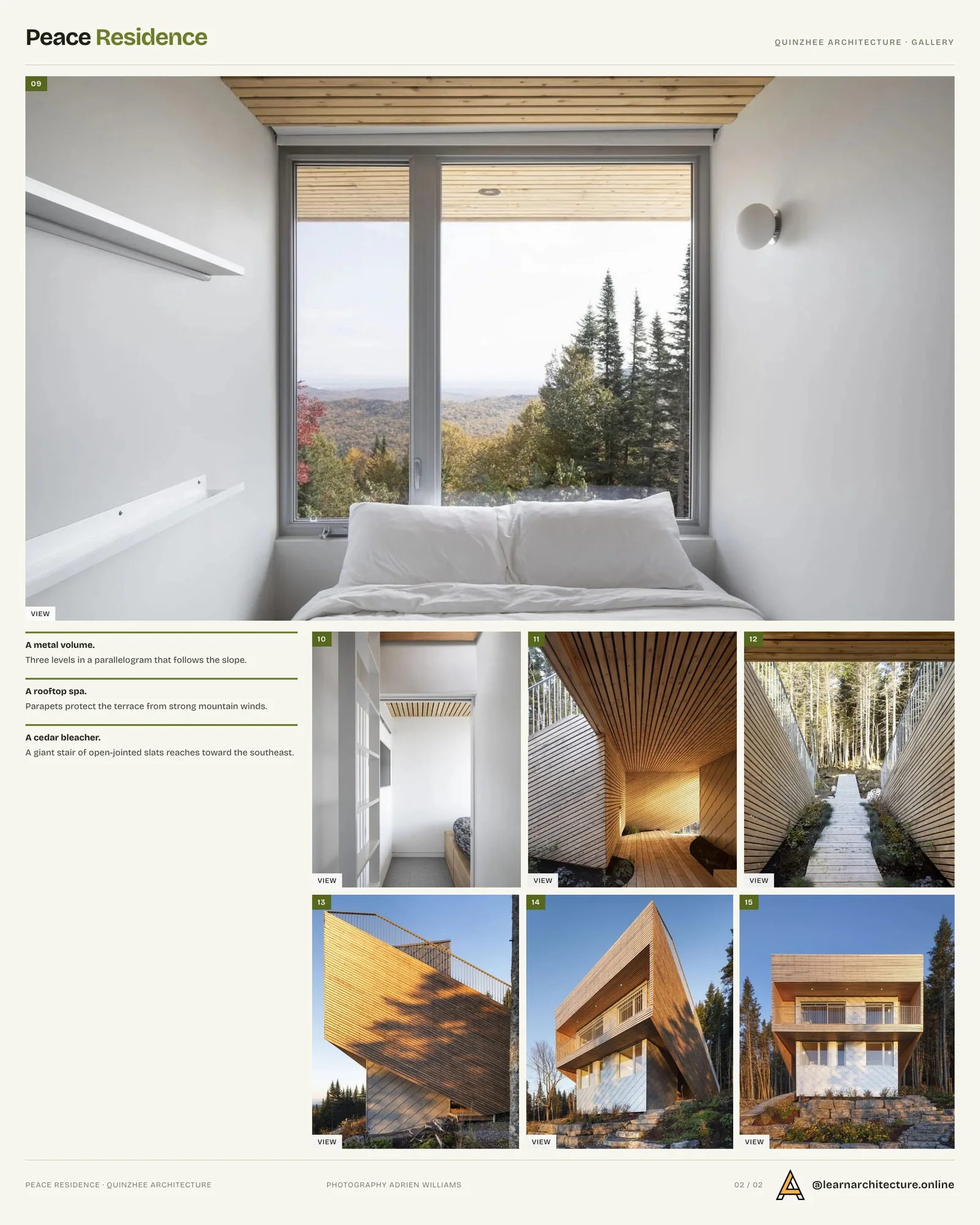
Climatically, the design uses form and orientation rather than technological complexity. The bleacher volume provides passive shading, the parapets protect the rooftop terrace, and the compactness of the interior volume helps preserve thermal comfort. These strategies result in a project that feels resilient and pragmatic while remaining deeply poetic.

Conclusion
Peace Residence is not simply a mountain house; it is an architectural landscape shaped by movement, topography, and lived experience. Through the careful interplay of two volumes (one protective and grounded, the other expressive and inhabitable), Quinzhee Architecture creates a retreat where architecture becomes a tool for slowing down, observing, and reconnecting with nature. The project demonstrates how thoughtful design can transform a private residence into an experiential territory, where dwelling extends beyond walls and becomes inseparable from the act of being present within the landscape.
Photography: Adrien Williams
- Architectural Concept House
- Architecture and landscape
- Architecture in Nature
- Cabin Architecture
- Canadian Architecture
- Cedar Wood Architecture
- Contemporary residential architecture
- Experimental House Design
- Forest House
- Minimalist House
- Mountain House
- Outdoor Living Architecture
- Peace Residence
- Quinzhee Architecture
- Retreat Architecture
- Rooftop Terrace House
- Site-Responsive Architecture
- Small-scale architecture
- Sustainable Residential Design
- Timber Architecture










Leave a comment