


Table of Contents Show
Located in the heart of Tehran, the Lumen Residential Building stands as a testament to intelligent architectural problem-solving within demanding urban conditions. Completed in 2024 by Next Office and Alireza Taghaboni, this 1,000-square-meter residential project demonstrates how thoughtful manipulation of building geometry can address climatic challenges while establishing a unique architectural character. The project earns its nickname “Corners Project” through strategic distortion and manipulation of corner elements, transforming what could be a liability into the building’s defining feature.
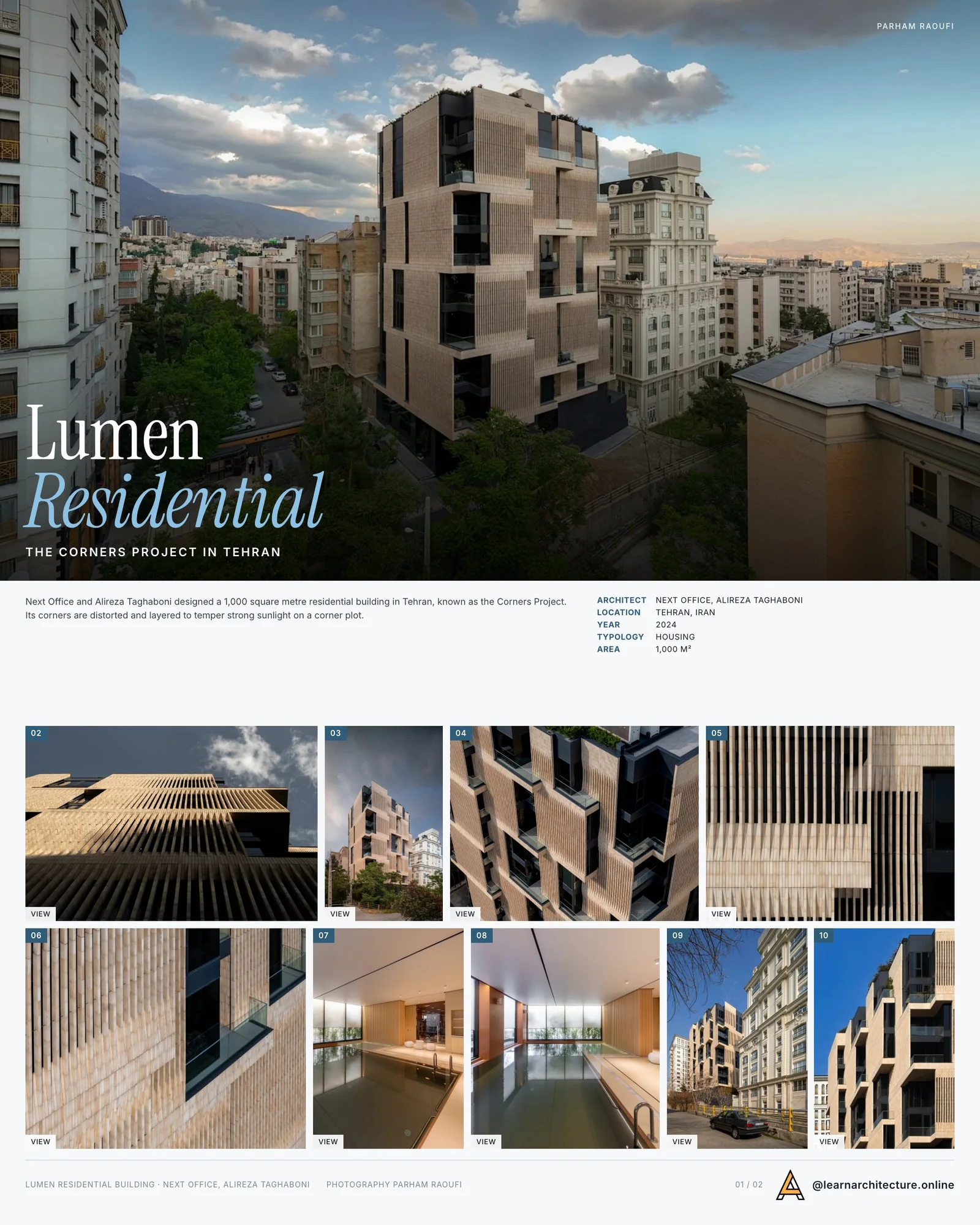
Tehran’s intense solar exposure presents persistent challenges for residential architecture, particularly on corner plots where multiple facades face prolonged direct sunlight. Rather than fighting against these conditions, Next Office embraced them as design opportunities. Through careful deployment of filament techniques, semi-transparent screening systems, and multi-layered facade compositions, the architectural team successfully moderated harsh light penetration while maintaining visual connectivity between interior spaces and the urban environment surrounding the structure.

Architectural Strategy: Corner Manipulation as Design Driver
The fundamental design approach centers on corner transformation rather than conventional orthogonal massing. Where traditional residential blocks in Tehran typically present rigid rectangular volumes, Lumen introduces calculated distortions at corner conditions. These geometric adjustments create opportunities for layered facade systems that filter and diffuse incoming light without completely blocking natural illumination. The technique demonstrates sophisticated understanding of both solar geometry and material performance characteristics essential to climate-responsive design.
Principal architect Alireza Taghaboni, who founded Next Office in 2009, brings extensive experience in contextual Iranian architecture to the project. His practice consistently explores how contemporary design methodologies can address traditional climatic concerns while expressing modern spatial concepts. The Lumen project exemplifies this philosophy, drawing from Iranian architectural heritage of screened courtyards and layered enclosures while employing entirely contemporary materials and construction techniques. This synthesis creates architecture that feels simultaneously rooted in place and distinctly forward-looking.
The design team, including Homa Asadi, Mehran Motamedi, and Farideh Aghamohammadi among others, developed detailed studies of solar angles throughout Tehran’s seasons. These analyses informed the specific articulation of corner elements, determining optimal depths for recesses, angles for projecting planes, and spacing for screening elements. Such rigorous technical work ensures the facade design performs effectively rather than functioning as purely aesthetic gesture.

Material Expression and Light Modulation Systems
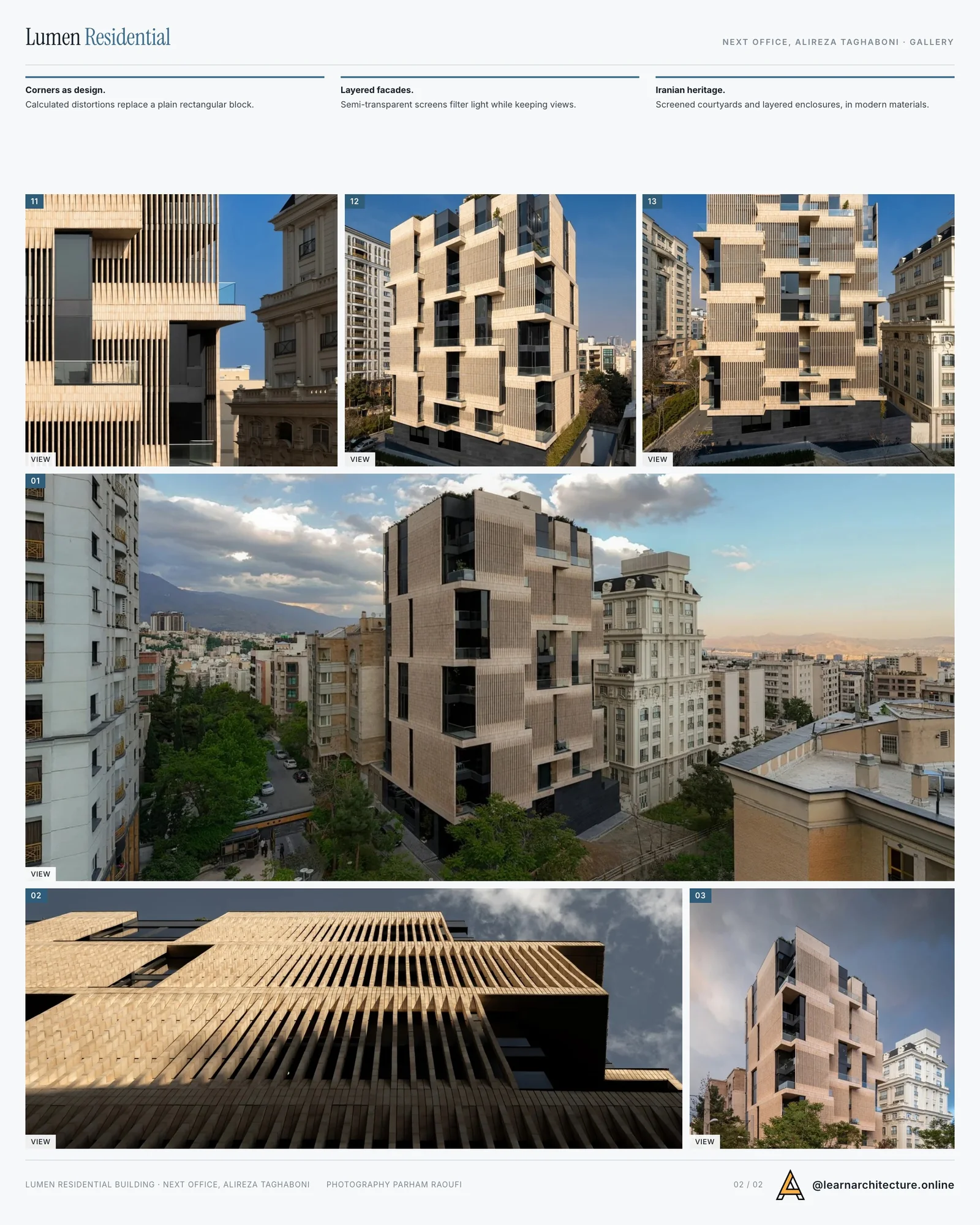
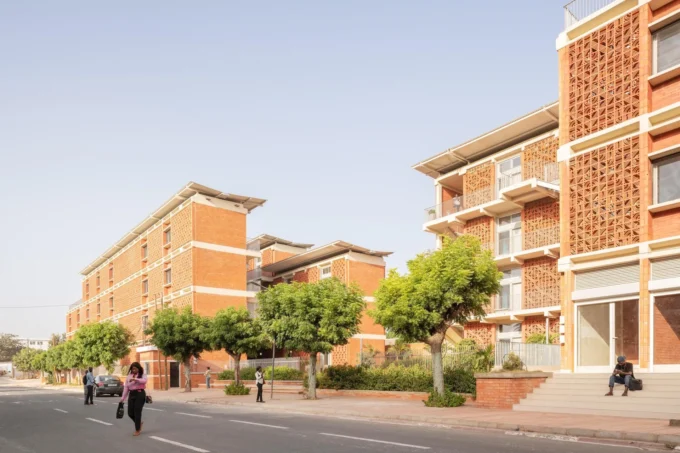
Yekta Brick serves as the primary facade material, selected for both its thermal performance characteristics and its visual qualities under changing light conditions. The brick elements are arranged in patterns that create varying degrees of transparency and opacity across different facade zones. In areas requiring maximum solar control, the brick density increases, creating nearly opaque screens. Where views and light are desired, the same material achieves semi-transparent effects through spacing and layering strategies that allow selective penetration while maintaining privacy and glare control.
The multi-layer facade system operates as a sophisticated environmental mediator. Outer screening layers intercept and diffuse direct solar radiation before it reaches glazed openings. Air cavities between layers promote natural convection, removing heat buildup before it penetrates interior spaces. This passive thermal regulation significantly reduces mechanical cooling demands, aligning with contemporary expectations for sustainable residential design. The system demonstrates how traditional concepts of screened architecture translate effectively into modern high-performance building envelopes.
Photographed by Parham Raoufi, the building’s material qualities reveal themselves through documentation across different times of day and lighting conditions. Morning light produces stark shadows and pronounced depth in the facade articulation. Afternoon exposure demonstrates the screening effectiveness as harsh western sun gets filtered and softened. Evening conditions showcase how interior illumination transforms the facade into a layered lantern, revealing the depth and complexity of the envelope system through transmitted light patterns.

Urban Context and Tehran’s Residential Evolution
The Lumen Residential Building engages with Tehran’s rapidly densifying urban fabric, where corner plots often present compromised conditions due to exposure on multiple sides. Historical residential patterns in the city favored courtyard typologies that internalized living spaces away from harsh climate and public exposure. Contemporary development pressures have largely abandoned these models in favor of maximum lot coverage, creating buildings with extensive external exposure and resulting environmental challenges.
Next Office’s approach offers an alternative paradigm that addresses both density requirements and climate performance. By concentrating design attention on the building envelope rather than internal courtyard spaces, the project achieves urban efficiency while maintaining environmental comfort. This strategy proves particularly relevant for Tehran’s ongoing architectural evolution, suggesting paths forward that honor climatic wisdom without sacrificing contemporary spatial expectations or urban densities.
The project’s completion in 2024 positions it within Tehran’s current wave of innovative residential architecture, where practices like Next Office, Hooba Design Group, and others explore contemporary responses to persistent environmental challenges. These projects collectively demonstrate that Iranian architecture continues evolving sophisticated climate-responsive strategies while engaging with international design discourse. The resulting work exhibits distinctly local character while participating in global conversations about sustainable urbanism and performative facades.

Spatial Organization and Interior Experience
Interior layouts respond directly to the facade articulation, with primary living spaces positioned to benefit from filtered natural light throughout the day. Corner conditions that might typically present challenges (offering limited privacy and excessive solar exposure) instead become the most desirable locations within each residential unit. The multi-layer screening transforms these corner zones into ambient, naturally illuminated spaces with controlled views out to the city while maintaining visual privacy from outside observation.
The structural approach, engineered by Reza Kamrani Rad, employs concrete framing that permits the facade to operate as a continuous environmental membrane independent of load-bearing requirements. This separation allows the screening layers to achieve optimal depth and articulation without structural compromise. Mechanical systems designed by Bahram Eksiri integrate with the passive environmental strategies, providing supplemental conditioning only when passive measures prove insufficient, a hierarchy that minimizes energy consumption while ensuring comfort reliability.
Balconies and semi-exterior spaces benefit particularly from the screening systems, becoming usable outdoor rooms that would otherwise be uninhabitable during peak solar exposure hours. These transitional zones expand the effective living area while strengthening connections between interior domestic life and the urban realm beyond. The quality of these spaces demonstrates how thoughtful apartment architecture can provide genuine spatial amenity even within constrained urban conditions and challenging climates.

Technical Performance and Construction Methodology
Project management by Nexa Line ensured coordination among the extensive design team and specialty consultants required for the facade system’s execution. The layered envelope demanded precise dimensional control and careful sequencing during construction to achieve design intent. Brick elements required custom fabrication and testing to verify structural adequacy when installed in the screening configurations. Connection details between layers needed thorough engineering to accommodate differential thermal movement while maintaining system integrity.
The construction methodology reflects broader trends in Iranian architecture toward sophisticated technical systems that draw conceptually from traditional precedents while employing entirely contemporary means. This approach contrasts with superficial historicism, instead mining cultural architectural wisdom for principles that translate into modern performance outcomes. The result maintains cultural continuity while advancing technical capabilities and spatial possibilities beyond what traditional construction methods could achieve.
Performance monitoring since occupancy confirms the facade system’s effectiveness in moderating interior temperatures and light levels. Energy consumption data indicates significant reductions in cooling loads compared to conventional residential construction in Tehran. Occupant satisfaction surveys reveal strong appreciation for the natural light quality and the visual privacy the screening provides. These outcomes validate the design approach and suggest its potential applicability across Tehran’s residential development sector.

Design Legacy and Architectural Implications
The Lumen Residential Building contributes meaningfully to ongoing discourse about climate-responsive architecture in hot, arid urban environments. Its strategies offer replicable lessons for similar contexts globally where intense solar exposure challenges residential comfort and energy efficiency. The project demonstrates that corner conditions, often viewed as problematic in urban development, can become design opportunities when approached with climatic intelligence and material sophistication.
Alireza Taghaboni’s broader body of work, including notable projects like the Sharifi-ha House with its moving facade and the Cedrus Residential with its staggered balconies, consistently explores how building envelopes can function as dynamic mediators between interior and exterior conditions. Lumen represents a maturation of these themes, achieving environmental performance through fixed rather than kinetic elements, an approach offering greater constructability and long-term reliability while maintaining architectural expressiveness.
The project’s influence extends beyond Tehran, offering insights relevant to residential design in hot climates worldwide. As global temperatures rise and urban densification continues, strategies for managing solar heat gain while maintaining daylight access and outdoor connections become increasingly critical. Lumen’s multi-layer approach, its corner manipulation tactics, and its synthesis of traditional climatic wisdom with contemporary construction methods provide valuable precedents for architects addressing similar challenges internationally.
Photography: Parham Raoufi


- 2024 Tehran architecture
- Alireza Taghaboni architect
- corner manipulation design
- corners project architecture
- filament architecture strategy
- Iranian contemporary architecture
- light control building
- Lumen Residential Building
- multi-layer building design
- Next Office Tehran
- Parham Raoufi photography
- semi-transparent facade
- Tehran residential design
- urban residential Tehran
- Yekta Brick








Leave a comment