


Table of Contents Show
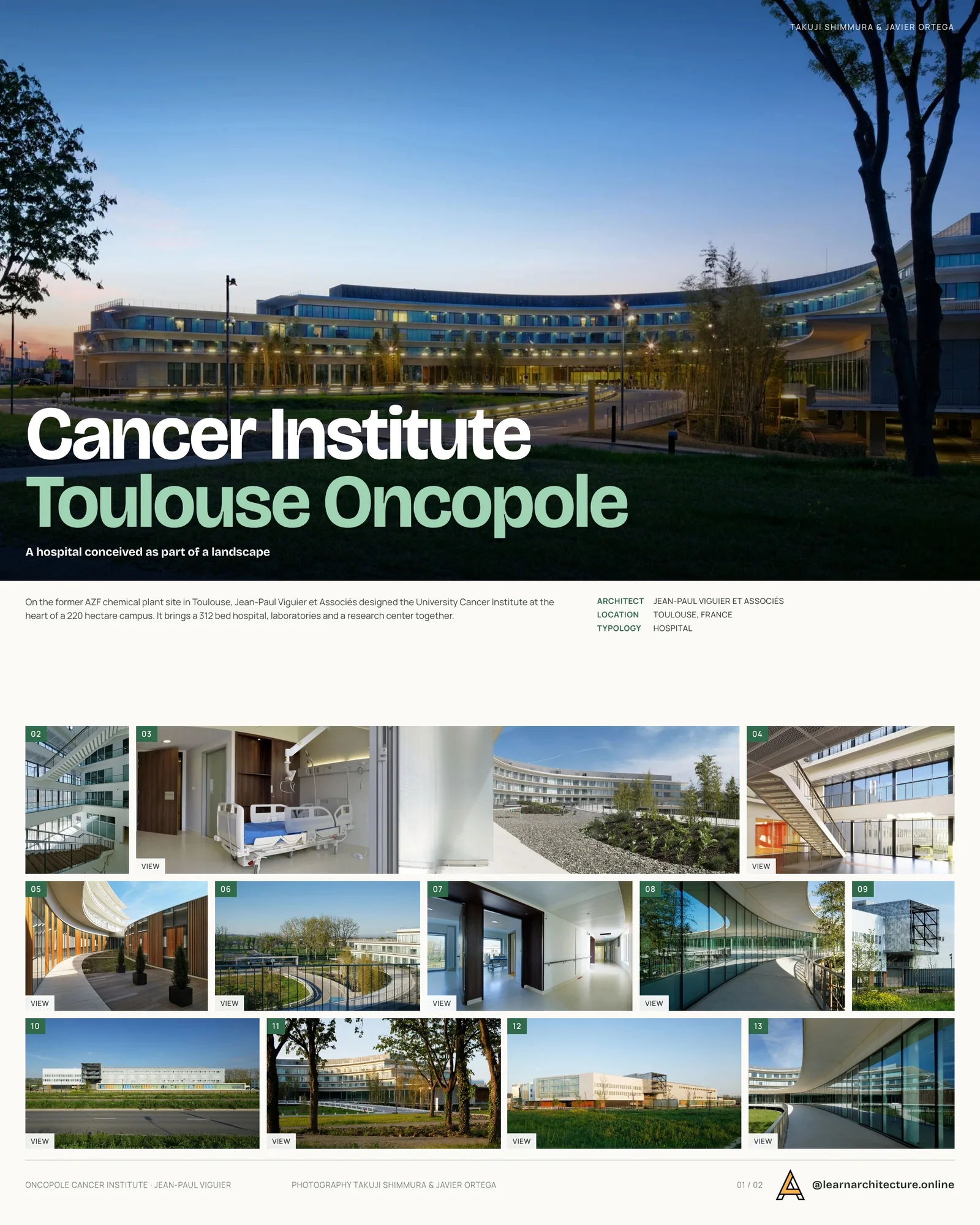
The University Cancer Institute Toulouse Oncopole stands on a site once marked by industrial and military use, now transformed into a vast 220-hectare green campus dedicated to healing, research, and public life. Conceived as the symbolic and functional heart of the wider Oncopole development, the project redefines what a contemporary healthcare environment can be by placing equal emphasis on architecture, landscape, science, and human experience within a unified spatial vision.

A Healing Campus Emerging from a Complex Site
The Oncopole masterplan represents an ambitious urban and ecological transformation. Where the AZF chemical plant once operated, the site has been reimagined as a living campus, including a 30-hectare public park and a constellation of scientific institutions, laboratories, and support facilities. Within this framework, the Cancer Institute plays a pivotal role, both programmatically and symbolically.
More than a hospital, it completes the full cycle of cancer care, from research and experimentation to treatment and patient recovery. By hosting a 312-bed hospital alongside laboratories and a research center, the institute becomes a point of convergence between medical staff, researchers, patients, families, and the wider public. This interconnected ecosystem transforms healthcare into a collective endeavor rather than an isolated process.

Architecture as a Landscape Experience
One of the defining ambitions of the project is the idea that the building should be conceived as part of a landscape, not as an object placed upon it. Architecture and site are inseparable here; the institute behaves as a spatial territory where built volumes and natural elements are carefully interwoven.
Rather than dominating its surroundings, the building unfolds horizontally and gently across the site. Paths, gardens, courtyards, and planted areas structure daily movement, offering patients and staff moments of calm, orientation, and retreat. This integration supports a growing understanding in healthcare design: that access to daylight, greenery, and visual openness directly contributes to wellbeing, recovery, and emotional comfort.

Spatial Organization Guided by Care
The architectural language of the institute is not arbitrary; it is deeply tied to the internal logic of healthcare processes. The design distinguishes between different types of spaces through geometry and orientation, reinforcing clarity and functionality.
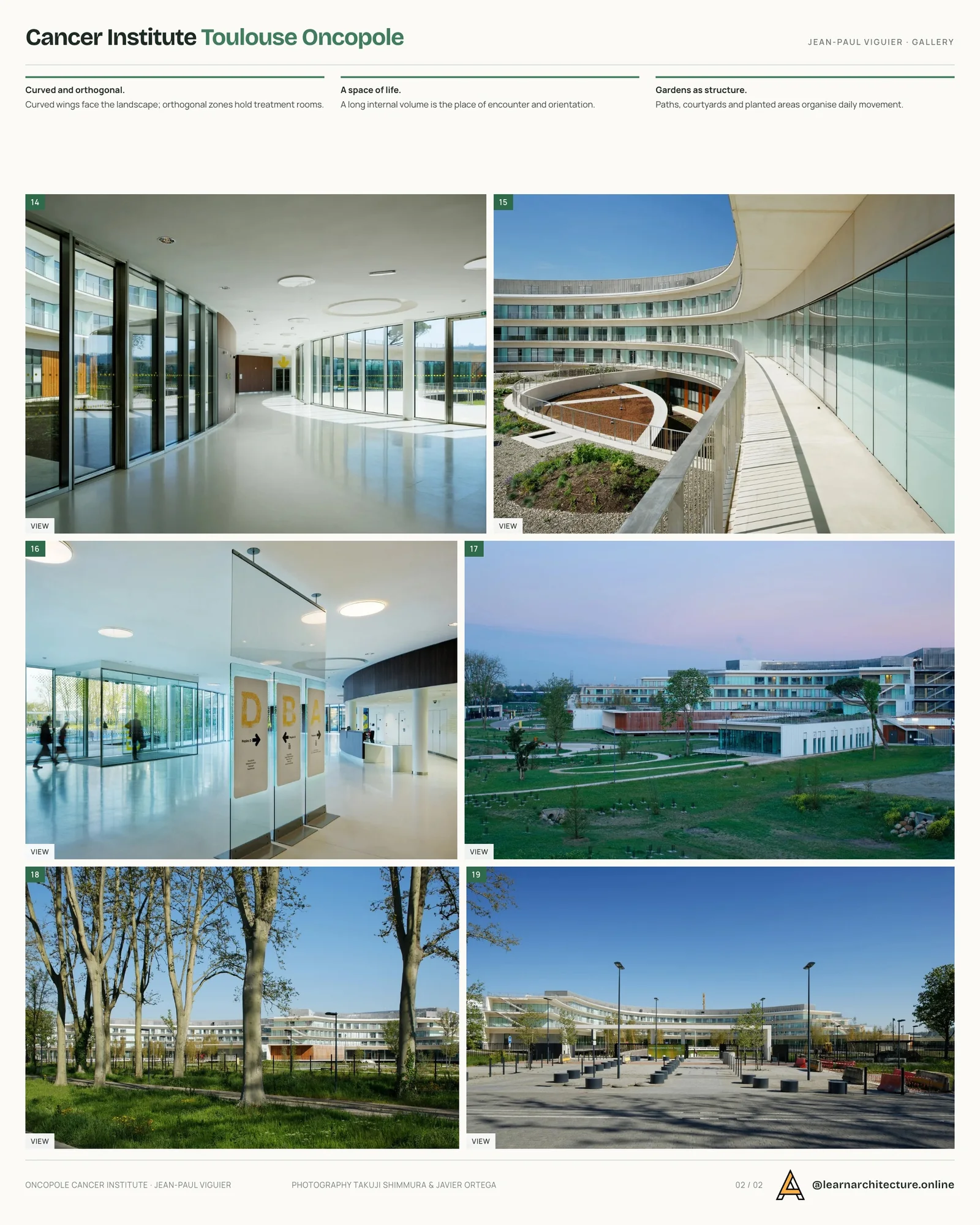
Curved volumes, oriented toward the surrounding landscape, house hospitalization areas. Their softer forms and outward views offer patients a calmer, more protective environment. In contrast, orthogonal zones accommodate treatment rooms and technical functions, supporting precision and operational efficiency. This dual spatial system allows the building to respond simultaneously to emotional needs and clinical rigor.
At the heart of the composition lies a large longitudinal volume described as a “space of life and communication.” This internal spine functions as a social and organizational backbone: a place of encounter, orientation, and exchange where patients, families, and professionals intersect throughout the day.

Light, Views, and the Human Scale of Care
Natural light plays a fundamental role in shaping the interior atmosphere. Large openings, controlled transparency, and careful orientation ensure that most spaces maintain a strong relationship with the exterior landscape. Gardens become visual companions to corridors, waiting areas, and patient rooms, reducing stress and reinforcing a sense of continuity between inside and outside.
Rather than producing monumental hospital architecture, the project favors human-scaled sequences, where circulation unfolds gradually and intuitively. The environment supports dignity, privacy, and calm without sacrificing functionality. This balance is especially evident in shared areas, where openness and legibility foster comfort for visitors navigating emotionally complex situations.

A New Model for Medical Architecture
Beyond its technical and programmatic success, the University Cancer Institute embodies a broader shift in how medical environments are conceived. It demonstrates that healthcare architecture can be both highly efficient and deeply humane. The building does not isolate itself from the world; instead, it actively participates in the life of the campus and the city.
By linking science, care, nature, and public space, the project establishes a model where architecture becomes an active participant in healing. Its strength lies not in formal spectacle, but in the intelligence of its spatial relationships and the subtle way it aligns medical processes with lived human experience.

Conclusion
The University Cancer Institute Toulouse Oncopole exemplifies how architecture can transform complex history into meaningful future. From an industrial scar to a green campus of innovation and care, the project demonstrates the power of design to shape both physical environments and collective values. Through its integration of landscape, clarity of organization, and attention to wellbeing, the building becomes more than a hospital: it becomes an architectural ecosystem dedicated to life, knowledge, and healing.
Photography: Takuji Shimmura & Javier Ortega


- Architecture and landscape
- Architecture and Nature
- Architecture for Wellbeing
- Contemporary Hospital
- French Architecture
- healing architecture
- Healthcare architecture
- Hospital Design
- human-centered architecture
- Jean-Paul Viguier Architects
- Landscape-integrated architecture
- Medical Architecture
- Oncopole Campus
- Oncopole Toulouse
- Public Campus Design
- Research Center Architecture
- Sustainable Healthcare Design
- therapeutic environments
- University Cancer Institute Toulouse
- Urban regeneration projects








Leave a comment