


Table of Contents Show
Across Taiwan, the traditional bamboo theatre once stood as a vibrant symbol of community life. Constructed almost entirely from bamboo scaffolding, these temporary pavilions arose during temple festivals, operatic performances, and local celebrations, framing rituals and cultural gatherings with an unmistakable structural poetry. Over time, however, these hand-built theatres have nearly disappeared, replaced by standardized stages and modern equipment that gradually eroded the craft behind them. For designer Cheng Tsung FENG, whose creative practice consistently engages with endangered traditions and fading vernacular forms, the bamboo theatre represents more than nostalgia; it embodies a cultural ingenuity on the brink of extinction. His installation in Shima Park, located in Xiaobantian, Nantou, revives this tradition with contemporary sensibilities, transforming the familiar logic of bamboo construction into a bold, expressive stage for today’s communal life.

A Contemporary Interpretation of Structural Memory
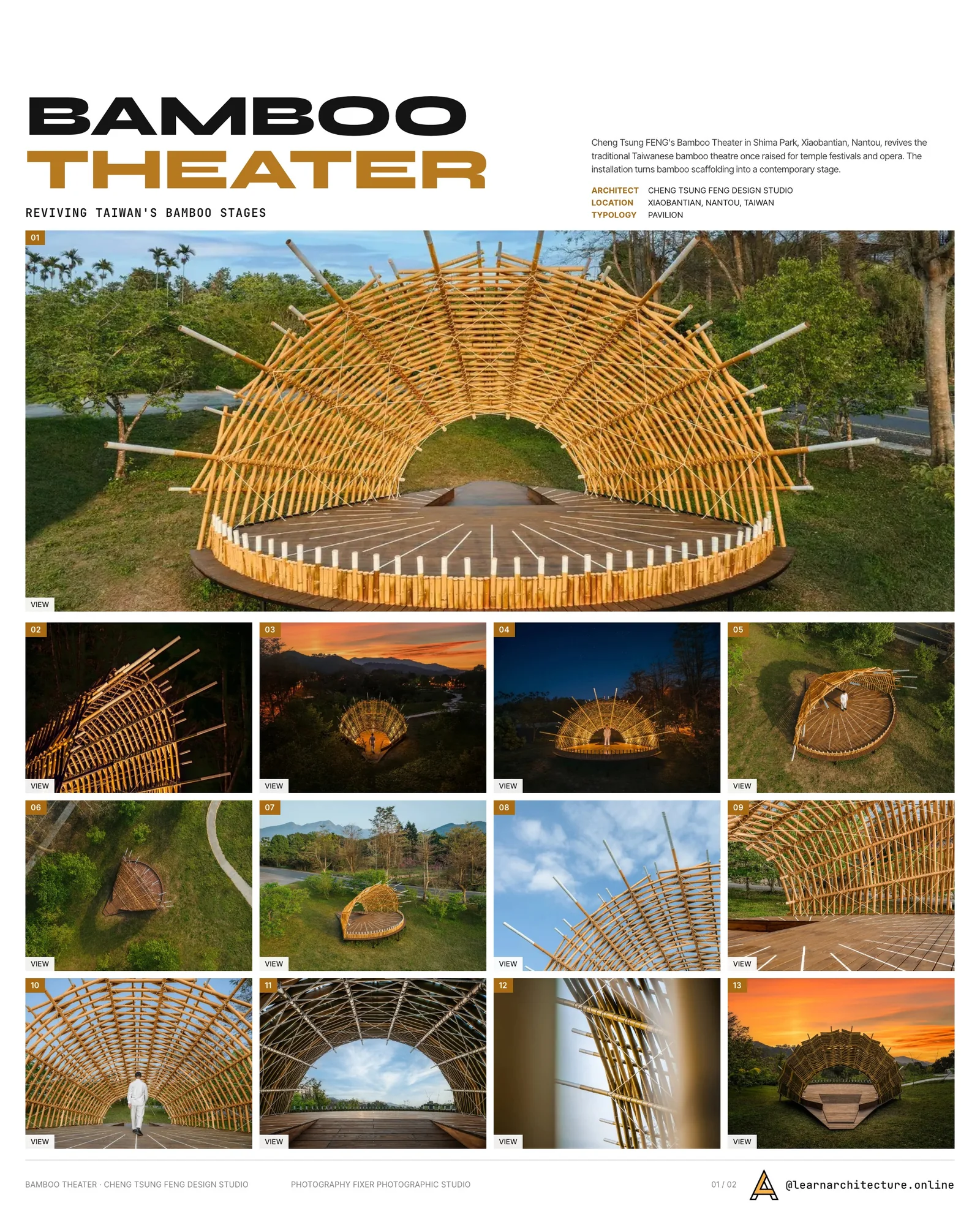
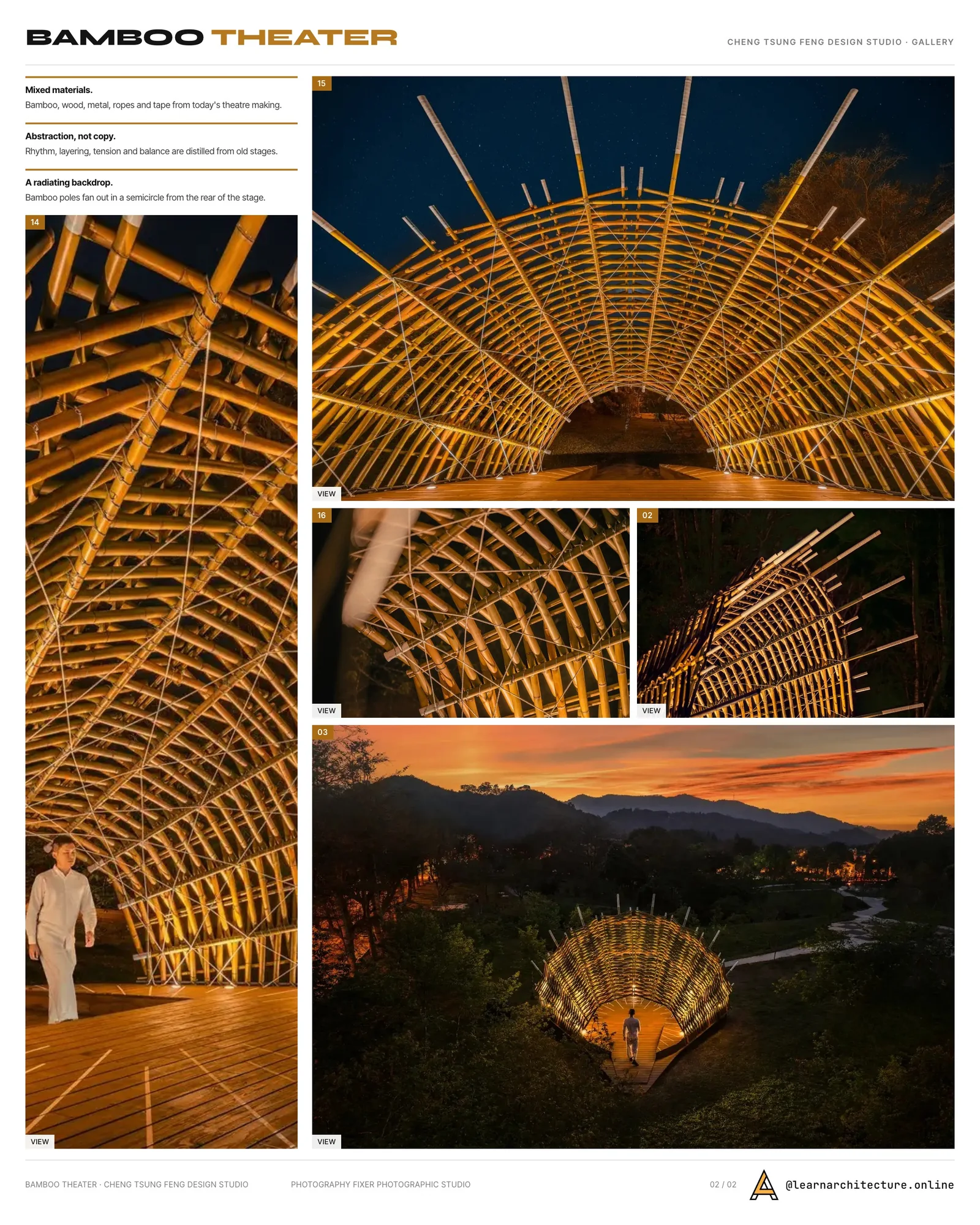
The Bamboo Theater installation takes cues from the structural clarity and improvisational spirit of historic bamboo stages but reinterprets them in a modern architectural vocabulary. Working with bamboo, wood, metal, ropes, and tape (materials common to contemporary theatre-making), FENG blends two worlds: the ephemeral craftsmanship of the past and the technical precision of present-day performance design. His approach does not mimic traditional bamboo theatres; instead, it reconstructs their essence through abstraction. By analyzing the way bamboo scaffolding was historically assembled, FENG distills its organizational principles (rhythm, layering, tension, and balance) and rearticulates them as a sculptural performance environment. The result is a structure that feels both familiar and entirely new, maintaining cultural continuity while inviting reinterpretation.

A Radiant Geometric Framework
The spatial composition of the Bamboo Theater is defined by an unfolding semicircular gesture. From the central point at the rear of the stage, bamboo poles of varying lengths intersect and fan outward, creating a radiating backdrop that serves simultaneously as structure, ornament, and a theatrical device. This sweeping arrangement evokes both the rising of a sun and the opening of a giant bamboo fan, amplifying the energy of the performance space. Thick and slender poles mingle in layered waves, their intersections tied with net-like ropes that recall traditional lashing techniques. This woven density reinforces the form while creating a delicate spatial filter, allowing light and shadows to play across the surface throughout the day. The texture of the backdrop becomes an active participant in performance, shifting visually as performers move before it. FENG’s design leverages this natural dynamism to transform the stage into a living canvas of material, movement, and atmosphere.

Ground Plane, Boundaries, and the Role of Modern Materials
While the backdrop amplifies structural memory, the ground plane introduces a subtle modern counterpoint. At the front edge of the platform, bamboo poles are aligned in a clean, orderly row, grounding the installation with a precise architectural threshold. White tape stripes extend from the stage outward into the park, echoing the radial geometry overhead. These painted lines read as both an extension of the stage’s geometry and an intentional marker of the theatre’s temporary presence, an elegant nod to the chalk markings, taped grids, and layout lines used in contemporary stage production. The interplay between bamboo and tape creates a language of contrasts: organic and manufactured, ancient and contemporary, tactile and minimal. Together, they define a stage that is accessible yet symbolic, rooted in traditional practices while confidently positioned in the present.

Community Space, Cultural Memory, and Living Continuity
Beyond its aesthetic and symbolic qualities, the Bamboo Theater is conceived as a fully functional public space. Positioned within Shima Park, the installation serves as a platform for performances, storytelling, community gatherings, and seasonal events. Its open form invites passersby to enter, rest, or take shelter from the sun, mirroring the hospitality of the bamboo theatres that once stood at the heart of Taiwanese celebrations. By integrating everyday use into the installation’s design, FENG ensures that the structure is not merely a commemorative gesture but an active agent in shaping contemporary communal life. In doing so, he preserves the spirit of the traditional bamboo theatre: a place where people come together, where craft and culture intersect, and where stories unfold in collective memory.

A Living Monument to Cultural Craft
FENG’s Bamboo Theater ultimately operates as both a cultural revival and an artistic provocation. It reframes a nearly lost architectural tradition through a fresh, innovative lens, demonstrating how heritage techniques can be carried forward through creative reinterpretation. The installation does not replicate the past; it revives its essence, translating it for modern audiences and environments. In this sense, the Bamboo Theater is a living monument: open, adaptable, and continuously animated by the people who use it. It reconnects community and craft, offering a stage for new performances while honoring the countless gatherings and celebrations that bamboo theatres once sheltered across Taiwan. Through this project, FENG ensures that a fading cultural symbol does not vanish but evolves, finding new relevance and renewed life in contemporary society.
Photography: Fixer Photographic Studio


- Asian performance architecture
- Bamboo architecture Taiwan
- Bamboo craftsmanship
- Bamboo installation design
- Bamboo stage design
- Bamboo structural art
- Bamboo Theater
- Cheng Tsung FENG
- Community performance space
- Contemporary Taiwanese architecture
- Cultural pavilion Taiwan
- Modern bamboo construction
- Public art installation Taiwan
- Shima Park Nantou
- Sustainable bamboo design
- Taiwanese cultural heritage
- Taiwanese festival architecture
- Temporary bamboo structures
- Traditional bamboo theatre
- Vernacular architecture revival










Leave a comment