


Table of Contents Show
Within the historic grounds of Club Hípico de Santiago lies an architectural intervention as modest as it is essential. Designed by José Ignacio Valdivieso in 2021, the Gardeners’ Pavilion serves a singular purpose: providing refuge for the 30-person team responsible for maintaining the venue’s celebrated grass racing surface. Spanning merely 60 square meters, this pavilion design addresses a straightforward yet critical need: offering shade and communal space to workers who spend their days under Chile’s unforgiving sun.
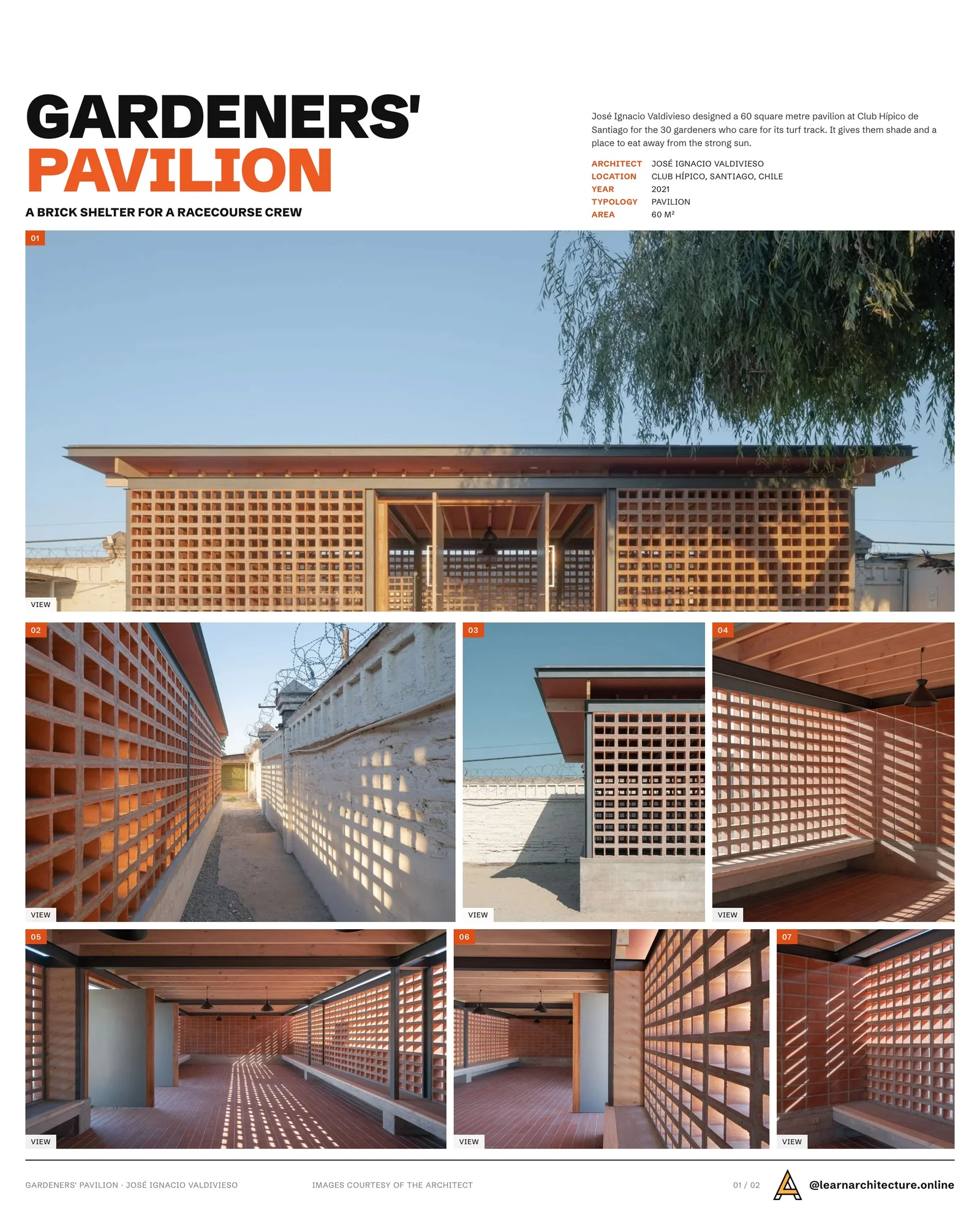
The project emerges from a simple observation. Club Hípico’s 1,200-meter turf circuit represents one of Latin America’s finest racing surfaces, demanding constant care from gardening crews who labor completely exposed to solar radiation. Each day at noon, these workers pause their duties to seek respite under whatever shade they can find, eating lunch and recovering before resuming their tasks. Valdivieso’s intervention transforms this daily ritual from improvisation into architectural dignity, according to ArchDaily’s coverage of the project.

Material Honesty and Climatic Response
The structure’s materiality speaks to both economy and environmental intelligence. Brick, sourced from Chilean manufacturer Cerámica Santiago, forms the primary construction element, chosen for thermal performance rather than aesthetic pretension. The material’s inherent mass moderates temperature fluctuations within the enclosed volume, creating a microclimate markedly cooler than the surrounding landscape. This passive cooling strategy aligns with broader principles of sustainable architecture, reducing dependence on mechanical climate control systems.
Structural elements remain deliberately visible throughout the pavilion. Exposed timber beams sourced from Arauco span the width of the space, supporting a simple roof assembly provided by Cubiertas Nacionales. The construction logic prioritizes clarity over concealment: each component fulfills its function without decorative elaboration. Slender columns punctuate the perimeter, defining boundaries without imposing barriers between interior occupation and the expansive track beyond.
This direct approach to construction recalls historical precedents in brick architecture, where material expression drove formal resolution. The pavilion’s 60-square-meter footprint accommodates dining tables, storage for maintenance equipment, and informal gathering areas. Natural ventilation flows freely through the structure, assisted by strategic openings that channel prevailing breezes through the occupied zone.

Contextual Integration Within Historic Grounds
Club Hípico de Santiago carries substantial architectural heritage, inherited largely from the work of architect Josué Smith Solar. Valdivieso’s pavilion responds to this legacy not through mimicry but through respectful restraint. The new structure occupies its site with minimal footprint, positioned to serve the maintenance crews without disrupting the racetrack’s operational choreography or visual clarity. As detailed by historical records, the venue opened in 1870 as Chile’s oldest thoroughbred racing facility.
The pavilion’s siting acknowledges patterns of worker movement across the grounds. Gardeners access the structure directly from their work zones along the track perimeter, eliminating unnecessary circulation distance. This functional efficiency reflects an understanding that architecture serves occupants first; ceremonial considerations remain secondary to daily utility. The building’s low profile preserves sightlines across the broader venue, maintaining visual continuity with the landscape-oriented character of the historic site.
Collaboration shaped the project’s realization. Pedro Del Río and Ignacio Rojas contributed design development alongside Valdivieso, while structural engineer Gonzalo Concha resolved the simple yet precise load-bearing system. Builder Mauricio Bravo of Constructora KBT executed the construction, working within strict budgetary constraints that demanded material efficiency and construction economy.

Function Preceding Form
The Gardeners’ Pavilion represents architecture stripped to essential components. No grand gesture announces the structure’s presence; instead, utility governs every decision. This philosophy extends from material selection through spatial organization to construction detailing. The result resembles less a designed object than a necessary tool: purpose-built infrastructure responding to identified human need, much like the pavilion projects that prioritize occupant comfort over architectural spectacle.
Interior spaces remain largely undefined by permanent partitions. Workers arrange furnishings according to daily requirements, adapting the volume to accommodate varying group sizes and activities. This flexibility acknowledges that amenity buildings must accommodate unpredictable patterns of use; rigid programming would constrain rather than support the structure’s fundamental purpose. The absence of mechanical systems reduces maintenance demands while eliminating ongoing operational costs, critical considerations for facilities serving labor-intensive maintenance operations.
Photographic documentation by Estudio Ibañez captures the pavilion in use, showing gardeners gathered beneath the protective roof plane. These images reveal the structure’s success not through formal composition but through occupied activity, architecture fulfilling its stated purpose without requiring theoretical justification. The building works because it addresses real conditions affecting real people performing necessary labor.

Architectural Minimalism as Social Infrastructure
Valdivieso’s project joins a lineage of worker amenity structures that privilege dignity over decoration. The pavilion acknowledges that those who maintain the venue’s celebrated landscape deserve considered shelter equal to any architectural program. This ethical stance positions architecture as responsive to labor conditions, according to research on architecture’s role in addressing social concerns. Rather than elaborate public-facing facilities while ignoring service workers, the project inverts conventional priorities.
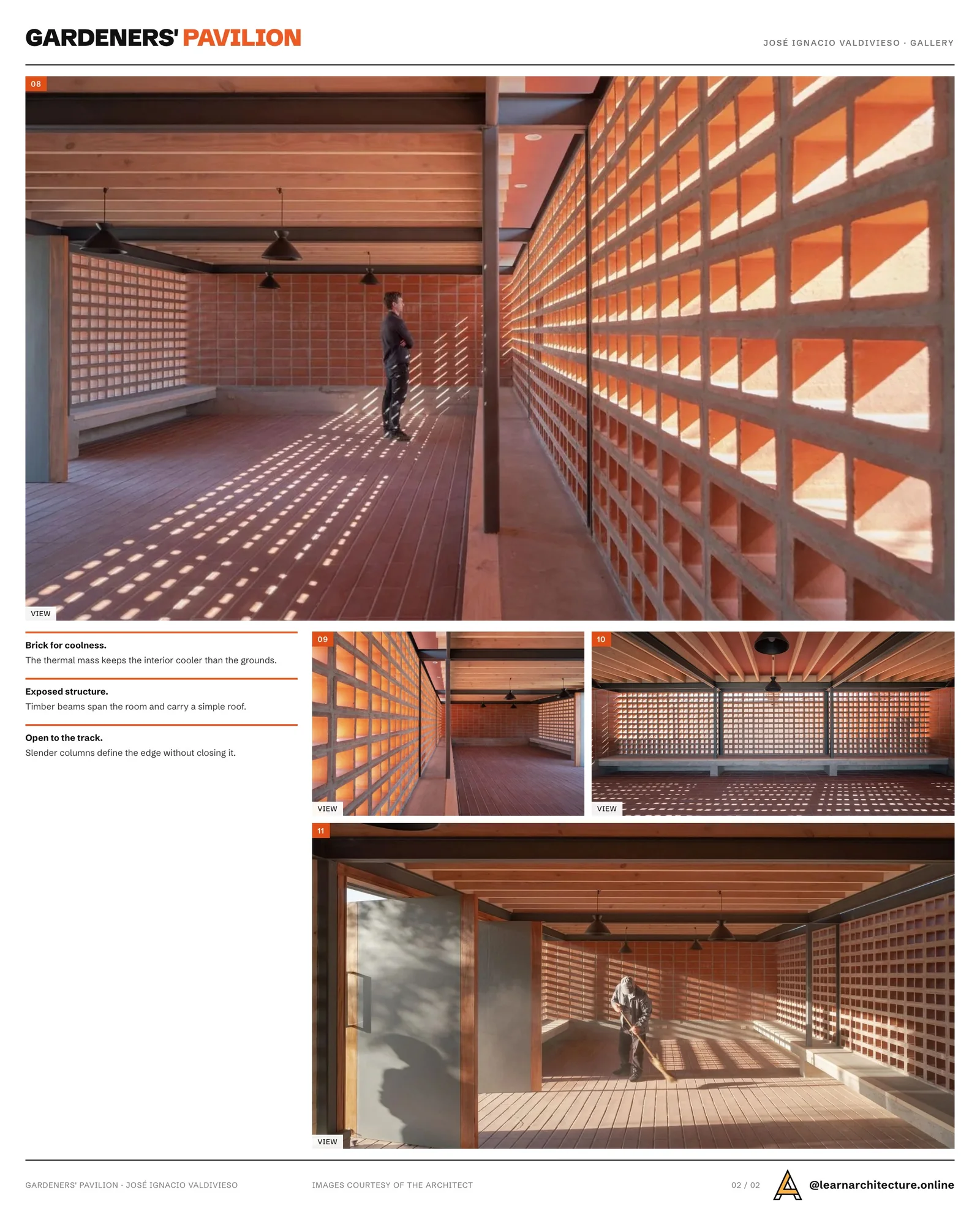
Construction completed in 2021 with total project costs remaining modest relative to the building’s 60-square-meter area. Material choices emphasized durability and thermal performance over finish quality or decorative elaboration. Brick surfaces remain unfinished, timber beams show natural grain patterns, and roofing presents straightforward weather protection without aesthetic embellishment. This economy reflects both budget realities and conceptual clarity: resources directed toward functional performance rather than cosmetic refinement.
The completed structure demonstrates how architectural intervention need not pursue monumentality to achieve significance. Small-scale projects addressing specific user needs can yield outcomes as valuable as high-profile commissions, particularly when they improve daily working conditions for underserved populations. Valdivieso’s pavilion stands as evidence that thoughtful design operates across all scales and budgets, provided architects maintain focus on human experience rather than formal experimentation.
Within Chile’s contemporary architectural landscape, the Gardeners’ Pavilion represents quiet resistance to spectacle-driven practice. The project neither photographs dramatically nor generates theoretical discourse; its success measures through shade temperatures, worker comfort, and daily utility. This humility positions architecture as service provision rather than artistic statement, a necessary correction within a discipline often consumed by image production at the expense of genuine social contribution.
Photography: Estudio Ibañez
- brick construction Chile
- brick pavilion architecture
- Chilean architecture
- Club Hipico Santiago
- equestrian facility architecture
- gardener shelter design
- gardeners pavilion
- Jose Ignacio Valdivieso
- Passive Cooling Architecture
- racetrack architecture
- Santiago pavilion
- Sustainable pavilion design
- thermal mass design
- worker amenity building
- worker welfare architecture








Leave a comment