


Table of Contents Show
Hotel Rakuragu emerges from one of architecture’s most challenging contexts: an 84-square-meter plot in the dense urban fabric of central Tokyo. Rather than treating this constraint as a limitation, kooo architects used it as the conceptual engine of the project. The nine-story boutique hotel is shaped by an attentive reading of the city’s overlooked conditions, specifically the “gaps” between buildings that unexpectedly allow light, air, and views to penetrate the otherwise compact skyline. Through this lens, the project transforms a highly restricted site into a layered experience of openness, privacy, and urban discovery.
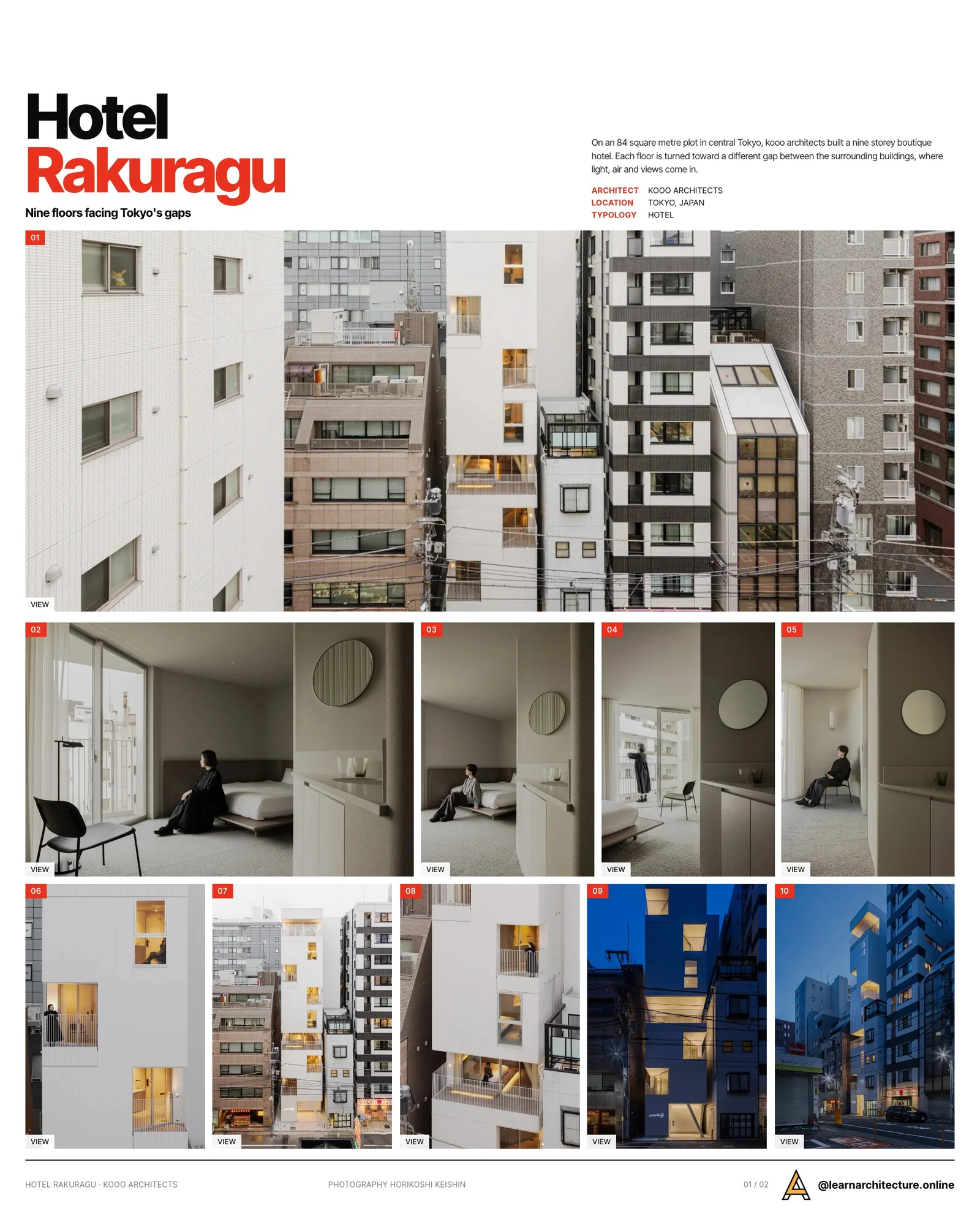
Located among mixed-use buildings of inconsistent heights, materials, and proportions, the hotel has no privileged panorama. Instead of resisting this fragmented context, the design embraces it, producing a building that is neither closed nor generic, but finely tuned to its surroundings.

The Terrace as Architectural Identity
At the heart of the project lies a deliberate rejection of the typical Tokyo hotel model. In most compact hotels, balconies are eliminated to maximize interior floor area. Here, kooo architects inverted that logic. By studying the surrounding buildings and identifying available sightlines between them, the architects oriented each floor toward a different urban gap. The result is a vertical collection of terraces facing multiple directions, each offering guests a unique perspective of Tokyo’s everyday life.
This strategy gives each room its own identity. Some balconies are triangular and intimate; others stretch across an entire bay. Together, these irregular voids carve the white cubic volume into a dynamic façade, producing a rhythmic play of solids and openings. The building reads as a sculpted mass, quiet in materiality yet animated by the diversity of its cutouts.
Rather than relying on overt formal gestures, the project’s character emerges from this consistent architectural idea: the terrace as both spatial device and conceptual core.

Structural Ingenuity Behind Spatial Freedom
Achieving such freedom in balcony configuration required an equally unconventional structural solution. Instead of employing a standard column-and-beam system, the building uses a steel rigid-frame structure with diagonal bracing. This system allows columns to be positioned more flexibly and kept exceptionally slender, reducing visual obstruction and preserving the openness of both interior and exterior spaces.

The compact structural elements (beams limited to 300 mm in depth and columns ranging from 150 to 200 mm in diameter) are concealed within walls wherever possible. This enhances the sense of continuity between room and balcony while allowing natural light to penetrate deeply into the rooms. Structurally, the project demonstrates how engineering innovation can directly support architectural intention, turning spatial ambition into built reality.

Passive Design and Environmental Comfort
Beyond aesthetics and experience, the terraces also perform environmentally. Each balcony contributes to passive climatic control by enabling natural ventilation and daylighting through carefully positioned openings. Low-E glazing moderates thermal gain while maintaining transparency, striking a balance between openness and comfort.
This attention to environmental performance became especially significant during the COVID-19 design phase, when access to fresh air, outdoor space, and psychological well-being gained renewed importance. The terraces offer guests not only views but also personal outdoor environments, a rare luxury in Tokyo’s dense hospitality landscape.

Interior Atmosphere: Softness Within Density
Inside, the spatial language shifts from urban fragmentation to calm continuity. Guest rooms are defined by curved walls that gently dissolve boundaries between interior and exterior, enhancing the perception of flow. The surfaces are finished with diatomaceous earth wallpaper, whose microporous texture diffuses light and improves indoor air quality, contributing to both visual softness and sensory comfort.
Programmatic decisions further support livability. Bathrooms are deliberately positioned away from windows to ensure privacy in the office-heavy Chuo Ward context. The washbasin is placed outside the bathroom, reducing spatial compression and creating a more open daily routine. These details reflect a careful understanding of both spatial psychology and practical hospitality needs.
Rather than pursuing dramatic aesthetics, kooo architects prioritize subtle experiential qualities (light, air, texture, and proportion), resulting in interiors that feel both contemporary and deeply humane.

A Contemporary Model for Compact Hospitality
Hotel Rakuragu exemplifies a broader cultural strength within Japanese architecture: the ability to transform extreme spatial limitation into architectural value. Through a precise reading of its context, a clear conceptual framework, and rigorous detailing, the project offers a hospitality experience that feels authentic to Tokyo rather than abstracted from it.
Each room becomes a micro-observatory onto the city. Each balcony frames a different slice of urban life. Together, these moments accumulate into an architecture that does not escape density but instead celebrates it, turning the everyday city into the hotel’s greatest asset.

Conclusion
Hotel Rakuragu demonstrates how architecture can operate intelligently within constraint, using the smallest of sites to produce a rich, layered spatial experience. By redefining balconies as instruments of identity, environmental performance, and urban engagement, kooo architects craft a hotel that feels deeply connected to its context while offering guests rare moments of openness in the heart of Tokyo. The project stands as a refined example of contemporary Japanese ingenuity: quietly radical, technically precise, and experientially generous.
Photography: Horikoshi Keishin


- Architecture in Tokyo
- Balcony architecture
- Boutique hotel design
- Compact building design
- Contemporary Japanese Design
- Hospitality architecture
- Hotel Rakuragu
- Japanese Architecture
- kooo architects
- Micro architecture
- Minimalist Architecture
- Modern hotel interiors
- passive design strategies
- Small plot architecture
- Steel frame architecture
- Structural innovation
- Terrace design
- Tokyo hotel architecture
- Urban gap concept
- Urban infill architecture









Leave a comment