


Table of Contents Show
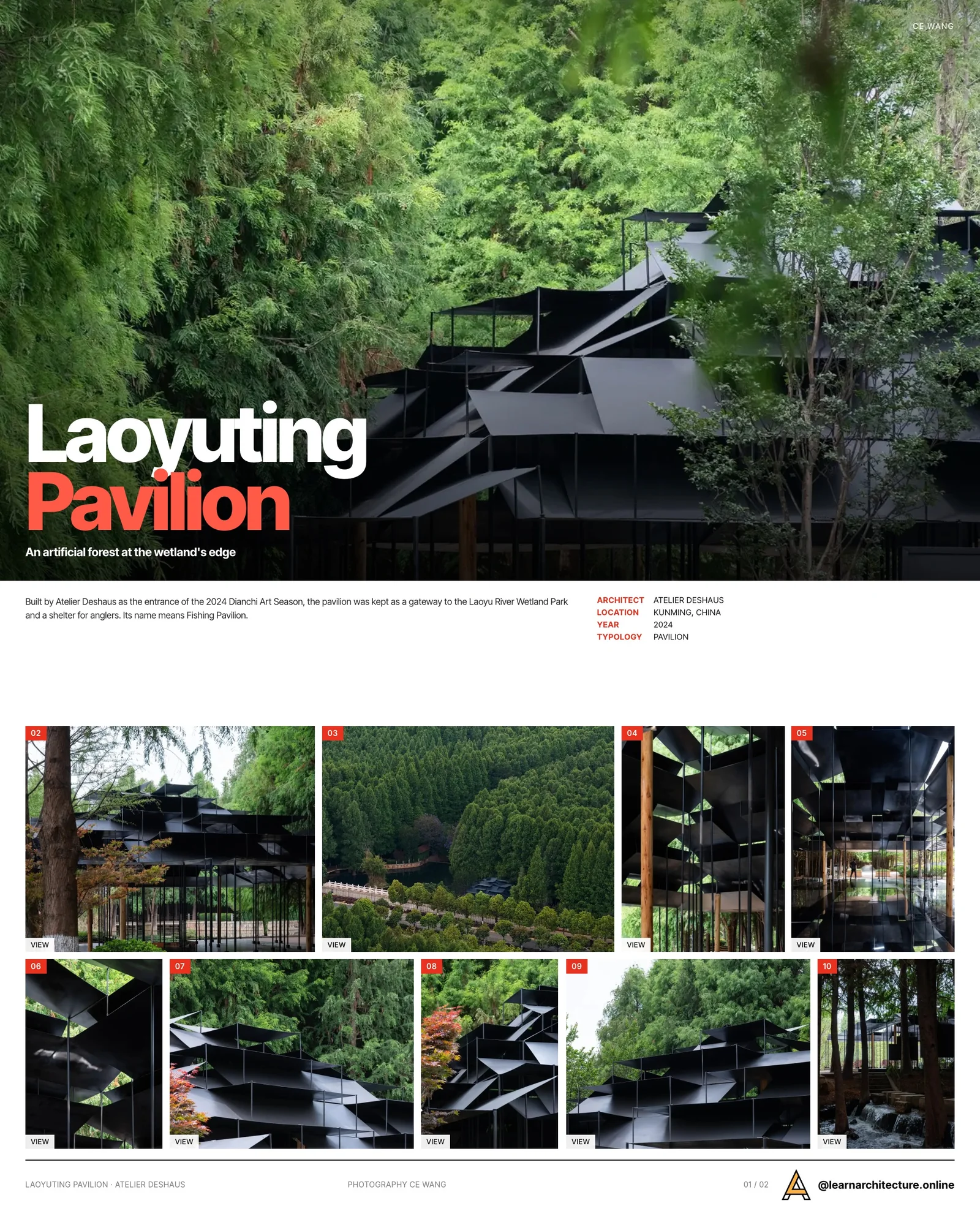
Set within the sensitive ecological landscape of the Laoyu River Wetland Park, Laoyuting Pavilion emerges as a refined architectural intervention that balances environmental restraint, cultural memory, and contemporary construction logic. Designed by Atelier Deshaus as part of the 2024 Dianchi Art Season: “Home and Future”, the pavilion initially functioned as the ceremonial entrance to the art festival. Following the event, it was permanently retained as both a gateway to the wetland and a resting shelter for visitors and local anglers, embedding architecture seamlessly into everyday life along Dianchi Lake.

Context: Wetland Ecology and Urban Ritual
The Laoyu River Wetland is not merely a recreational landscape but an active component of Kunming’s water purification infrastructure, serving as the final natural filtration stage before water enters Dianchi Lake. Lined with bald cypress groves and shallow waters teeming with fish, the wetland has long attracted city residents who come to fish, walk, and rest along its edges.
Within this layered context of ecology, infrastructure, and leisure, the pavilion adopts a role that is both modest and symbolic. Its name, Laoyuting, meaning “Fishing Pavilion,” reflects its everyday function while grounding the structure within the cultural rhythms of the site.

An Artificial Forest as Architectural Strategy
Rather than asserting a singular object, the pavilion is conceived as an artificial forest: a porous spatial field composed of slender steel columns and a fragmented roof plane. Positioned between a busy roadway and the expansive wetland, the pavilion mediates between the manmade and the natural, offering a transitional atmosphere that feels simultaneously sheltered and open.
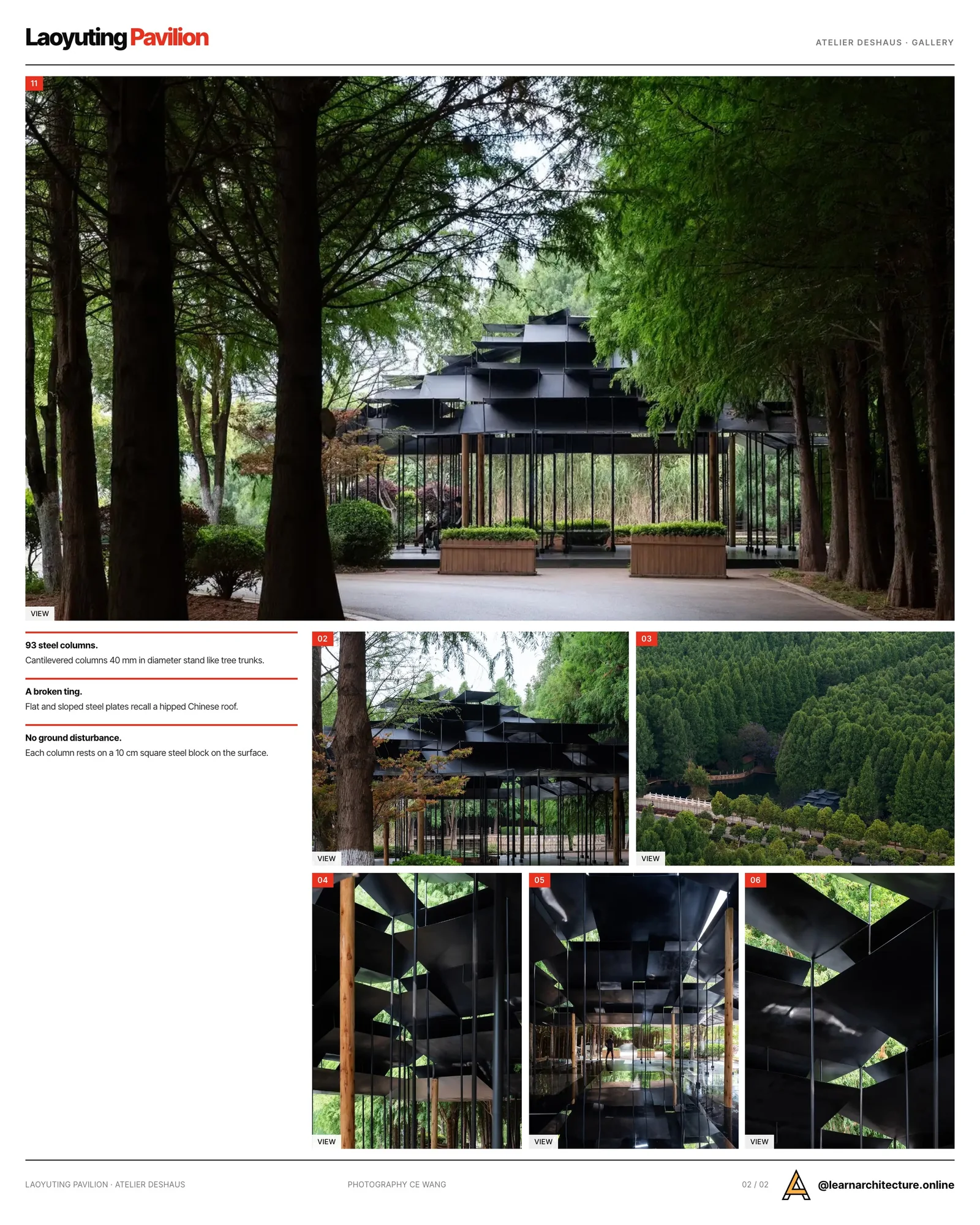
Ninety-three 40 mm diameter steel columns, working in cantilever, are arranged with varying densities, producing a rhythm that recalls tree trunks rather than conventional structural grids. Within this forest-like interior, two subtle paths unfold toward the deeper wetlands, allowing visitors to gather, pause, or disperse organically. The experience is less about enclosure and more about inhabiting shade, movement, and filtered views.

Reinterpreting the Traditional Chinese Ting
From a distance, Laoyuting Pavilion reads as a contemporary echo of the traditional Chinese ting, with its fragmented roof suggesting the familiar silhouette of a four-sloped hipped roof. Yet upon closer inspection, the roof dissolves into a constellation of flat and sloped steel plates, creating an appearance closer to thatched shelter than industrial canopy.
This intentional fragmentation allows light to penetrate unevenly, producing deep shadows punctuated by glimpses of sky and treetops. Through this dematerialization of steel, Atelier Deshaus displaces the material’s industrial connotations, encouraging a renewed dialogue between technology, tradition, and landscape. The pavilion does not replicate historical forms; instead, it deconstructs and reassembles them into a spatial condition that feels both ancient and contemporary.

Minimal Impact Construction and Structural Innovation
Strict environmental regulations within the Dianchi Wetland Park prohibited any disturbance to the existing ground surface. In response, the pavilion employs an above-ground micro-foundation system. Each column rests on a 10-centimeter square solid steel block, placed directly on the terrain and lightly reinforced to support cantilevered loads. This approach ensures structural stability while signaling a conscious effort to protect the fragile wetland soil.
The pavilion’s construction follows a fully prefabricated and assembled system. Columns, roof plates, joints, and bolts were manufactured off-site and assembled on location, reducing construction impact and transforming the building process into something closer to an outdoor installation than conventional architecture. Structurally, the pavilion is composed of modular units, each formed by six columns and hinged steel plates, which overlap and redistribute loads through an additional layer of 125 short steel columns. The result is a roof structure that exists between rigidity and flexibility, mirroring the dynamic balance of the wetland itself.

Architecture as Breathing Structure
At its core, Laoyuting Pavilion revisits the tree as a structural archetype, recalling humanity’s earliest shelters formed from branches and foliage. By abstracting this primal logic through steel, the pavilion becomes a space that breathes, filters, and invites traversal. It is neither fully natural nor overtly technological, but instead occupies a delicate middle ground where architecture acts as mediator rather than object.
Laoyuting Pavilion stands as a quiet yet powerful example of how architecture can engage with ecology through lightness, restraint, and reinterpretation. By merging prefabricated steel construction with the spatial memory of the traditional pavilion, Atelier Deshaus creates a structure that belongs equally to the wetland and to human culture. It is a place to rest, to observe, and to linger, an architectural threshold that honors the past while gently framing the future of Dianchi’s evolving landscape.
Photography: Ce Wang
- Architectural installations China
- Art pavilion China
- Atelier Deshaus
- Chinese pavilion architecture
- Contemporary Chinese architecture
- Dianchi Lake pavilion
- Ecological pavilion
- Experimental structural design
- Fishing pavilion architecture
- Landscape-integrated architecture
- Laoyuting Pavilion
- Lightweight steel architecture
- Minimal impact construction
- Nature and technology architecture
- Pavilion roof reinterpretation
- Prefabricated pavilion design
- Public resting pavilion
- Steel column architecture
- Urban wetland design
- Wetland architecture design








Leave a comment