


Table of Contents Show
When diving into the world of architecture, one concept that stands out is the parti diagram. It’s more than just a sketch; it’s a powerful tool that captures the essence of a design idea. I often find that these diagrams help clarify complex concepts and provide a visual roadmap for the architectural journey ahead.
Parti diagrams distill a project’s core elements into simple shapes and lines, making it easier to communicate ideas with clients and collaborators. Whether you’re a seasoned architect or just starting out, understanding how to create and utilize a parti diagram can elevate your design process. Join me as I explore the significance of this essential architectural tool and how it can transform your approach to design.

Understanding Architecture Parti Diagram
Parti diagrams serve as essential visual tools in architecture, translating complex design concepts into simplified representations. By breaking down ideas into basic shapes and lines, these diagrams create a clearer understanding of architectural intentions.

Definition of Parti Diagram
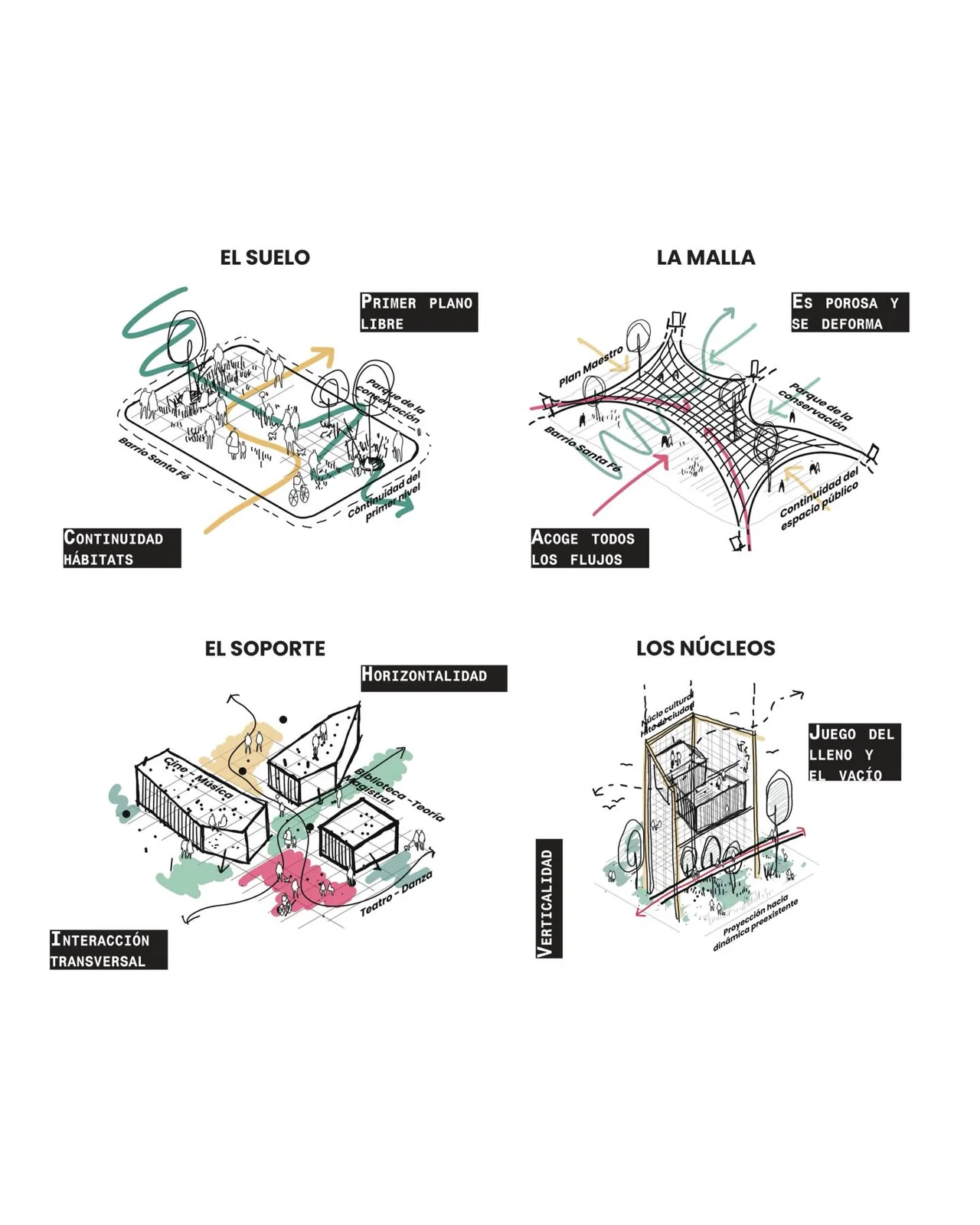
A parti diagram represents the main idea or concept of an architectural design. It captures the fundamental aspect of a project, illustrating spatial organization and key elements. Typically, it includes abstract shapes that convey relationships between spaces, functions, and elements. For example, a parti diagram for a residential home might specifically show the division between public and private areas through distinct geometric shapes.
Importance in Architectural Design
Parti diagrams play a crucial role in the architectural design process. They enable architects to communicate design concepts effectively with clients and collaborators, fostering better understanding and feedback. By visualizing concepts early on, architects can explore and refine their ideas before committing to detailed plans. Furthermore, parti diagrams serve as a foundation for further design development, guiding decision-making throughout the project lifecycle. Emphasizing clarity and simplicity, these diagrams enhance collaboration and innovation within the architectural community.
Components of a Parti Diagram
Parti diagrams consist of several key components that collectively convey architectural ideas in a simplified manner. Understanding these components enhances my ability to create effective diagrams.

Key Elements
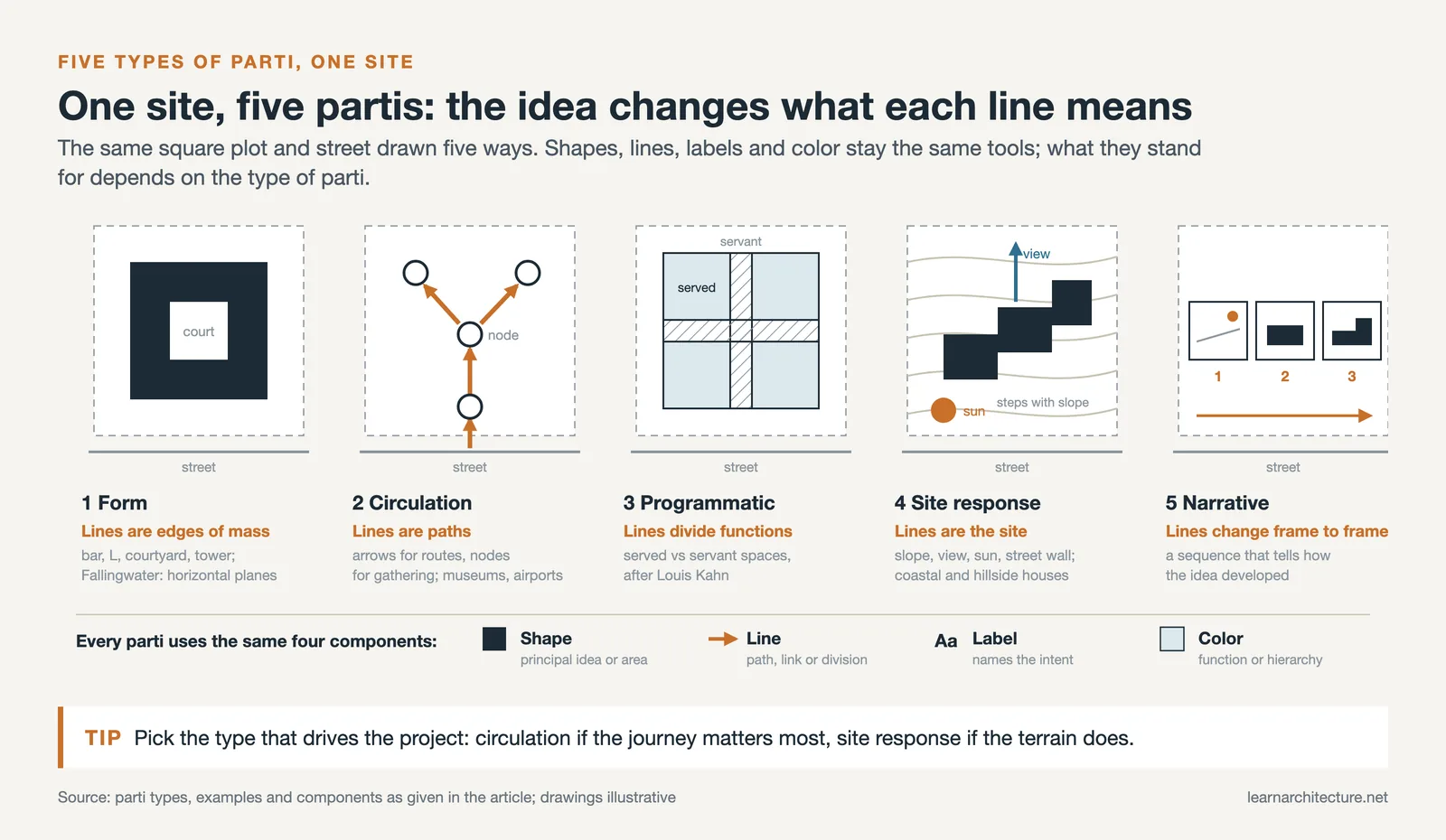
- Shapes: Basic geometric forms represent principal ideas and concepts. Common shapes include rectangles, circles, and triangles, which can symbolize various functional areas within a design.
- Lines: Lines demonstrate relationships between spaces. They can indicate movement paths, connections, or divisions, thereby clarifying how different elements within the design interact.
- Labels: Annotations provide context and convey specific meanings for each shape or line. Clear labeling ensures viewers understand the diagram’s intent and function, enhancing communication.
- Color: Color can signify different aspects of a design, such as functionality or hierarchy. Using varied colors strategically highlights important areas or themes within the parti diagram.
Visual Representation
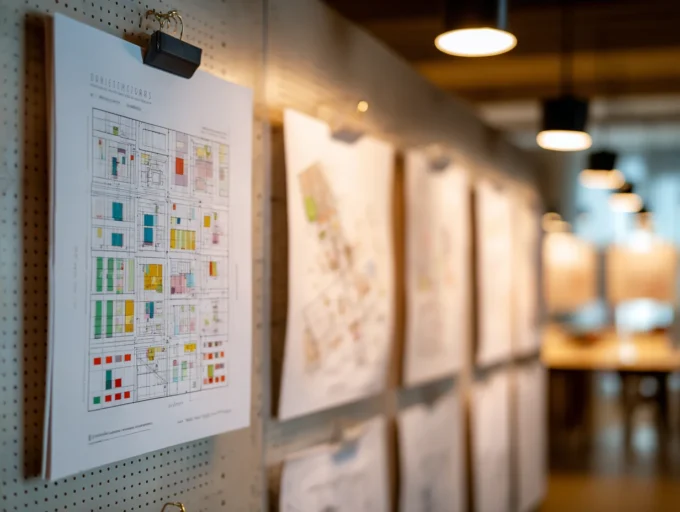
Visual representation plays a crucial role in parti diagrams. It allows for immediate comprehension of complex ideas through simplified imagery. A well-structured diagram employs minimalism, ensuring clarity and focus. Visual components align logically to depict spatial organization and functional relationships. For instance, a parti diagram for a commercial building might show the contrast between public and private zones using distinct shapes and lines, allowing viewers to understand the overall layout at a glance. The strategic use of space and composition within the diagram further reinforces the design concept, making it an effective communication tool for architects.
Applications of Parti Diagrams
Parti diagrams find broad applications within architectural practice. They simplify complex ideas, making them accessible throughout the design process.

Conceptual Design Process
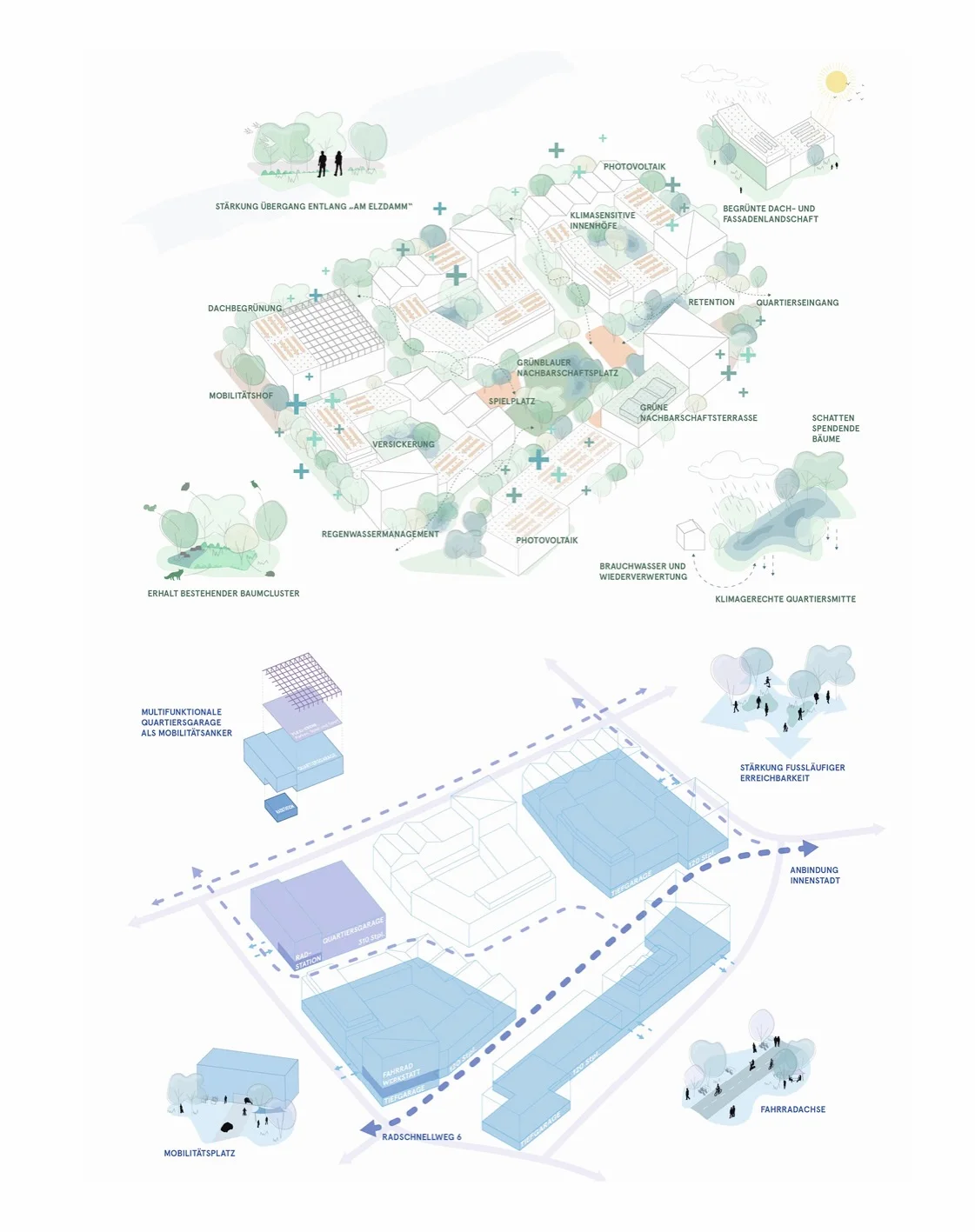
Parti diagrams play a vital role in the conceptual design process. They allow architects to distill key ideas into visual representations, aiding in brainstorming sessions. During these sessions, I capture initial thoughts and explore various design directions. For example, a parti diagram may convey the hierarchy of spaces in a building, clarifying the organization’s flow. By using these diagrams early, I can effectively communicate concepts with team members and clients, fostering collaboration and feedback.
Case Studies in Architecture
Analyzing case studies reveals the effectiveness of parti diagrams in real-world projects. For instance, the Seattle Central Library employed a parti diagram to outline the relationship between diverse programmatic elements. This diagram illustrated the public spaces’ accessibility and the organization of reading areas, leading to a groundbreaking design. Another significant example is the Guggenheim Museum in Bilbao, where a simple parti diagram identified the flow of visitors, enhancing their experience. Such case studies demonstrate how parti diagrams serve as foundational tools in translating architectural ideas into functional designs.
Benefits of Using Parti Diagrams
Parti diagrams offer numerous advantages in architectural design, simplifying processes and fostering effective communication. Their visual nature enhances understanding and collaboration throughout the design journey.
Simplifying Complex Ideas
Parti diagrams break down intricate design concepts into digestible visual representations. They prioritize essential elements by using basic shapes and lines to convey critical relationships within a space. For example, a parti diagram for an urban park might illustrate pathways, recreational areas, and natural features, making it easier to grasp the overall design intent. This simplification helps both architects and clients differentiate between various space functions and their interconnections, promoting clarity in the design process.
Enhancing Communication
Parti diagrams significantly improve communication among architects, clients, and stakeholders. By presenting design ideas visually, they facilitate discussions that clarify concepts and gather feedback early on. Clear visuals reduce misunderstandings that can arise from technical jargon or complex explanations. Architects can use these diagrams to effectively showcase different design options, guiding clients through the decision-making process. For instance, when discussing a residential project, the diagram could illustrate how the layout supports the lifestyle of its occupants, fostering an engaging dialogue about preferences and requirements. The result is a more collaborative and innovative design process that resonates with all parties involved.
Why Parti Diagrams Matter in the Design Process
Parti diagrams serve three critical functions. First, they force clarity. When you reduce your concept to a few lines on paper, you quickly discover whether your idea holds together or falls apart. Many student projects fail not because of poor detailing but because the core concept was never clearly defined.
Second, they improve communication. Architects work with clients, engineers, contractors, and planners who may not read technical drawings fluently. A well-drawn parti bridges that gap. It gives everyone at the table a shared understanding of where the project is headed.
Third, they act as a reference point throughout the project lifecycle. As designs evolve through schematic design, design development, and construction documentation, the parti keeps the team anchored. When disputes arise about layout changes or material choices, returning to the parti helps resolve them quickly.
Types of Parti Diagrams
Most parti diagrams fall into one of five types, depending on what drives the concept: form, circulation, program, site, or a narrative sequence.
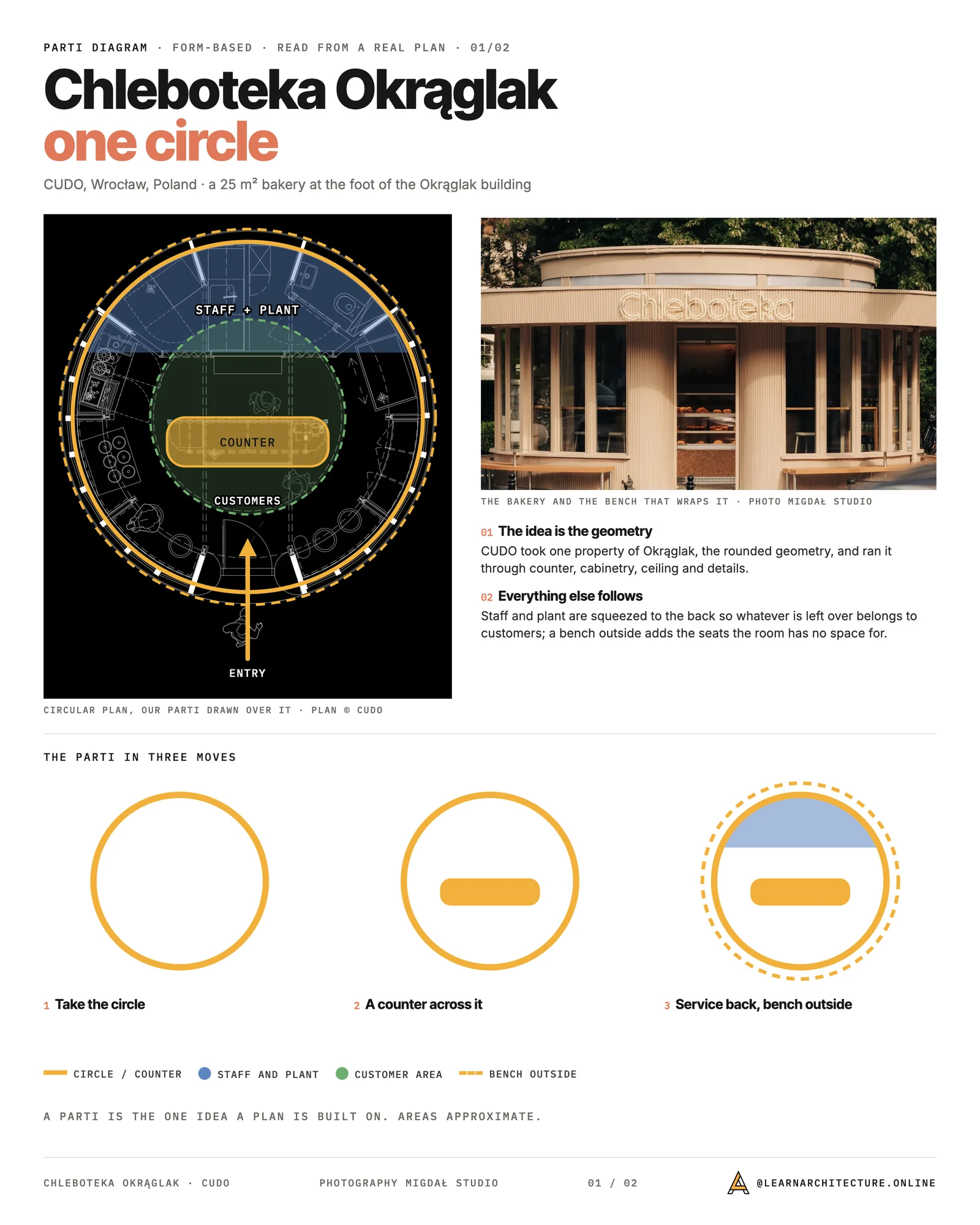
Form-Based Parti
A form-based parti focuses on geometry, massing, and the physical composition of a building. It answers questions about shape: is the building a bar, an L, a courtyard, a tower? This type works especially well for projects where the built form itself carries the concept. Frank Lloyd Wright’s Fallingwater, for instance, can be described through a parti of horizontal planes cantilevered over a waterfall. The form is the idea.
Circulation-Based Parti
This type maps how people move through a space. Arrows indicate primary paths, while nodes mark gathering points or transitions. Circulation-based partis are particularly useful for public buildings like museums, airports, and hospitals where user flow is a primary design driver. If you are working on a project where the journey through the building matters as much as the destination, this is your starting point. For more on movement mapping, see our guide on architecture circulation diagrams.
Programmatic Parti
A programmatic parti organizes the building by function. It shows where different activities occur and how they relate to one another. Public versus private zoning, served versus servant spaces, noisy versus quiet areas: these relationships become the organizing logic. Louis Kahn frequently used programmatic partis to distinguish between “served” spaces (like living rooms and libraries) and “servant” spaces (like mechanical rooms and staircases).
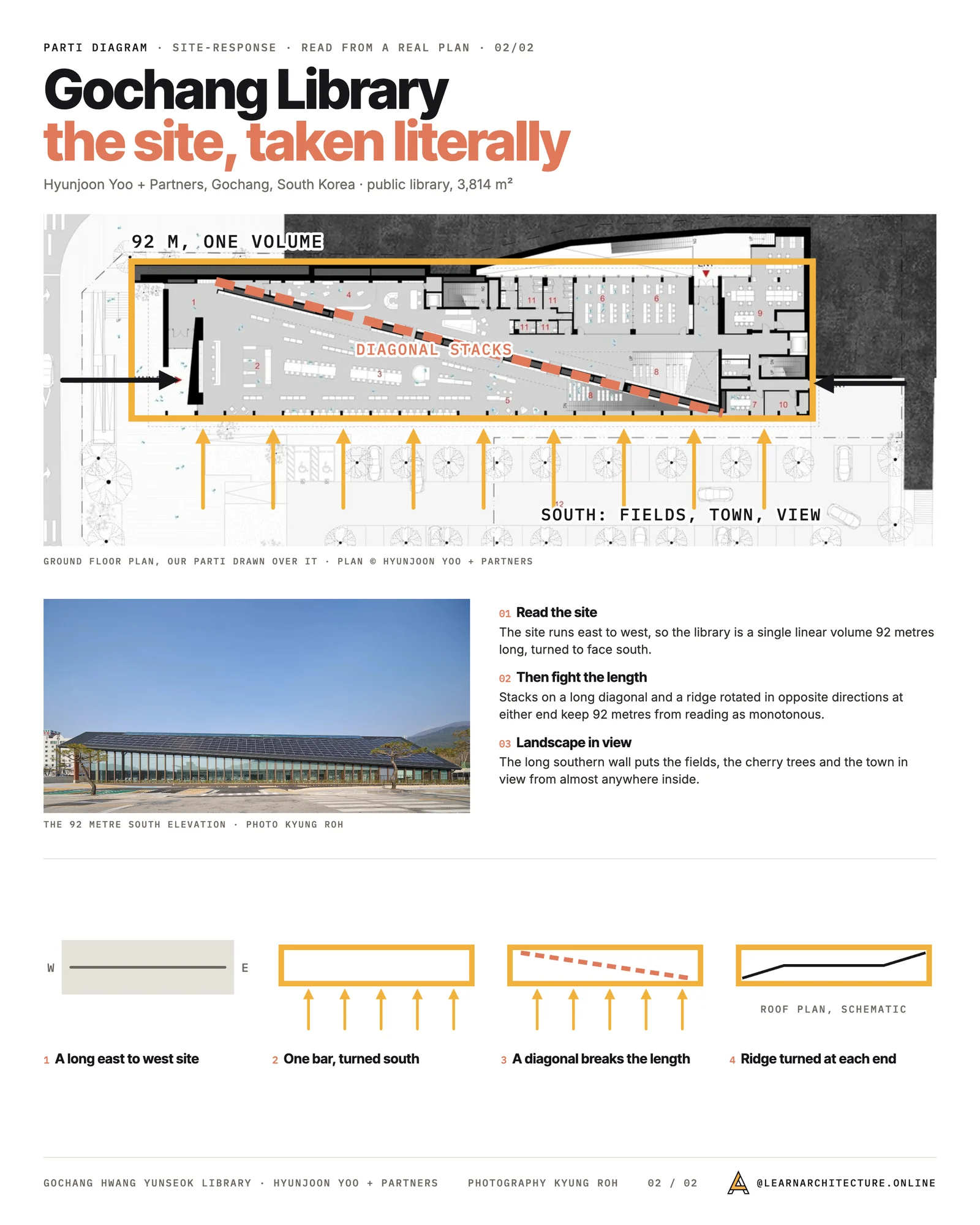
Site-Response Parti
Some projects are driven primarily by their context. A site-response parti illustrates how the building engages with topography, views, solar orientation, wind patterns, or neighboring structures. Coastal houses that open toward the ocean, hillside buildings that step with the terrain, and urban infill projects that respond to street walls all begin with this type of parti.
Narrative or Sequential Parti
Rather than a single image, a narrative parti unfolds as a sequence of diagrams that tell a story. Each frame builds on the last, showing how the design concept developed from initial site observations through to the final form. This approach works well for competition entries and client presentations, where the audience benefits from understanding the reasoning process behind the design.
How to Create a Parti Diagram in Four Steps
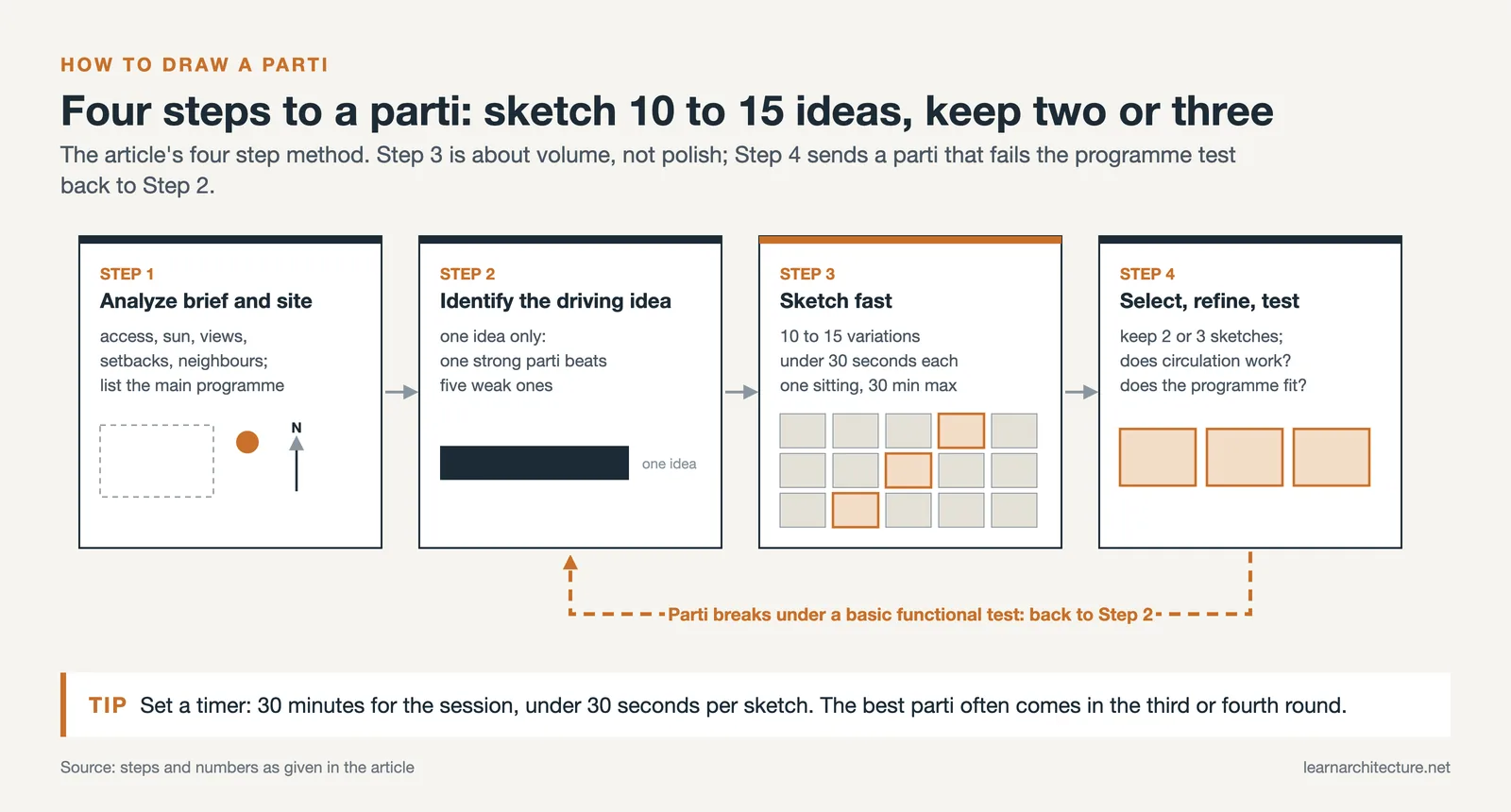
Step 1: Analyze the Project Brief and Site
Before you pick up a pen, read the brief carefully and visit the site. Identify the non-negotiable constraints: access points, solar orientation, views, setback requirements, neighboring structures. List the primary program elements and their approximate sizes. This groundwork gives you the raw material for your parti.
Step 2: Identify the Driving Idea
Ask yourself: what is the single most important idea for this project? It might be the relationship between indoor and outdoor space, the way light enters the building, or how the structure addresses a sloping site. Avoid the temptation to combine multiple ideas. One strong parti beats five weak ones every time.
Step 3: Sketch Rapidly and Iteratively
Use trace paper or a sketchbook and draw quickly. Produce at least 10 to 15 variations in a single sitting. Keep each sketch to under 30 seconds. You are not designing the building yet; you are testing ideas. Some will be geometric, others diagrammatic, others almost abstract. The goal is volume, not polish.
Step 4: Select, Refine, and Test
Pick the two or three strongest sketches and develop them slightly. Add enough detail to test whether the parti can accommodate the program. Does circulation work? Can the primary spaces fit within the form? If the parti breaks under basic functional testing, return to Step 2.
Parti Diagram vs. Other Architectural Diagrams
Architecture diagramming includes a wide family of visual tools, and students often confuse the parti with related diagram types. Understanding the differences helps you choose the right tool at the right stage of the process.
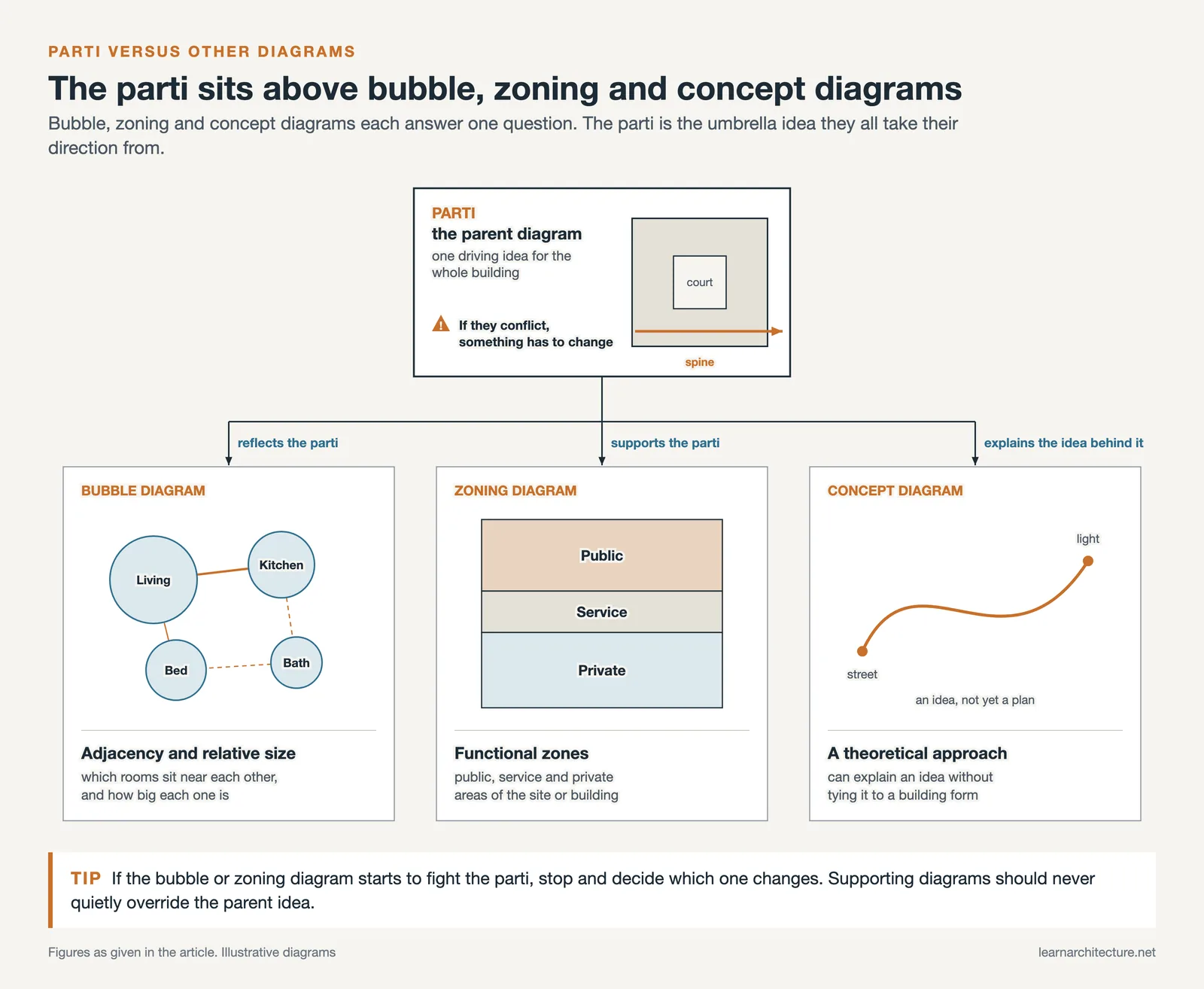
A bubble diagram maps spatial adjacencies. It shows which rooms should be near each other and how large they should be relative to one another. An architecture zoning diagram divides the site or building into functional zones (public, private, service). A concept diagram might illustrate a theoretical approach without tying it to a specific building form.
The parti sits above all of these. It is the umbrella idea that gives direction to every subsequent diagram. Your bubble diagram should reflect the parti. Your zoning diagram should support it. If they conflict, something needs to change. Thinking of the parti as the “parent” diagram and everything else as supporting diagrams is a useful mental model.

Interior Design Parti Diagram: Applying the Concept Indoors
The interior design parti diagram applies the same principle at a smaller scale. Instead of organizing an entire building, it organizes a single room, a floor, or an interior renovation. The driving idea might be a central social hub with private zones radiating outward, a linear progression from public entry to private retreat, or a material palette that transitions from raw to refined as you move deeper into the space.
Interior parti diagrams are especially valuable for open-plan projects where the boundaries between functions are fluid. Without walls to define zones, the parti becomes the invisible organizer. It determines furniture placement, material changes, lighting strategies, and even color shifts. Residential designers and hospitality architects rely heavily on this type of architecture diagramming to maintain a cohesive vision through the design process.
Conclusion
Parti diagrams can elevate any architectural practice. These visual tools not only clarify complex concepts but also foster collaboration and innovation. By translating intricate ideas into simple shapes and lines, you can communicate effectively with clients and colleagues alike.
Used consistently, parti diagrams sharpen the design process and lead to more informed decisions. Whether you are a seasoned architect or just starting out, knowing how to use these diagrams can make a significant difference in your projects, so make them a regular part of your workflow.
- Architectural Design Tools
- architecture concept diagrams
- architecture design innovation
- architecture design planning
- architecture design transformation
- architecture diagram examples
- Architecture parti diagrams
- architecture planning diagrams
- architecture process improvement
- architecture project planning
- architecture schematic design
- architecture visualization techniques
- design process optimization
- effective architecture diagrams
- enhancing design workflow
- innovative architecture tools
- mastering architecture diagrams
- parti diagram architecture tools
- parti diagram design process
- parti diagram techniques
- streamlining design processes
- visualizing architecture concepts











Leave a comment