


Table of Contents Show
The contemporary architecture era refers to the period from roughly the 1980s onward, when architects began moving beyond the rigid doctrines of modernism to explore bold forms, cultural identity, environmental responsibility, and technological experimentation. These eight architects represent the leading edge of that shift, each bringing a distinct vision that continues to influence how buildings are designed and experienced around the world.
What Defines the Contemporary Architecture Era?
Unlike modern architecture, which followed a defined ideological program, the contemporary era is deliberately pluralistic. There is no single style or manifesto. What unites contemporary architects is a willingness to question inherited assumptions about form, material, structure, and the relationship between buildings and their users.
Contemporary design architects work at the intersection of cultural context, advanced technology, and sustainability. A building by Zaha Hadid looks nothing like one by Renzo Piano, and that is precisely the point. The contemporary architecture era celebrates divergence. It rewards architects who develop a recognizable visual language while remaining responsive to place, program, and the people who will inhabit their work.
To understand how this era developed, it helps to have a grounding in the core principles that preceded it. The core elements of architecture such as space, light, material, and structure remain constant across eras, but how contemporary architects interpret and prioritize these elements differs dramatically from their predecessors.
⚠️ Common Mistake to Avoid
Many people use “modern” and “contemporary” as interchangeable terms in architecture, but they describe two entirely different things. Modern architecture is a specific historical movement from the early-to-mid 20th century built around principles like “form follows function” and the elimination of ornament. Contemporary architecture simply means work being designed and built right now. An architect working today can be contemporary without being modern, and many of the most celebrated contemporary buildings deliberately push back against modernist austerity.
Zaha Hadid: Form as Movement

No figure did more to expand what a building could look like than Zaha Hadid. Born in Baghdad in 1950 and trained at the Architectural Association in London, Hadid spent her early career building a reputation on paper. Her projects won competitions but were rarely built, earning her the label “paper architect.” That changed with the Vitra Fire Station in Weil am Rhein, Germany, completed in 1993, and accelerated sharply in the decade that followed.
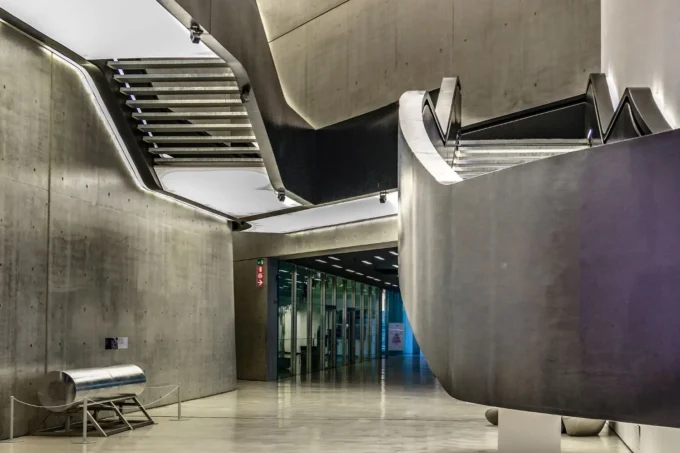
Hadid’s architecture is characterized by what she called “the explosion of forms.” Walls lean, floors tilt, and surfaces fold into each other with no clear separation between horizontal and vertical. The MAXXI National Museum of 21st Century Arts in Rome, the Heydar Aliyev Center in Baku, and the Guangzhou Opera House all demonstrate her ability to treat reinforced concrete and glass as fluid materials rather than rigid structural necessities.
In 2004, Hadid became the first woman to receive the Pritzker Architecture Prize, widely considered the field’s highest honor. Her firm, Zaha Hadid Architects, continues operating under her principles following her death in 2016, completing projects she developed and pushing the practice’s parametric design methods further into the digital realm.
🎓 Expert Insight
“Architecture should speak of its time and place, but yearn for timelessness.”
Frank Gehry
This quote cuts to the heart of what separates the best contemporary architects from their imitators. Hadid’s buildings are unmistakably of this moment in material science and computational design, yet the underlying drive to express movement and human experience through built form connects her to every great architect in history.
Bjarke Ingels: Architecture as World-Building

Danish architect Bjarke Ingels founded BIG (Bjarke Ingels Group) in 2005, and within a decade had built one of the most recognizable and discussed practices in the world. Ingels describes his philosophy as “pragmatic utopianism,” the idea that architecture can simultaneously solve real social and environmental problems while being genuinely enjoyable to inhabit.
BIG’s projects range from the 8 House in Copenhagen, a residential building shaped like a giant figure-eight with internal streets and gardens, to the Amager Bakke waste-to-energy plant in the same city, which doubles as a ski slope on its roof. The firm’s approach to mixed-use programs, publicly accessible rooftops, and integrated green space has influenced how developers and urban planners in the contemporary architecture era think about what buildings owe to their surrounding communities.
Ingels also pushed the idea of the architect as communicator. His use of diagrams, comics, and accessible presentations has made his practice unusually legible to clients and the public alike, a quality that has helped BIG secure ambitious commissions from governments, corporations, and cultural institutions across North America, Europe, and Asia.
💡 Pro Tip
If you are studying the work of BIG as a student, pay close attention to how Ingels uses section drawings to explain the social logic of a building before focusing on its exterior form. Understanding a project’s internal organization tells you far more about a contemporary architect’s intentions than looking at renderings alone. Many contemporary design architects now publish their process diagrams alongside finished photography for exactly this reason.
Renzo Piano: Light, Craft, and the City

Renzo Piano’s career stretches from the radical to the refined. His collaboration with Richard Rogers on the Centre Georges Pompidou in Paris, completed in 1977, turned every structural and mechanical system inside out and painted them in primary colors, a deliberate provocation that helped launch an era of high-tech architecture. Decades later, Piano became one of the most trusted designers of cultural institutions in the world.
The Menil Collection in Houston, the Jean-Marie Tjibaou Cultural Center in New Caledonia, and the Shard in London all reflect Piano’s sustained interest in light as a building material. His buildings tend to be quietly sophisticated rather than aggressive, using refined details and honest structural expression to create spaces that feel both calm and alive. Piano has called this approach “poetic industrialism,” a phrase that captures how his work honors the beauty of fabricated materials without losing sight of human experience.
Piano received the Pritzker Prize in 1998. His firm, Renzo Piano Building Workshop, operates across three offices in Genoa, Paris, and New York, with a consistent focus on craftsmanship and the relationship between buildings and their urban context.
Norman Foster: Technology as Humanism

Norman Foster built his reputation on the argument that advanced engineering and human comfort are not competing priorities. His early work with Richard Rogers and Buckminster Fuller shaped a rigorous, systems-oriented approach to design that prioritized energy performance decades before sustainability became a standard expectation in the profession.
The Hong Kong and Shanghai Banking Corporation headquarters, completed in 1986, was at the time one of the most expensive buildings ever constructed. Every element was resolved with exceptional precision, from the suspension structure that eliminated interior columns to the heliostats on the atrium ceiling that tracked the sun. The building also pioneered the idea of a public ground plane beneath a corporate tower, opening the base to the city rather than closing it off.
Later projects including the Reichstag dome in Berlin, Hearst Tower in New York, and the Apple Park campus in Cupertino continued Foster’s investigation of how technology can produce buildings that feel more human rather than less. Foster received the Pritzker Prize in 1999 and remains active through his firm Foster + Partners, which has become one of the largest and most technically sophisticated architecture practices in the world.
📌 Did You Know?
The HSBC headquarters in Hong Kong required over 30,000 drawings and took nearly seven years to complete. Foster designed the building to be entirely prefabricated off-site and assembled in place, a method that allowed the project to proceed floor by floor without disrupting the bank’s operations at street level. It remains a benchmark for high-tech architecture more than three decades after its completion.
Tadao Ando: Silence in Concrete

Tadao Ando is one of the most unusual figures in the contemporary architecture era. He is entirely self-taught, learning architecture through books, travel, and relentless sketching rather than formal education. That outsider perspective produced an architectural language of striking originality, one built almost entirely from poured concrete, natural light, and the controlled encounter between human movement and geometric form.
Ando’s Church of the Light in Osaka, completed in 1989, is a defining work of the period. The interior is nearly bare: a concrete box with a cross-shaped void cut into the wall behind the altar, admitting two bars of light that change throughout the day. There are no conventional religious symbols or decorative elements. The architecture itself carries all the spiritual weight. This reduction of building to the essentials of space and light has influenced generations of contemporary architects worldwide.
The Pritzker committee awarded Ando its prize in 1995, describing his work as proof that architecture could be both disciplined and deeply poetic. His firm continues to work across Japan, Europe, and the United States on projects including museums, residences, and cultural institutions. His collaboration with Francois Pinault produced the Punta della Dogana and Palazzo Grassi art foundations in Venice, both transformations of historic buildings that show how his methods translate from new construction to adaptive reuse.
Herzog and de Meuron: Material as Language
Jacques Herzog and Pierre de Meuron have built one of the most distinctive bodies of work in contemporary architecture by treating the surface of a building as a primary site of meaning. Where other architects use form or structure to communicate, H&M often work through material transformation: wrapping buildings in copper mesh, printing photographs onto glass, patterning facades with ceramic tiles, or celebrating the texture of raw concrete in ways that border on the painterly.
The Tate Modern in London, a conversion of the Bankside Power Station completed in 2000, is their most widely visited building. The project preserved the station’s monumental turbine hall as a free public space while inserting a new museum program around it. The result created a new model for large-scale cultural institutions, one that has been replicated in cities around the world.
Their work on the Beijing National Stadium for the 2008 Olympics, designed with Ai Weiwei as artistic consultant, brought their approach to materials to a vast public scale. The stadium’s interlocking steel structure, which gave rise to the nickname “Bird’s Nest,” was not merely decorative but structurally functional, with the visual complexity emerging directly from the engineering logic. Herzog and de Meuron received the Pritzker Prize in 2001.
💡 Pro Tip
When analyzing Herzog and de Meuron’s work, start with the facade rather than the floor plan. Unlike most contemporary design architects whose work reads primarily in section or plan, H&M develop their concepts through what they call “the skin” of a building. Understanding their material choices and how each project responds to its context through surface treatment will give you the clearest picture of their design thinking.
Wang Shu: Memory and the Local
Wang Shu’s career challenges a common assumption about the contemporary architecture era: that its most important figures operate on a global stage. Wang works almost exclusively in China and has built a practice rooted in the specific textures, materials, and spatial traditions of Chinese vernacular architecture. His 2012 Pritzker Prize, the first awarded to a Chinese architect, drew international attention to a body of work that had developed deliberately outside the mainstream of global architectural culture.
His Ningbo History Museum uses millions of recycled tiles and bricks salvaged from villages demolished to make way for the new city. The resulting building is both ancient and entirely new, a structure that carries the material memory of a landscape that no longer exists. The Xiangshan Campus of the China Academy of Art in Hangzhou demonstrates a similar principle at larger scale, with buildings that respond to the topography of a mountain site through traditional spatial sequences rather than conventional Western planning logic.
Wang Shu’s work offers a model for how contemporary architects can engage with local culture and history without resorting to pastiche. His practice, Amateur Architecture Studio, which he founded with his wife Lu Wenyu, operates with a deliberately small and experimental structure that prioritizes long-term research over the scale of output common among large global firms.
🏗️ Real-World Example
Ningbo History Museum (Ningbo, China, 2008): Wang Shu’s team collected over five million recycled tiles and bricks from approximately twenty villages that had been demolished during Ningbo’s rapid urbanization. The tiles were laid by local craftspeople using traditional techniques, creating a facade with a texture and warmth that no new material could replicate. The building demonstrates how contemporary architecture can address social memory and urban loss through material choices, not just programmatic intent.
Kengo Kuma: Nature, Texture, and the Anti-Object

Kengo Kuma has spent his career arguing against what he calls “the object building,” the idea that architecture’s purpose is to announce its own presence through a bold, singular form. In contrast, Kuma works with materials that absorb their surroundings: stone screens that allow light to pass through, timber louvers that reference Japanese joinery, and facades that seem to dissolve into their landscape rather than stand apart from it.
The V&A Dundee, opened in 2018 as Scotland’s first dedicated design museum, shows how Kuma’s approach translates to Western contexts. The building’s jagged cliff-like facade is clad in pale sandstone and responds directly to the geology of the Scottish coast. Rather than importing a Japanese aesthetic, Kuma developed a material language specific to Dundee, while using the same layering and lightness that characterize all his work.
His design for the Japan National Stadium for the 2020 Tokyo Olympics returned Japanese architecture to the global stage after Zaha Hadid’s original design was controversially abandoned. Kuma’s solution used timber extensively as a primary material in a major sports venue, a choice that resonated with both the Japanese tradition of wood construction and contemporary concerns about embodied carbon in large public buildings. His firm, Kengo Kuma and Associates, operates internationally from its Tokyo base.
What These Architects Share Across the Contemporary Architecture Era
Looking across these eight figures, certain threads connect their work even amid obvious differences in style and geography. All of them treat architecture as a discipline of ideas, not just a service. All of them maintain a consistent design philosophy that is identifiable across multiple project types and scales. And all of them have used specific buildings to advance arguments about what architecture should be, arguments that have changed how the profession and its clients think.
The contemporary architecture era is also defined by a shared seriousness about context. Whether Ando is responding to the light of Osaka or Wang Shu is reading the ruins of rural China, the best contemporary work begins with careful attention to where a building is, who will use it, and what it will mean to the city or landscape around it. This is distinct from the universalism that characterized high modernism, and it marks one of the most important shifts the profession has made in the past half-century.
For students and young professionals exploring the architecture and design field, studying the work of these architects is not just an exercise in aesthetic appreciation. Each of their practices represents a coherent position on how the built environment can improve, challenge, or serve the people who inhabit it, which is ultimately what the discipline exists to do.
Further reading and primary source material on many of these architects is available through the Pritzker Architecture Prize archive, which publishes jury citations, acceptance speeches, and project documentation for every laureate. The ArchDaily database also provides detailed project coverage and interviews that give insight into each architect’s working methods. For deeper academic engagement, the Architectural Review and Dezeen offer critical analysis that goes beyond project photography.
✅ Key Takeaways
- The contemporary architecture era is not defined by a single style but by a pluralism of approaches, each grounded in a coherent design philosophy.
- “Modern” and “contemporary” describe different things: modern architecture was a defined historical movement, while contemporary simply means current.
- The eight architects profiled here all received the Pritzker Architecture Prize, the profession’s highest recognition, reflecting their sustained influence on the field.
- Common threads include attention to context, material honesty, and a commitment to architecture as a discipline of ideas rather than mere building production.
- Studying these architects through their process diagrams and written statements, not just finished photographs, gives a much clearer understanding of how contemporary design works.










Leave a comment