


Table of Contents Show
Floating architecture refers to buildings and structures designed to rest on water, using buoyant foundations such as pontoons, concrete hulls, or modular platforms. These projects respond to rising sea levels, urban density, and limited waterfront land by treating water as buildable ground rather than a barrier.
For centuries, communities from Cambodia’s Tonle Sap to Amsterdam’s canal houses have lived on water. What separates today’s floating architecture from those traditions is the scale, the technology, and the ambition. Architects are now designing entire neighborhoods, offices, farms, and cultural venues that float on rivers, harbors, and open sea. Many of these projects share DNA with broader green architecture movements, prioritizing renewable energy, closed-loop waste systems, and low-carbon materials. Waterfront architecture is no longer limited to buildings that face the water. A growing number of projects sit directly on it.
The eight projects below span residential, commercial, cultural, and agricultural programs across Europe, South America, and Asia. Each one addresses a different aspect of what it means to build on water, from structural buoyancy and climate resilience to community planning and off-grid energy.

What Is Floating Architecture?
Floating architecture describes any built structure that sits on water rather than on solid ground. The building rests on a buoyant foundation, typically made of reinforced concrete, steel pontoons, or expanded polystyrene (EPS) foam encased in a rigid frame. Unlike houseboats, which are classified as vessels, floating buildings are designed to remain stationary and function as permanent or semi-permanent structures, connected to shore-based utilities through flexible service lines.
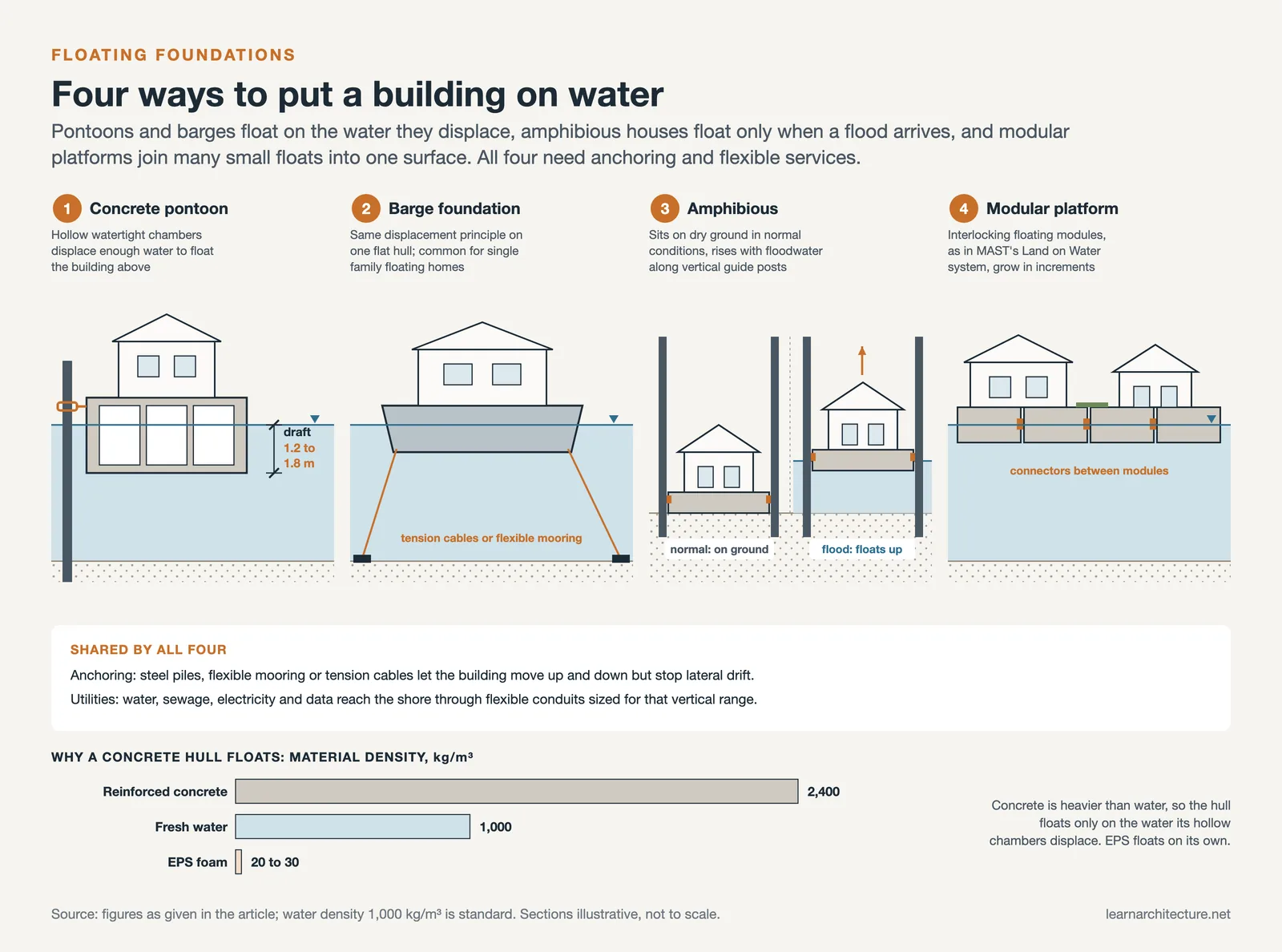
Four primary structural systems support buildings on water. Pontoon-based systems use hollow, watertight chambers (usually concrete or steel) that displace enough water to support the structure above. Barge foundations work on the same principle and are common for single-family floating homes. Amphibious foundations allow a building to sit on dry land during normal conditions but rise with floodwater, guided by vertical posts or sleeves. Modular platform systems, such as the Land on Water system developed by Danish studio MAST, use interlocking floating modules that can be assembled into neighborhoods or public spaces of varying sizes.
Anchoring keeps floating structures in position. Most projects use flexible mooring systems, steel piles driven into the lakebed or seabed, or tension cables that allow vertical movement with tides and water levels while preventing lateral drift. Utility connections, including water supply, sewage, electricity, and data, run through flexible conduits designed to accommodate this vertical range of motion.
📐 Technical Note
Standard concrete pontoon foundations for floating homes typically have a draft (submerged depth) of 1.2 to 1.8 meters, depending on structural load. Reinforced concrete hulls used in Dutch floating homes weigh approximately 2,400 kg/m³ but achieve buoyancy through hollow chamber displacement. EPS foam-core systems reduce foundation weight to roughly 20-30 kg/m³ while maintaining sufficient load capacity for single-story residential structures.

Why Waterfront Architecture Is Moving onto the Water
Several pressures are pushing architects and developers beyond the shoreline. Land scarcity in dense coastal cities is one driver. Rotterdam, Amsterdam, Copenhagen, and Miami all face situations where available waterfront land is either built out or prohibitively expensive. Water offers a new surface for development without demolishing existing structures or encroaching on green space.
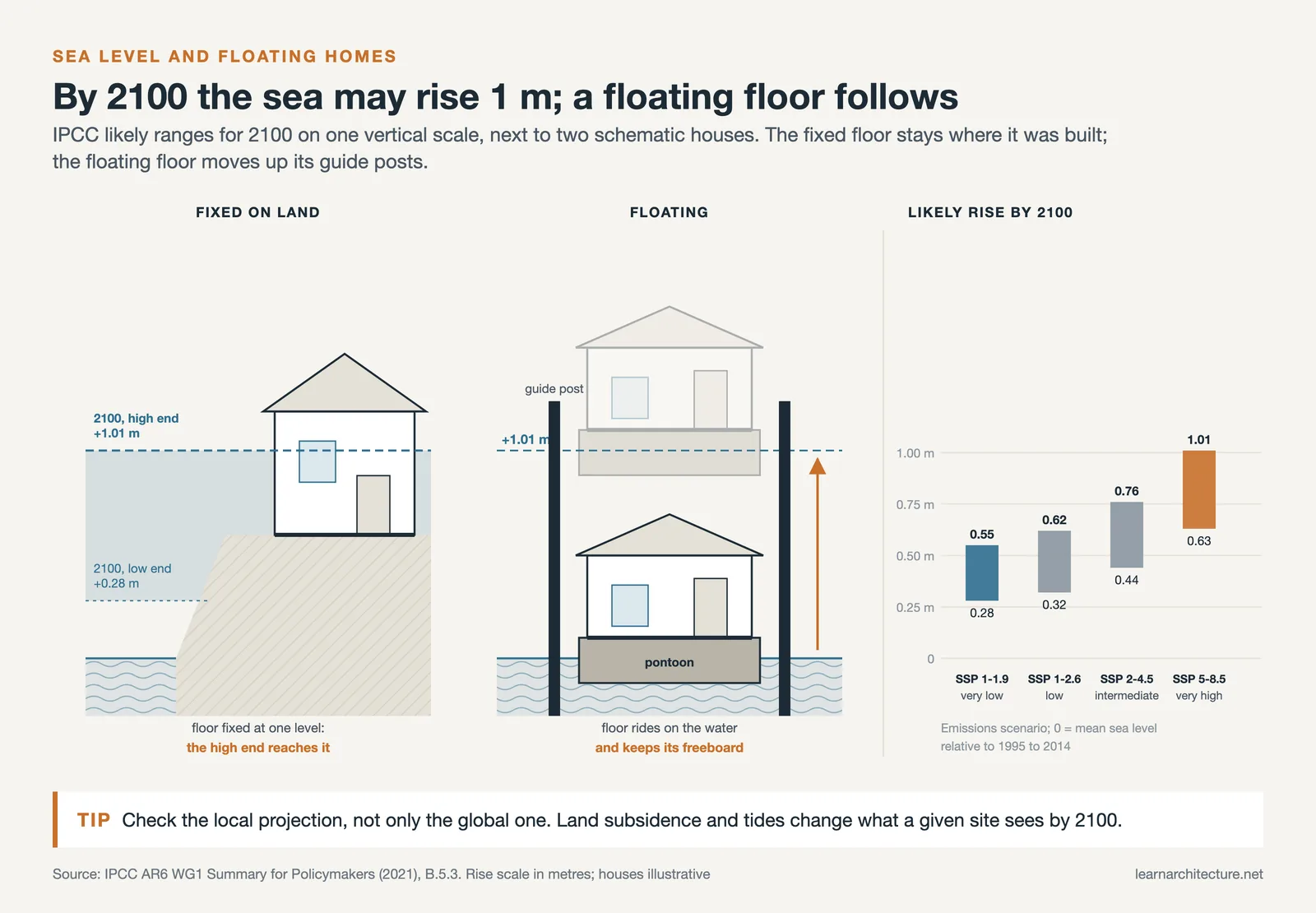
Climate change adds urgency. According to the Intergovernmental Panel on Climate Change (IPCC) Sixth Assessment Report (2021), global mean sea level is projected to rise 0.28 to 1.01 meters by 2100 under various emissions scenarios. For low-lying cities, floating structures offer a way to adapt rather than retreat. A floating building rises with the water rather than being submerged by it.
There is also a regulatory factor. In some jurisdictions, floating structures fall outside conventional building codes, which can paradoxically speed up approvals for experimental or temporary projects. Koen Olthuis, founder of the Dutch firm Waterstudio, has noted that governments sometimes grant permits more readily for floating facilities because they are classified as temporary and removable. This flexibility has enabled pilot projects in cities that would otherwise face years of zoning and permitting delays.
The best waterfront architecture examples today treat the boundary between land and water as a design opportunity, not a constraint. For a broader look at how environmental conditions shape building decisions, see our article on finding architectural concepts in the natural environment.
8 Floating Architecture Projects Worth Studying
1. Schoonschip, Amsterdam (2021)
Schoonschip is a floating residential neighborhood in Amsterdam’s Johan van Hasselt Canal, developed over more than a decade and completed in 2021. The project comprises 46 households spread across 30 floating plots, connected by a single pedestrian jetty. Each home sits on a concrete hull and is individually designed, though all share a common infrastructure backbone: a smart microgrid, heat exchangers drawing energy from canal water, solar panels, green roofs, and a shared waste-separation system.
What makes Schoonschip significant for waterfront architecture is its scale and collective governance model. Residents formed a cooperative early in the development process, which guided decisions on energy sharing, waste management, and community spaces. This kind of resident-led design process reflects a broader trend in architecture that addresses social challenges through participatory planning. The project demonstrates that floating neighborhoods can function as integrated urban systems rather than isolated houseboats.

2. Floating Office Rotterdam (2021)
Designed by Powerhouse Company, the Floating Office Rotterdam (FOR) sits on the Rijnhaven harbor and serves as the headquarters of the Global Center on Adaptation. The three-story timber structure measures approximately 3,400 square meters and is built almost entirely from cross-laminated timber (CLT), which keeps the overall weight low enough for the concrete pontoon to support it.
FOR generates its own energy through rooftop solar panels and uses the harbor water for heating and cooling via a heat-pump system. The building is designed to be fully disassembled, relocated, or recycled at the end of its service life. It received a BREEAM Outstanding rating, making it one of the most sustainable office buildings in the Netherlands. For more on how timber construction supports environmental goals, see our guide on natural construction resources.
💡 Pro Tip
When designing floating structures with CLT, factor in the weight-to-buoyancy ratio early in the schematic phase. Timber’s lower density compared to steel or concrete reduces the required pontoon size, which in turn lowers material costs and draft depth. The Floating Office Rotterdam team selected CLT specifically because it allowed a shallower hull, keeping the building closer to dock level for accessibility.
3. Floating Farm, Rotterdam (2019)
Floating Farm is a dairy farm on Rotterdam’s Merwehaven harbor, initiated by Peter and Minke van Wingerden of Beladon and designed by architecture studio Goldsmith. The three-level structure houses approximately 40 Montbéliarde cows on its upper deck, with a processing facility below and a floating foundation at water level. The farm produces milk, yogurt, and cheese, which are sold directly to Rotterdam consumers.
The project generates electricity from floating solar panels and collects rainwater for irrigation. Cow feed includes grass clippings from Rotterdam’s municipal parks and potato peels from local restaurants, creating a closed urban food loop. While the scale is modest, Floating Farm serves as a proof of concept for urban agriculture on water, particularly in cities where industrial waterfront land is underused.

4. Salmon Eye, Hardangerfjord, Norway (2022)
Salmon Eye is a floating visitor center and exhibition pavilion on Norway’s Hardangerfjord, designed by Kvorning Design. The structure’s ovoid form is clad in mirror-finished stainless steel plates meant to reference fish scales, a direct example of biomimicry in architecture applied to a marine context. It floats in the fjord among active aquaculture sites. Inside, exhibitions cover the science, environmental impact, and future of salmon farming.
The building’s position on the fjord is strategic: visitors arrive by boat, experiencing the aquaculture landscape directly before entering the exhibition. This approach to waterfront architecture turns the building’s location into part of its educational program. The mirrored facade reflects the surrounding mountains and water, making the structure appear as an extension of its environment rather than an object placed upon it.
🎓 Expert Insight
“Whether it’s New York or London, Bangkok or Dhaka, all these cities are growing, all these cities are next to the water, and all are threatened by the water.”
Koen Olthuis, Founder, Waterstudio
Olthuis, named one of TIME Magazine’s most influential people in 2007 for his work in floating urbanism, has designed over 200 floating buildings worldwide. His observation captures the core argument for floating architecture: the cities most at risk from water are often the same ones with the greatest need for new space.
5. La Balsanera, Babahoyo River, Ecuador (2023)
Designed by Natura Futura Arquitectura and architect Juan Carlos Bamba, La Balsanera is a floating house on Ecuador’s Babahoyo River. The project draws on the tradition of balsa-wood river dwellings that were once common in the region but have largely disappeared due to urbanization and flooding. The house uses a timber frame on a buoyant platform and can rise and fall with seasonal water level changes.
La Balsanera is as much a cultural recovery project as an architectural one. By adapting vernacular construction techniques with updated materials and structural detailing, the designers argue for reviving river-based living as a viable housing model in flood-prone regions of Latin America. This approach aligns with the growing emphasis on eco-friendly architecture trends that draw on local materials and climate-responsive traditions. The project highlights how floating architecture does not require high-tech solutions or large budgets. Simple, locally sourced materials and traditional knowledge can produce effective results.

6. Maldives Floating City (Under Construction)
The Maldives Floating City is a joint venture between the Government of the Maldives, Dutch Docklands, and Waterstudio. Located in a 200-hectare lagoon near Malé, the project aims to create a neighborhood of several thousand residential units, along with commercial spaces, a hospital, schools, and a hotel, all floating on modular platforms arranged in a pattern inspired by natural coral formations.
The Maldives face an existential threat from sea level rise. With an average ground elevation of roughly 1.5 meters above sea level, the nation is one of the most vulnerable countries on Earth. The Floating City is designed as a practical response: a community that rises with the water rather than being overtaken by it. Construction began in 2022, with early-phase housing units expected to be occupied within the next few years.
For context on how sustainability drives modern building design, see our roundup of sustainable architecture projects around the world.
7. Oceanix Busan, South Korea (In Development)
Oceanix Busan is a prototype floating community developed in partnership with the United Nations Human Settlements Programme (UN-Habitat) and BIG (Bjarke Ingels Group). The concept calls for interconnected floating platforms in Busan’s harbor, each roughly 2 hectares in size, supporting residential, research, and commercial functions. The platforms are designed to withstand Category 5 hurricanes and tsunamis.
What sets Oceanix apart from other floating architecture proposals is its institutional backing. UN-Habitat’s involvement signals that international organizations view floating urbanism as a serious climate adaptation strategy, not a speculative exercise. If built as planned, Oceanix Busan would become one of the first floating communities developed under a formal international framework for sustainable ocean urbanization.
⚠️ Common Mistake to Avoid
Many people assume floating buildings are inherently unstable or subject to constant rocking. In practice, wide, flat pontoon foundations distribute weight across a broad surface area, producing very little perceptible movement. The Floating Office Rotterdam, for example, reports that occupants rarely notice any motion during normal working hours. Stability depends on the hull’s beam-to-length ratio and ballast distribution, not on whether the structure sits on land or water.

8. MAST Floating Neighbourhood, Rotterdam (Proposed)
Danish maritime architecture studio MAST, working with construction company BIK Bouw, has proposed a floating residential neighborhood for Rotterdam’s disused Spoorweghaven dock. The plan includes over 100 apartments, public spaces, and commercial units, all on floating platforms accessible by boat. The project has received initial support from the Municipality of Rotterdam.
MAST’s Land on Water system uses modular, interlocking floating platforms that can be prefabricated in a factory and assembled on site. This approach reduces construction time and allows neighborhoods to grow incrementally. The Spoorweghaven proposal represents the largest planned floating housing development in Europe and could set a template for how other cities repurpose underused harbor infrastructure.
How Floating Architecture Addresses Climate Resilience
Floating architecture’s primary climate advantage is straightforward: a building that floats rises with floodwater instead of being damaged by it. This makes floating structures particularly relevant for cities on river deltas, low-lying coastlines, and island nations where conventional flood defenses are either insufficient or prohibitively expensive.
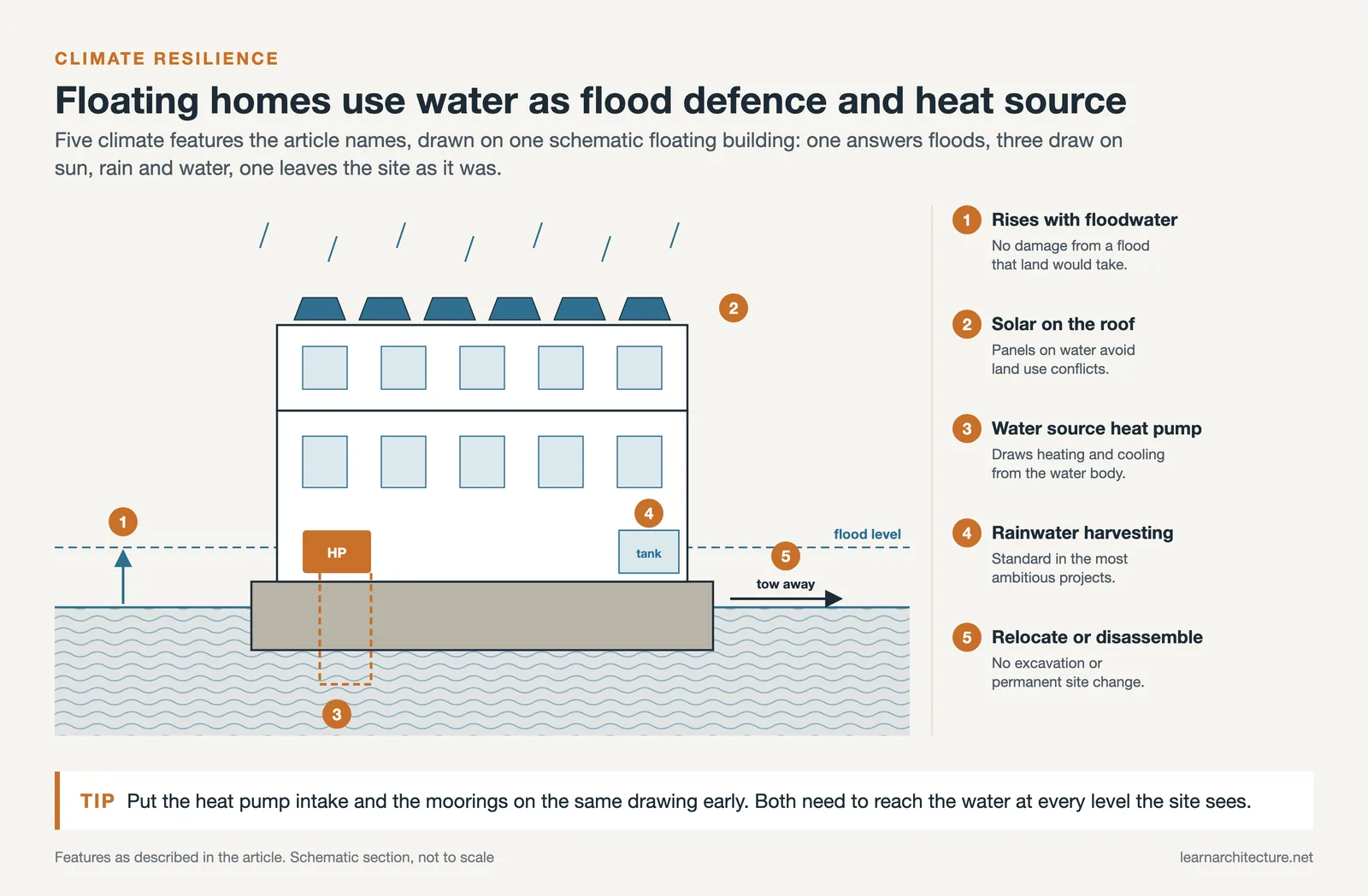
Beyond flood resilience, floating buildings can integrate sustainability features that are difficult or impossible on land. Water-source heat pumps draw thermal energy from the surrounding body of water, providing efficient heating and cooling. Solar panels on floating platforms avoid land-use conflicts. And because floating structures can be relocated or disassembled, they carry a lower long-term environmental footprint than permanent land-based construction, which typically requires excavation, soil compaction, and irreversible site alteration.
The relationship between floating architecture and sustainability is increasingly well documented. Water-source heat pumps, solar arrays, and rainwater harvesting are standard in the most ambitious floating projects, and several of the examples above have achieved top-tier environmental certifications.
💡 Pro Tip
If you are evaluating a site for a floating project, check the local water authority’s tidal range data and seasonal water level fluctuations first. A site with a tidal range exceeding 3 meters requires significantly more complex mooring and utility connections than a calm inland lake. Experienced practitioners recommend selecting sites with a maximum tidal range of 1.5 meters for first-time floating projects to keep engineering costs manageable.

Challenges Facing Floating Architecture Today
Despite growing interest, floating architecture faces real obstacles. Regulatory uncertainty is among the most persistent. Most national and municipal building codes were written for land-based construction. Floating structures often fall into a gray area between buildings and boats, creating confusion about which safety standards, fire codes, and property laws apply. In some jurisdictions, floating homes cannot be mortgaged like conventional real estate, limiting financing options for buyers.
Material durability is another concern. Saltwater environments accelerate corrosion, requiring marine-grade stainless steel, specialized coatings, and ongoing maintenance schedules. Freshwater environments are less demanding, but all floating structures must account for biofouling (algae, barnacles, mussels) on submerged surfaces, which can affect buoyancy and structural integrity over time.
Community acceptance also varies. Some waterfront communities welcome floating development as a way to activate underused harbors. Others view it as gentrification or a threat to maritime heritage. Successful projects like Schoonschip have shown that early community engagement and cooperative ownership models can address these concerns, but each site demands its own social strategy.
📌 Did You Know?
The Netherlands already has over 120 floating homes in the IJburg district of Amsterdam alone, moored in the water beside the district’s artificial islands to address the city’s chronic housing shortage. The community, developed starting in the early 2000s, proved that floating housing can be integrated into a standard urban neighborhood complete with schools, transit connections, and municipal services.
What Best Waterfront Architecture Examples Have in Common
Looking across these eight projects, a few shared principles emerge. The best waterfront architecture examples do not simply place a building at the water’s edge. They engage with the water as a material, a structural medium, and a programmatic asset.
First, successful floating projects prioritize site-specific engineering. The hull design, mooring system, and utility connections are tailored to local water conditions, not imported from a generic template. Second, they integrate energy and water systems that use the aquatic environment as a resource: heat exchange, rainwater collection, and solar generation. Third, the most compelling projects address a social or environmental need beyond novelty, whether it’s housing, food production, education, or climate adaptation.
Floating architecture is not a universal solution. Not every waterfront site is suitable, and the engineering costs remain higher than conventional construction in most cases. But as sea levels rise and urban density increases, the number of sites where building on water makes practical and economic sense will only grow. The projects listed here show what the early stages of that shift look like. For ongoing coverage of floating projects worldwide, ArchDaily’s floating architecture tag tracks new developments as they are announced and completed.
✅ Key Takeaways
- Floating architecture uses buoyant foundations (pontoons, concrete hulls, modular platforms) to place buildings directly on water rather than adjacent to it.
- Four primary structural systems support floating buildings: pontoon-based, barge, amphibious, and modular platform systems, each suited to different site conditions.
- Projects like Schoonschip and the Maldives Floating City demonstrate that floating neighborhoods can function as complete urban systems with shared energy, waste, and governance infrastructure.
- Climate resilience is a core driver: floating buildings rise with floodwater and can integrate water-source heat pumps, solar energy, and rainwater harvesting.
- Regulatory gaps, material durability in marine environments, and community acceptance remain the primary barriers to wider adoption of floating architecture.

Final Thoughts
Floating architecture has moved well beyond concept renders and experimental pavilions. Built projects in Rotterdam, Amsterdam, Norway, Ecuador, and the Maldives prove that living and working on water is technically achievable, economically viable in the right context, and increasingly necessary as climate pressures mount. The question is no longer whether floating buildings work. It is how quickly cities, regulators, and developers can adapt their frameworks to support them.
For architects and students, these projects offer a rich area of study where structural engineering, environmental design, and urban planning intersect in ways that land-based architecture rarely demands. Waterfront architecture will only become more critical as coastal populations grow and sea levels rise. The firms and designers who understand how to build on water, not just beside it, will have a significant advantage in the decades ahead.
Note: Project timelines and construction status are based on the most recent available information as of early 2026. Development schedules for large-scale floating projects, particularly the Maldives Floating City and Oceanix Busan, are subject to change based on regulatory, funding, and engineering factors.










Leave a comment