


Table of Contents Show
Architecture design and development is the project phase where schematic concepts transform into detailed, buildable plans. During this stage, architects finalize materials, coordinate structural and MEP systems, refine cost estimates, and secure client approval before moving into construction documents. A well-managed DD phase reduces change orders, prevents budget overruns, and keeps every discipline aligned.
The design development phase sits at the center of the five-phase architectural process defined by the American Institute of Architects (AIA). It follows schematic design and precedes construction documentation. According to typical AIA fee structures, DD accounts for roughly 20% of an architect’s total effort on a project. That relatively modest share of time carries outsized importance: decisions made during design development fix much of a building’s final construction cost, because later phases mostly document choices that are already settled.
Below are eight practical tips to help architects, project managers, and clients get the most from the architectural design development process.
What Is Design Development in Architecture?
Design development in architecture is the phase where a project moves from rough layouts and massing studies to a resolved building design. Think of schematic design as the “what” and design development as the “how.” During DD, the team determines exact wall assemblies, selects window and door products, sizes mechanical equipment, and coordinates the structural grid with architectural intent. The deliverable is typically a set of drawings (floor plans, sections, elevations, details) paired with an outline specification that describes materials and assemblies.
The DD phase also serves a financial checkpoint. Architects work alongside cost estimators or pre-construction managers to confirm that the evolving design still fits the owner’s budget. If a schematic concept called for a curtain wall facade but the budget only supports a storefront system, DD is the moment to resolve that gap. Waiting until construction documents makes such pivots far more expensive and disruptive.
Tip 1: Set Clear Goals Before DD Begins

One of the biggest pitfalls in architectural design development is entering the phase without firm agreement on what schematic design actually resolved. Before DD kicks off, make sure the client has signed off on the overall floor plan, massing, and program. Any lingering debates about building orientation, number of stories, or major program elements should be settled first. Trying to redesign fundamentals during DD wastes time and erodes the coordination that this phase depends on.
Create a brief DD kickoff checklist: confirmed program areas, approved schematic floor plans, agreed site strategy, preliminary structural system, target construction budget, and a realistic schedule. Distribute it to every team member and consultant. This single document keeps everyone rowing in the same direction.
Tip 2: Coordinate Engineering Disciplines Early

Design development architecture demands tight collaboration between the architect and the structural, mechanical, electrical, and plumbing (MEP) engineers. Do not wait until drawings are half-finished to loop in consultants. Schedule a coordination kickoff meeting in the first week of DD and establish a regular meeting cadence, ideally every two weeks, throughout the phase.
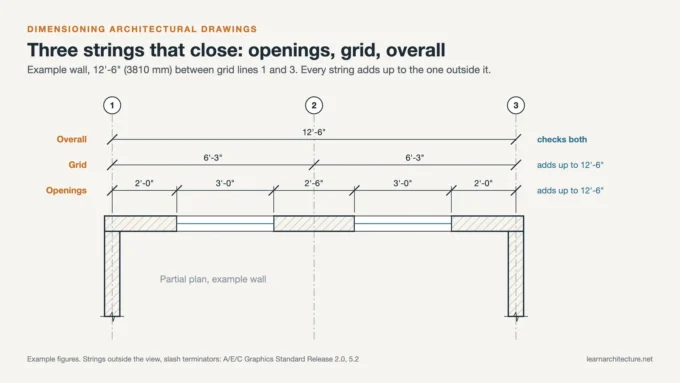
Structural decisions deserve special attention. Column grid spacing, floor-to-floor heights, and lateral system type (moment frame, braced frame, shear wall) all ripple through the architectural design. Locking these in early during DD prevents cascading revisions.
How to Develop an Architectural Design Concept into DD Documents

Concept development architecture design is the bridge between a schematic idea and the technical rigor of DD. Start by translating the design concept into a clear set of “rules” that guide every detail decision. For example, if the concept centers on transparency and connection to landscape, those rules might specify floor-to-ceiling glazing on the south elevation, minimal mullion profiles, and recessed window frames to emphasize the glass plane. Every material selection and detail during DD should be tested against these rules.
Next, build a materials palette early. Gather physical samples, manufacturer cut sheets, and cost data for your primary exterior and interior finishes. Present them to the client in a single session rather than trickling selections across weeks. Batch decision-making keeps the process efficient and gives the cost estimator enough data to produce a meaningful mid-DD budget check.
Translating Schematic Sketches into Technical Drawings
During the architecture design development process, floor plans gain real dimensions, wall types get defined assemblies, and generic “glass wall” annotations become specific curtain wall or storefront systems. Sections are cut at every critical condition: stair cores, elevator pits, building transitions, and roof parapets. Elevations show actual material joints and panel patterns rather than schematic line work.
A good benchmark: by the end of DD, a contractor should be able to look at your drawings and produce a cost estimate within 10-15% of the final construction number. If drawings are too vague for that, the DD phase needs more development before moving on.
Tip 3: Lock In Material Selections Systematically
Material selection is one of the defining tasks of the architectural design development process. Approach it methodically rather than ad hoc. Organize selections by building system: exterior envelope first (because it drives the building’s thermal performance, waterproofing strategy, and aesthetic), then structure, then interior finishes, and finally fixtures and equipment.
For each material, document the product name, manufacturer, finish or color, unit cost, lead time, and warranty. Compile this information into an outline specification. According to the Whole Building Design Guide (WBDG), an outline specification during DD typically covers CSI Divisions 3 through 8 at minimum, with narrative descriptions for other divisions.
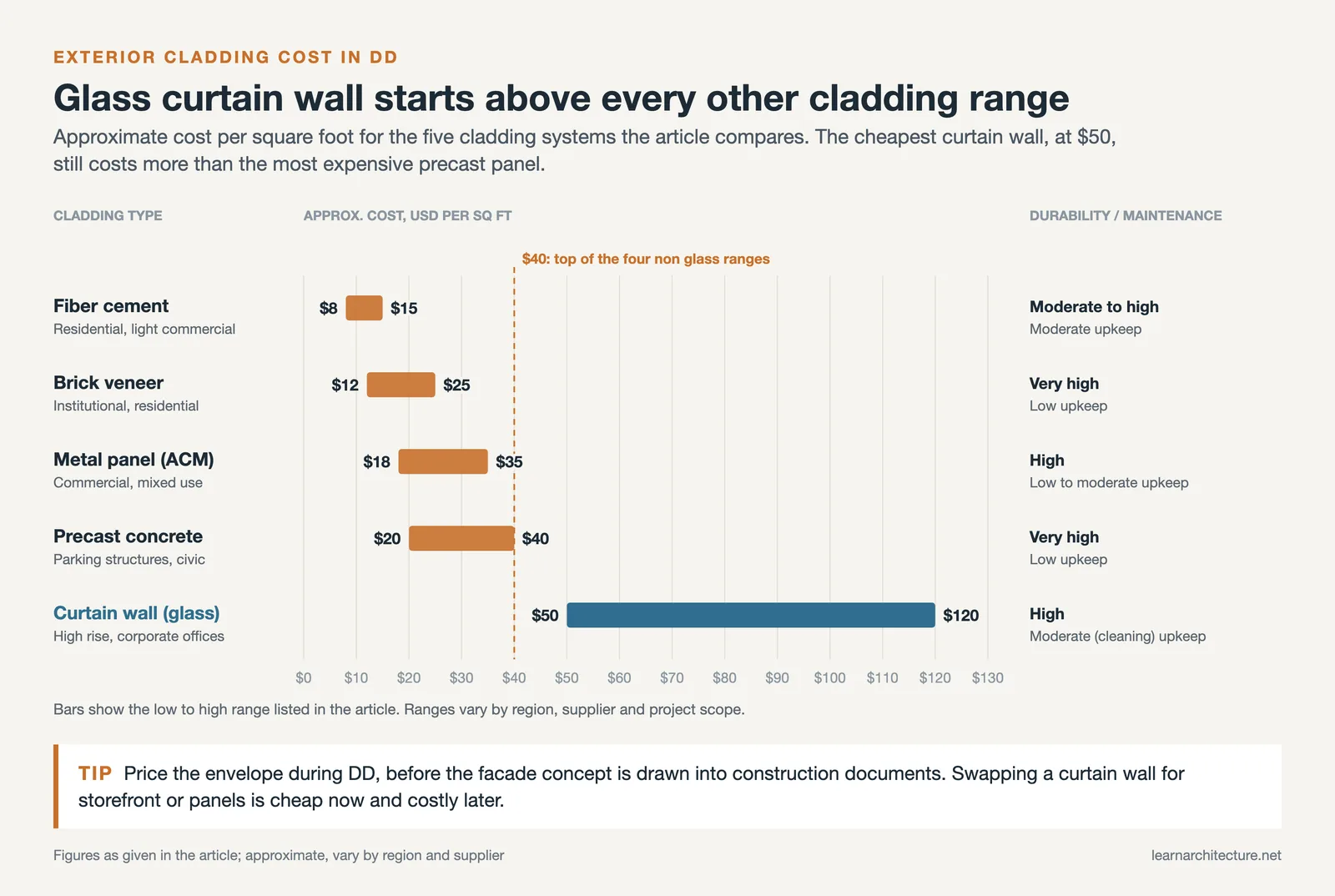
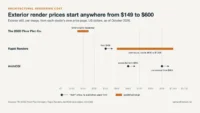
Comparison of Common Exterior Cladding Options
Selecting the right cladding system during DD involves balancing cost, durability, aesthetics, and maintenance. The table below outlines common options architects evaluate during design development.
| Cladding Type | Approx. Cost (USD/sq ft) | Durability | Maintenance Level | Best For |
|---|---|---|---|---|
| Brick Veneer | $12 – $25 | Very High | Low | Institutional, residential |
| Metal Panel (ACM) | $18 – $35 | High | Low to Moderate | Commercial, mixed-use |
| Fiber Cement | $8 – $15 | Moderate to High | Moderate | Residential, light commercial |
| Curtain Wall (Glass) | $50 – $120 | High | Moderate (cleaning) | High-rise, corporate offices |
| Precast Concrete | $20 – $40 | Very High | Low | Parking structures, civic |
Cost figures are approximate and vary by region, material supplier, and project scope. Consult local suppliers and cost estimators for project-specific pricing.
Tip 4: Use BIM for Clash Detection During DD

If your team uses Building Information Modeling (BIM), the DD phase is where clash detection becomes genuinely useful. By mid-DD, structural and MEP models should be developed enough to run automated interference checks. Identifying a duct-beam conflict on screen costs minutes to resolve; discovering it on site costs days and thousands of dollars.
Even on smaller projects where full BIM coordination is not practical, overlay the structural engineer’s framing plan onto your reflected ceiling plan and your MEP consultant’s duct layouts. Look for pinch points: areas where ductwork, beams, sprinkler mains, and lighting all compete for the same ceiling cavity. Resolve these in DD, not during construction administration.
Tip 5: Maintain a Running Cost Check
Do not treat budget verification as a single event at the end of the design development phase. Instead, maintain a running cost log that updates as major decisions are made. When the team selects a roofing system, update the estimate. When structural engineers size the foundations, update the estimate. This rolling approach prevents the unpleasant surprise of a DD-end budget check revealing a 25% overage.
Schedule at least two formal cost reviews during design development, for example at mid-DD and before sign-off, so budget problems surface while they are still cheap to fix. Build those checkpoints into the DD schedule from day one.
For clients and owners reading this: ask your architect for a mid-DD cost update. It is reasonable and responsible. You should know whether the design is tracking to budget before the team invests another month of effort detailing something that may need to be value-engineered anyway.
Tip 6: Address Code Compliance and Accessibility
Building codes, zoning regulations, and ADA accessibility standards must be addressed during design development, not deferred to construction documents. Waiting until CD to verify egress widths, fire ratings, or accessible restroom clearances often triggers redesigns that ripple through the entire drawing set.
During DD, confirm the following code-driven items: occupancy classification and allowable area/height, required fire-resistance ratings for walls and floors, egress path widths and travel distances, accessible routes from site entry to every floor, and energy code compliance strategy (prescriptive vs. performance path). Document your code analysis in a written summary and include it in the DD submission to the client.
Tip 7: Establish a Clear Decision-Making Process
The architecture design and development phase requires hundreds of decisions, from tile grout color to structural connection type. Without a clear process for who decides what and by when, projects stall. Establish a decision matrix at DD kickoff that assigns authority levels: which decisions the architect can make independently, which need client approval, and which require full stakeholder review.
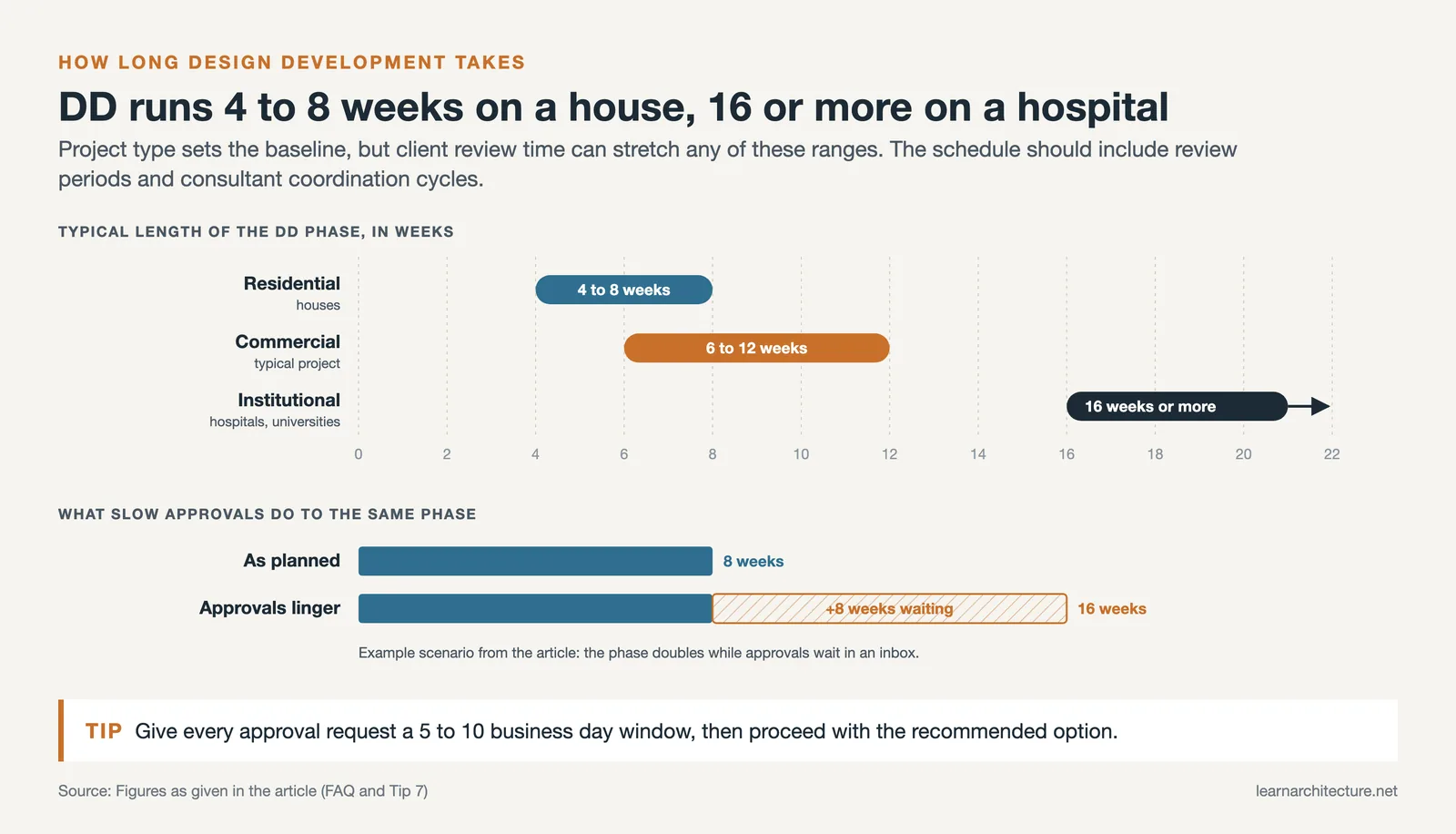
Set a firm rule: decisions have a deadline. If a client does not respond to a material approval request within an agreed window (typically 5 to 10 business days), the architect proceeds with the recommended option. This prevents the common scenario where DD stretches from the planned 8 weeks to 16 weeks because approvals linger in someone’s inbox. The Royal Institute of British Architects (RIBA) Plan of Work similarly emphasizes stage-gate approvals to keep projects on track.
Tip 8: Document Everything for a Smooth CD Transition

The final tip for a successful architecture design development process is thorough documentation. DD drawings and specifications become the foundation for construction documents. If DD deliverables are messy, incomplete, or inconsistent, the CD phase starts with a cleanup effort that wastes time and introduces errors.
Before closing out DD, run an internal quality review. Check that floor plans, sections, and elevations are consistent with each other. Verify that the outline specification matches the materials shown on drawings. Confirm that all consultant drawings reference the same structural grid and floor elevations. This discipline during DD pays dividends throughout the rest of the project.
Key Deliverables at the End of Design Development
A complete DD package typically includes updated and dimensioned floor plans at all levels, building sections at key conditions, exterior elevations with material annotations, enlarged plans for complex areas (stairs, restrooms, lobbies), structural framing plans and foundation layouts, MEP single-line diagrams and equipment layouts, an outline specification covering primary building systems, and an updated construction cost estimate. Having all of these elements finalized and coordinated before entering CDs is what separates a smooth project from a chaotic one.
Frequently Asked Questions
How long does the design development phase typically take?
DD duration depends on project size and complexity. For a typical commercial project, expect 6 to 12 weeks. Residential projects may complete DD in 4 to 8 weeks. Larger institutional projects, such as hospitals or university buildings, can take 16 weeks or more. The schedule should account for client review periods and consultant coordination cycles.
What is the difference between schematic design and design development?
Schematic design establishes the overall layout, massing, and spatial relationships of a building at a conceptual level. Design development in architecture takes that approved concept and adds technical specificity: real dimensions, defined wall assemblies, selected materials, coordinated engineering systems, and a refined cost estimate. SD answers “what are we building?” while DD answers “how are we building it?”
How much does the design development phase cost?
DD fees typically represent about 20% of the total architectural fee. For a project with a $100,000 architectural fee, expect roughly $20,000 allocated to DD. However, this percentage can shift based on project complexity, the number of consultants involved, and whether the architect is providing additional services like interior design or landscape architecture during this phase.
Can the design change significantly during DD?
Minor adjustments are normal and expected during DD. Room dimensions may shift by a few feet, window sizes get refined, and materials evolve as cost data comes in. Major changes, such as adding a floor, relocating the building on site, or fundamentally altering the program, should be avoided. Such changes effectively restart the design process and will impact both the fee and the schedule.
Why is design development important for controlling construction costs?
DD is the last phase where major design changes can be made without significant financial consequences. Once construction documents are issued and the project goes to bid, changes become formal change orders that add cost and delay. A thorough DD phase with accurate material selections and coordinated systems gives contractors the information they need to produce reliable pricing, reducing the risk of budget surprises during construction.
- architectural design development
- architectural design development process
- architecture design and development
- architecture design development
- architecture design development process
- concept development architecture design
- design development architecture
- design development in architecture
- how to develop an architectural design concept
- what is design development in architecture









Leave a comment