


Table of Contents Show
The world’s most enduring architectural wonders share one thing that no modern building can claim: they have already passed the test of time. Structures like the Great Pyramid of Giza, the Colosseum in Rome, and Angkor Wat in Cambodia were built without computers, steel reinforcement, or power tools, yet they have outlasted every empire that created them. This guide explores eight of these remarkable sites, examining what they were built for, how they were constructed, and why they continue to stand.

What Makes an Architectural Wonder Truly Timeless?
Not every old building becomes an architectural wonder. The structures that survive millennia tend to share a few qualities: exceptional material selection, a purpose that made local populations unwilling to demolish them, and construction techniques that distributed structural loads so efficiently that gravity itself becomes an ally rather than an enemy.
Ancient builders understood their materials in ways that remain instructive today. Egyptian pyramid builders sourced limestone from local quarries, matching the thermal expansion coefficients of their blocks to the desert climate. Roman engineers developed a volcanic ash concrete known as pozzolana that actually gains strength when exposed to seawater, a property modern researchers are still studying for coastal construction. These were not lucky accidents; they reflect centuries of accumulated empirical knowledge passed between generations of craftsmen.
💡 Pro Tip
When studying ancient sites for design inspiration, pay particular attention to their orientation. Most enduring structures, from the Parthenon to Angkor Wat, were deliberately aligned with solar or astronomical events. This orientation reduced thermal stress on stone joints and created predictable light conditions that prolonged the life of interior surfaces. It was proto-passive design, and it worked remarkably well.
The relationship between ancient architecture and the landscape it occupies also deserves attention. Unlike modern buildings that often impose form on a site, ancient wonders tend to grow out of their terrain. Machu Picchu follows the natural contours of its Andean ridge. The Parthenon sits on the highest point of Athens not merely for symbolic effect but because the solid bedrock of the Acropolis provided a foundation that would never settle or shift.
For a deeper look at how architectural styles evolved across civilizations, the overview of seven architectural styles in history provides useful context on the cultural forces that shaped these traditions.

Ancient Egyptian Architecture: The Great Pyramid of Giza
The Great Pyramid of Giza remains the only structure from the original Seven Wonders of the Ancient World still standing. Commissioned by Pharaoh Khufu and completed around 2560 BCE, it stood approximately 146.6 meters tall at completion and held the title of the world’s tallest man-made structure for over 3,800 years. Its base covers roughly 53,000 square meters, and each side aligns with cardinal compass points to within a fraction of a degree, a precision that modern surveyors find difficult to explain given the tools available at the time.
Ancient Egyptian architecture as expressed in the pyramid was fundamentally a theological statement. The sloped sides were designed to represent the rays of the sun descending from the sky, providing the deceased pharaoh a symbolic ramp to the heavens. The internal chamber arrangement, including the King’s Chamber constructed from polished Aswan granite, was positioned with astronomical precision: a narrow shaft points directly toward the star Orion’s Belt, associated with the god Osiris in Egyptian cosmology.
📌 Did You Know?
The Great Pyramid is not a four-sided structure in the traditional sense. Each of its four faces is subtly concave, divided down the middle by a barely perceptible indentation, giving it a total of eight sides when viewed from above during the spring and autumn equinoxes. This feature was only formally documented in the 20th century when a British Royal Air Force pilot noticed it during a flight over Giza. The engineering purpose behind this concavity remains debated among archaeologists and structural engineers.
Construction required an estimated 2.3 million stone blocks, some weighing up to 80 tons. Archaeological evidence discovered in 2013, including the logbook of a labor supervisor named Merer, confirms that workers were organized, paid, and fed by the state rather than being enslaved laborers as popular myth suggests. These were skilled tradesmen operating within a sophisticated logistics network that moved blocks from quarries via the Nile and specially constructed waterways.

Ancient Greek Architecture: The Parthenon in Athens
The Parthenon in Athens, completed in 432 BCE, is perhaps the most analyzed building in architectural history. Dedicated to the goddess Athena, it was designed by the architects Iktinos and Kallikrates under the supervision of the sculptor Phidias. What makes ancient Greek architecture as expressed in the Parthenon so extraordinary is not merely its scale but the deliberate optical refinements built into every element of its structure.
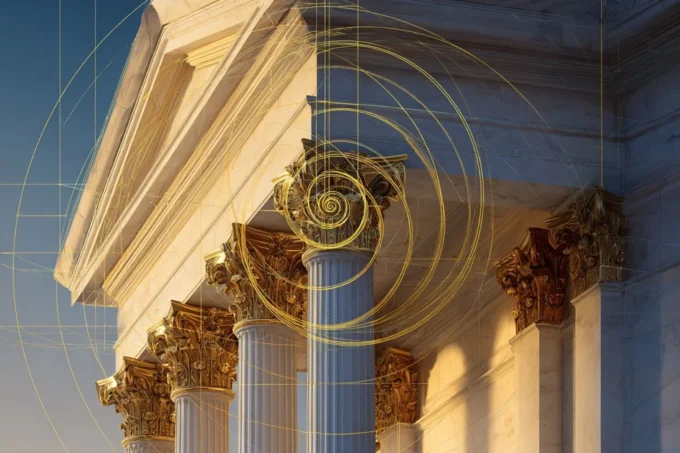
Every horizontal surface on the Parthenon curves slightly upward at the center, the columns bulge subtly outward at their midpoints (a technique called entasis), and the corner columns are slightly thicker than their neighbors. None of these features are visible to the naked eye in isolation. Together, they correct optical illusions that would otherwise make perfectly straight lines appear to sag and perfectly vertical columns appear to lean outward. The Greeks called this the pursuit of ideal visual harmony, and achieving it required a level of precision that PBS NOVA’s documentary analysis found rivaled modern machining tolerances.
🎓 Expert Insight
“The Parthenon was the greatest monument in the greatest sanctuary in the greatest city of classical Greece.” — Jeffrey Hurwit, Art Historian, University of Oregon
Hurwit’s assessment, made in the context of the PBS NOVA documentary on the Parthenon, underlines why this temple continues to define classical standards for proportion and harmony in Western architecture. Its influence runs directly through Roman temple design, Renaissance civic buildings, and the neoclassical facades of courthouses, museums, and parliaments built across Europe and North America.
The study of iconic architectural styles of Europe provides additional context on how ancient Greek architecture propagated through subsequent Western traditions, from Rome through the Renaissance and into modern civic design.

Ancient Rome Architecture: The Colosseum and the Pantheon
Roman architecture produced two structures that have shaped every public building constructed in the Western world since: the Colosseum and the Pantheon. Both rely on the same structural innovation, concrete, but deploy it in fundamentally different ways.
The Colosseum Rome, completed in 80 CE under Emperor Titus, seated between 50,000 and 80,000 spectators and was designed to fill and empty with extraordinary efficiency. Its 80 numbered entrances and vaulted corridor system allowed the entire crowd to exit in under fifteen minutes, a crowd management achievement that influenced stadium design well into the 20th century. The elliptical plan distributed weight evenly around a continuous foundation, while the combination of concrete barrel vaults and travertine stone facing created a structure that could flex slightly under load without cracking catastrophically.
The Pantheon Rome, rebuilt by Emperor Hadrian around 125 CE, solved an even more ambitious structural problem: covering a 43.3-meter diameter circular space with an unreinforced concrete dome. This remains the largest unreinforced concrete dome in the world, a record the Pantheon has held for nearly 1,900 years. The secret lies in the composition of the concrete itself. Heavier aggregate was used in the lower sections of the dome, gradually transitioning to lighter pumice stone near the oculus, reducing the load at exactly the point where tensile stresses are highest. The oculus at the apex, 8.7 meters in diameter, is not just an architectural gesture but a structural device that relieves stress at the dome’s crown.
🔲 Quick Numbers
- The Pantheon’s dome has a diameter of 43.3 meters, unchanged since 125 CE and still the largest unreinforced concrete dome on Earth (Roman Archaeological Survey, 2022)
- The Colosseum used approximately 100,000 cubic meters of travertine stone and 300 tons of iron clamps in its construction (Colosseum Archaeological Park, 2023)
- Roman volcanic ash concrete (pozzolana) gains compressive strength over centuries in seawater exposure, outperforming modern Portland cement by a significant margin in marine environments (UC Berkeley study, 2017)
For architects studying the structural logic behind these Roman achievements, the overview of styles in architecture covers how Roman innovations in the arch, vault, and dome translated into later Western building traditions.
Hagia Sophia Istanbul: Engineering at the Edge of Possibility
When the Byzantine Emperor Justinian commissioned the Hagia Sophia Istanbul in 532 CE, he tasked his architects with building the largest enclosed space in the world. The architects Anthemios of Tralles and Isidoros of Miletus completed it in just five years and ten months, an extraordinary timeline for a building of such structural ambition. For roughly 800 years after its completion, the Hagia Sophia held the record as the world’s largest enclosed building. The Statue of Liberty, standing 93 meters tall, can fit beneath its dome with room to spare.
The central dome spans 31.24 meters and sits atop a square base through a structural innovation called the pendentive: a curved triangular surface that transitions the circular dome to the square plan below. This solution to one of architecture’s most persistent geometric problems was so elegant that it became the standard approach for domed buildings throughout the Byzantine and Islamic worlds. The building has survived on one of the world’s most seismically active fault lines for nearly 1,500 years, absorbing multiple significant earthquakes without catastrophic collapse, partly through the flexibility of its mortar joints and partly through the mass of its buttressed walls.
💡 Pro Tip
When analyzing the Hagia Sophia’s seismic resilience, pay particular attention to its mortar composition. Byzantine builders used lime mortars with a higher water-to-cement ratio than modern standards would permit, producing joints that are slightly more flexible than the stone they bind. This controlled flexibility allows the structure to rack slightly during seismic events and return, rather than developing the rigid crack patterns that cause catastrophic collapse in stiffer masonry systems.

Machu Picchu Peru: Inca Architecture and the Living Mountain
Perched at 2,430 meters above sea level on a ridge between two Andean peaks, Machu Picchu Peru was built by the Inca emperor Pachacuti around 1450 CE and abandoned less than a century later, likely due to the spread of smallpox that devastated Inca civilization before Spanish forces ever reached the site. Its isolation preserved it; local communities knew of its existence but Spanish colonizers never documented or looted it, leaving the site largely intact when Hiram Bingham brought it to international attention in 1911.
Inca architecture at Machu Picchu employed a technique called ashlar masonry: stones shaped and fitted together without mortar, relying solely on precision cutting and gravitational interlocking. The site sits on two geological fault lines. The stone foundations were intentionally designed to allow subtle movement during earthquakes, with stones shifting slightly and resettling after tremors. The precise interlocking of the blocks ensures they redistribute back to their original positions rather than cascading into collapse. This is passive seismic engineering, developed without modern knowledge of plate tectonics, and it has protected Machu Picchu through centuries of seismic activity in one of the world’s most geologically active regions.
🏗️ Real-World Example
Sacsayhuaman Fortress (Cusco, Peru, c. 1438 CE): Located on the northern outskirts of Cusco, this Inca military complex uses stones weighing up to 125 tons, fitted together without mortar to such precision that a standard credit card cannot be inserted between the blocks. After more than 500 years and multiple significant Andean earthquakes, the walls remain structurally intact, demonstrating that the Inca mastery of dry-stone construction at Machu Picchu was part of a broader, systematically applied engineering tradition rather than a singular achievement.
Angkor Wat Cambodia: Sacred Geometry at Monumental Scale
Built in the early 12th century under Khmer King Suryavarman II, Angkor Wat Cambodia is the largest religious monument ever constructed, covering approximately 1.6 square kilometers including its outer enclosure. It was originally a Hindu temple dedicated to Vishnu, later converted to Theravada Buddhism, a transition that paradoxically helped preserve it: the site remained in active religious use throughout the Khmer Empire’s decline, preventing the abandonment-driven decay that destroyed other Angkor-era complexes.
The architectural achievement at Angkor Wat is partly structural and partly hydrological. The temple sits on an artificial island created by a moat more than five kilometers in circumference. This water management system served ritual purposes but also regulated groundwater levels beneath the sandstone foundations, preventing the differential settlement that has destabilized other large masonry structures in tropical environments. Recent LiDAR surveys published by the Greater Angkor Project have revealed that the entire Angkor region was supported by an elaborate hydraulic network of canals, reservoirs, and channels, with Angkor Wat’s moat serving as a key node in a regional system that supported a population archaeologists estimate at over 900,000 people at its peak.
The role of shapes in architecture covers how geometric systems similar to those embedded in Angkor Wat’s proportional grid have been used across Asian architectural traditions to encode cosmological meaning into built form.

How Ancient Architecture Influences Modern Design
The lessons embedded in these ancient architectural wonders are not merely historical curiosities. They represent tested solutions to structural and environmental problems that modern architecture continues to encounter. The Pantheon’s aggregate gradation in concrete influenced the development of lightweight concrete mixes used in modern long-span roofs. The Inca dry-stone technique is being studied by engineers developing earthquake-resistant construction methods for low-resource contexts in seismically active regions. The Hagia Sophia’s flexible mortar joints have informed approaches to structural damping in heritage building restoration.
What unites these structures across cultures and centuries is a shared commitment to working with materials rather than against them, to reading landscape rather than ignoring it, and to building for permanence rather than convenience. Modern architectural education increasingly returns to these principles under the banner of sustainability, but ancient builders did not treat longevity as a design feature. For them, it was simply the expected result of doing the work correctly.
⚠️ Common Mistake to Avoid
A common misconception is that ancient architecture survived because it was over-engineered through sheer mass. In reality, the most enduring structures, from the Pantheon to the Parthenon, relied on sophisticated understanding of load paths and material behavior rather than brute thickness. The Parthenon’s columns have subtle entasis curves. The Pantheon’s dome tapers dramatically from base to crown. Many of these buildings survived because their builders understood structural efficiency, not because they used more material than necessary.
For students and practitioners exploring the relationship between architectural history and contemporary practice, the rich history behind Europe’s architectural styles and the landmark buildings that defined architectural eras offer complementary reading on how these ancient foundations were adapted and transformed across different periods and cultures.
External resources worth consulting include the UNESCO World Heritage List, which documents the conservation status and significance of all the sites covered in this article, the ArchDaily ancient architecture archive for visual and technical analysis of these structures, and the PBS NOVA Ancient section for peer-reviewed documentary research on construction techniques at the Parthenon, Hagia Sophia, and the Pyramids of Giza.
✅ Key Takeaways
- The Great Pyramid of Giza is the only surviving structure from the original Seven Wonders of the Ancient World, built with a precision that still challenges modern engineers to fully explain.
- The Parthenon’s durability owes as much to its optical refinements and material selection as to its structural form, techniques that reflect centuries of accumulated Greek building knowledge.
- Roman concrete, particularly the volcanic ash pozzolana mix used in the Pantheon and the Colosseum, gains strength over time in ways that modern Portland cement cannot replicate.
- Inca builders at Machu Picchu developed a passive seismic engineering system using mortar-free interlocking stone, keeping their structures intact through hundreds of years of Andean earthquakes.
- Angkor Wat’s survival is tied to both its continuous religious use and a sophisticated regional water management system that regulated groundwater beneath its sandstone foundations.
- The Hagia Sophia has withstood major earthquakes for nearly 1,500 years partly because Byzantine builders used flexible lime mortar joints rather than rigid connections, a principle now applied in heritage restoration engineering.












Leave a comment