


Table of Contents Show
The tallest skyscrapers in the United States tell a story of ambition, engineering skill, and cultural identity. Since Chicago gave the world its first skyscraper in 1885, American cities have pushed vertical boundaries decade after decade. Today, eight of the ten tallest towers stand in New York City, with Chicago claiming two spots on the list. According to the Council on Vertical Urbanism (CVU), the United States currently has 255 buildings exceeding 200 meters in height and 33 completed supertalls. Below, you will find a ranked breakdown of the ten highest completed skyscrapers in the country as of September 2026, measured by standard architectural height (which includes spires but excludes antennas).

Quick Comparison: 10 Tallest Skyscrapers in the United States
Before diving into each building, here is a side-by-side look at all ten towers and their key specifications as of September 2026, plus the Bank of America Tower, which now sits just outside the top ten in eleventh place.
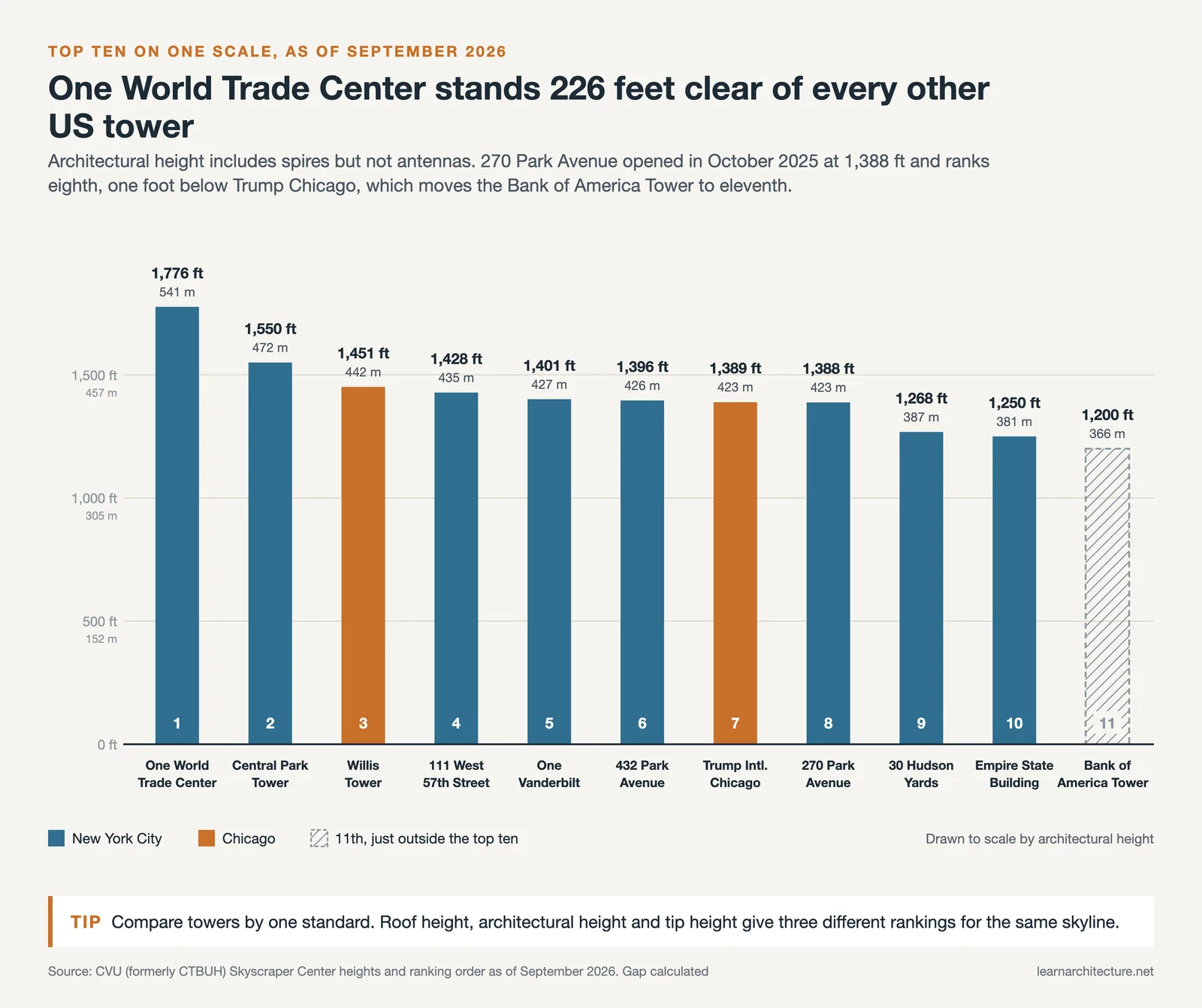
Top 10 U.S. Skyscrapers at a Glance
| Rank | Building | City | Height | Floors | Year |
|---|---|---|---|---|---|
| 1 | One World Trade Center | New York City | 1,776 ft (541 m) | 104 | 2014 |
| 2 | Central Park Tower | New York City | 1,550 ft (472 m) | 98 | 2021 |
| 3 | Willis Tower | Chicago | 1,451 ft (442 m) | 110 | 1974 |
| 4 | 111 West 57th Street | New York City | 1,428 ft (435 m) | 84 | 2022 |
| 5 | One Vanderbilt | New York City | 1,401 ft (427 m) | 58 | 2020 |
| 6 | 432 Park Avenue | New York City | 1,396 ft (426 m) | 85 | 2015 |
| 7 | Trump International Hotel and Tower | Chicago | 1,389 ft (423 m) | 98 | 2009 |
| 8 | 270 Park Avenue (JPMorganChase Tower) | New York City | 1,388 ft (423 m) | 60 | 2025 |
| 9 | 30 Hudson Yards | New York City | 1,268 ft (387 m) | 73 | 2019 |
| 10 | Empire State Building | New York City | 1,250 ft (381 m) | 102 | 1931 |
| 11 (just outside the top 10) | Bank of America Tower | New York City | 1,200 ft (366 m) | 55 | 2009 |
1. One World Trade Center: The Tallest Skyscraper in the United States
Standing at a symbolic 1,776 feet, One World Trade Center has held the title of the tallest skyscraper in the United States since its completion in 2014. The height references 1776, the year the Declaration of Independence was signed. Designed by David Childs of Skidmore, Owings & Merrill (SOM), the tower rises from the rebuilt World Trade Center complex in Lower Manhattan with 104 floors of office and observation space.
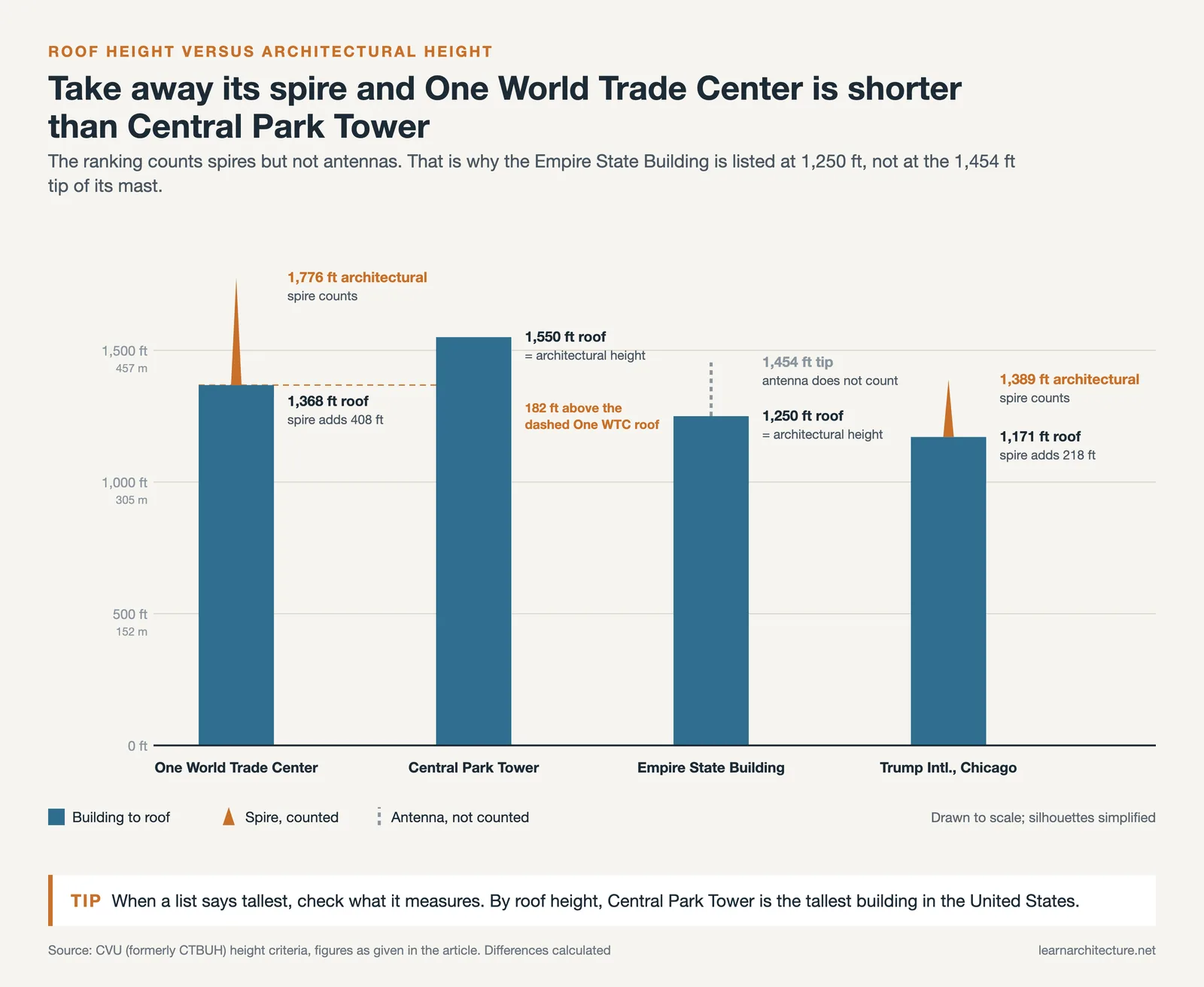
The building’s base is a reinforced concrete structure reaching 185 feet, engineered to withstand extreme forces. Its tapered glass facade creates an octagonal form at the midpoint before returning to a square at the rooftop parapet. The One World Observatory on floors 100 through 102 offers 360-degree views stretching across three states. While its roof sits at 1,368 feet (matching the original North Tower), the 408-foot spire brings the total architectural height to 1,776 feet.

2. Central Park Tower: The World’s Tallest Residential Building
Central Park Tower on West 57th Street reaches 1,550 feet, making it the second tallest building in America and the tallest residential skyscraper on the planet. Designed by Adrian Smith + Gordon Gill Architecture, the 98-story tower topped out in September 2019 and completed construction in late 2021. Its roof height actually surpasses that of One World Trade Center by roughly 180 feet, though it lacks a spire.
The lower floors house a Nordstrom flagship store, while the upper levels contain luxury condominiums with prices reaching tens of millions of dollars. The cantilevered upper section steps back above floor 60, creating outdoor terraces at the highest private residences in the Western Hemisphere. Engineering firm WSP handled the structural design, using a reinforced concrete core with outrigger walls to manage wind loads at this extreme height.
3. Willis Tower: Chicago’s Iconic Supertall
Formerly known as the Sears Tower, Willis Tower held the title of the tallest building in the world from 1974 until 1998. Its 110 stories rise to 1,451 feet at the roof, and the building remains the tallest skyscraper in the United States outside New York City. Architect Bruce Graham and structural engineer Fazlur Rahman Khan of SOM developed the innovative “bundled tube” structural system for this project, a concept that changed high-rise engineering worldwide.
The system consists of nine square tubes bundled together, with tubes terminating at different heights to create a stepped profile. This approach distributes wind loads efficiently across the full structure. The Skydeck on the 103rd floor, featuring glass-bottom Ledge boxes installed in 2009, attracts over 1.7 million visitors annually. According to the American Institute of Architects (AIA), the bundled tube concept pioneered here influenced supertall design for decades.

4. 111 West 57th Street (Steinway Tower): The World’s Thinnest Skyscraper
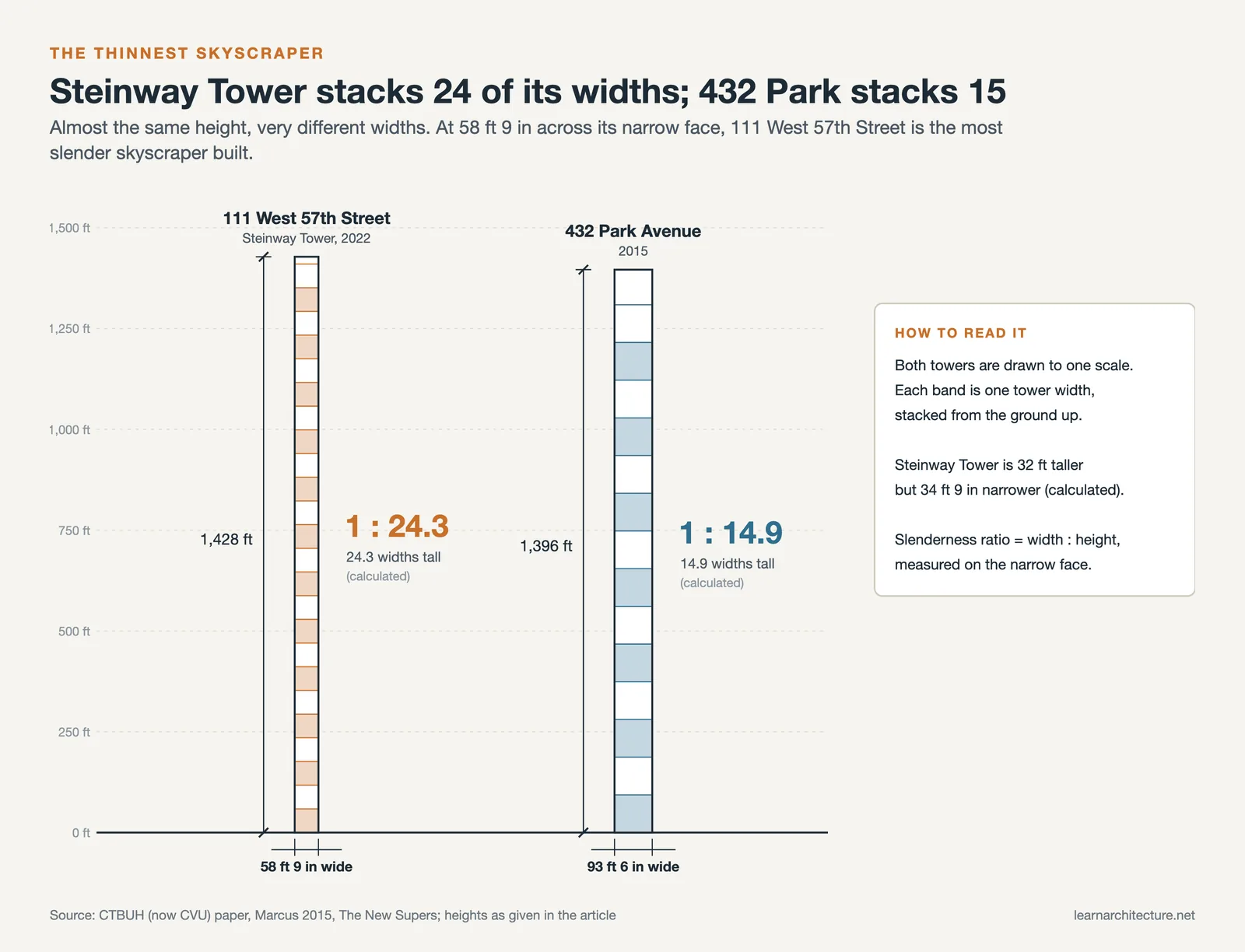
Reaching 1,428 feet with just 84 floors, 111 West 57th Street is recognized as the thinnest skyscraper ever built, with a width-to-height ratio of about 1:24. Designed by SHoP Architects with interiors by Studio Sofield, the residential tower was completed in 2022 along Manhattan’s Billionaire’s Row. The building incorporates the historic Steinway Hall at its base, preserving the 1925 landmark as part of the lobby.
Structural engineer WSP designed a system of tuned mass dampers and concrete outriggers to control sway at such an extreme slenderness ratio. The terracotta and bronze facade references early 20th-century New York architecture, setting it apart from the all-glass aesthetic of neighboring supertalls. Only 60 residential units occupy the tower, with full-floor apartments starting above the 30th story.
5. One Vanderbilt: Grand Central Terminal’s Supertall Neighbor
Adjacent to Grand Central Terminal, One Vanderbilt stands at 1,401 feet across 58 floors. Kohn Pedersen Fox Associates (KPF) designed the tower, which opened in September 2020 and earned LEED Platinum certification. The building’s stepped, angular silhouette was shaped by zoning requirements, producing a form that tapers upward through a series of setbacks.
The SUMMIT observation experience on floors 91 through 93 features mirrored rooms and glass-floor installations that have become a major tourist attraction. Below street level, a direct connection to Grand Central Terminal improves transit access for the 67,000 daily commuters who pass through the area. The tower’s mechanical systems reclaim waste heat from the building’s operations, contributing to its sustainability performance.
6. 432 Park Avenue: A Minimalist Residential Tower
At 1,396 feet and 85 floors, 432 Park Avenue was the tallest residential building in the world when it opened in 2015 (since surpassed by Central Park Tower). Architect Rafael Viñoly designed the tower with a strict grid of 10-by-10-foot square windows, giving it a minimalist, repetitive facade that stands in contrast to its more sculpted neighbors. The reinforced concrete structure uses double-height mechanical floors at regular intervals to break wind vortices and reduce sway.
The tower contains 104 condominiums, many of which sold for prices exceeding $20 million. Its location on Billionaire’s Row provides unobstructed views over Central Park and the Manhattan skyline. The building’s slender profile (roughly 93 feet wide) made it one of the first “pencil towers” to reshape the midtown skyline.

7. Trump International Hotel and Tower, Chicago
Chicago’s second tallest building rises to 1,389 feet including its spire, with a roof height of 1,171 feet across 98 floors. Designed by SOM, the mixed-use tower was completed in 2009 and contains a hotel, residential condominiums, and a restaurant. The setback design creates three distinct tiers that relate proportionally to neighboring buildings along the Chicago River, including the Wrigley Building and Marina City.
The tower uses a reinforced concrete structural system with a central core and perimeter columns, chosen partly because concrete construction generates less noise for residential occupants during wind events compared to steel framing. Its riverfront location on North Wabash Avenue places it within the Chicago Riverwalk corridor, one of the city’s most photographed stretches.
8. 270 Park Avenue (JPMorganChase Tower): The Newest Supertall on the List
The newest entry in the ranking, 270 Park Avenue rises 1,388 feet (423 m) in Midtown Manhattan as the global headquarters of JPMorgan Chase. Designed by Foster + Partners, the 60-story office tower topped out in November 2023 and officially opened on October 21, 2025. It stands just one foot below Trump International Hotel and Tower in Chicago, and the CVU lists the two at 423.2 m and 423.1 m, which is why it takes eighth place. The tower replaced the 52-story Union Carbide Building, an SOM design from 1960 that was demolished in 2021, and SOM returned to work on the new interiors alongside Gensler and Studios Architecture.
Because the site sits directly above the tracks of Grand Central Terminal, the building rests on 24 massive columns that lift the office floors above an 80-foot-high lobby. JPMorgan credits this fan column structure and its triangular bracing with creating 2.5 times more public space at street level than the previous building. Above the base, a series of setbacks steps the 2.5 million square feet of workspace toward the crown. The bank describes the tower as New York City’s largest all-electric skyscraper, with net zero operational emissions, power sourced from a New York State hydroelectric plant, and water reuse systems that cut consumption by more than 40%. Critics have been less generous, questioning the carbon cost of tearing down a working tower and the heavy use of structural steel.
9. 30 Hudson Yards: The Hudson Yards Anchor
The tallest tower in the Hudson Yards development, 30 Hudson Yards reaches 1,268 feet with 73 floors. The building was designed by KPF and completed in 2019 as the northern anchor of the massive West Side redevelopment. It serves as the headquarters for several financial and media companies and contains over 2.6 million square feet of office space.
The Edge, an outdoor observation deck cantilevered roughly 80 feet from the building’s facade at the 100th floor, is the highest outdoor sky deck in the Western Hemisphere. Visitors stand on a glass floor 1,100 feet above street level. The tower’s triangular observation platform extends beyond the building envelope, supported by a steel truss system engineered by Thornton Tomasetti.

10. Empire State Building: An Enduring Icon
Completed in 1931, the Empire State Building held the title of the world’s tallest building for 41 years. Its architectural height reaches 1,250 feet (381 m) to the roof, with the iconic antenna mast bringing the pinnacle to 1,454 feet. The 102-story Art Deco tower was designed by Shreve, Lamb & Harmon and constructed in just 410 days, a pace that still impresses structural engineers today.
Roughly 2.5 million visitors tour the building each year, with observation decks on the 86th and 102nd floors. A $165 million renovation completed in 2019 modernized the lobby, upgraded the observation experience, and improved the building’s energy efficiency by 40%, earning it an ENERGY STAR rating. The limestone and granite facade, combined with its stepped profile, remains one of the most recognized architectural silhouettes in the world.
Just Outside the Top 10: Bank of America Tower (One Bryant Park)
Ranked eleventh as of September 2026, the Bank of America Tower at One Bryant Park stands 1,200 feet tall with 55 floors. It held the tenth spot until 270 Park Avenue was completed in 2025. Designed by Cookfox Architects and completed in 2009, it was the first commercial skyscraper in the United States to receive LEED Platinum certification. The tower’s crystalline spire and angular glass facade create a distinctive profile on Sixth Avenue, directly across from Bryant Park.
The building was designed with sustainability as a core objective. Its systems include an on-site cogeneration plant, rainwater harvesting, and floor-to-ceiling insulating glass that maximizes daylight while reducing energy consumption. Ice storage tanks in the basement produce ice at night using cheaper off-peak electricity, then use the ice to cool the building during the day. This approach to green high-rise design influenced subsequent commercial towers across the country.

What Makes the Tallest Skyscrapers in the United States Stand Out?
Several patterns emerge when examining the tallest skyscrapers in the United States as a group. New York City dominates the list with eight entries, reflecting the borough of Manhattan’s unique combination of bedrock geology, economic demand, and zoning incentives. Chicago holds two positions, both designed by SOM, showcasing the city’s long-standing role in structural innovation.
The list also reveals a shift in building function. Older entries like Willis Tower and the Empire State Building were built primarily as office space, while newer additions like Central Park Tower and 432 Park Avenue are ultra-luxury residential projects. This change mirrors a broader trend in supertall development, where residential units at extreme heights command premium prices that justify construction costs.
Office towers have not disappeared from the list, though. 270 Park Avenue (the new JPMorgan Chase headquarters designed by Foster + Partners) topped out at 1,388 feet in November 2023 and opened as the bank’s headquarters in October 2025. As of September 2026 it ranks eighth by architectural height, which pushes the Bank of America Tower to eleventh. Looking ahead, the proposed 1,907-foot Legends Tower in Oklahoma City, if built, would surpass One World Trade Center as the highest skyscraper in the United States.
Height measurements in this article follow the CVU (formerly CTBUH) standard, which includes spires and architectural elements but excludes antenna masts. Data is sourced from the Council on Vertical Urbanism’s Skyscraper Center database and verified against multiple architectural references. Rankings are current as of September 2026 and may shift as new buildings are completed or topped out.
- how tall is the talest skyscraper in the united states
- skyscrapers in the united states
- tallest skyscraper in the united states
- tallest skyscrapers in the united states
- the highest skyscraper in the united states
- the tallest skyscraper in the united states
- what is the tallest skyscraper in the united states
- what's the tallest skyscraper in the united states









Leave a comment