


Table of Contents Show
Modern skyscrapers and Gothic cathedrals sit centuries apart, yet they share an obsession: reaching higher. The pointed spires of Chartres Cathedral and the glass-clad tower of 270 Park Avenue both answer the same fundamental question, though their solutions could not look more different. One relied on stone, faith, and ingenuity; the other depends on steel, capital, and computation. Understanding how each era solved the problem of verticality reveals more about architecture than any single building can.
This comparison examines what gothic architecture and the modern skyscraper actually share, where they diverge, and why the drive to build upward keeps returning in new forms.
What Is Gothic Architecture and Why Does Verticality Define It?
Gothic architecture emerged in 12th-century France, beginning with the reconstruction of the choir at the Abbey of Saint-Denis around 1140. Abbot Suger wanted a church filled with light, and the builders who answered his call developed a structural system that would spread across Europe within a generation. Pointed arches, ribbed vaults, and flying buttresses worked together to redirect the weight of stone ceilings away from walls and onto external supports. This allowed walls to become thinner, windows to grow larger, and interiors to rise dramatically.
The verticality of medieval gothic architecture was not just an engineering outcome. It carried theological weight. Height symbolized aspiration toward the divine. Chartres Cathedral’s nave rises roughly 37 meters, and Beauvais Cathedral pushed even further to about 48 meters before portions of it collapsed. According to the Council on Tall Buildings and Urban Habitat (CTBUH), these heights may seem modest by today’s standards, but achieving them in stone, without modern calculation tools, required extraordinary structural courage.
The architecture of gothic cathedrals relied on three core innovations working in concert. Pointed arches distributed weight more efficiently than the rounded Romanesque arches they replaced. Ribbed vaults created a skeletal ceiling framework that channeled loads to specific points. Flying buttresses transferred lateral thrust from the upper walls to external piers, freeing the wall surface for stained glass. Every element served the goal of building taller, lighter, and brighter.

How Modern Skyscrapers Achieve Verticality
Where Gothic builders stacked stone, modern skyscraper designers frame steel and pour concrete. The shift began in the 1880s in Chicago, where engineers like William Le Baron Jenney introduced iron and steel frames that carried a building’s weight internally, freeing exterior walls from any structural role. This invention, the skeleton frame, is the single most important distinction between a modern skyscraper and every tall structure that came before it.
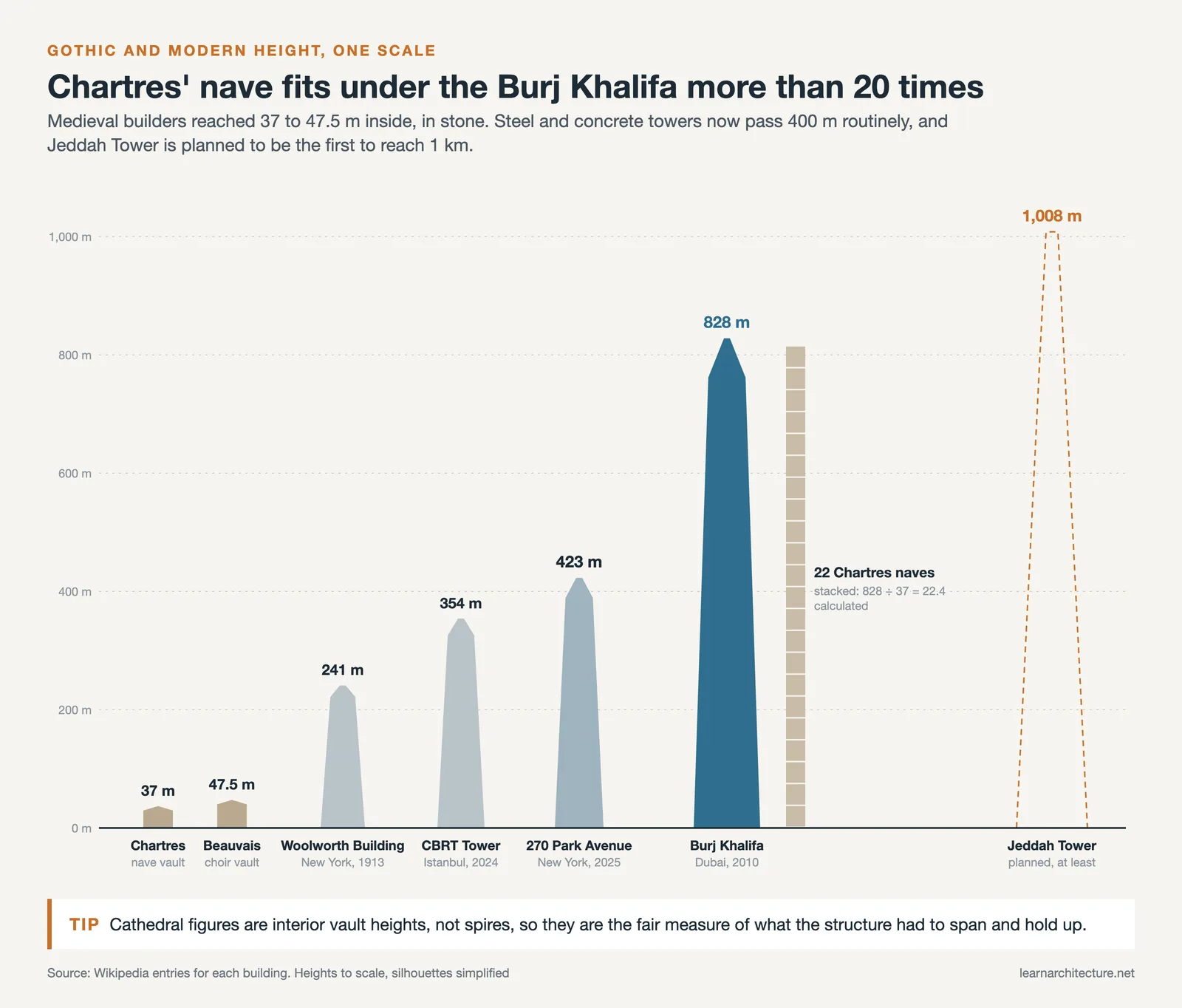
Today’s tallest towers use reinforced concrete cores, steel outrigger trusses, and tuned mass dampers to resist wind and seismic forces. The Burj Khalifa in Dubai stands at 828 meters, more than 20 times the height of Chartres Cathedral’s nave. According to the CTBUH’s 2025 Trends and Forecasts report, the world had completed 2,521 buildings taller than 200 meters by the end of 2024, and that number has doubled since 2017.
A modern skyscraper achieves its height through a fundamentally different logic than a Gothic cathedral. Instead of channeling gravity loads outward through arches and buttresses, a skyscraper channels them inward, down through a central core to deep foundations. Curtain wall systems, often made of glass and aluminum, hang from the structure like a skin. They carry no load at all. This separation of structure from enclosure is the exact opposite of Gothic construction, where the wall, the arch, and the buttress were inseparable parts of one system.
Recent completions illustrate how far vertical ambition has traveled. The 423-meter 270 Park Avenue tower in New York, designed by Foster + Partners, uses vertical fins across its facade to manage daylight while emphasizing height. In Istanbul, the 354-meter Central Bank of the Republic of Türkiye headquarters joined the world’s 100 tallest buildings in 2024. These projects show that the skyscraper modern form continues to evolve.

Gothic Style Architecture Meets the Skyscraper: The Revival Bridge
Gothic architecture and modern skyscrapers are not entirely separate stories. In the early 20th century, american gothic architecture fused medieval ornament with steel-frame construction to produce some of the most recognizable towers in the United States. The Woolworth Building, completed in 1913 in New York, stands 241 meters tall and wraps a steel skeleton in terra-cotta gothic detailing. Architect Cass Gilbert clad the tower in pointed arches, crockets, and gargoyles, earning it the nickname “Cathedral of Commerce.”
Chicago’s Tribune Tower, completed in 1925, applied a similar strategy. Its gothic revival architecture used ornate buttresses and a crown inspired by the Butter Tower of Rouen Cathedral in France. The international design competition that produced the Tribune Tower became a landmark event in 20th-century architecture, pitting Gothic revivalists against early modernists.
These buildings demonstrate that gothic style architecture translated naturally to the vertical demands of the skyscraper. The pointed arch already drew the eye upward; steel simply allowed that upward gesture to continue for dozens of additional stories. Pittsburgh’s Cathedral of Learning, a 42-story university building completed in 1934, pushed the concept even further, creating what remains one of the tallest educational structures in the world.

Comparison of Gothic Cathedrals vs Modern Skyscrapers
The following table summarizes the key structural and design differences between these two approaches to vertical building:
| Feature | Gothic Cathedrals | Modern Skyscrapers |
|---|---|---|
| Primary Material | Cut stone, mortar, timber framing | Steel, reinforced concrete, glass |
| Structural System | External: pointed arches, flying buttresses, ribbed vaults | Internal: steel/concrete core, outrigger trusses, curtain wall |
| Typical Height | 30 to 48 meters (nave height) | 200 to 828+ meters |
| Construction Time | Decades to centuries | 3 to 7 years typically |
| Light Strategy | Stained glass windows enabled by thin walls | Floor-to-ceiling glazing via non-load-bearing curtain walls |
| Wind Resistance | Massive stone weight and wide footprint | Tuned mass dampers, aerodynamic shaping, outriggers |
| Symbolic Purpose | Spiritual aspiration, divine presence | Economic power, civic identity, technological progress |
Structural Logic: Pushing Forces Out vs Drawing Them In
The most revealing difference between gothic architecture and modern skyscrapers lies in how each manages gravity and lateral forces. In a Gothic cathedral, structural forces move outward. The weight of the vaulted stone ceiling pushes down and sideways, and the entire system of arches and buttresses exists to redirect that outward thrust safely to the ground. Walk around any Gothic cathedral and you can read the structural logic from the outside: every buttress tells you where forces are being managed.
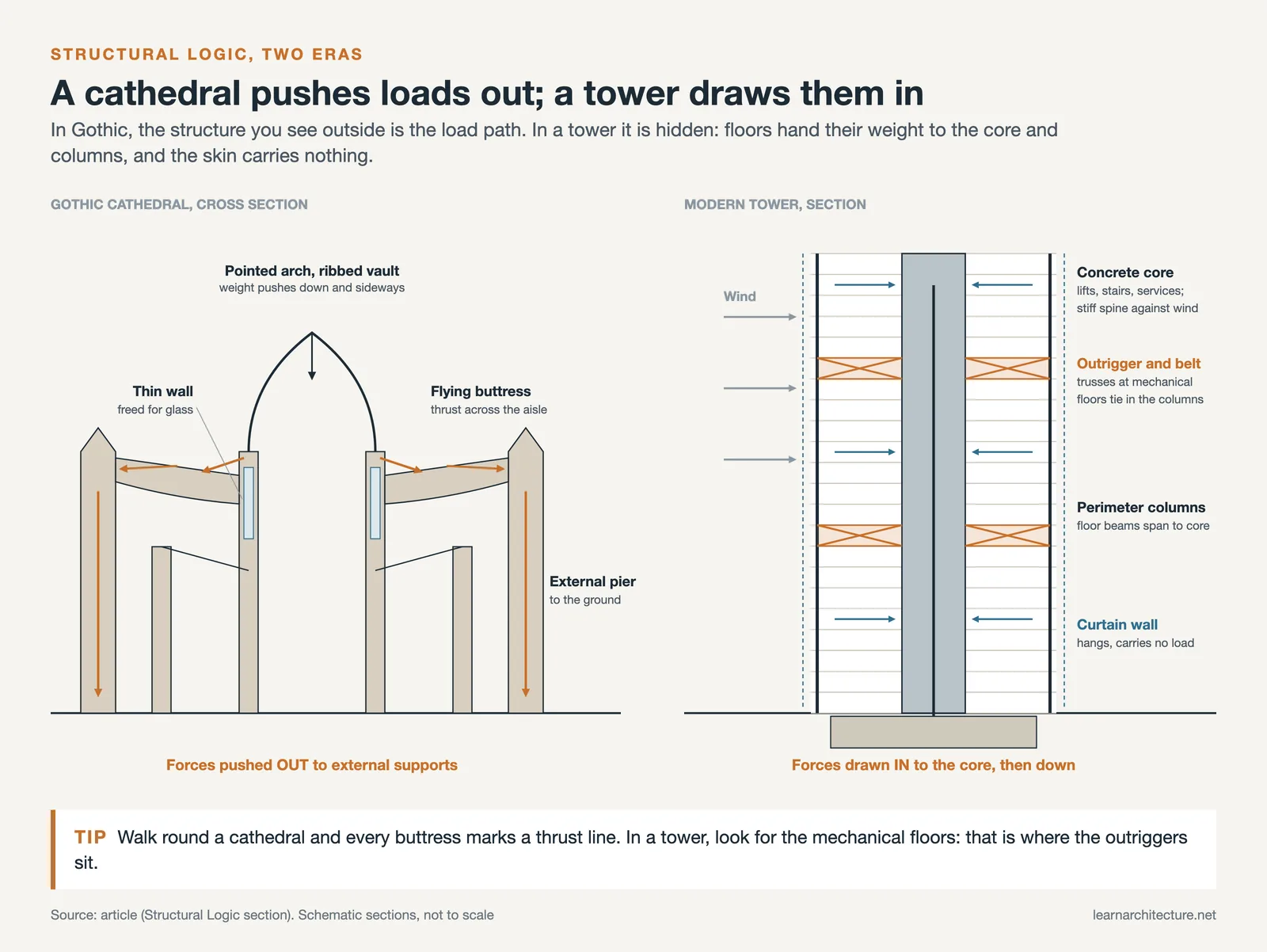
A modern skyscraper reverses this logic entirely. Forces move inward toward a central core, usually a reinforced concrete shaft containing elevators, stairs, and mechanical systems. Steel floor beams span from this core to the perimeter columns, creating open floor plates. Wind loads, which become the dominant design challenge above roughly 40 stories, are resisted by the core’s stiffness, sometimes assisted by belt trusses or outrigger systems at mechanical floors.
Both approaches are brilliant solutions to the same problem: how do you build taller without the structure collapsing under its own weight or toppling in the wind? Gothic builders solved it with geometry, distributing forces across many elements. Skyscraper engineers solve it with material strength, concentrating forces in a few very strong elements.

Light, Enclosure, and the Pursuit of Transparency
Gothic and modern builders both wanted light-filled interiors, and both had to invent new wall systems to get them. In Gothic cathedrals, the flying buttress freed the wall from carrying loads, which allowed builders to replace stone with vast expanses of stained glass. Chartres Cathedral contains roughly 176 stained glass windows covering nearly 2,600 square meters. The effect was transformative: colored light flooding a stone interior created an atmosphere unlike anything built before.
Modern skyscrapers pursue transparency through curtain wall technology. Since the exterior skin carries no structural load, it can be made almost entirely of glass. High-performance glazing now incorporates low-emissivity coatings, argon gas fills, and ceramic frit patterns to manage solar heat gain while maintaining visual openness. The result is buildings that appear to dissolve into the sky.
The parallel is striking. Both eras found ways to liberate the wall from structure, and both used that freedom to flood interiors with light. The motivations differ (divine illumination versus workplace daylight and views), but the architectural ambition is the same: make the enclosure as light and transparent as the structure will allow.
What Is Gothic Architecture’s Lasting Influence on Tall Building Design?
What is gothic architecture’s true legacy in the age of supertall towers? More than ornament. The principles that Gothic builders pioneered, including structural honesty, the expression of forces through form, and the integration of light as a design element, still resonate in contemporary practice.
Santiago Calatrava’s work, for instance, frequently echoes Gothic structural expression. His projects use exposed ribs and skeletal forms that recall the visible logic of a Gothic vault. Norman Foster’s 30 St Mary Axe in London (the Gherkin) uses a diagrid structural system on its exterior, making the load path visible from the street, much as flying buttresses do on a cathedral.
Parametric design tools like Grasshopper and Rhino now allow architects to generate complex geometric patterns that recall Gothic tracery. Laser-cut steel facades, algorithmically optimized for daylight and airflow, can achieve effects that medieval stone carvers would recognize immediately. The tools have changed; the ambition has not.
According to Dezeen’s review of the top skyscrapers of 2024, several recent towers incorporate organic, nature-inspired structural forms that parallel how Gothic architects modeled their columns after tree trunks and their vaults after forest canopies. The Henderson in Hong Kong, for instance, uses curvilinear glass walls inspired by natural movement, while towers in São Paulo by UNStudio feature “windmill-shaped” floor plans that prioritize light and air.

The Future of Verticality: Where Gothic Ambition Meets Modern Technology
The global count of buildings over 200 meters continues to grow, and the next frontier is already visible. The Jeddah Tower in Saudi Arabia, planned at more than 1,000 meters, restarted construction in January 2025 after years of delay. If completed, it would be the world’s first building to reach one kilometer, a structure that would have been inconceivable even to the most ambitious Gothic cathedral builders.
Yet the conversation around tall buildings is shifting. The CTBUH’s 2025 report noted a record number of stalled projects globally, particularly in China, where 199 towers over 200 meters are currently on hold. Some governments have begun introducing regulations against supertall construction, citing concerns about environmental impact and urban livability. The era of building tall simply to hold the record may be ending, replaced by a more nuanced question: what does a tall building owe to its city and its occupants?
This is, in a way, the same question that Gothic builders asked. Cathedrals were not just tall; they were communal gathering spaces, libraries of stained glass narrative, and demonstrations of collective effort. The best modern skyscrapers are moving in a similar direction, incorporating sky gardens, public observation decks, mixed-use programming, and sustainable building systems that serve the surrounding neighborhood as much as the tenants inside.
Verticality, whether expressed in stone or steel, has always been about more than height. It is about what a culture values enough to build toward.
Technical specifications and construction data referenced in this article are based on published sources and may vary by project, location, and engineering conditions. Always consult licensed professionals for project-specific structural decisions.















Leave a comment