


Table of Contents Show
Rising 333 meters above the streets of central Tokyo, Tokyo Tower is one of the most recognizable structures in Japan. Completed in 1958 in the Shiba-koen district of Minato, this lattice steel tower was built as both a broadcasting antenna and a national symbol of Japan’s recovery after World War II. Officially named Nippon Denpatō (Japan Radio Tower), the tower draws its design inspiration from the Eiffel Tower in Paris, yet it stands taller and weighs significantly less than its French predecessor.
For architects and structural engineers, Tokyo Tower represents a fascinating case study in efficient lattice design, seismic engineering, and the creative reuse of materials. The tower held the record as the tallest freestanding tower in the world from 1958 until 1967, and it remained Japan’s tallest structure until Tokyo Skytree surpassed it in 2012.

The History Behind Tokyo Tower Japan
By the mid-1950s, Japan’s television broadcasting industry was expanding rapidly. Multiple transmission towers began dotting the Tokyo skyline, and the Japanese government recognized the need for a single, centralized broadcasting structure that could serve the entire Kantō region. At the same time, Japan was searching for a monument that would symbolize its remarkable post-war economic recovery.
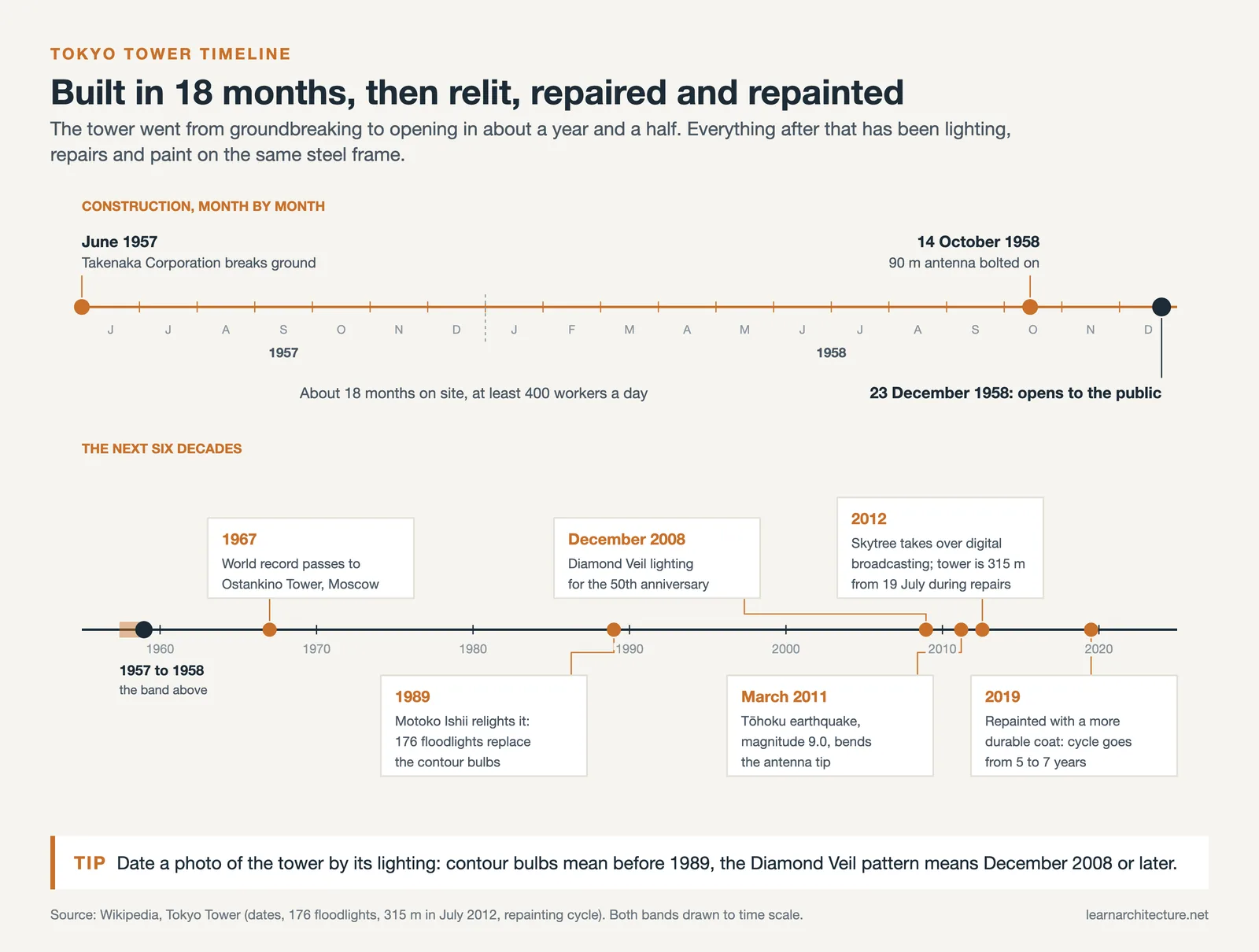
Hisakichi Maeda, founder of Nippon Denpatō, originally envisioned a tower taller than the Empire State Building, which stood at 381 meters. Budget constraints forced a revision, and the final height of 333 meters was determined by the transmission range needed to cover approximately 150 kilometers across the Kantō region, according to Wikipedia’s Tokyo Tower entry.
The Takenaka Corporation broke ground in June 1957. Over 220,000 workers contributed to the project, with at least 400 laborers on site each day. Among them were hundreds of tobi, traditional Japanese construction workers who specialized in high-rise structures. The 90-meter antenna was bolted into place on October 14, 1958, and Tokyo Tower opened to the public on December 23 of that year at a cost of ¥2.8 billion (roughly $7.8 million at the fixed 1958 rate of ¥360 to the US dollar).

Tokyo Tower Architecture: Design and Structural Form
Structural engineer Tachū Naitō (1886-1970) was selected to design the tower. Known as the father of earthquake-proof design in Japan, Naitō had already proven his seismic theories when his Industrial Bank of Japan building survived the devastating 1923 Great Kantō earthquake. He collaborated with engineering firm Nikken Sekkei Ltd. to develop the Tokyo Tower design.
The tower’s architecture follows a lattice steel framework with a square cross-section that tapers as it rises. Naitō modeled the overall form on the Eiffel Tower but made significant modifications to account for Japan’s seismic conditions. The lattice structure allows wind to pass through the frame, reducing lateral loads, while also providing flexibility during earthquakes. Naitō claimed the design could withstand earthquakes with twice the intensity of the 1923 Great Kantō earthquake and typhoons with wind speeds up to 220 km/h.
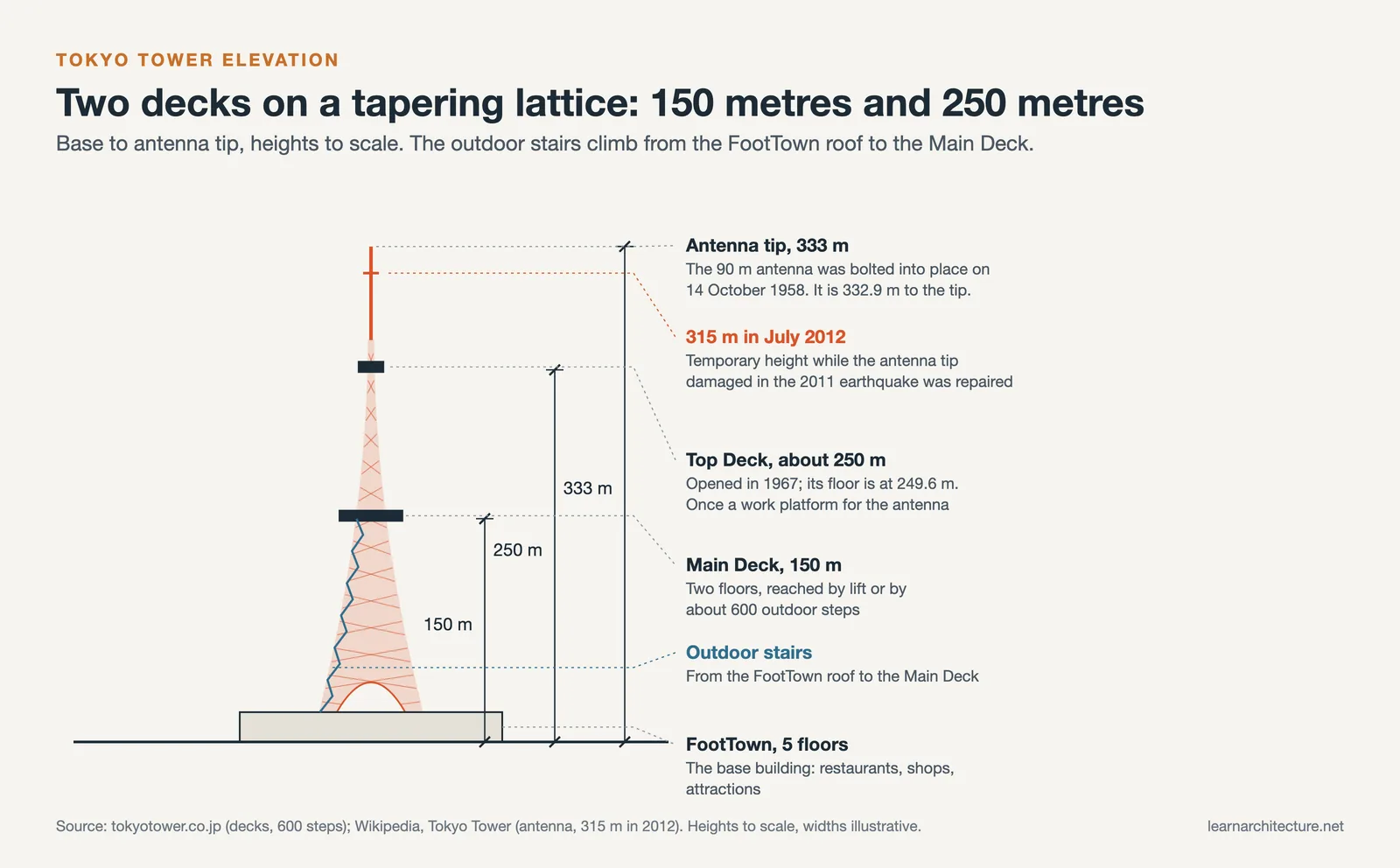
The structure is divided into three distinct sections. FootTown, the five-story base building, houses restaurants, shops, and entertainment facilities. Above it, the Main Deck observation platform sits at 150 meters, accessible by elevator or a 600-step outdoor staircase. The Top Deck crowns the tower at approximately 250 meters, offering panoramic views of the city and, on clear days, Mount Fuji.
How Tall Is Tokyo Tower Compared to the Eiffel Tower?
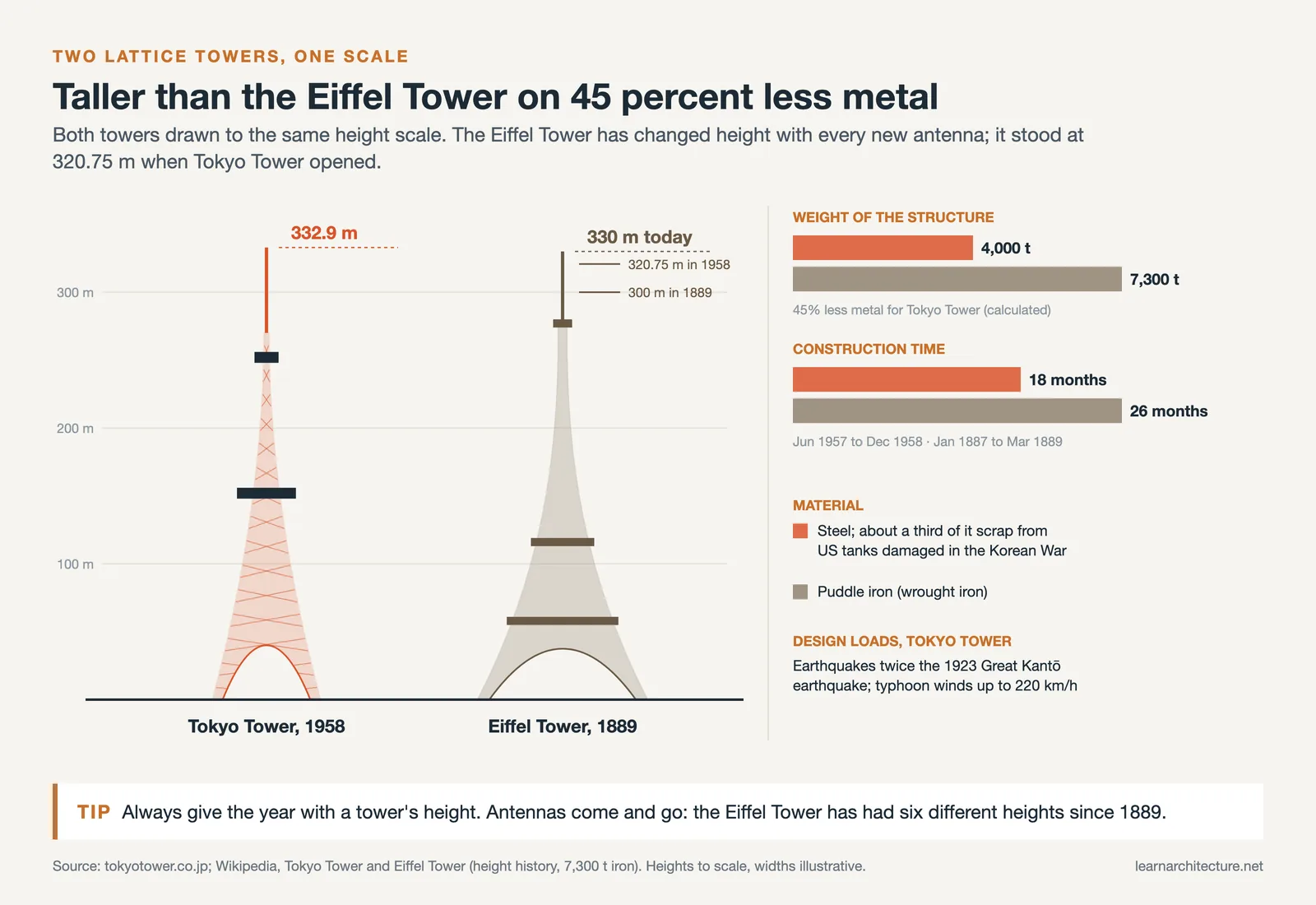
Tokyo Tower height stands at 332.9 meters (1,092 feet), making it about 12 meters taller than the Eiffel Tower stood when Tokyo Tower opened in 1958 (320.75 meters), and about 3 meters taller than the Eiffel Tower today (330 meters since 2022). The following table breaks down the key structural differences between these two famous lattice towers.

Tokyo Tower vs Eiffel Tower: Key Specifications
Understanding the structural differences between these two towers reveals how much engineering advanced between 1889 and 1958.
| Specification | Tokyo Tower | Eiffel Tower |
|---|---|---|
| Total Height | 332.9 m (1,092 ft) | 330 m (1,083 ft) since 2022 |
| Weight | Approx. 4,000 tons | Approx. 7,300 tons |
| Year Completed | 1958 | 1889 |
| Construction Duration | 18 months | 26 months |
| Material | Steel (1/3 recycled) | Wrought iron |
| Seismic Resistance | Yes, earthquake-proof | Not designed for seismic |
| Primary Function | Broadcasting + tourism | Exhibition + tourism |
The weight difference is particularly striking. Tokyo Tower uses roughly 45% less material than the Eiffel Tower despite being taller. This efficiency comes from advances in steel manufacturing and Naitō’s structural optimization techniques, which minimized material usage while maximizing seismic performance.
The Red Tower Tokyo: Why International Orange?
One of the most frequently asked questions about Tokyo Tower concerns its distinctive color. The tower’s white and orange paint scheme is not an aesthetic choice but a legal requirement. Japan’s Civil Aeronautics Act mandates that structures above a certain height be painted in high-visibility colors to ensure aircraft safety. The specific shade used is called “international orange,” the same color applied to the Golden Gate Bridge in San Francisco.
Maintaining this appearance requires 28,000 liters of paint for a complete recoating. Historically, the tower was repainted every five years in a process that took a full year to complete. The most recent painting in 2019 used a more durable coating, extending the official repainting cycle to seven years, according to data published by Nippon.com.

Earthquake-Resistant Engineering of Japan Tokyo Tower
Japan experiences seismic activity with extraordinary frequency. Designing a 333-meter lattice tower in this environment required engineering solutions that went well beyond conventional practice in 1958. Tachū Naitō brought decades of seismic research to the project, having developed his earthquake-proof wall theory during studies in the United States in 1916.
The tower’s lattice structure provides inherent flexibility. Rather than resisting seismic forces through rigid mass, the steel framework absorbs and dissipates energy through controlled flexing. This approach has proven remarkably effective. During the 2011 Tōhoku earthquake, which measured magnitude 9.0, the tower sustained only minor damage to the tip of its antenna. The antenna was repaired in 2012; from 19 July 2012 the work temporarily reduced the tower’s height to 315 meters.
A remarkable aspect of the construction is the sourcing of materials. According to Wikipedia, approximately one-third of the steel used came from scrap metal recycled from U.S. military tanks damaged during the Korean War. This detail carries symbolic weight: instruments of conflict were transformed into a peaceful broadcasting and observation structure.
Tokyo Tower Tokyo: Cultural and Architectural Significance Today
Although Tokyo Skytree assumed the primary digital broadcasting role in 2012, Tokyo Tower continues to operate as an FM radio broadcasting antenna and remains one of Japan’s most visited landmarks. The tower recorded its 190 millionth visitor in 2024, according to its Wikipedia entry. After ticket sales bottomed out at 2.3 million visitors in 2000, a series of renovations revitalized public interest.
Lighting designer Motoko Ishii redesigned the tower’s illumination in 1989, replacing the original contour light bulbs with 176 floodlights. A further lighting upgrade in 2008, called the “Diamond Veil,” celebrated the tower’s 50th anniversary. The seasonal lighting scheme shifts between warm orange tones in winter and cool white in summer, and special illuminations mark events ranging from national holidays to the 2020 Tokyo Olympics.
For architects visiting Tokyo, the tower offers a useful contrast with the nearby contemporary skyscraper designs in the surrounding Minato district. The juxtaposition of the lattice tower against Zojoji Temple, a Buddhist temple dating to the 16th century, also creates one of Tokyo’s most photographed compositions. You can read more about form finding in architecture on our site.
Tokyo Tower remains a defining element of the city’s skyline. Its combination of structural efficiency, seismic resilience, and cultural meaning makes it a relevant subject for anyone studying iconic tower architecture and the relationship between engineering and national identity.
Technical specifications referenced in this article are based on publicly available data from the tower’s operator, Nippon Denpatō, and verified through the Architectural Institute of Japan records. Structural performance claims reflect design specifications; actual performance may vary with specific seismic events.






Leave a comment