


Table of Contents Show
Farmhouses in Tuscany can cost as little as €30,000 to €80,000 for unrenovated stone ruins in lesser-known provinces like Lunigiana, Garfagnana, and the Maremma interior. With careful planning, realistic renovation budgets, and knowledge of the Italian buying process, owning a Tuscan farmhouse is more affordable than most buyers expect.
What Makes Tuscan Farmhouses So Appealing?
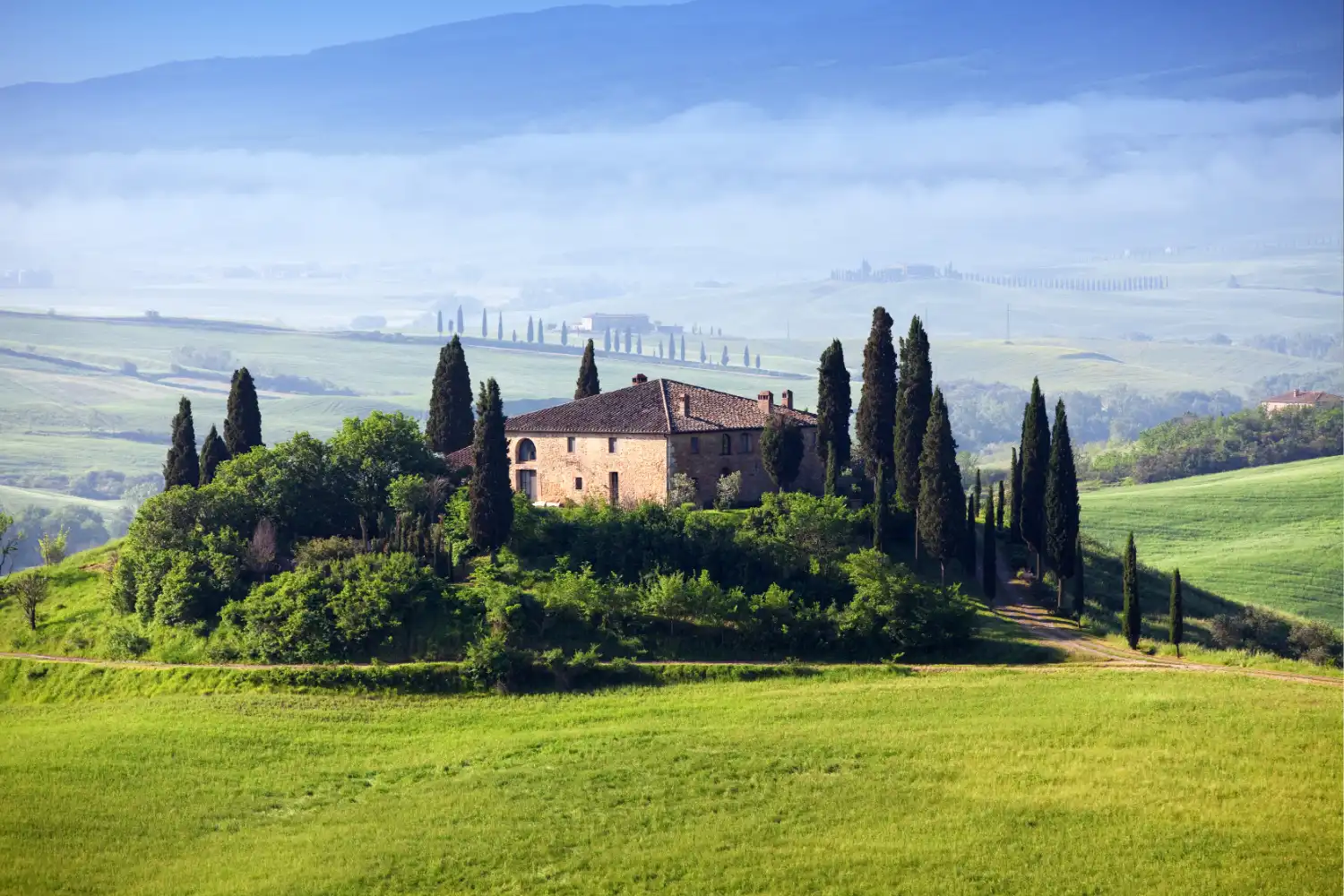
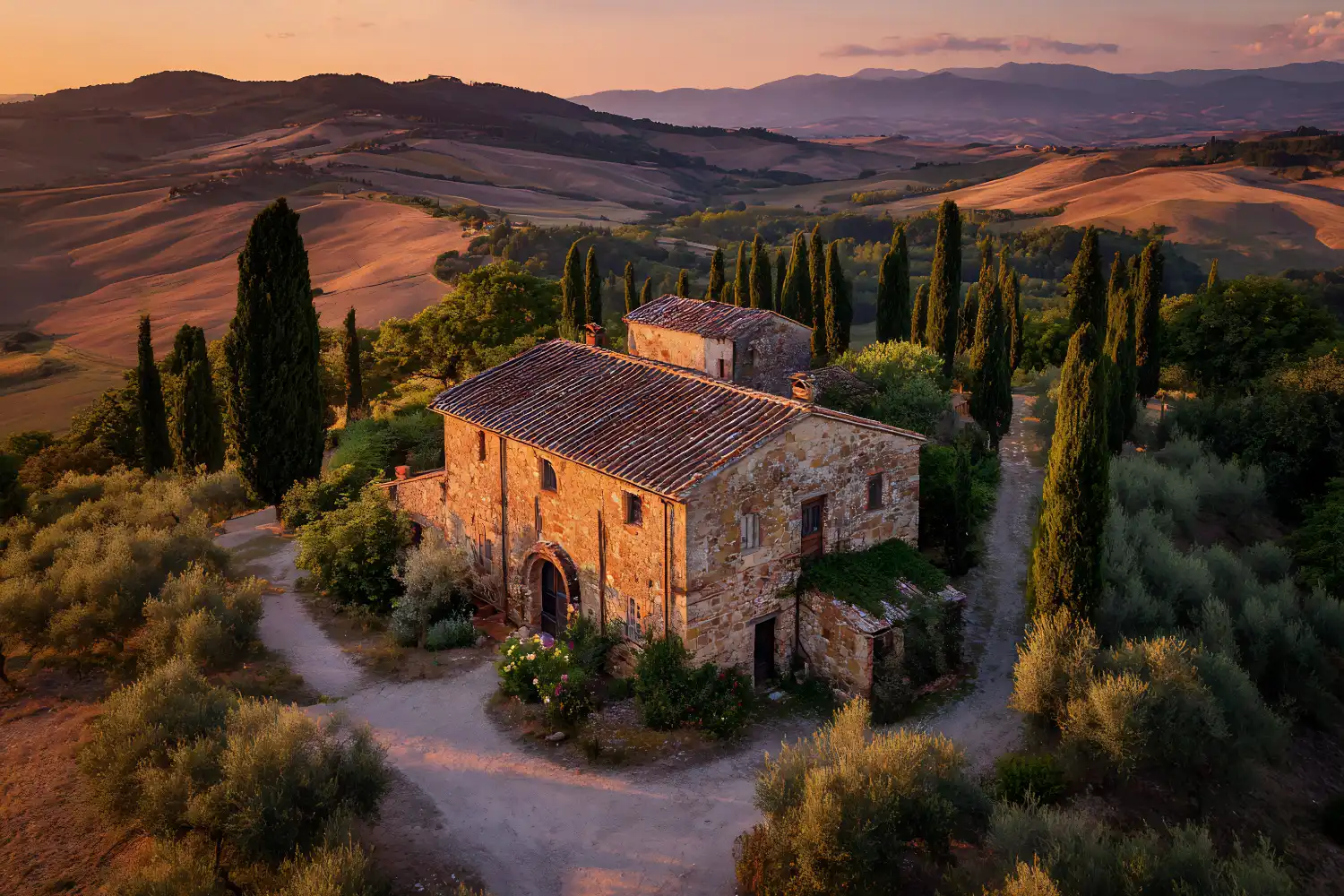
Tuscany farmhouses, known locally as casali or poderi, are typically stone-built rural homes that once served as working agricultural estates. They sit on rolling hillsides among olive groves, vineyards, and cypress-lined roads. The architectural character of these properties draws from centuries of vernacular building traditions rooted in locally quarried pietra serena sandstone, handmade terracotta roof tiles, and thick load-bearing walls designed for passive thermal comfort.
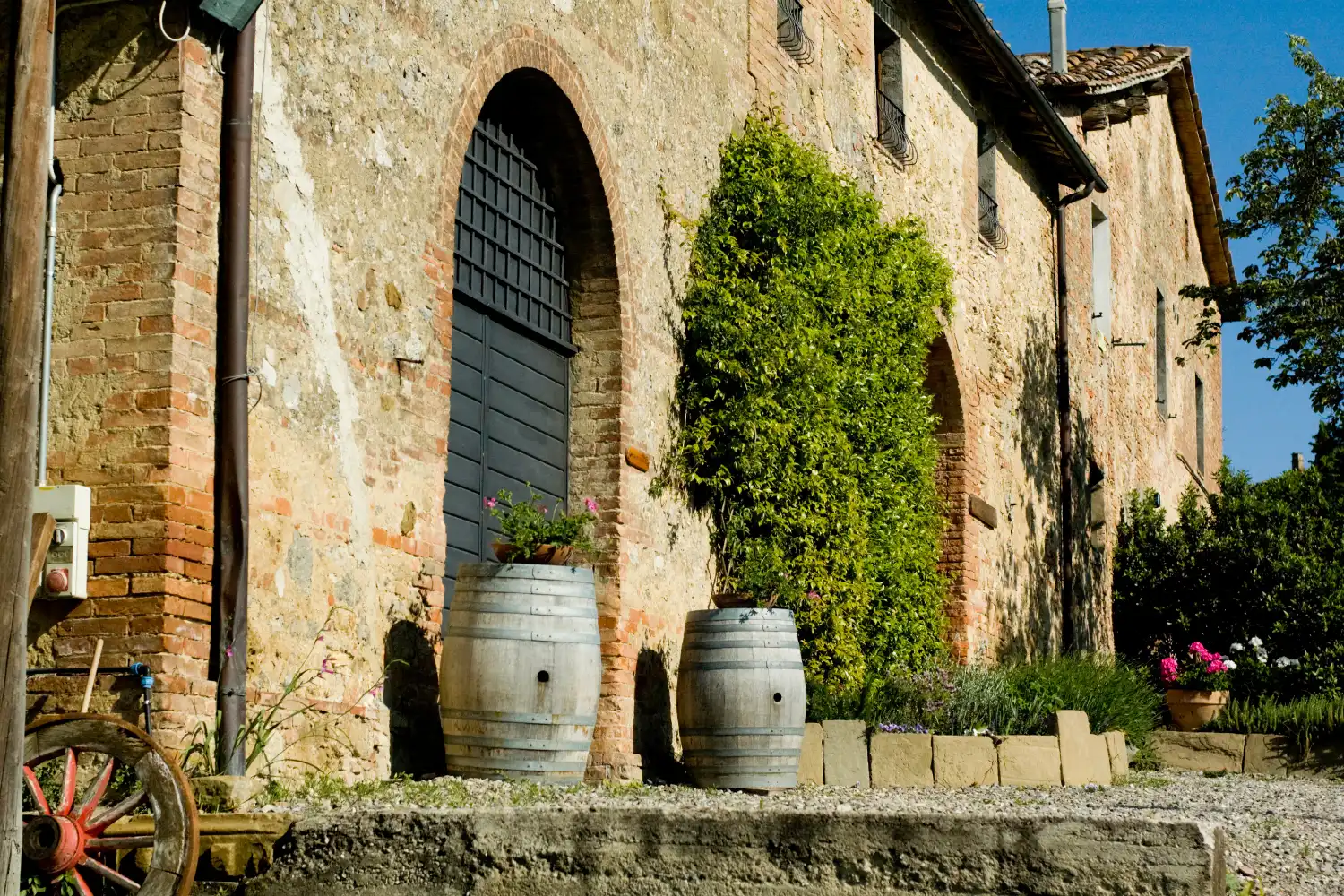
Unlike mass-produced suburban housing, a farmhouse in Tuscany carries tangible history. Many date to the 17th or 18th century. Original features like exposed wooden ceiling beams (often chestnut or oak), brick arched doorways, and stone fireplaces give these buildings a warmth that modern construction rarely matches. The combination of landscape, material authenticity, and cultural heritage is what keeps demand steady among both Italian and international buyers.
For architecture and design enthusiasts, a Tuscan farmhouse also represents a live case study in vernacular architecture and climate-responsive building. Thick stone walls moderate summer heat. Small, strategically placed windows reduce glare while framing views. Covered loggias provide shaded outdoor living space. These are not arbitrary aesthetic choices; they are functional responses to the Tuscan climate that modern sustainable design is now trying to replicate.
Where to Find Cheap Farmhouses in Tuscany
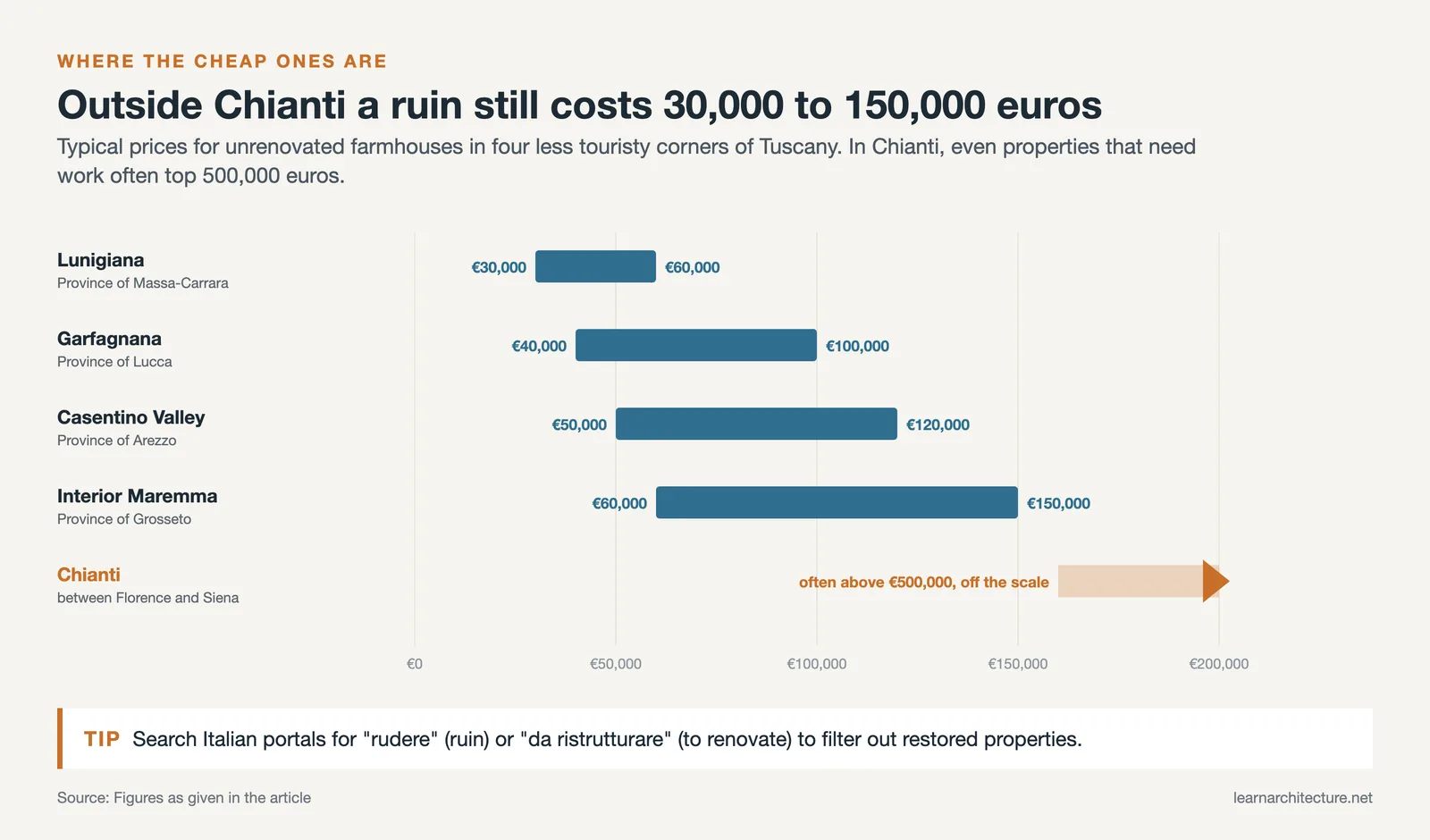
Price varies dramatically depending on province and proximity to tourist hotspots. The Chianti region between Florence and Siena commands premium prices, often above €500,000 even for properties needing significant work. But Tuscany is a large region with 10 provinces, and several areas offer genuinely affordable farmhouse properties.
Lunigiana (Province of Massa-Carrara)
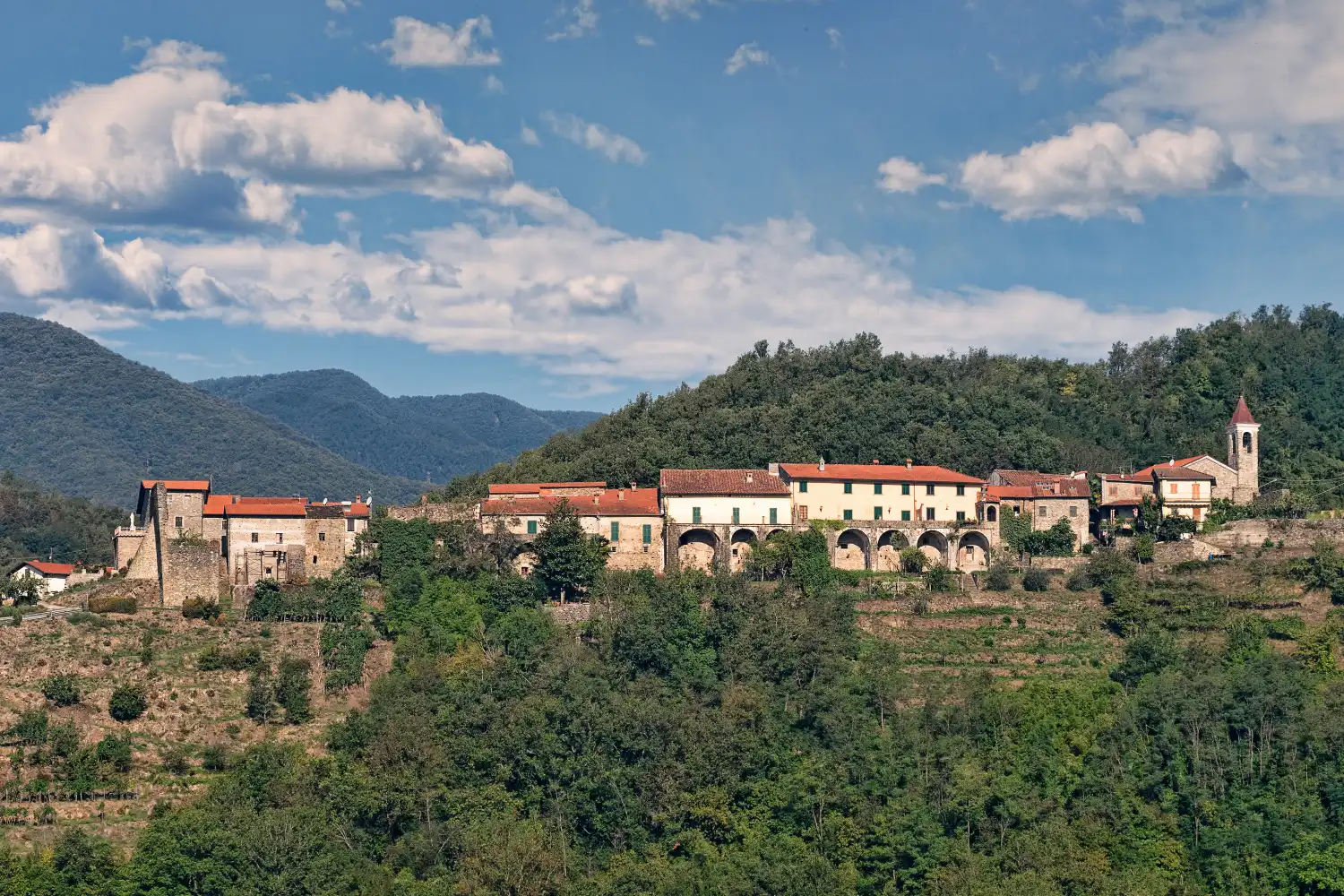
Lunigiana, in Tuscany’s far northwest corner near the Ligurian border, is one of the most affordable zones. Unrenovated stone farmhouses here can start from €30,000 to €60,000. The landscape is mountainous, green, and less manicured than the classic Tuscan postcard, but the villages are authentic and the area attracts a small community of foreign buyers drawn by the low entry cost. The town of Fivizzano and surrounding hamlets are popular starting points.
Garfagnana (Province of Lucca)
North of Lucca, the Garfagnana valley sits between the Apuan Alps and the Apennines. Farmhouses here are often compact, built into hillsides, and priced between €40,000 and €100,000 for properties needing renovation. The area is known for its chestnut forests and farro grain production. While less convenient for quick airport access, it offers strong value and a quieter pace of life.
Southern Maremma (Province of Grosseto)
The Maremma interior, away from the coast, still has affordable farmhouse stock. Prices for unrenovated properties typically range from €60,000 to €150,000. The landscape here is wilder and less cultivated than central Tuscany, with cork oak forests and thermal springs. Buyers should expect longer distances to major cities, but property sizes tend to be larger for the money.
💡 Pro Tip
Search for properties listed as “rudere” (ruin) or “da ristrutturare” (to renovate) on Italian real estate portals like Immobiliare.it and Casa.it. These keywords filter out restored properties and surface the cheapest listings. Always request the property’s certificato catastale (cadastral certificate) before visiting to confirm the exact boundaries, buildable area, and legal classification.
Casentino Valley (Province of Arezzo)
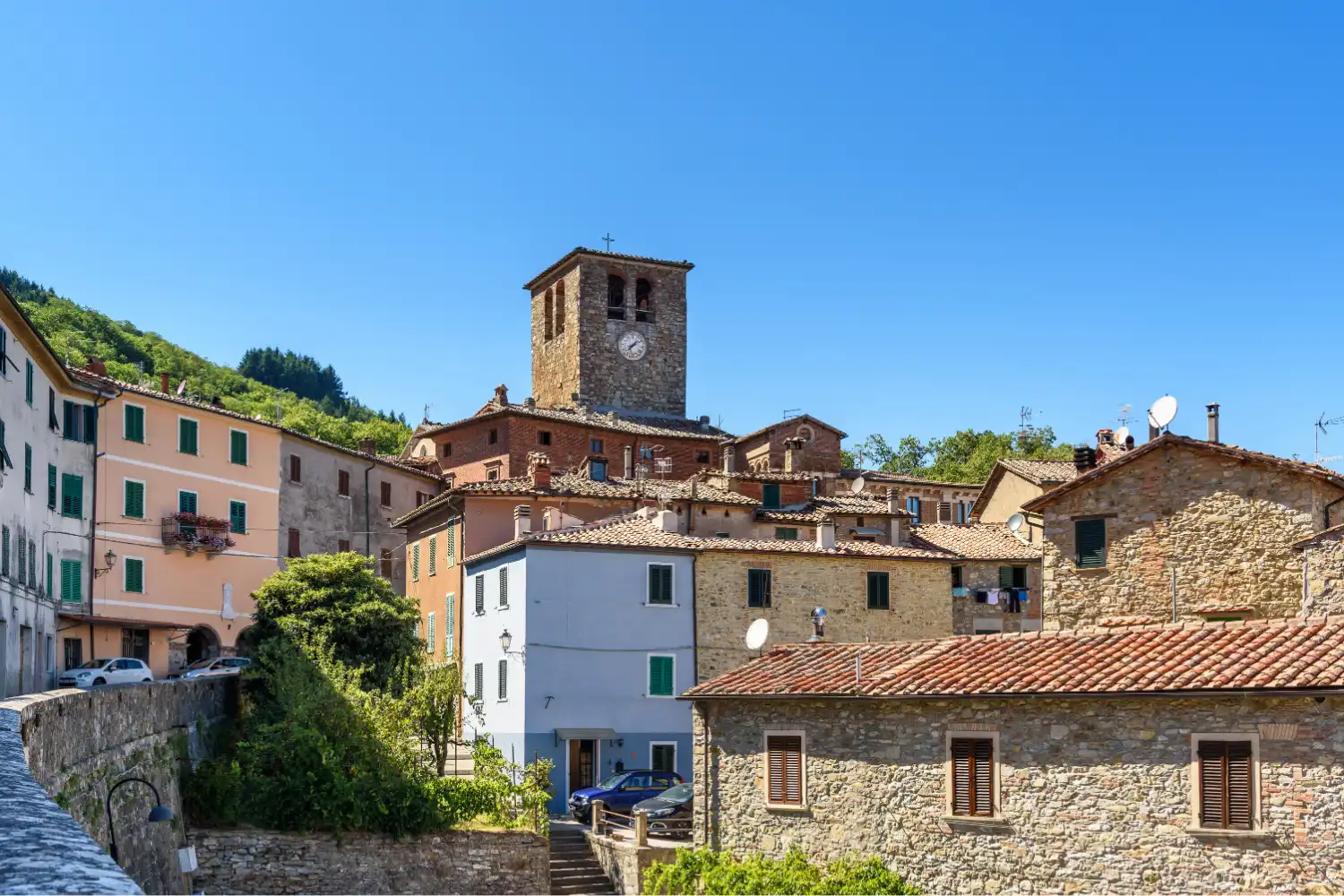
East of Florence, the Casentino is a forested valley with small medieval villages. Farmhouses here are less publicized internationally, which keeps prices moderate. A stone property needing full renovation can be found for €50,000 to €120,000. The area has good road connections to Arezzo and is within 90 minutes of Florence.
How Much Does Renovation Actually Cost?
The purchase price of a cheap Tuscan farmhouse is only part of the total investment. Renovation costs for rural stone properties in Italy typically range from €1,000 to €2,000 per square meter for a standard residential conversion, depending on the scope of work and local labor rates. A 150 sqm farmhouse needing full restoration (roof, floors, plumbing, electrical, windows, kitchen, bathrooms) will usually require €150,000 to €300,000 in renovation budget.
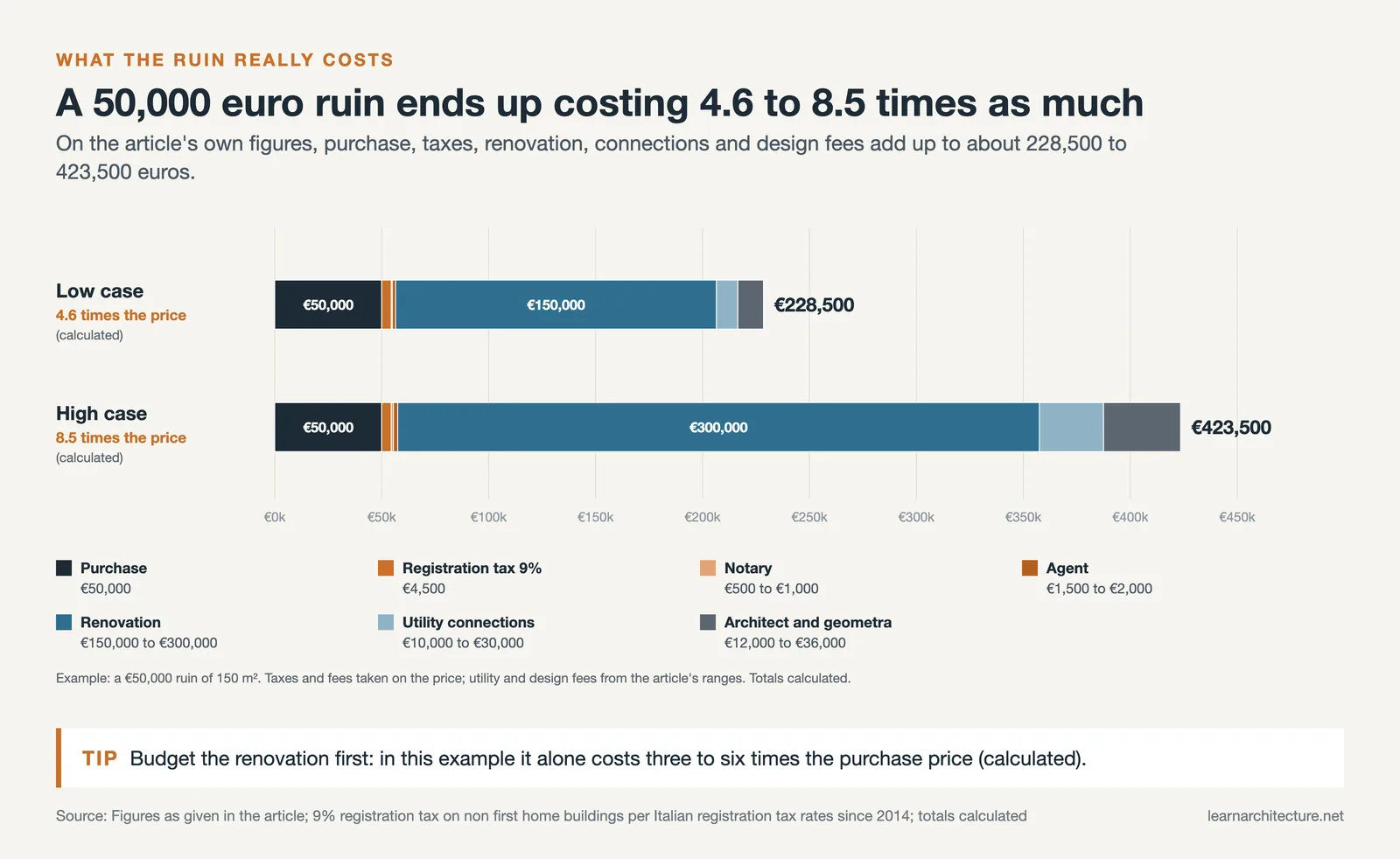
Several factors push costs higher. Structural issues like cracked load-bearing walls or failed roof timbers require specialist stone masonry or timber framing work. Connecting to mains water, electricity, or sewage in remote rural locations can add €10,000 to €30,000. Italian building regulations also require seismic reinforcement in many Tuscan zones, which adds engineering costs. Permits (permesso di costruire) involve architect and geometra fees, typically 8% to 12% of the construction budget.
⚠️ Common Mistake to Avoid
Many buyers assume that a €50,000 purchase price means a €50,000 project. In practice, the total cost of buying and restoring a cheap Tuscan farmhouse is usually several times the purchase price: on the figures in this section, a €50,000 ruin of 150 sqm comes to roughly €230,000 to €425,000 all in. Budget for registration tax (9% on a second home, whether or not you are resident), notary fees (1-2%), agent commission (3-4%), plus the full renovation. Underestimating this is the single most common reason foreign buyers abandon or stall their projects.
Cheap Farmhouse Design Ideas That Work in Tuscany
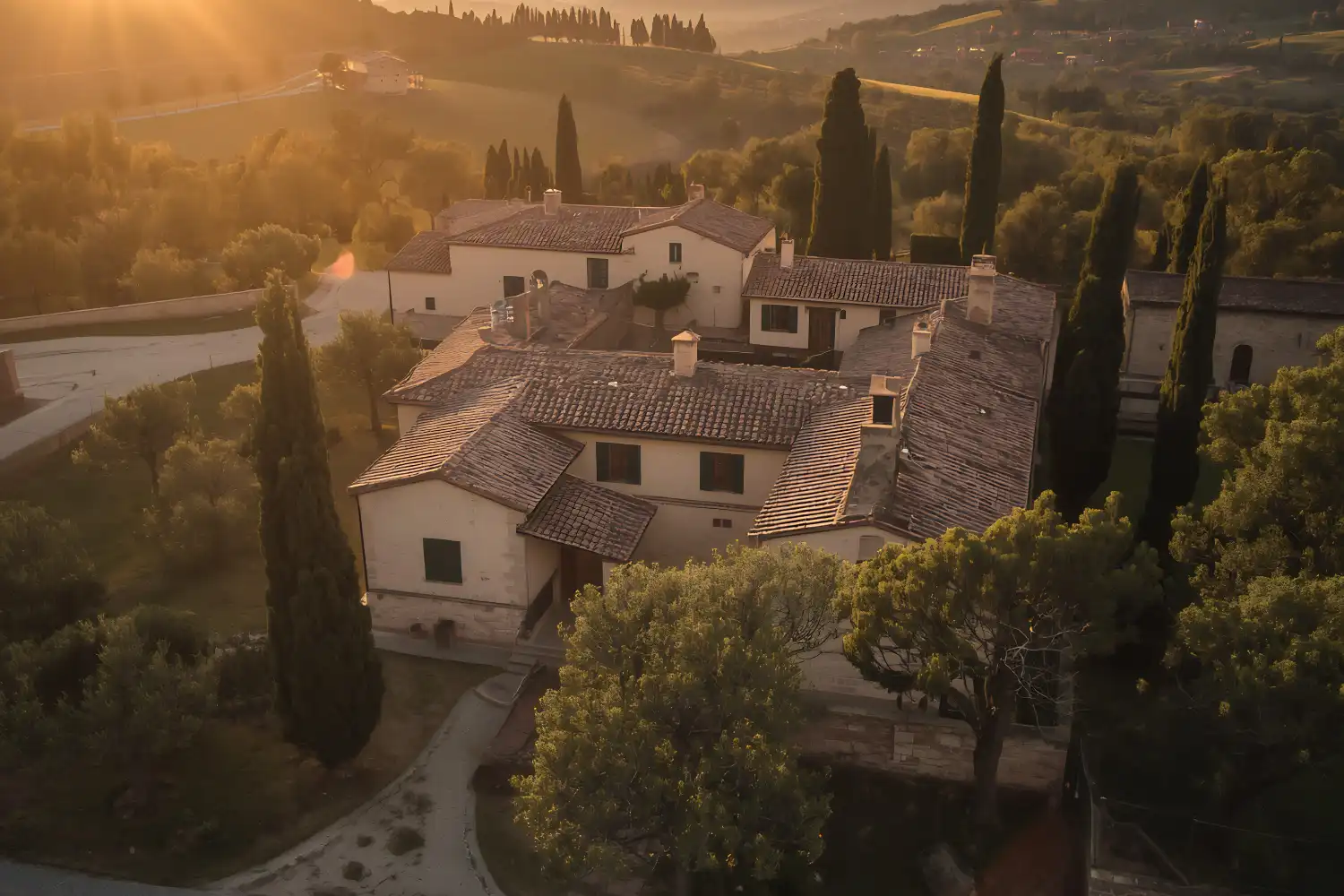
A limited budget does not mean sacrificing design quality. Some of the most effective farmhouse interiors in Tuscany draw on the building’s original materials rather than importing expensive finishes. Reclaimed terracotta floor tiles, exposed stone walls, and original timber beams cost nothing extra when they are simply cleaned, treated, and left visible. This approach respects the building’s character and reduces material costs.
For cheap farmhouse furniture, consider mixing locally sourced vintage pieces with simple modern items. Tuscan markets and mercatini dell’antiquariato (antique flea markets) held monthly in towns like Arezzo and Lucca offer solid wood furniture at reasonable prices. Pair these with affordable linen textiles and iron light fixtures for an authentic look that avoids the generic “farmhouse chic” aesthetic found in mass retail.
Cheap modern farmhouse design works well when it respects the building’s bones. Open-plan living areas created by removing non-structural internal partitions can make small farmhouses feel larger. A simple white plaster finish on interior walls, contrasted with the natural stone of an exposed chimney breast, creates visual interest without expensive materials. Polished concrete or cocciopesto (crushed terracotta mixed with lime mortar) floors are durable, affordable alternatives to imported stone.
If you are interested in how sustainable materials can reduce renovation costs while improving thermal performance, consider insulating with lime-hemp plaster rather than synthetic boards. This breathable material suits old stone walls and is increasingly popular among Tuscan restoration specialists.
🎓 Expert Insight
The best Tuscan renovations often change the least: the existing walls, beams and proportions should guide the design rather than a new style imposed on them.
This reflects a widely shared philosophy among Italian restoration professionals: preserving original materials and spatial proportions, rather than imposing a new design language, produces the most successful and cost-effective results.
The Buying Process for Foreign Buyers
Italy allows foreign nationals from most countries to buy property without restrictions, thanks to reciprocal treaties. The buying process follows a standard sequence: property search, offer, preliminary contract (compromesso), and final deed (rogito) signed before a notary. The entire process typically takes 2 to 4 months.
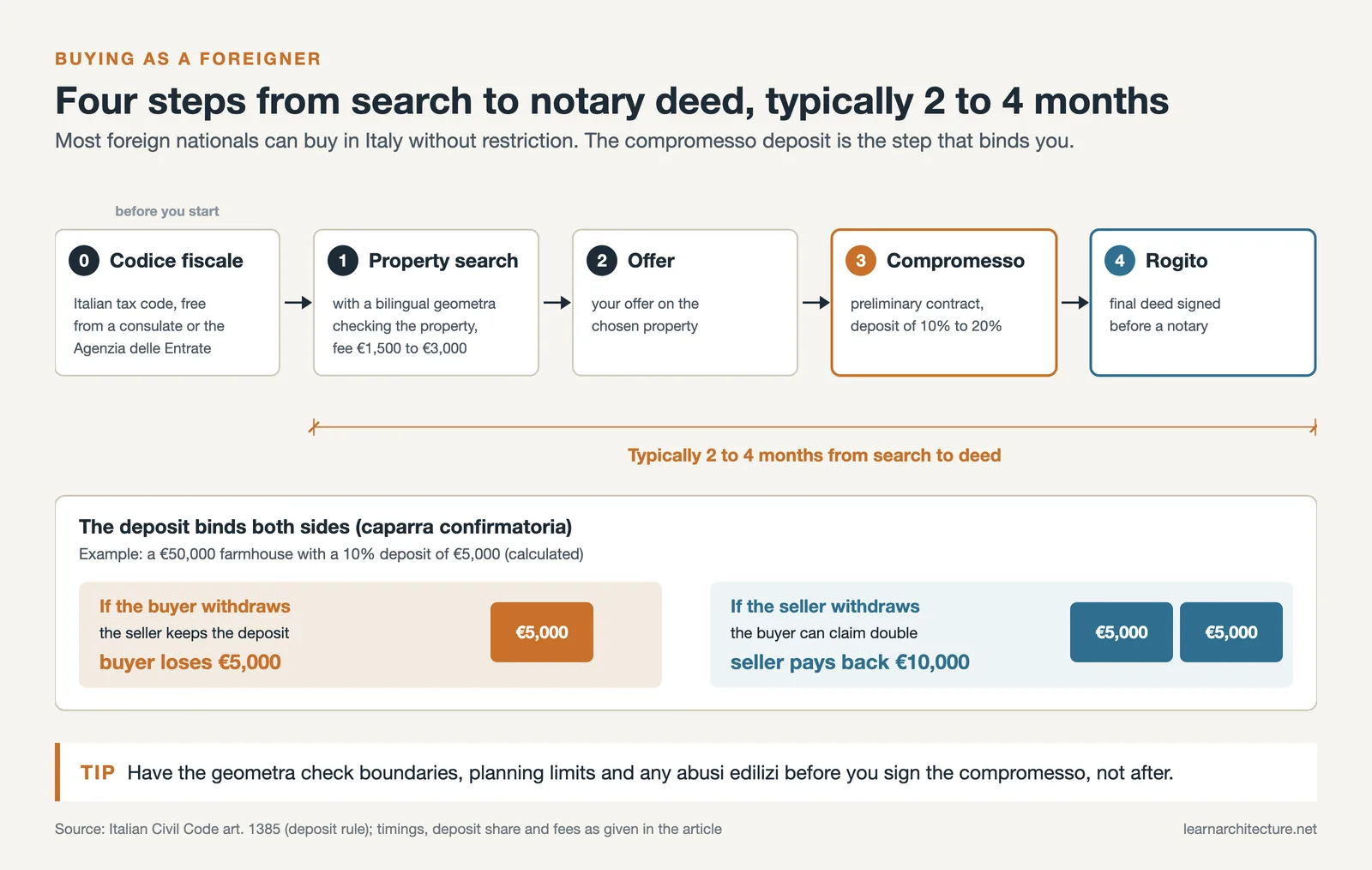
You will need an Italian tax code (codice fiscale), which can be obtained free from the Italian consulate in your home country or from the local Agenzia delle Entrate office. A deposit of 10% to 20% is paid at the preliminary contract stage. This deposit is legally binding: if the buyer withdraws, the deposit is forfeited; if the seller withdraws, they must return double the deposit.
Hiring a bilingual geometra (surveyor/technical consultant) is strongly recommended for rural properties. They will verify the property’s structural condition, check for planning restrictions, confirm land boundaries against the cadastral map, and identify any abusive building works (abusi edilizi) that could cause legal problems later. Budget €1,500 to €3,000 for this service.
📌 Did You Know?
Italy’s “1 euro house” schemes have been offered by several Tuscan municipalities, including Fabbriche di Vergemoli in Garfagnana. While the purchase price is symbolic, buyers must commit to completing renovation within a set timeframe (usually 3 years) and post a guarantee deposit of €5,000 to €10,000. The actual renovation costs make these projects comparable to buying a cheap ruin on the open market.
Hidden Costs and Annual Running Expenses
Beyond the purchase and renovation, ongoing costs include property tax (IMU), which for a non-primary residence in a rural area runs roughly €500 to €2,000 per year depending on the property’s cadastral value. Waste collection tax (TARI), utility connections, and building insurance add another €1,000 to €2,000 annually.
Owners of rural farmhouses should also budget for land maintenance. Even a small olive grove of 50 trees requires annual pruning, harvesting, and pest management. Unmaintained land can attract fines from the local comune and increases wildfire risk. Many owners hire a local farmer or gardener on a part-time basis, costing €200 to €500 per month depending on the land area.
💡 Pro Tip
If you plan to rent out your farmhouse as a holiday let, register as a Casa Vacanze (holiday home) with your local comune. This classification has lighter regulatory requirements than agriturismo status and allows short-term rentals. In popular Tuscan areas, a well-presented 2-bedroom farmhouse can generate €8,000 to €15,000 per season through platforms like Airbnb, which can offset most annual running costs.
Video: Renovating a Farmhouse in Tuscany
This video documents the renovation of a stone ruin on a Tuscan farm, showing the practical realities of converting an old agricultural building into a livable home on a modest budget.
Tuscan Farmhouse Architecture: Key Features to Look For
When evaluating a farmhouse in Tuscany, certain architectural elements signal a well-built property worth restoring. Look for thick exterior walls (60 cm or more), which indicate solid stone construction rather than rubble infill. Check the roof structure for chestnut timber beams, which resist rot and insect damage better than softwoods. Original terracotta tile roofs (coppi e tegole) in good condition save significant replacement costs.
The classic Tuscan farmhouse layout places the living quarters on the upper floor (piano nobile), with storage, stables, or a wine cellar on the ground floor. This arrangement keeps the living spaces above damp ground level and provides natural ventilation. During renovation, the ground floor is typically converted into additional living space, a kitchen, or guest rooms.
Many farmhouses include a fienile (hay barn) or tabaccaia (tobacco drying barn) as a separate structure. These outbuildings can often be converted into guest accommodation or a home studio, subject to local planning permission. The open interior volumes of barns, with their high ceilings and minimal partition walls, lend themselves well to modern open-plan living while preserving the agricultural character of the property.
Final Thoughts
Buying a cheap farmhouse in Tuscany is genuinely possible, but it requires honest budgeting, patience with Italian bureaucracy, and a willingness to invest in quality restoration. The most affordable properties are found in Lunigiana, Garfagnana, the Casentino, and interior Maremma. Renovation costs will often exceed the purchase price several times over. Cheap farmhouse design ideas that preserve original materials keep costs down while honoring the building’s history. And for buyers who plan well, a Tuscan farmhouse can become both a personal retreat and an income-generating asset.
Cost figures in this article are approximate and vary by region, property condition, and current market conditions. Always consult a qualified local professional before making a purchase decision.
For further reading on how local building materials improve construction outcomes, or to understand different architectural styles across history, visit the related guides on our site. You can also explore properties for sale through reputable Italian agencies like Immobiliare Italiano or Toscana Houses. For official information on Italian property regulations, the Agenzia delle Entrate provides guidance on tax codes, property taxes, and cadastral records.








Leave a comment