


Table of Contents Show
London the Crystal is a fully electric, all-glass building at the Royal Victoria Dock in east London, completed in 2012 by Wilkinson Eyre Architects for Siemens. It became the world’s first structure to simultaneously receive both BREEAM Outstanding and LEED Platinum certification, the two most demanding green building standards in existence. In 2022, the building underwent adaptive reuse and reopened as London’s new City Hall.
What Is the Crystal London and Who Designed It?
The Crystal London UK sits within east London’s Royal Docks, an area designated as the Green Enterprise District by the Greater London Authority. Siemens commissioned the building as part of their Sustainable Cities Initiative, aiming to create a physical hub where architects, urban planners, engineers, and city decision-makers could collaborate on the future of sustainable urban living.
Wilkinson Eyre Architects led the design, with interior fit-out by Perkins + Will and structural engineering by Arup. The building spans approximately 6,300 square meters across two interlocking wings, housing exhibition spaces, a 270-seat conference auditorium, office space for over 100 desks, a café, and what was, at the time of opening, the world’s largest exhibition dedicated to sustainable urban development.
The project opened in September 2012, just weeks after the London Olympics concluded, positioning it within east London’s broader regeneration story. Sebastien Ricard, Director at Wilkinson Eyre Architects, described the challenge at opening: “This project offers the fantastic opportunity to explore how new technologies can help create a highly sustainable building without relying solely on passive systems.”
🎓 Expert Insight
“The Crystal is a response to a very unique brief, which involves creating an iconic building to house an international centre of excellence for sustainability founded by Siemens.”
Sebastien Ricard, Director, Wilkinson Eyre Architects
This framing was important because it set the Crystal apart from standard green building projects. The building was not designed to be merely efficient; it was designed to be demonstrably and visibly sustainable, acting as a living teaching tool for the urban sustainability community.
The Crystal London Architecture: Form Derived from Function

The Crystal’s architecture draws its form from the geometry of a crystal itself. The building has no conventional front facade, back facade, or identifiable roof plane. Instead, the structure is composed of a series of angular facets that create a multidirectional composition, visible from all sides with equal architectural presence. This 360-degree approach was deliberate: the building sits as a pavilion within a landscaped park, surrounded by water and accessible public realm on all sides.
The structural system, engineered by Arup, consists of two steel-frame parallelogram wings clad entirely in glass curtain walling. Box-section columns run along the roof ridge, which tapers in multiple axes simultaneously, allowing for large column-free interior spaces suited to flexible exhibition and conference use. Around 85 percent of the roof connections were welded on site rather than prefabricated, a decision driven by the complexity of the angular geometry.
One of the most deliberate architectural moves in the Crystal London architecture is the use of six distinct types of insulated glass across the facade. Rather than treating glass as a single material with uniform properties, the design team varied transparency, reflectivity, and insulation values depending on each panel’s orientation relative to the sun. Reflective glass covers surfaces angled toward direct solar exposure, while transparent glass covers surfaces angled away from the sun and toward the ground. The result is a facade that admits daylight without the solar heat gain that would otherwise undermine the building’s energy performance.
📐 Technical Note
The Crystal’s glass facade uses six types of insulated glazing units, with a centre pane U-value of 1.1 W/m²K. The maximum predicted energy consumption for the building is 136 kWh/m², which can be reduced further through active building management. This compares favorably with UK commercial building benchmarks, which typically range from 200 to 400 kWh/m² annually for comparable mixed-use facilities.
The landscape surrounding the building, designed by Townshend Landscape Architects, was also integrated into the sustainability strategy. Irrigation for the grass areas around the building is supplied through a blackwater recycling system that processes the building’s own waste water, eliminating demand on mains water for outdoor use. The planting palette was selected to balance visual quality with high biodiversity value, including native wildflower meadows designed to support pollinators.
What Are the Crystal’s Sustainability Credentials?

The Crystal London became the first building in the world to achieve BREEAM Outstanding and LEED Platinum certification at the same time. BREEAM Outstanding is the highest tier of the Building Research Establishment Environmental Assessment Method, awarded on a percentage score; the Crystal scored 85.92 percent. LEED Platinum is the highest tier of the US Green Building Council’s Leadership in Energy and Environmental Design framework. Achieving both simultaneously had not been accomplished by any building prior to the Crystal’s completion.
🔢 Quick Numbers
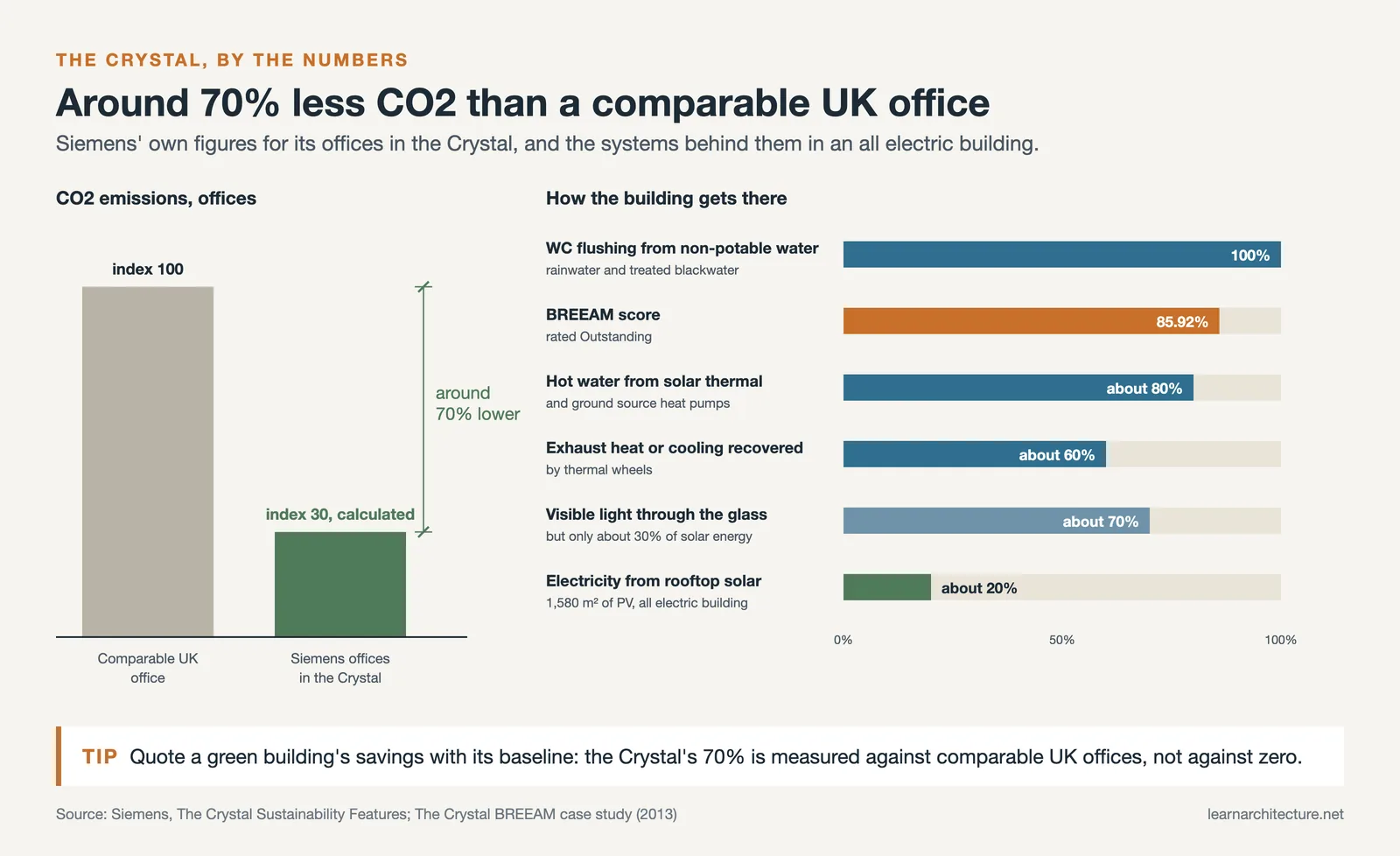
- 100% electric building, with around 20% of its electricity generated by 1,580 m² of rooftop solar panels (Siemens, The Crystal sustainability features)
- Around 70% lower CO2 emissions for the Siemens offices in the Crystal than in comparable office buildings in the UK (Siemens, The Crystal sustainability features)
- 90% reduction in potable water use through rainwater harvesting and blackwater recycling systems (Crystal sustainability documentation, 2013)
- 30 m³ (30,000-litre) underground rainwater tank collects and treats roof water for toilet flushing and irrigation (The Crystal sustainability features)
The building operates as a fully electric structure with no on-site combustion of fossil fuels. Energy is generated through two complementary renewable systems: photovoltaic panels mounted on the roof produce electricity from sunlight, and ground source heat pumps exchange thermal energy with the ground beneath the site to provide heating and cooling without burning fuel. A battery storage system retains surplus electricity, and the building is connected to the National Grid in such a way that excess energy can be fed back to support the wider network.
For buildings interested in replicating this approach, learnarchitecture.net’s overview of impressive green architecture projects worldwide provides comparative analysis of how different buildings achieve high sustainability benchmarks across different climates and programs.
💡 Pro Tip
When pursuing dual BREEAM and LEED certification on the same project, begin alignment at the briefing stage rather than at detailed design. The two systems share many prerequisites, but their measurement methodologies differ in areas like water efficiency and transport access. Mapping overlaps and conflicts early prevents costly redesigns during certification review. The Crystal team had the advantage of Siemens holding firm on sustainable specification even when value engineering pressure emerged during tender.
How the Crystal’s Building Management System Works

The Crystal’s operational performance depends on a sophisticated building management system developed by Siemens that integrates all mechanical and electrical functions into a single monitored network. Over 3,500 internal data points feed into the system, supplemented by a dedicated outdoor weather station. Every major building subsystem, from heating, ventilation, and air conditioning to lighting, fire detection, and photovoltaic output, is connected, monitored, and adjustable in real time.
The system allows the building to operate in mixed ventilation modes, combining natural ventilation through openable facade elements with mechanical ventilation depending on external conditions. Lighting is controlled using occupancy detection and daylight sensors, ensuring artificial lighting only activates where and when natural light falls below required levels. This granular control is what allows the building to consistently perform below its maximum predicted energy consumption of 136 kWh/m².
Importantly, the building management data was live-streamed into the exhibition spaces during the Crystal’s time as a Siemens sustainability centre, allowing visitors to see the building’s real-time energy and water consumption as part of the exhibit itself. The building was its own demonstration project, not just a venue for one.
For context on how smart building systems compare across the wider category, learnarchitecture.net’s guide to innovative ideas shaping architecture today covers the broader landscape of intelligent building integration.
📌 Did You Know?
The Crystal’s carpets were manufactured from recycled fishing nets, part of a broader approach to specifying sustainable materials throughout the interior. The building’s flooring, furniture, and fit-out materials were selected to contribute to LEED and BREEAM materials credits, making the sustainable specification extend well beyond the building’s active systems into its physical fabric.
Water Systems and Landscape Integration

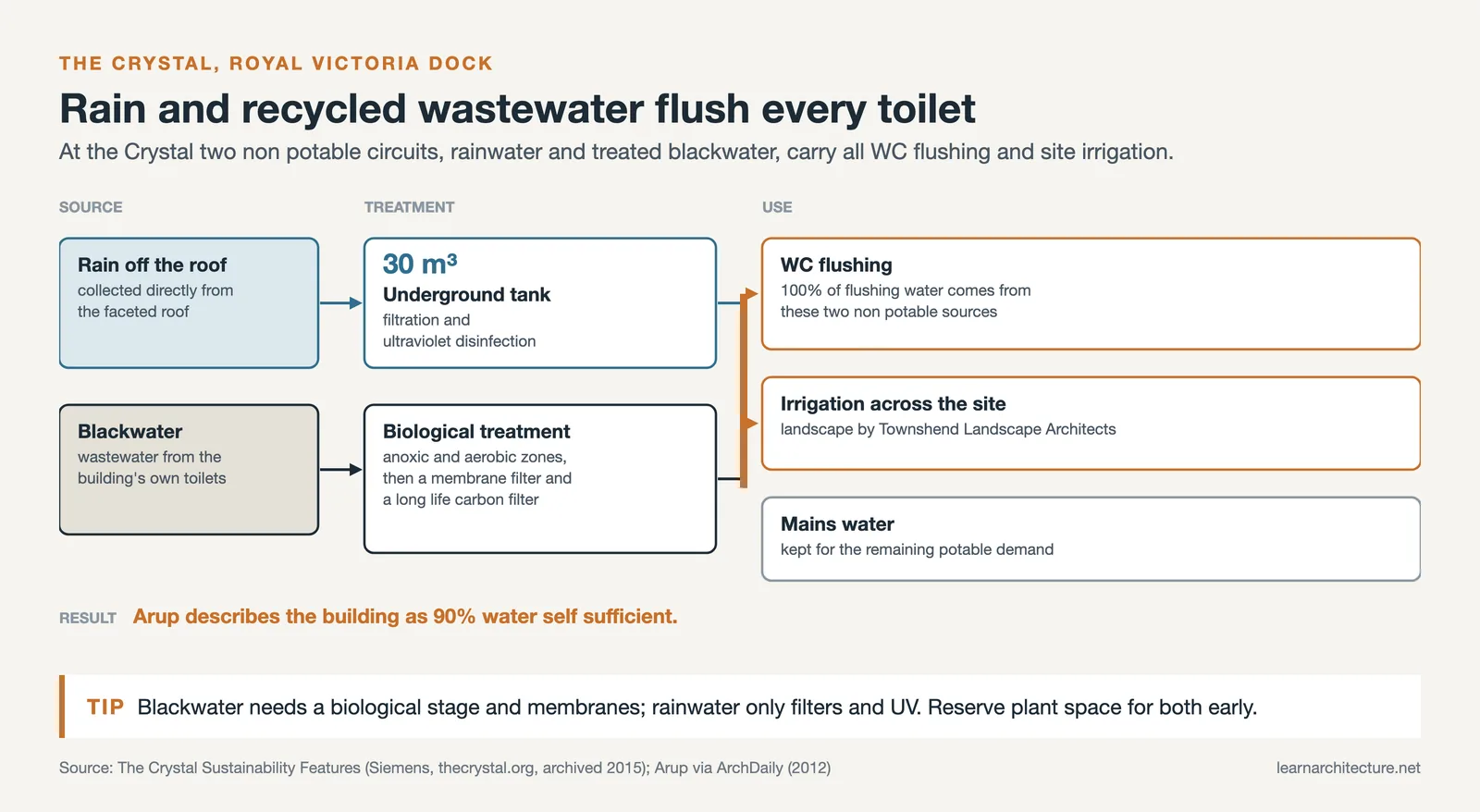
Water management at the Crystal London goes well beyond a simple rainwater collection tank. The building runs three parallel water systems: a mains cold water supply for kitchen and drinking use; a rainwater harvesting circuit for toilet flushing, irrigation, and cleaning; and a blackwater treatment system that processes and recycles wastewater from the building’s own sanitary facilities. Together, these three circuits reduce potable water demand by approximately 90 percent compared to a conventionally serviced building of equivalent size.
The underground rainwater tank holds 30 m³ (30,000 litres), and the water is treated by filtration and ultraviolet disinfection for non-potable internal uses. The blackwater system treats wastewater to a standard suitable for irrigation, closing a loop that means the landscape surrounding the building is irrigated entirely from water produced within the building’s own operating cycle. This integration of building infrastructure and landscape systems is one of the features that distinguished the Crystal at the time of its certification and continues to be referenced as a model in water-efficient design guidance.
Understanding the cost implications of specifying systems like these is explored in detail in learnarchitecture.net’s analysis of green architecture design costs and long-term benefits.
The Crystal London’s Adaptive Reuse as London City Hall
In 2022, a decade after its original opening, the Crystal underwent a significant change of use. The Greater London Authority relocated the offices of the Mayor and the London Assembly from the former City Hall building at Tower Bridge to the Crystal, renaming it London City Hall. This decision was partly economic, reducing the occupancy costs for the GLA, and partly symbolic: the Mayor wanted the city’s civic centre to be located in a building that embodied London’s commitment to net-zero carbon goals by 2030.
The transition from exhibition centre to working civic offices demonstrated precisely the adaptability the design team had built into the Crystal London architecture from the outset. Wilkinson Eyre had designed the building with future flexibility in mind, specifying structural column-free spans, modular fit-out systems, and building services infrastructure capable of supporting different uses. The energy systems, including the photovoltaics, ground source heat pumps, and building management platform, continued to operate effectively under the new occupancy pattern.
🏗️ Real-World Example
The Edge, Amsterdam (2014): Often cited alongside the Crystal as a benchmark for sustainable office design, The Edge achieved a BREEAM score of 98.36%, the highest recorded at the time, and operates as an energy-positive building, generating more electricity through its solar panels than it consumes. Its network of 28,000 occupancy and environmental sensors adjusts lighting and HVAC in real time, resulting in approximately 70% lower energy consumption than a comparable Amsterdam office building (BREEAM, 2014). The Edge demonstrates that the approach pioneered by the Crystal, combining active technology systems with high-performance envelopes, has been successfully replicated at larger scale in commercial office settings.
The adaptive reuse of the Crystal is now cited in academic research as evidence that sustainable buildings designed with long-term flexibility can genuinely serve multiple programmes across their operational life. The 2024 peer-reviewed study on the Crystal’s sustainable performance and technologies (published via ResearchGate) evaluates the building’s continued energy performance under its new City Hall function through digital simulation and physical modelling.
How Does the Crystal Compare to the Original Crystal Palace London?

The name carries deliberate historical weight. The original Crystal Palace London was a cast-iron and plate-glass structure designed by Joseph Paxton for the Great Exhibition of 1851, erected in Hyde Park and later relocated to south London. It was a technological landmark of the Victorian era, demonstrating that mass-produced materials could be assembled at extraordinary scale and speed. Siemens chose the name to draw a direct parallel: just as the Crystal Palace represented the engineering ambitions of the Industrial Revolution, the Crystal of 2012 was intended to represent the aspirations of a clean industrial revolution built on renewable energy and digital systems.
The comparison holds in architectural terms too. Both buildings use glass as their primary material and treat transparency as a core value. Both were conceived as exhibition structures designed to communicate ideas to a broad public rather than as conventional commercial or residential buildings. And both were ahead of their immediate context, demonstrating possibilities that mainstream construction had not yet adopted.
💡 Pro Tip
When referencing the Crystal in academic or professional presentations, be precise about which building you mean. “The Crystal Palace London” typically refers to Paxton’s 1851 structure and its south London legacy, while “the Crystal London” or “the Crystal building London” refers to the 2012 Wilkinson Eyre project at Royal Victoria Dock. The two buildings share a name by design but are architecturally, structurally, and functionally entirely different.
Lessons from the Crystal for Contemporary Sustainable Design
The Crystal London offers several specific lessons that remain relevant as building standards tighten and net-zero targets become legal obligations rather than aspirational benchmarks.
First, the combination of active and passive strategies is more effective than relying on either alone. The Crystal is not a passive house; it depends on sophisticated technology to perform. But that technology is layered onto a thermal envelope that has been designed to reduce the load those systems must manage. The insulated glass, the orientation of reflective versus transparent panels, the mixed ventilation modes, all reduce demand before the active systems engage.
Second, adaptability is not a luxury in sustainable design; it is a performance requirement. A building that cannot be repurposed when its original use changes will eventually be demolished, and demolition eliminates all the embodied carbon invested in its construction. The Crystal’s 2022 reuse as London City Hall is a direct payoff from the design team’s decision to build in structural and services flexibility from the start.
Third, certification alone does not ensure performance. The Crystal used its building management system to monitor, benchmark, and publish actual operational data, not just design intent data. This distinction matters because many certified buildings perform significantly worse in use than their models predicted. The Crystal’s approach of live data transparency, streaming real building performance into the exhibition hall, remains one of the more rigorous examples of post-occupancy accountability in sustainable architecture.
For students and practitioners exploring how these principles apply across different building types, learnarchitecture.net’s article on eco-friendly architecture trends and the deeper guide to sustainable shelter concepts provide useful comparative frameworks.
✅ Key Takeaways
- The Crystal London was the world’s first building to achieve both BREEAM Outstanding and LEED Platinum certification simultaneously, setting a benchmark that still guides sustainable design ambition globally.
- Its fully electric operation with no on-site fossil fuel combustion was achieved through photovoltaic panels, ground source heat pumps, and battery storage, rather than passive design alone.
- Six types of insulated glass were used across the facade, each calibrated for its solar orientation, reducing heat gain without sacrificing the transparency central to the building’s architectural identity.
- The building’s adaptive reuse as London City Hall in 2022 validates the design team’s early decision to prioritize structural flexibility and service adaptability alongside energy performance.
- Water consumption was reduced by approximately 90% through an integrated system of rainwater harvesting, blackwater treatment, and demand-managed irrigation, all running in parallel with conventional mains supply.
The Crystal London UK remains one of the most cited case studies in sustainable architecture education precisely because it combined design ambition with measurable, independently verified performance. It did not treat certification as a marketing exercise; it treated the building itself as evidence. For anyone studying the Crystal’s architecture or working on buildings that need to meet the next generation of energy and carbon standards, the project rewards close reading.
For further reference, the project is documented on the WilkinsonEyre official project page, and covered in depth on ArchDaily’s Crystal project entry. The USGBC LEED project database contains the building’s certification records, and the BREEAM official site provides the methodology against which its Outstanding rating was assessed.













Leave a comment